
Wheat Straw vs Bagasse Tableware: Buyer Comparison
Choose between a durable reusable composite and a molded-fiber service format by matching the complete article to the buyer’s operating system and evidence needs.
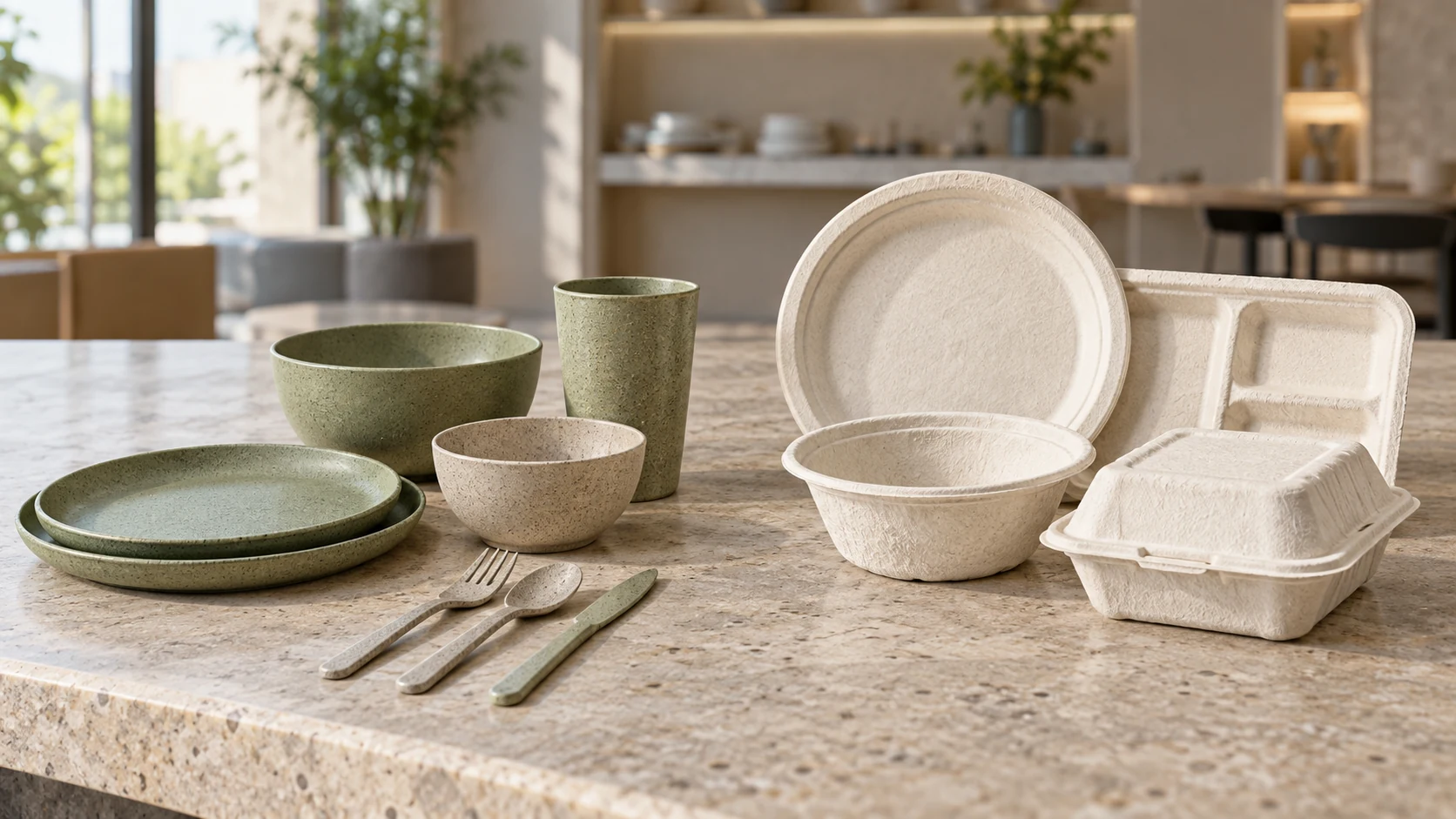
The decision in wheat straw vs bagasse tableware is not which agricultural residue sounds greener. Choose wheat-straw polypropylene composite when the program needs a durable item returned, washed, inspected, and reused; choose molded bagasse when it needs a lightweight single-service format and has verified food-contact, barrier, and end-of-life controls. Neither is universally better.
Wheat straw composite and bagasse begin as plant byproducts, but their finished constructions and business systems are different. A reusable composite normally depends on a thermoplastic matrix and repeat-use management, while bagasse serviceware depends on molded fiber performance, contamination control, and a credible disposal route.
Buyers should compare the complete SKU under its intended food, temperature, duration, transport, wash or disposal conditions. The procurement implication is to write two different evidence packages and cost models rather than asking suppliers for one interchangeable eco plate. This keeps the sourcing decision tied to use and proof.
Buyer Answer: Which Plant-Fiber Tableware Fits the Program?
Use wheat-straw composite for controlled reuse when durability, shape retention, custom molding, repeated handling, and a washable asset justify the return system. Use bagasse for single-service meals when fiber structure, lids, stacking, leak resistance, food contact, and the available waste route are validated for the actual menu and market.
Compare cost per completed service, not unit price alone. Include purchase quantity, loss, washing, labor, utilities, storage, reverse logistics, secondary packaging, contamination, disposal fees, and claim substantiation. Buyers can share the service brief for a factory-side product comparison before samples are ordered.
Start with the Service Model, Not the Fiber Story
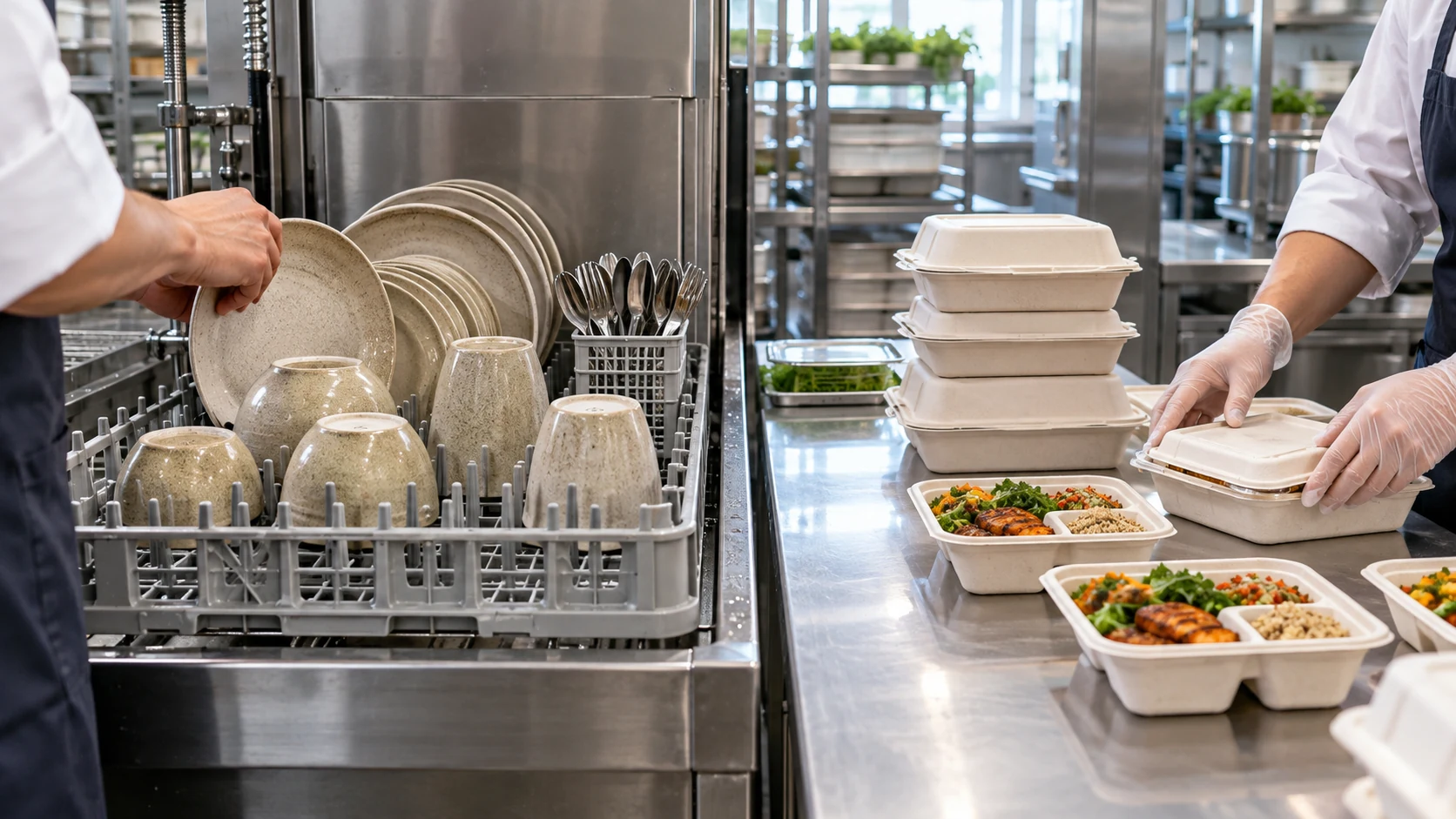
Define where the item enters, how food is filled or served, who uses it, and what happens immediately afterward. A cafeteria with collection stations, racks, washers, storage, and inventory control can support reusable tableware, while a takeaway counter, festival, airline meal, or off-site delivery route may lack any practical return loop. The service model determines whether durability or convenient one-way distribution creates value.
For reuse, specify expected service life as a validation target rather than a marketing promise. Record washing method, detergent, temperature, drying, stacking, utensil contact, staining foods, microwave or reheating rules, inspection, loss, and retirement criteria. A reusable article only delivers repeated utility when the operator consistently retrieves and keeps it fit for service.
For bagasse, map filling, lidding, holding, transport, condensation, reheating, consumer use, and disposal. A short dry-food service differs from an oily hot entrée held in delivery for an extended period. Test time-to-failure and presentation under the worst realistic menu and logistics case, not only a fresh sample on a showroom table.
State the outcome the buyer values: fewer purchased units over time, fast service, reduced washing, low outbound weight, premium feel, menu containment, or compatibility with a verified organics program. Without that priority, teams compare unrelated attributes and the lowest sample price wins by default.
Wheat straw vs bagasse tableware serves different operating loops
Draw the material and product flow from factory shipment through every use or disposal step. Mark infrastructure, labor, handoffs, loss points, contamination sources, and evidence owners so the real operating burden is visible.
The wheat-straw product range is a starting point for reusable composite formats. The buyer must still define the particular service, return, cleaning, and market requirements.
Compare the Finished Material Construction
Wheat-straw composite tableware is not pressed straw alone. Commercial reusable formats commonly blend prepared wheat-straw fiber with a polymer matrix such as polypropylene, plus pigments and processing aids selected for molding and service performance. The polymer, fiber percentage, additives, surface, and molded geometry must be declared because each affects food contact, cleaning, durability, claims, and end-of-life options.
Bagasse tableware is commonly formed from pulped sugarcane residue into plates, bowls, trays, clamshells, or lids. Fiber source is only one part of the article: pulp processing, forming, drying, wet-strength chemistry, sizing, barrier treatment, pigment, printing, coatings, and attachments can affect function and evidence. “Made from bagasse” does not prove the product is uncoated, fluorine-free, compostable, or suitable for every food.
Structure changes feel and performance. A molded thermoplastic composite can provide smooth washable surfaces, defined ribs, clips, suction features, or tight dimensional interfaces, while molded fiber typically offers a matte fibrous surface and shapes optimized for nesting and short service. Tooling, draft, wall distribution, rim design, closure geometry, and de-nesting behavior should be assessed on representative production samples.
Ask both suppliers for a complete bill of materials and a change-notification rule. A different binder, fiber ratio, colorant, release aid, wet-strength agent, barrier, coating, ink, adhesive, or pulp source can change test scope or claims. The approved material name on an RFQ is not enough to control repeat orders.
Agricultural residue is an input, not the product specification
Compare verified component percentages and functions rather than marketing photos. Note which part directly contacts food, which layers remain after use, and which components must be separated for the intended recovery route.
Use factory process information to plan sample identity, production records, and change control. Final formulation and market acceptance require SKU-specific evidence.
Match Heat, Moisture, Grease, Load, and Handling Performance
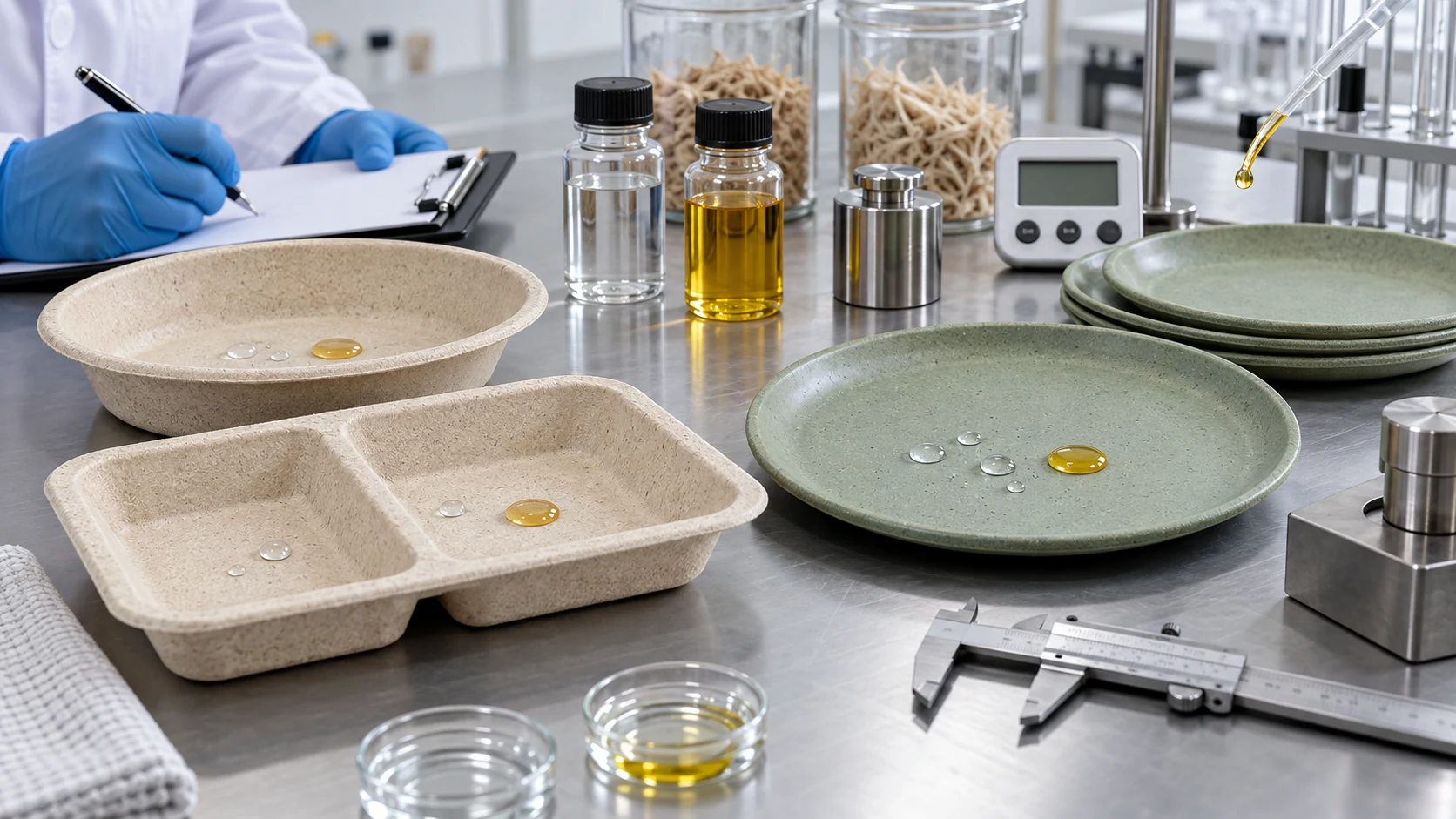
Create one test matrix from the actual menu and service process. Include food type, fat and acidity, fill temperature, contact time, lidding, stacking load, transport vibration, condensation, reheating, utensil force, drop events, washing, and storage. The comparison is meaningful only when both candidates face the same defined use case or when the matrix clearly explains why their use cases differ.
A reusable composite should be checked through repeated cycles. Measure dimensional stability, surface change, colour, odour, staining, cracking, warpage, lid fit, suction or closure function, and cleanability at planned intervals. Stop criteria should distinguish cosmetic wear from a hygiene, function, or customer-experience failure.
Bagasse should be assessed through the complete holding period and delivery route. Watch for softening, seepage, oil penetration, rim distortion, lid release, stack compression, condensation, fibre shedding, and failure during carrying or eating. Barrier choices must be evaluated with food-contact and end-of-life evidence rather than judged only by short-term leak resistance.
Do not convert one passing sample into a universal temperature or time claim. Specify the tested product revision, food simulant or menu, temperature, duration, equipment, loading, observations, criteria, and laboratory or factory method. Buyers need a usable operating limit and uncertainty, not a slogan.
Best fit depends on the harshest realistic service condition
Rank failures by safety, containment, service interruption, visual quality, complaint risk, and recovery cost. A small rim distortion may be acceptable on an open plate but critical on a delivery container that must keep its lid engaged.
Approve samples alongside written use instructions. Procurement, operations, quality, marketing, and the end customer should see the same limitations before pricing or artwork is frozen.
Compare Wheat Straw vs Bagasse Tableware Evidence
Build separate food-contact evidence files for the exact composite and molded-fiber article. Each file should identify composition, supplier, manufacturing site, intended foods, temperatures, contact time, repeat-use or single-service status, test conditions, report scope, declarations, and change controls. A report for plain PP, generic pulp, or a different barrier does not automatically cover the marketed SKU.
For wheat-straw composite, investigate both the polymer system and plant-fiber contribution. Confirm raw-material identity, additives, pigments, processing aids, migration conditions, sensory performance where relevant, and the effects of repeated cleaning or heating if those uses are claimed. The evidence must match the buyer’s market and the real conditions of use.
For bagasse, review pulp, wet-strength and sizing chemistry, coatings or barriers, inks, adhesives, and any separate lid. Grease and moisture performance can introduce additional substances or layers that need food-contact and disposal review. In the United States, current FDA information on PFAS-related paper and paperboard grease-proofing is relevant, but buyers still need supplier-specific declarations and appropriate testing rather than assuming every molded-fiber article has the same chemistry.
Distinguish legal requirements, official guidance, third-party tests, supplier records, factory controls, and buyer acceptance. A certificate logo or short “food safe” statement cannot replace the applicable evidence chain. Keep report dates, sample photographs, model numbers, laboratories, methods, results, limits, authorized signatories, and revision links together.
Wheat straw vs bagasse tableware needs two scoped files
Create an evidence matrix with one row per product claim and one column for source, SKU, market, use condition, owner, expiry or review date, and change trigger. Any blank cell becomes a pre-launch action rather than an implied approval.
The wheat-straw fiber verification guide explains how to separate a material-content claim from other product claims. Composition evidence does not independently prove safety, durability, compostability, or overall environmental benefit.
Model Total Cost per Completed Service
For reusable wheat-straw composite, start with purchase cost and expected validated service cycles, then add return collection, washing labor, detergent, water, energy, drying, inspection, storage, breakage, loss, replacement, and inventory buffer. Divide by completed services actually delivered, not by a laboratory cycle target. A durable plate that disappears after one event behaves economically like an expensive disposable.
For bagasse, include unit price, lids or films, freight cube, secondary packaging, de-nesting labor, damage, leakage replacements, waste bin liners, collection, contamination, hauling, processing fees, and any certification or claim-review cost. A low ex-factory piece price can be offset by bulky cartons, poor stack release, or a waste route that charges the load as residual trash.
Model demand variability and operational peaks. Reusables need enough clean inventory to cover turnaround time and loss, while single-service formats need replenishment stock and storage for volume. Compare normal, peak, and disruption scenarios such as washer downtime, off-site catering, delayed imports, contaminated organics loads, or sudden menu changes.
Assign costs to the function that controls them. Procurement may own the product price, operations the wash line, logistics the reverse flow, facilities the waste contract, quality the evidence file, and marketing the claims. A cross-functional model prevents one department from claiming savings while another absorbs the hidden workload.
The lowest unit price can create the highest system cost
Use the same meal count, service quality, horizon, labor rates, loss assumptions, and disposal conditions for both scenarios. Show the break-even reuse count and test how it changes when return rate, washing cost, damage, or bagasse disposal changes.
Before quotation, send expected meal volume, product format, menu and operating model for a clearer manufacturing brief. The factory quote should make materials, tooling, packaging, minimums, samples, testing, and lead-time assumptions explicit.
Verify the Use-After-Use Path Instead of Assuming It
A reusable composite program succeeds when products are returned, cleaned, retained in service, and eventually directed to a documented retirement route. Track purchases, active inventory, services, losses, damage categories, wash rejects, transfers, and retired mass. Without return and cycle data, a reuse claim describes design intent rather than program performance.
Bagasse disposal depends on the full article and local infrastructure. Food-soiled molded fiber may be accepted in some commercial organics programs, while other programs exclude serviceware, coated fiber, PFAS concerns, slow-disintegrating formats, or loads with high contamination. Landfill disposal does not become composting merely because the base fiber is plant-derived.
Recycling is also conditional. Fiber products can be unacceptable when food-soiled or treated, while wheat-straw PP composite can fall outside local rigid-plastic collection or reprocessor specifications. Ask the named operator about the exact article, preparation, geography, collection method, sorting, processing, and destination before printing an instruction.
Build a measurable pathway for the selected option. Reuse needs return and wash records; commercial composting needs program acceptance, certification or testing as required, contamination control, hauling, and processing confirmation; recycling needs collection and reprocessor evidence. If no verified route exists, use accurate disposal guidance and avoid broad circularity claims.
End-of-life claims must match the actual customer route
Map the intended market rather than relying on a supplier’s home-city infrastructure. A disposal claim may need different wording by country, municipality, institution, retailer, or event operator.
Keep product and packaging instructions separate, and date every operator confirmation. Recheck routes before repeat orders because facilities, accepted-item lists, contracts, and regulations can change.

Wheat-Straw Composite and Bagasse Decision Matrix
These are best-fit patterns, not universal verdicts. Validate each finished SKU, market, food, service process, customer expectation, and recovery route before awarding a purchase order.
| Decision criterion | Wheat-straw PP composite | Molded bagasse |
|---|---|---|
| Primary service model | Reusable return, wash, inspect, and recirculate | Single-service fill, distribute, use, and collect or discard |
| Material construction | Plant fiber in a durable thermoplastic matrix | Formed sugarcane-fiber pulp with possible functional chemistry or barriers |
| Performance focus | Cycle durability, cleaning, dimensions, surface and function | Holding time, grease and moisture resistance, lid fit, stacking and delivery |
| Operations needed | Return stations, washing, drying, storage, inspection and loss control | Replenishment, de-nesting, waste separation, collection and hauling |
| Customization | Detailed molded features, colors, logos and reusable-set architecture | Fiber-form geometry, compartments, embossing, printing and compatible lids |
| Evidence emphasis | Complete formulation, repeat-use conditions and cycle validation | Pulp and chemistry, barrier, food use, single-service and disposal evidence |
| Cost driver | Purchase, validated uses, return rate, wash, labor, loss and replacement | Unit price, freight cube, handling, secondary items, leakage and disposal |
| End-of-life reality | Reuse results first; recycling remains program-specific | Composting or other recovery remains product- and facility-specific |
| Best fit | Controlled sites or users able to retrieve and wash assets | Fast or off-site service without a reliable return loop |
B2B Buyer Tableware Comparison Checklist
Answer these eight questions with the operations, quality, compliance, facilities, logistics, marketing, and finance teams. A sample should not be approved until its evidence and operating system agree.
| Check | Question | Why It Matters |
|---|---|---|
| Service loop | Will the item return for washing, or leave with the meal? | Determines whether reusable or single-service economics apply. |
| Complete material | Are polymer, fiber, additives, pulp chemistry, barriers, inks and attachments declared? | Defines the article that must be tested and claimed. |
| Food conditions | Which foods, temperatures, contact times, lids, loads and transport events apply? | Creates the performance and food-contact test matrix. |
| Operations | Are washing, storage, de-nesting, return, collection and contamination controls available? | Tests whether the selected format can work at scale. |
| Evidence scope | Do reports and declarations match the SKU, market and use conditions? | Prevents generic files from supporting an unrelated product. |
| Total cost | Are labor, freight, loss, utilities, replacements, rejects and disposal included? | Compares completed service rather than piece price. |
| Claims and disposal | Can each reuse, fiber, composting, recycling or PFAS-related statement be substantiated? | Reduces misleading environmental and safety messages. |
| Change control | Which supplier, formula, barrier, design, market or route changes require reapproval? | Protects repeat orders from silent scope drift. |
Official Sources for Claims and Market Review
Use current primary guidance to frame questions, then obtain SKU-specific evidence and qualified advice for the destination. Official pages do not replace applicable law, product testing, contracts, or facility acceptance.
The US Federal Trade Commission’s official Green Guides summary says compostable claims need competent and reliable scientific evidence for the complete product, and facility-dependent claims require qualification when access is limited. It also cautions against broad eco claims and explains that renewable-material language can imply separate attributes that still need substantiation.
The US Food and Drug Administration’s current page on authorized PFAS uses in food-contact applications explains the phase-out and later loss of effectiveness of specified food-contact notifications for PFAS-containing grease-proofing substances used on paper and paperboard. Buyers of molded-fiber serviceware should use current supplier declarations and appropriate evidence for the exact article rather than turning this market change into an unsupported universal claim.
The European Commission’s official single-use plastics overview describes the EU policy framework for preventing and reducing impacts from specified single-use plastic products. Because legal scope depends on the complete composition, design, intended use, and current rules, buyers should have qualified advisers classify both composite and fiber formats before choosing market language or a substitution strategy.
Practical disclaimer: this comparison provides manufacturing and procurement information, not legal, food-contact, environmental-claim, compostability, recycling, PFAS, waste, customs, or market-access advice. Requirements and outcomes depend on the exact article, chemistry, food use, market, operator, facility, contract, current rules, and evidence, so obtain qualified regional review before sale.
Select the Format by Operating Scenario
Scenario one is a controlled cafeteria, office, school, hotel, or campus with central collection and washing. Wheat-straw composite can be the better candidate when the site can retrieve items, validate cleaning and repeated performance, store clean inventory, inspect damage, and control losses. Model the actual return rate and washer capacity before using an ambitious service-life assumption.
Scenario two is takeaway, delivery, travel, or an event where the item leaves the operator’s control. Bagasse can be the better candidate when the chosen format holds the real menu, survives lidding and transport, separates cleanly in service, and fits a documented waste route. If commercial composting is unavailable or rejects serviceware, the decision should acknowledge residual disposal rather than assuming recovery.
Scenario three is a mixed on-site and off-site business. Use distinct SKUs and instructions where the operating loops differ instead of forcing one material across every order type. Reusable dine-in pieces and single-service takeaway pieces can share brand architecture while keeping food-use, cleaning, inventory, claims, and disposal files separate.
Scenario four is a retailer or promotional program selling durable sets to consumers. Evaluate wheat-straw composite as a reusable consumer article, with care, heating, dishwasher, staining, breakage, replacement, and local disposal instructions validated for the target market. Bagasse usually belongs to a different purchase occasion centered on prepared-food service rather than long-term household ownership.
Scenario five is a customer tender with a mandatory environmental specification. Translate every tender word into a measurable requirement: material percentage, excluded substances, test standard, certification scope, reuse count, return rate, composting access, recycled outcome, reporting period, or chain of custody. Ask clarification where the tender merges renewable content, biodegradability, compostability, and recyclability into one undefined score.
Score each candidate against service fit, product performance, food-contact confidence, operational readiness, customer experience, supply continuity, claim defensibility, total cost, and verified use-after-use outcome. Weight the criteria before opening prices so a visually attractive sample or low quote cannot redefine the buyer’s priorities.
Run a limited operational pilot with production-representative articles. Track meal type, temperature, holding time, leakage, breakage, user feedback, wash results, return or disposal behavior, contamination, labor, inventory variance, and total cost. Approve scale-up only after the pilot confirms both the physical product and the surrounding system.
Contract the selected design and evidence, not only the material name. Lock the bill of materials, approved sample, drawings, use conditions, performance criteria, inspection plan, packaging, claims, documentation, supplier and process change notice, and market-specific instructions. This makes the comparison reproducible when the buyer reorders or expands to another region.
Wheat Straw and Bagasse Tableware Buyer FAQ
Is bagasse tableware always plastic-free?
No broad assumption is safe. The finished article may include wet-strength chemistry, sizing, coatings, barriers, inks, adhesives, or a separate lid, so buyers should obtain a complete declaration and assess the claim under local rules.
Is wheat-straw composite designed for multiple uses?
Many commercial formats are designed as durable reusable articles, commonly with a thermoplastic matrix. The buyer must still validate the exact construction, cleaning method, use conditions, inspection limits, and expected operating cycles.
Which option is better for hot and oily food?
The answer depends on the exact food, temperature, contact time, barrier, geometry, lid, transport, and acceptance criteria. Test production-representative samples through the full service route instead of relying on a material-wide claim.
Can bagasse go into a home compost bin?
Only make that instruction when the complete product has suitable evidence and the intended home-composting conditions support it. Industrial-compostability evidence or plant-fiber content does not automatically prove home compostability.
How should buyers compare price?
Compare cost per completed service over the same meal volume and period. Include return and washing for reusables, replenishment and disposal for single-service items, plus freight, labor, rejects, evidence, storage, loss, and disruption.
Can one test report cover both materials?
No. The constructions, chemistry, use patterns, test conditions, and claims differ, so each finished SKU needs an evidence file matched to its market and intended use. Shared corporate documents do not replace product-specific scope.
Make the Product System Match the Service Promise
A sound wheat straw vs bagasse tableware decision begins with the meal and operating loop, then tests the complete article against performance, evidence, logistics, cost, and the real after-use route. Wheat-straw composite generally fits controlled reuse; bagasse generally fits single-service distribution, but every commercial claim remains SKU- and market-specific.
Choose the option whose surrounding system your customer can operate consistently. A durable item without returns and washing, or a molded-fiber item without validated barriers and a credible disposal path, will not deliver the promise implied by its material story.
Finish the decision with a production-representative pilot, a total-cost model, scoped documents, approved wording, and change triggers. That package gives procurement a defensible basis for quotation and repeat orders without declaring a universal material winner.
Request a Plant-Fiber Tableware Comparison
Share the menu, service channel, target markets, meal volumes, return and washing setup, delivery time, temperature, barrier needs, product format, branding, evidence requirements, disposal routes, and commercial targets. The Naike Group manufacturing team can prepare a wheat-straw composite option and a structured comparison brief for the buyer’s bagasse, operations, compliance, and cost review.
Request a Custom Quote
Share your product, quantity, target market and customization needs. Our factory team will reply with the next practical step.
Continue Your Sourcing Research
The six newest factory-side articles are updated automatically by publication date.

Can Wheat Straw Tableware Be Recycled? Buyer Q&A
A practical buyer answer on whether reusable wheat-straw composite tableware can enter PP recycling streams, which evidence matters, and how to qualify market claims.

Global SKU vs Regional SKU: Tableware Decision Guide
A buyer decision framework for choosing one global tableware SKU or controlled regional variants across compliance, packaging, logistics, inventory and change control.

Australia Food Packaging Evidence: Buyer Guide
A practical evidence guide for Australian food-packaging buyers covering intended use, migration risk, supplier assurance, testing, hygiene, release and change control.

EU PPWR Tableware Packaging vs Conventional Packs
A buyer comparison of PPWR-ready and conventional tableware packaging across product protection, material choices, empty space, evidence, labeling and release timing.

Prop 65 Tableware Requirements: Buyer Q&A
A practical buyer Q&A for defining California Proposition 65 exposure scenarios, evidence, warning decisions, supplier records and release controls for tableware.

Silicone Baby Tableware CPSIA: US Buyer Decision Guide
A procurement decision guide for classifying silicone baby tableware under US children’s-product rules and building the testing, certificate, label and import file.