
Can Wheat Straw Tableware Be Recycled? Buyer Q&A
Treat recyclability as a market-specific recovery pathway that must be demonstrated, not as an automatic benefit of plant-fiber content or a resin code.

The direct answer to can wheat straw tableware be recycled is: sometimes, but never assume it from the name or a number-five resin symbol. Reusable wheat-straw tableware is commonly a polypropylene composite, and it is recyclable only where the complete article is accepted, sorted, processed, and sold into a viable local recovery stream without impairing recycled output.
Plant fiber does not make the article compostable, and polypropylene content does not guarantee curbside acceptance. A buyer must verify the exact formulation, attachments, dimensions, colour, residue, collection program, sorting technology, reprocessor specification, and claim rules in each sales market.
For procurement, the safest position is a qualified, market-specific instruction backed by current evidence. If the route is unverified, emphasize durability, reuse, reduced virgin-plastic input where substantiated, and responsible disposal guidance instead of printing a broad recyclable claim.
Buyer Answer: When Is Wheat Straw Composite Recyclable?
A wheat-straw composite plate, bowl, cup, or cutlery item can be described as recyclable only when its whole construction is compatible with an available recovery route. The path must cover consumer preparation, collection, sorting, size and shape recognition, contamination limits, grinding or washing, melt processing, output quality, and an end market for the recovered material.
Do not treat “contains PP,” “plant based,” or a recycling symbol as proof. Ask the program and reprocessor about the finished article, then retain dated written acceptance or test evidence. Buyers can send the intended market and disposal brief for a factory-side material review before artwork approval.
Identify the Finished Composite Before Discussing Recycling
Start with the actual bill of materials rather than the consumer-facing material name. Reusable wheat-straw tableware often combines cleaned and milled agricultural fiber with a thermoplastic matrix such as polypropylene, plus pigments, coupling agents, processing aids, labels, inks, coatings, or separate components. Recovery behavior belongs to that complete formulation and design, not to wheat straw in isolation.
Record the polymer grade, verified fiber percentage, filler and additive package, colour, total article weight, wall thickness, attachments, printed decoration, and food-contact use. Obtain supplier declarations or analytical evidence for claim-critical inputs, because a nominal material description cannot show whether the article behaves like the PP stream expected by a recycler. A formulation change can invalidate earlier compatibility work even when the product looks unchanged.
Separate renewable content, recycled content, recyclability, compostability, and biodegradability. These are different attributes with different evidence, and proving one does not prove another. A plate may contain an agricultural byproduct while remaining a durable PP-bound composite that neither belongs in organics collection nor has broad access to plastics recycling.
Define whether the inquiry concerns the product or its packaging. A recyclable paper sleeve does not make the tableware recyclable, while a difficult product does not prevent a separately removable carton from carrying its own supported instruction. Artwork should name the component and disposal route clearly so consumers do not place the wrong material in a stream.
The buyer question applies to the whole article
A practical specification should connect every component to a removal or recovery instruction. If a silicone foot, paper label, adhesive, metallic decoration, or mixed-material handle remains attached, include it in the compatibility review rather than assuming consumers will separate it.
Use the custom wheat-straw products page to frame the product family, then confirm the exact formulation and construction for the proposed SKU. Product-category information is not recycling substantiation.
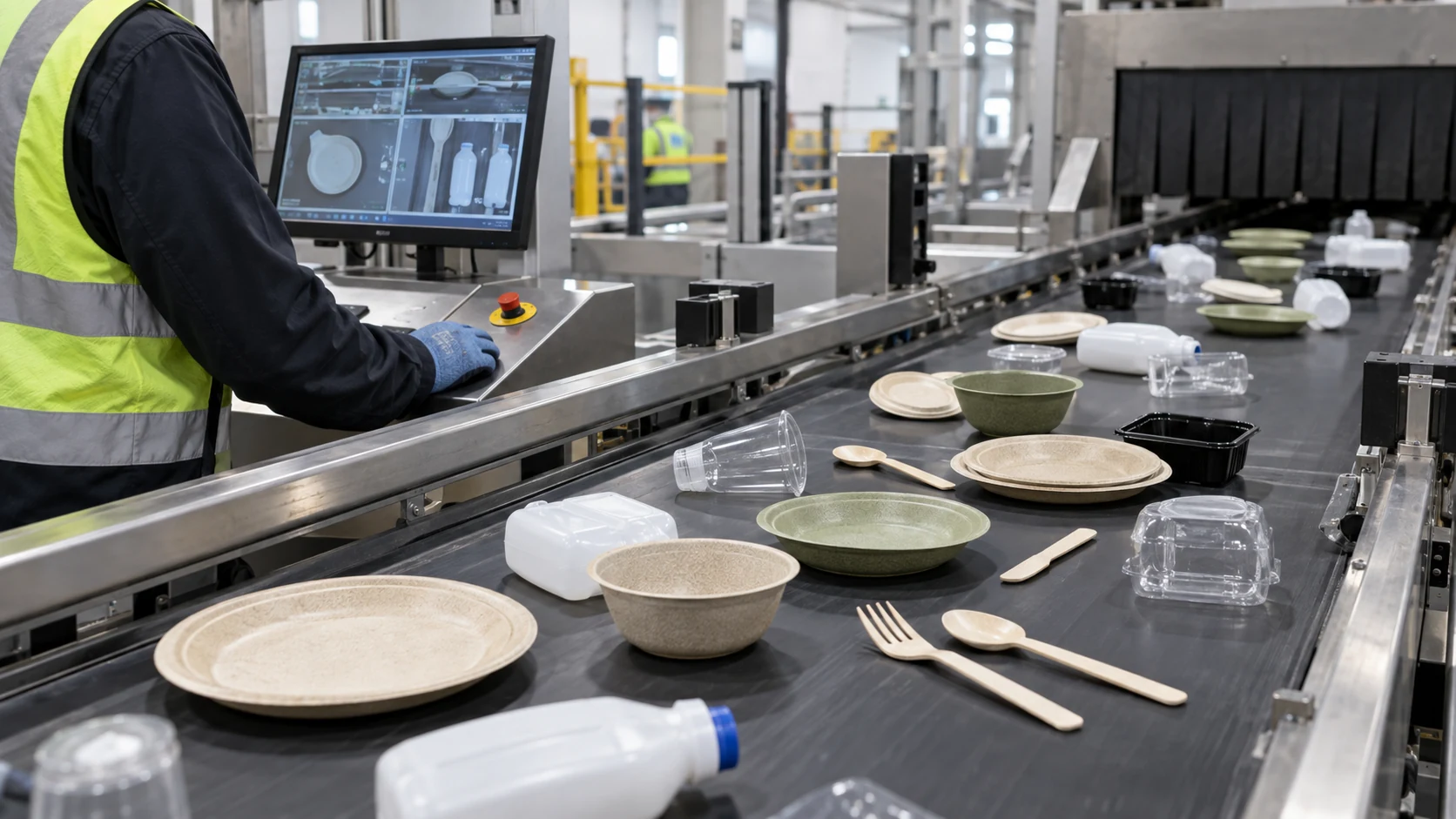
Can Wheat Straw Tableware Be Recycled in Real Markets?
Technical recyclability asks whether an item can be converted into useful material under a defined process. Practical recyclability asks whether buyers can place it in an accessible system that will collect, sort, process, and market it at commercial scale. A laboratory can demonstrate melt processing while most households still lack an approved collection route.
Collection lists often use broad labels such as bottles, tubs, jugs, rigid plastics, or polypropylene containers. Reusable tableware may fall outside those accepted shapes even if its polymer matrix is PP, because programs design instructions around local equipment and end-market contracts. The buyer must ask whether durable plates, bowls, cups, and cutlery are accepted, not merely whether “number five plastic” appears on a website.
Access also varies by country, municipality, retailer take-back network, and customer segment. A claim suitable for a closed-loop hospitality program may be misleading on national consumer packaging if the same route is unavailable to ordinary households. Map the percentage and location of intended purchasers who can use the documented route, then qualify wording wherever access is limited.
A resin identification code is not a recovery guarantee. It may help identify the predominant polymer, but collection and processing decisions still depend on form, additives, contamination, size, colour, economics, and local specifications. Never add a code or disposal icon until the brand owner confirms the applicable marking rules and the evidence behind the implied instruction.
Can wheat straw tableware be recycled in the buyer’s market?
Ask the question for each destination and channel: curbside, drop-off, commercial back-of-house, retailer take-back, or a contracted closed loop. Record the operator, accepted item description, preparation instruction, effective date, geographic coverage, and any exclusions.
If access is narrow, use precise language such as “check locally” only when that qualification is clear, prominent, and legally reviewed. Do not let a small pilot program support an unqualified claim across a much larger sales territory.
Map Collection and Sorting Before Promising Recovery
Build the pathway from the consumer’s hand to a reprocessor rather than stopping at the recycling bin. Confirm whether the item should be empty, rinsed, separated from packaging, kept loose, returned through a special program, or excluded when heavily food-soiled. Instructions must be realistic for the actual user and visible at the disposal decision point.
Next, examine material recovery facility behavior. Flat plates can travel differently from three-dimensional containers, small cutlery can fall through screens, dark pigments may reduce optical-sort detection, and fiber-filled surfaces may not match standard recognition assumptions. Request written feedback or a representative sortation trial where the format is unfamiliar.
Check bale and buyer specifications after sorting. An item collected as mixed rigid plastic can still be removed later if it does not meet a processor’s feedstock limits. Trace the proposed stream to at least one current end market rather than counting collection as proof that the article becomes a new product or material.
Consider scale and leakage. A take-back route needs collection points, consumer communication, storage, transport, contamination control, aggregation volume, a processing contract, and records showing where material went. Without those operational links, a logo can describe an aspiration rather than a functioning recycling system.
Sorting evidence closes the gap between bin and bale
Photographs of a recycling bin or a generic facility do not demonstrate acceptance. Keep program correspondence, test protocols, sample construction, results, limitations, and review dates in the market evidence file.
The factory capability overview can support sample identification and production controls. Collection operators and reprocessors must still judge compatibility with their own systems.
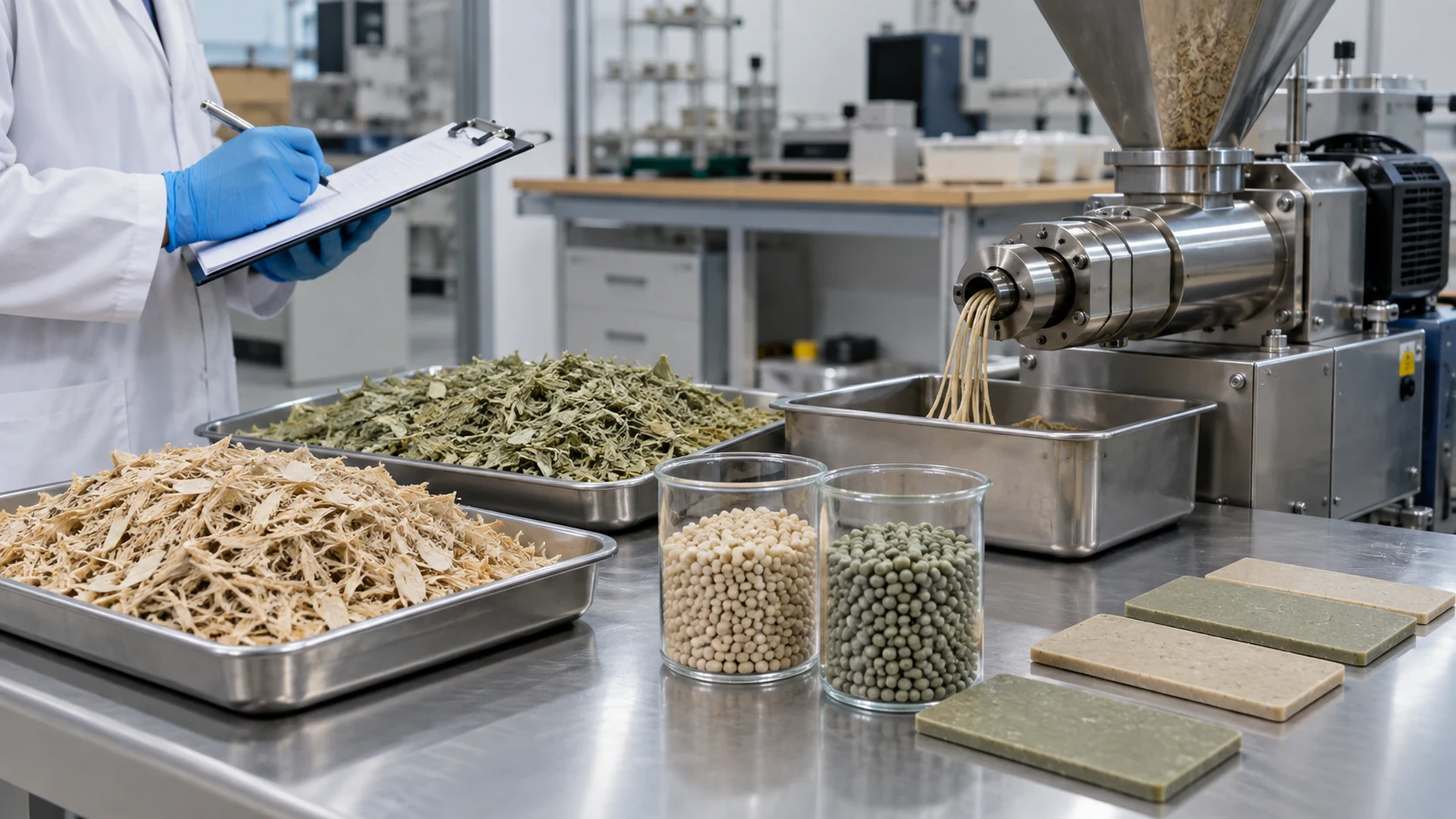
Test Whether the Composite Fits the Target Reprocessor
A credible trial starts with production-representative articles, not clean base resin or a hand-selected laboratory blend. Document the formula revision, fiber level, colour, decoration, attachments, molding conditions, aging, and food-use preparation applied to the samples. The test conclusion should be limited to that construction and the named recycling stream.
Evaluate size reduction and material preparation first. Observe shredding behavior, dust generation, fiber release, bulk density, washing response, drying needs, metal or label separation, odour, and yield. Natural fiber can carry moisture and can change how ground material stores and feeds, so a processor may need controls that are not used for ordinary rigid PP.
Then assess extrusion, filtration, pelletizing, and molding under the target process. Record screen pressure, volatile generation, melt stability, colour, odour, ash or residue, equipment fouling, pellet consistency, and usable output. Compare the recovered blend with an agreed control rather than declaring success merely because molten material passed through an extruder.
Finally, test the properties required by the intended end market. Depending on the application, this can include melt flow, density, moisture, ash, tensile or impact behavior, colour, odour, surface appearance, and repeated processing. A recycler may accept limited blend rates for non-food-contact products while rejecting the material for a higher-value PP application.
A recycling test needs an output specification
Define pass criteria before the trial: acceptable process stability, contamination rate, recovered yield, property change, blend ratio, and end-use restrictions. Without those criteria, a visually acceptable pellet can be mistaken for commercially useful recycled material.
Keep chain-of-custody records from article sample through granulate, pellet, and molded test piece. The evidence should show who performed each step, which equipment and conditions were used, and whether the processor would purchase or accept comparable production material.
Control Environmental Claims by Market and Evidence Scope
A recyclable claim communicates more than theoretical processability. In the United States, the Federal Trade Commission’s Green Guides connect an unqualified claim to access for a substantial majority of consumers or communities where an item is sold, and recommend stronger qualification as access declines. Other markets apply their own consumer-protection, environmental-claim, labeling, and waste rules, so local review remains essential.
Draft claim wording from the weakest verified link in the actual pathway. If the product is accepted only through a named take-back program, say so and provide usable participation instructions. If acceptance varies, a clear local-check qualification may be appropriate, but it should not be hidden in fine print or contradicted by a prominent recycling icon.
Do not combine separate attributes into one broad eco message. “Contains verified wheat-straw fiber” describes material content; “reusable” describes intended repeated use; “recyclable where accepted” describes a conditional recovery route. None of those statements independently proves lower total environmental impact, biodegradation, compostability, recycled content, carbon reduction, or plastic-free construction.
Create a dated claim substantiation file before artwork release. Include the approved sentence, product and packaging scope, markets, channels, evidence sources, program coverage, compatibility test, consumer instruction, legal reviewer, effective date, and triggers for reapproval. Monitor program changes because a municipality, retailer, or recycler can revise acceptance after the product launches.
Qualified wording protects buyers from an implied universal claim
The claim should help a reasonable purchaser dispose of the article correctly. If it creates a stronger impression than the underlying evidence supports, revise the main wording rather than relying on a remote disclaimer.
Teams can request a product-and-claim specification review before committing to molds, material, decoration, or packaging. Final environmental wording should be approved by qualified advisers in each target market.
Choose a Procurement Path When Curbside Recycling Is Uncertain
First decide whether recyclability is a mandatory tender requirement, a preferred marketing benefit, or simply one option in an end-of-life plan. If a customer contract requires verified collection and recycling, name the operator, geography, volumes, contamination threshold, processor, output market, reporting method, and cost before awarding the order. A generic supplier declaration cannot satisfy an operational service requirement.
For broad retail distribution with uncertain acceptance, prioritize a durable product designed for repeated use and use only narrowly supported material-content language. Give accurate disposal directions by market and keep packaging claims separate. This route avoids teaching consumers to place a composite article into a stream that may remove it as residue.
For hospitality, events, campuses, or closed facilities, evaluate a controlled take-back model. Standardize the SKU, prevent mixed-material contamination, train collection staff, consolidate sufficient volume, and contract a processor that has trialed the article. Measure returned mass, rejected material, transport, processing yield, destination, and cost so the program can substantiate what actually happened.
For products where recovery is commercially impractical, improve the upstream decision. Reduce unnecessary material, extend usable life, design replaceable components, simplify pigments and decorations, provide care guidance, and avoid unsupported end-of-life claims. Procurement should compare these verified benefits with a speculative recycling promise rather than treating the word recyclable as the only sustainability metric.
Decide before RFQ, sample approval, and artwork freeze
Put the required recovery route and evidence into the RFQ so suppliers quote the same obligation. Approve the formulation, finished construction, claims, disposal wording, and validation plan together because any one of them can change the conclusion.
Use the custom solutions process to align product design, material, branding, packaging, and market needs. A lower-risk brief states the environmental outcome the buyer needs and the proof that will be accepted.

Compare Four End-of-Life Routes for Wheat-Straw Composite
The same article can have different outcomes under different systems. Buyers should select a route from documented access, technical fit, measurable recovery, customer behavior, and total cost rather than from the most attractive label.
| Decision criterion | Municipal curbside | Public drop-off | Brand take-back | Controlled closed loop |
|---|---|---|---|---|
| User access | Potentially broad but location-dependent | Limited to participating sites | Limited to program participants | Limited to contracted facilities |
| Item acceptance | Must name durable composite tableware | Must confirm exact item and preparation | Defined by brand and processor contract | Defined by site specification |
| Sorting control | Managed by local MRF | Managed by drop-off operator and downstream MRF | Can pre-sort before transport | High control through dedicated collection |
| Contamination risk | Highest from mixed household stream | Moderate with clear signage | Lower with program instructions | Lowest with trained staff and bins |
| Volume visibility | Usually unavailable to the brand | May be reported by operator | Trackable by collection batch | Trackable by facility and event |
| Evidence strength | Program acceptance plus processor pathway | Written acceptance and downstream route | Returns, rejects, yield, and destination records | Mass balance, trial, and processor records |
| Best fit | Markets with explicit, durable-item access | Concentrated users near accepted sites | Brands able to fund logistics and communication | Hospitality, campus, event, or institutional use |
B2B Buyer Recycling Claim Checklist
Complete all eight checks before approving a recyclable statement, disposal icon, tender response, or take-back promise. A “not yet verified” answer is a claim blocker, not a reason to lower the evidence threshold.
| Check | Question | Why It Matters |
|---|---|---|
| Finished construction | Is the polymer, fiber level, additive, colour, decoration, and attachment specification verified? | Defines the actual material entering the system. |
| Claim scope | Does wording identify the product or packaging component and each target market? | Prevents one attribute from implying a universal benefit. |
| Collection access | Which named programs accept this exact durable tableware format? | Connects the claim to a route buyers can use. |
| Preparation | Are rinse, separation, return, or drop-off instructions realistic and visible? | Reduces contamination and consumer confusion. |
| Sorting result | Will screens, optical sorters, and quality controls retain the item? | Shows whether collected material reaches a bale. |
| Reprocessing trial | Has representative product passed defined shredding, extrusion, and output criteria? | Tests compatibility rather than theoretical meltability. |
| End market | Who accepts the recovered output, at which blend and specification? | Confirms useful recovery beyond collection. |
| Change control | Which formula, design, program, rule, or processor changes trigger reapproval? | Keeps future orders within the evidence scope. |
Three Authoritative Sources for Recycling Decisions
Use current official guidance and technical evaluation methods as starting points, then confirm local law and the actual collection-to-end-market chain. No general webpage can approve one finished SKU for every sales territory.
The US Federal Trade Commission’s official summary of the Green Guides explains that recyclable claims should be qualified when appropriate facilities are not available to at least 60 percent of consumers or communities where the item is sold. It also warns that unqualified renewable-material language can imply separate attributes such as recyclability or biodegradability, so marketers should state the supported benefit specifically.
The US Environmental Protection Agency publishes standardized terms for materials accepted by municipal recycling programs and tells users to confirm materials with local curbside or drop-off programs. This supports a market-by-market acceptance check rather than treating one resin family or symbol as universal collection evidence.
The Association of Plastic Recyclers provides an official industry test protocol for evaluating rigid polypropylene articles against current recycling operations and PP streams. Its framework covers innovations such as additives, coatings, labels, structures, and manufacturing methods, reinforcing the need to test the finished composite article and its effect on usable recycled output.
Practical disclaimer: this article is manufacturing and procurement information, not legal, environmental-marketing, waste-classification, labeling, tender, or local recycling advice. Acceptance and claim rules depend on the exact article, sales territory, customer access, current operator specifications, end markets, and law, so obtain written program confirmation and qualified market review before making a claim.
Use an Evidence Ladder Before Approving the Artwork
Level one identifies the product. Freeze the bill of materials, fiber percentage, polymer grade, additives, decorations, detachable parts, dimensions, colour, and production revision. If the supplier cannot provide a stable construction, neither a collection answer nor a compatibility test can remain valid through repeat orders.
Level two maps access. List each intended market and channel, then obtain current written answers from municipal programs, commercial collectors, drop-off operators, retailers, or take-back partners about the exact durable tableware form. Record whether acceptance applies to all users, only selected locations, or only a contracted business stream.
Level three follows sorting. Ask how the article moves through screens, optical identification, manual quality control, mixed-rigid categories, and bale specifications. A collected item that becomes facility residue does not support the same buyer message as an item retained for processing.
Level four tests processing. Run representative articles through preparation, grinding, washing or drying where relevant, extrusion, filtration, pelletizing, and an agreed output application. Set pass criteria for yield, process stability, odour, colour, ash, moisture, properties, contamination, and acceptable blend rate before seeing results.
Level five verifies the end market. Obtain a recycler or converter statement describing the accepted feedstock, output specification, destination, limitations, and commercial conditions. For a take-back program, add batch weights, rejects, transport records, processing yield, and destination evidence so reported results distinguish material collected from material actually recovered.
Level six converts evidence into qualified wording. Name the item, route, location limits, required consumer action, and review date clearly enough for a purchaser to act correctly. Test the full front, back, online listing, icon, headline, and nearby imagery because the overall impression can be broader than one carefully written sentence.
Level seven controls change. Reopen approval when the formula, supplier, pigment, decoration, product geometry, packaging, target market, collection program, sorting rule, processor, output use, regulation, or claim changes. Keep the prior approval date and evidence version so the team can explain which wording applied to each production lot.
This ladder also creates a rational stop decision. If access, sorting, processing, or end-market evidence fails, remove the claim and redirect resources toward durable reuse, material reduction, repair or replacement options, accurate material-content statements, and packaging improvements that can be substantiated.
Wheat Straw Tableware Recycling FAQ
Is wheat-straw tableware the same as biodegradable tableware?
No. Reusable wheat-straw composite commonly contains a durable thermoplastic binder, and plant-fiber content alone does not prove biodegradation or compostability. Verify the complete formulation and never interchange those claims.
Does a number-five PP symbol prove curbside recyclability?
No. A resin code can identify a polymer family, but local programs may exclude durable tableware, composites, small shapes, dark colours, or contaminated items. Confirm the finished article with the actual program.
Can consumers place wheat-straw plates in food-waste collection?
Not unless the complete product is accepted by that organics program and supported by applicable compostability evidence. A PP-bound reusable composite should not be placed in organics collection merely because it contains plant fiber.
What sample should a recycler test?
Use production-representative finished articles with the approved formulation, colour, decoration, labels, attachments, aging, and preparation. Testing clean base resin or an incomplete blend does not establish compatibility for the marketed SKU.
Is a take-back program stronger than a curbside claim?
It can provide tighter control and better records, but only if customers can access it and the program actually sorts, processes, and sends usable output to an end market. Collection totals alone are incomplete evidence.
When must the recycling claim be reviewed again?
Review it after any claim-relevant product, supplier, formula, colour, design, program, processor, market, law, or artwork change. Also set periodic checks because collection lists and end-market contracts can change without altering the product.
Answer the Recycling Question with a Verified Pathway
The defensible answer to can wheat straw tableware be recycled is conditional: the finished composite needs an accessible collection route, successful sorting, compatible reprocessing, and a real end market in the buyer’s territory. Polymer identity and plant-fiber content are inputs to that decision, not the conclusion.
Procurement should preserve that pathway in the specification, test plan, claim file, contract, and change-control record. When one link is missing, qualify or remove the claim and communicate the verified product benefits that remain.
Before the next quotation, decide which outcome matters most—broad household access, a documented closed loop, long service life, or a narrower material-content story. That decision gives the factory, recycler, adviser, and artwork team one evidence target they can actually verify.
Request a Recycling Pathway and Product Review
Share the target markets, user channel, product construction, fiber percentage, decoration, expected volumes, current disposal wording, collection route, processor feedback, and required evidence. The Naike Group manufacturing team can help align a representative wheat-straw composite sample and controlled production specification with the buyer’s independent recycling and claims review.
Request a Custom Quote
Share your product, quantity, target market and customization needs. Our factory team will reply with the next practical step.
Continue Your Sourcing Research
The six newest factory-side articles are updated automatically by publication date.

Wheat Straw vs Bagasse Tableware: Buyer Comparison
A B2B decision guide comparing reusable wheat-straw polypropylene composite tableware with molded bagasse fiber formats across use, evidence, operations and end of life.

Global SKU vs Regional SKU: Tableware Decision Guide
A buyer decision framework for choosing one global tableware SKU or controlled regional variants across compliance, packaging, logistics, inventory and change control.

Australia Food Packaging Evidence: Buyer Guide
A practical evidence guide for Australian food-packaging buyers covering intended use, migration risk, supplier assurance, testing, hygiene, release and change control.

EU PPWR Tableware Packaging vs Conventional Packs
A buyer comparison of PPWR-ready and conventional tableware packaging across product protection, material choices, empty space, evidence, labeling and release timing.

Prop 65 Tableware Requirements: Buyer Q&A
A practical buyer Q&A for defining California Proposition 65 exposure scenarios, evidence, warning decisions, supplier records and release controls for tableware.

Silicone Baby Tableware CPSIA: US Buyer Decision Guide
A procurement decision guide for classifying silicone baby tableware under US children’s-product rules and building the testing, certificate, label and import file.