
Wheat Straw Tableware Color Variation: Why It Happens
A practical evidence-based guide for importers and private-label teams that need repeatable color without treating a natural-fiber composite like a perfectly uniform solid polymer.

Wheat straw tableware color variation occurs because the visible result comes from a composite system: polymer matrix, plant-fiber particles, pigment, processing heat, surface texture and lighting all contribute. B2B buyers should approve a controlled range under defined viewing and measurement conditions instead of requiring every molded piece to look identical in every environment.
Naike Group manufacturing team manages color as an approval system through our Custom Solutions workflow. The system begins with material identity and buyer references, then connects trial samples, retained standards, production checks and change control.
This guide applies to the wheat-straw composite products in our custom tableware catalog. Buyers can use it together with our wheat straw composite material explanation when preparing an RFQ, sample protocol or repeat-order specification.
Factory insider takeaway: Approve color with one named material construction, one controlled reference, one viewing method, one measurement method and one production tolerance. Natural speckle distribution and lighting effects should be separated from unacceptable batch drift, contamination, burning or pigment error.
Why Wheat Straw Tableware Color Variation Happens
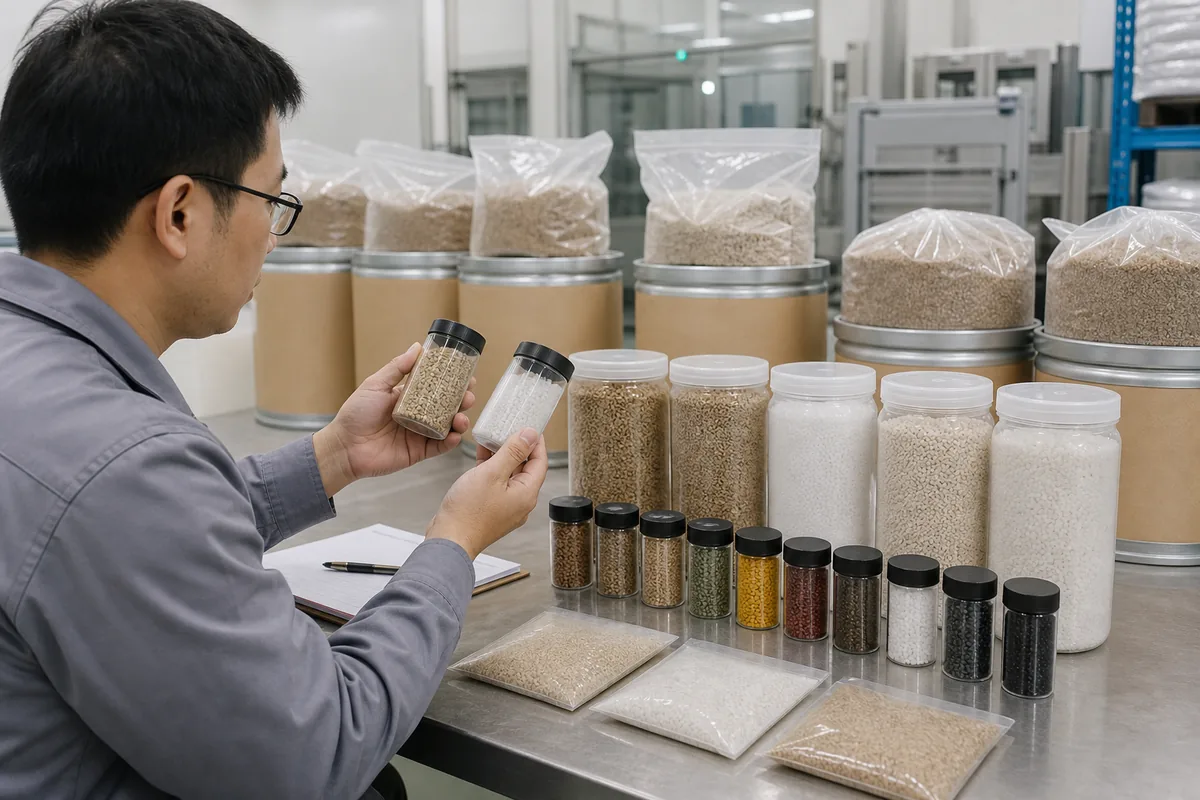
Wheat-straw composite tableware is not visually identical to a single-color engineering polymer. Fine plant-derived particles remain visible in the molded surface, and normal differences in particle tone, size and distribution can change the overall beige or muted-color impression even when the formulation target is unchanged.
The polymer matrix and approved additives also influence lightness, opacity and gloss. A more translucent base can reveal fiber contrast more strongly, while an opaque color system can reduce visible variation but cannot eliminate every particle-level difference.
Pigment concentration and dispersion affect hue and saturation across the part. Small dosing errors, incomplete mixing or an uncontrolled masterbatch substitution can create a systematic lot shift that should not be excused as natural fiber character.
Molding temperature, residence time and local shear can change appearance. Excessive thermal exposure may darken the composite, while different flow paths, wall sections or cooling conditions can produce localized gloss and shade differences that look like a color problem.
Surface texture changes perception even when instrumental coordinates are close. A matte cavity scatters light differently from a polished area, and a rib, gate region or curved wall can appear lighter or darker because the viewing angle changes.
How Wheat Straw Tableware Color Variation Is Evaluated
Natural character is usually random, fine-grained and distributed within the approved appearance family. Process drift is more likely to create a repeated direction, such as an entire lot becoming yellower, darker, glossier or more uneven than the retained standard.
The distinction should be documented with approved photographs, physical boundary samples and measurable limits where the surface permits reliable readings. Words such as natural, eco or handmade are not substitutes for an acceptance rule.
Start Wheat Straw Color Control with a Complete Buyer Brief
A useful brief identifies product code, material construction, target market, color family, surface finish, logo method and packaging presentation. Color cannot be approved independently when the buyer may later change resin grade, fiber content, texture, decoration or wall geometry.
Provide a physical reference whenever brand consistency is important. Digital screens, online photographs and compressed files vary by device and cannot serve as the only production standard, although they remain useful for discussing direction before sampling.
Pantone or another commercial color reference can communicate a starting target, but it does not automatically predict the result in a speckled composite. The factory needs to translate the reference into trial plaques or production-intent parts using the actual material and surface.
Define whether the target applies to an individual component or an assembled set. A plate, bowl and cup can show different perceived lightness because thickness, curvature and texture differ, even when the same compound batch is used.
State the sales environment and photography expectations. A muted natural beige acceptable for outdoor retail may be unsuitable for a brand whose online assortment requires tightly matched pastel sets under studio lighting.
Which color references belong in the quotation package
The package should list the target reference, approved material, component revision, surface, measurement area, lighting condition and allowed range. It should also state which reference controls when a photograph, color code and physical sample appear inconsistent.
If your brief is incomplete, send the sourcing team your product and color references before requesting a fixed quotation. Early review prevents price comparisons based on different material or approval assumptions.
Check Color under More Than One Relevant Light Source
Human color judgment changes with illumination. A wheat-straw beige set can look warmer under incandescent-like retail lighting, more neutral under daylight and cooler under some warehouse LEDs, so approval under only one uncontrolled office lamp creates avoidable disputes.
Metamerism describes situations in which two samples appear to match under one light source but separate under another. Different pigment systems, fiber backgrounds or optical additives can create this behavior even when the samples look acceptable in the development room.
Select viewing conditions that reflect the buyer channel. Daylight-type inspection is useful for general comparison, while retail brands may add the store lighting used on shelf and e-commerce teams may add the controlled illumination used for product photography.
The viewing booth, lamp condition, background, observer adaptation and sample orientation should remain stable. Placing one sample near a colored wall or comparing a glossy curved cup against a flat matte plate can distort the visual conclusion.
Record whether a difference is visible across all relevant sources or only one. A buyer can then decide whether the commercial risk justifies formulation changes instead of repeatedly adjusting color without a documented reason.
Why a phone photograph cannot approve wheat straw color tolerance
Automatic white balance, exposure, display calibration and image compression alter color. Photographs are excellent for recording speckle distribution, contamination or gross lot differences, but they should support rather than replace the physical or instrumental reference.
When remote approval is unavoidable, both sides should agree on controlled photography and couriered samples. The final production basis should identify the signed physical sample or measured dataset, not the appearance of a messaging-app preview.

Use Instrumental Measurement without Hiding Visual Risk
Colorimeters and spectrophotometers convert reflected light into numerical coordinates under defined settings. CIELAB values describe lightness and opponent color axes, while a color-difference formula summarizes the distance between a sample and reference.
A single delta value is not meaningful unless instrument geometry, illuminant, observer, aperture, surface condition and calculation method are identified. Results from different settings or instruments should not be mixed as though they belong to one dataset.
Wheat-straw speckles make measurement location important. A small aperture may react strongly to one dark particle, while a larger aperture averages a broader area, so the chosen method must represent the buyer-visible surface and remain consistent across lots.
Measure several defined locations or several pieces and review the distribution, not only the best result. An average can hide one visibly unacceptable component, while one isolated reading may exaggerate normal particle variation.
Instrumental data should be paired with visual assessment because gloss, texture, translucency and localized streaking may not be captured by a simple pass/fail number. The buyer needs both objective repeatability and a realistic judgment of shelf appearance.
How to set a wheat straw color tolerance from evidence
Begin with trial lots and boundary samples rather than copying a generic tolerance from another material. Determine which measured differences remain visually acceptable on the real component under the agreed lights, then set a range supported by process capability.
A tighter number is not automatically better. An unrealistically narrow tolerance increases sorting and rejection without improving consumer value, while an overly broad range allows brand-visible drift and weakens repeat-order consistency.
Build a Physical Sample Approval System for Repeat Orders
The approved sample should be production-intent in material, pigment, surface and geometry. A flat laboratory plaque can help formulation work, but it does not fully represent a curved bowl, textured plate or thick cup wall.
Retain a master reference in protected conditions and define working references for routine comparison. Frequent handling, sunlight, heat, cleaning chemicals or dust can change a sample, so uncontrolled ageing may make a good production lot appear wrong.
Boundary samples are especially useful for natural composites. They show the lightest, darkest, most speckled and least speckled appearances that remain commercially acceptable while allowing inspectors to reject contamination, scorching or visible mixing defects.
Label every reference with product revision, material, color code, approval date and status. A sample without identity can be confused with a development trial, rejected version or different cavity and should not govern shipment release.
For repeat orders, compare the current lot with the valid retained standard and review whether any approved change occurred. A buyer should not demand a match to an old consumer photograph if the original material or product specification changed.
When a color change needs formal reapproval
Changes to fiber source, polymer grade, pigment supplier, color concentration, surface texture, cavity, processing window or recycled-content claim may affect appearance. The change record should decide whether visual review, instrumental measurement, food-contact evidence or a new buyer sample is required.
The traceability logic in our food contact tableware traceability guide helps connect the approved color construction to the material and production lots shipped. Color approval without lot identity cannot protect repeat orders.
Control Wheat Straw Color during Bulk Production
Production starts with released material and pigment identities, verified dosing and a documented mixing route. Operators should not correct shade by adding pigment informally because the adjustment can affect compliance scope, opacity, processing and future repeatability.
First-piece review should confirm appearance after the process reaches a stable condition. Samples taken too early can reflect start-up material, temperature or purge history rather than the normal production state that will fill the order.
Check multiple cavities, machines, shifts and material lots when they contribute to one shipment. Cavity texture, equipment history or batch transitions can create patterns that disappear when only one convenient sample is inspected.
Keep inspection records linked to production order, compound lot, pigment lot, date, shift and retained samples. This connection allows the team to investigate drift instead of arguing from photographs after the goods reach another country.
Final packing checks should review set-level coordination and color allocation. Individual pieces may pass their ranges while an assembled set looks inconsistent because components from different boundaries were combined without a matching rule.
What the factory should do when a lot moves toward the limit
Hold affected material, verify the measurement system and compare retained samples before changing the process. Confirm whether the cause is material identity, dosing, dispersion, thermal history, contamination, surface or lighting rather than making an immediate pigment correction.
Corrective action should be validated across the relevant cavities and normal production duration. Release requires restored evidence and buyer-defined appearance, not merely one favorable reading after adjustment.

Write a Buyer RFQ That Prevents Color Disputes
The RFQ should state the intended material construction, product revision, target reference, required colors, assortment ratio and sales channel. Suppliers cannot quote comparable control when one assumes a generic natural beige and another assumes a tightly matched custom pastel.
Ask how the factory translates color references into the composite, how many trial stages are planned and which sample governs production. The answer should describe records and approval points rather than promising an exact match before material trials.
Define the visual and instrumental methods, including relevant light sources, measurement settings, locations and sample count. Leave room to establish the final tolerance from trial evidence when the product or formulation is new.
Include change-control triggers and repeat-order expectations. A buyer needs notification before material or pigment changes that could alter color, compliance evidence or the relationship to the approved sample.
Commercial terms such as sample charges, minimum quantities, lead time and testing depend on the final product, color split, packaging and evidence plan. They should be confirmed in the project quotation rather than copied from an unrelated listing.
Prepare a project-specific wheat straw color review
Share the target product, physical reference, quantity, markets and packaging through our project inquiry page. Naike Group manufacturing team can identify the missing color-control decisions before sampling begins.
Review the color-translation principles in our Pantone-to-production guide, while recognizing that silicone and wheat-straw composites have different backgrounds, surfaces and process effects. The method must be adapted to the real material.
Wheat Straw Color Differences: Accept, Review or Reject?
The table separates common natural-composite appearance from conditions that require investigation. Final acceptance must follow the approved product-specific specification and boundary samples. Record the selected comparison assumptions in the wheat straw tableware color variation project brief before quotation.
| Observation | Likely Meaning | Buyer Response | Factory Evidence | Typical Decision |
|---|---|---|---|---|
| Fine random speckle variation | Natural particle distribution within the approved composite | Compare with boundary samples | Material identity and visual reference | Accept when inside approved range |
| Whole lot shifts darker or yellower | Material, pigment or thermal-process change | Hold and investigate direction | Lot records, measurements and process history | Review or reject |
| One cavity appears glossier | Surface or cavity condition difference | Compare by cavity and angle | Cavity map and surface inspection | Correct before release if visible |
| Match under daylight but not retail LED | Possible metamerism | Assess agreed sales lighting | Multi-light visual record | Reformulate or accept by channel risk |
| Dark streaks or burnt particles | Dispersion, contamination or thermal degradation concern | Segregate affected pieces | Defect investigation and retained samples | Reject unless proven acceptable |
| Set pieces individually pass but look mismatched | Assembly from different tolerance boundaries | Apply set-level matching rule | Packing and assortment records | Re-sort or revise allocation |
B2B Buyer Checklist for Wheat Straw Color Approval
Use this checklist before approving samples or releasing a repeat order. Each answer should point to a controlled reference, method or record. Record every answer against the current wheat straw tableware color variation project assumptions and approval owner.
| Check | Question | Why It Matters |
|---|---|---|
| Material identity | Is the polymer, fiber system, pigment and surface construction fixed? | Color cannot repeat when the visible construction changes. |
| Target reference | Which physical sample or measured dataset controls production? | Screens and photographs cannot serve as the only color standard. |
| Viewing lights | Which daylight, retail or warehouse lighting conditions matter? | The same product can appear different under different illumination. |
| Measurement setup | Are illuminant, observer, aperture, geometry and formula defined? | Different settings create non-comparable numerical results. |
| Locations and count | Where and how many pieces will be measured or viewed? | Speckles and geometry make one reading unreliable. |
| Boundary samples | Are acceptable light, dark and speckle limits physically represented? | Boundaries distinguish natural character from unacceptable drift. |
| Set matching | Must plates, bowls, cups and utensils match as one retail set? | Individual acceptance may still produce a visibly inconsistent set. |
| Change control | Which material, pigment, tool or process changes trigger reapproval? | Old evidence may not cover a changed construction. |
| Repeat orders | How is the valid retained reference stored and identified? | A degraded or unidentified sample cannot protect consistency. |
| Incident plan | Can color results trace back to material and production lots? | Traceability supports focused investigation and correction. |
Factory Control Notes for wheat straw tableware color variation
Together, these controls turn subjective color preference into a practical factory and buyer approval system without pretending a natural-fiber composite is perfectly uniform. Each wheat straw tableware color variation decision should identify its owner, evidence and release condition.
1. Material identity control for wheat straw tableware color variation
For wheat straw tableware color variation, the material identity checkpoint must become a dated project record rather than an informal chat instruction. The resulting material identity record must name its owner, source evidence, revision authority and the commercial consequence of a late change after the buyer asks, “Is the polymer, fiber system, pigment and surface construction fixed?”
Color cannot repeat when the visible construction changes. For the material identity decision in this wheat straw tableware color variation project, our factory links the checkpoint to the quotation, approved sample, purchase order or inspection standard that governs the next approval. If the wheat straw tableware color variation evidence is incomplete, the team holds that approval gate, closes the information gap and records the revised assumption before production continues.
2. Target reference control for wheat straw tableware color variation
For wheat straw tableware color variation, the target reference checkpoint must become a dated project record rather than an informal chat instruction. The resulting target reference record must name its owner, source evidence, revision authority and the commercial consequence of a late change after the buyer asks, “Which physical sample or measured dataset controls production?”
Screens and photographs cannot serve as the only color standard. For the target reference decision in this wheat straw tableware color variation project, our factory links the checkpoint to the quotation, approved sample, purchase order or inspection standard that governs the next approval. If the wheat straw tableware color variation evidence is incomplete, the team holds that approval gate, closes the information gap and records the revised assumption before production continues.
3. Viewing lights control for wheat straw tableware color variation
For wheat straw tableware color variation, the viewing lights checkpoint must become a dated project record rather than an informal chat instruction. The resulting viewing lights record must name its owner, source evidence, revision authority and the commercial consequence of a late change after the buyer asks, “Which daylight, retail or warehouse lighting conditions matter?”
The same product can appear different under different illumination. For the viewing lights decision in this wheat straw tableware color variation project, our factory links the checkpoint to the quotation, approved sample, purchase order or inspection standard that governs the next approval. If the wheat straw tableware color variation evidence is incomplete, the team holds that approval gate, closes the information gap and records the revised assumption before production continues.
4. Measurement setup control for wheat straw tableware color variation
For wheat straw tableware color variation, the measurement setup checkpoint must become a dated project record rather than an informal chat instruction. The resulting measurement setup record must name its owner, source evidence, revision authority and the commercial consequence of a late change after the buyer asks, “Are illuminant, observer, aperture, geometry and formula defined?”
Different settings create non-comparable numerical results. For the measurement setup decision in this wheat straw tableware color variation project, our factory links the checkpoint to the quotation, approved sample, purchase order or inspection standard that governs the next approval. If the wheat straw tableware color variation evidence is incomplete, the team holds that approval gate, closes the information gap and records the revised assumption before production continues.
5. Locations and count control for wheat straw tableware color variation
For wheat straw tableware color variation, the locations and count checkpoint must become a dated project record rather than an informal chat instruction. The resulting locations and count record must name its owner, source evidence, revision authority and the commercial consequence of a late change after the buyer asks, “Where and how many pieces will be measured or viewed?”
Speckles and geometry make one reading unreliable. For the locations and count decision in this wheat straw tableware color variation project, our factory links the checkpoint to the quotation, approved sample, purchase order or inspection standard that governs the next approval. If the wheat straw tableware color variation evidence is incomplete, the team holds that approval gate, closes the information gap and records the revised assumption before production continues.
6. Boundary samples control for wheat straw tableware color variation
For wheat straw tableware color variation, the boundary samples checkpoint must become a dated project record rather than an informal chat instruction. The resulting boundary samples record must name its owner, source evidence, revision authority and the commercial consequence of a late change after the buyer asks, “Are acceptable light, dark and speckle limits physically represented?”
Boundaries distinguish natural character from unacceptable drift. For the boundary samples decision in this wheat straw tableware color variation project, our factory links the checkpoint to the quotation, approved sample, purchase order or inspection standard that governs the next approval. If the wheat straw tableware color variation evidence is incomplete, the team holds that approval gate, closes the information gap and records the revised assumption before production continues.
7. Set matching control for wheat straw tableware color variation
For wheat straw tableware color variation, the set matching checkpoint must become a dated project record rather than an informal chat instruction. The resulting set matching record must name its owner, source evidence, revision authority and the commercial consequence of a late change after the buyer asks, “Must plates, bowls, cups and utensils match as one retail set?”
Individual acceptance may still produce a visibly inconsistent set. For the set matching decision in this wheat straw tableware color variation project, our factory links the checkpoint to the quotation, approved sample, purchase order or inspection standard that governs the next approval. If the wheat straw tableware color variation evidence is incomplete, the team holds that approval gate, closes the information gap and records the revised assumption before production continues.
8. Change control control for wheat straw tableware color variation
For wheat straw tableware color variation, the change control checkpoint must become a dated project record rather than an informal chat instruction. The resulting change control record must name its owner, source evidence, revision authority and the commercial consequence of a late change after the buyer asks, “Which material, pigment, tool or process changes trigger reapproval?”
Old evidence may not cover a changed construction. For the change control decision in this wheat straw tableware color variation project, our factory links the checkpoint to the quotation, approved sample, purchase order or inspection standard that governs the next approval. If the wheat straw tableware color variation evidence is incomplete, the team holds that approval gate, closes the information gap and records the revised assumption before production continues.
9. Repeat orders control for wheat straw tableware color variation
For wheat straw tableware color variation, the repeat orders checkpoint must become a dated project record rather than an informal chat instruction. The resulting repeat orders record must name its owner, source evidence, revision authority and the commercial consequence of a late change after the buyer asks, “How is the valid retained reference stored and identified?”
A degraded or unidentified sample cannot protect consistency. For the repeat orders decision in this wheat straw tableware color variation project, our factory links the checkpoint to the quotation, approved sample, purchase order or inspection standard that governs the next approval. If the wheat straw tableware color variation evidence is incomplete, the team holds that approval gate, closes the information gap and records the revised assumption before production continues.
10. Incident plan control for wheat straw tableware color variation
For wheat straw tableware color variation, the incident plan checkpoint must become a dated project record rather than an informal chat instruction. The resulting incident plan record must name its owner, source evidence, revision authority and the commercial consequence of a late change after the buyer asks, “Can color results trace back to material and production lots?”
Traceability supports focused investigation and correction. For the incident plan decision in this wheat straw tableware color variation project, our factory links the checkpoint to the quotation, approved sample, purchase order or inspection standard that governs the next approval. If the wheat straw tableware color variation evidence is incomplete, the team holds that approval gate, closes the information gap and records the revised assumption before production continues.
Authoritative References and Practical Limits
ISO/CIE 11664-4:2019 defines the CIE 1976 L*a*b* colour space and methods for calculating color differences. Review the official ISO standard overview. Buyers should confirm how this reference applies to the named product, target market and current wheat straw tableware color variation project.
ASTM D2244 describes calculations of color tolerances and differences from instrumentally measured color coordinates. Review the official ASTM D2244 record when selecting a calculation method. Buyers should confirm how this reference applies to the named product, target market and current wheat straw tableware color variation project.
The U.S. FDA explains that colorants used in food-contact polymers are regulated as food additives and points to 21 CFR 178.3297. Review the official FDA colorant guidance with qualified compliance professionals. Buyers should confirm how this reference applies to the named product, target market and current wheat straw tableware color variation project.
This article explains color-control practice and is not a universal tolerance, material authorization, certification or legal opinion. Buyers must approve the actual formulation, intended use, target-market requirements and product-specific appearance with qualified technical and compliance support.
Wheat Straw Tableware Color Variation FAQ
Can wheat straw tableware be perfectly identical in color?
A controlled composite can be consistent, but fine particle tone and distribution may create natural visual variation. The buyer should approve a realistic range and defect boundaries.
Is a Pantone code enough for bulk production?
No. It is a useful direction, but the factory should translate it into the actual composite, geometry and surface before a physical sample controls production.
What does a colorimeter solve?
It improves numerical repeatability under defined settings. It does not replace visual review of gloss, texture, speckles, streaking, metamerism or assembled-set appearance.
Why does the same sample look different in photographs?
Camera white balance, exposure, lighting and display calibration change appearance. Photographs should support defect records rather than serve as the sole color reference.
When should a repeat order receive new color approval?
Reapproval should be considered when material, fiber system, pigment, surface, tool, process or approved use changes. It is also needed when the retained standard is no longer reliable.
How should buyers request a color quotation?
Send the product revision, material direction, physical reference, colors, quantity split, target market, packaging and required approval evidence. The factory can then define trials and commercial variables.
Conclusion: Turn Wheat Straw Color Variation into an Approval System
Reliable control of wheat straw tableware color variation starts by accepting the material as a composite while refusing uncontrolled lot drift. The specification should connect material identity, lighting, physical references, measurements, boundary samples and set-level appearance.
Our factory uses trial samples, retained standards, lot records and change review to make color decisions traceable. This gives purchasing, product and quality teams one shared basis for sample approval and repeat orders.
To prepare the next step, request a wheat straw color and sample review with your target product, reference, quantity and market. The Naike Group manufacturing team will identify which decisions must be confirmed before quotation.
Build a Repeatable Wheat Straw Color Standard
Send your product reference, target colors, quantity split and market requirements for a factory-side sampling review. Our manufacturing team will use those details to define the next review step for your wheat straw tableware color variation project.
Request a Custom Quote
Share your product, quantity, target market and customization needs. Our factory team will reply with the next practical step.
Continue Your Sourcing Research
The six newest factory-side articles are updated automatically by publication date.

Wheat Straw vs Bagasse Tableware: Buyer Comparison
A B2B decision guide comparing reusable wheat-straw polypropylene composite tableware with molded bagasse fiber formats across use, evidence, operations and end of life.

Can Wheat Straw Tableware Be Recycled? Buyer Q&A
A practical buyer answer on whether reusable wheat-straw composite tableware can enter PP recycling streams, which evidence matters, and how to qualify market claims.

Global SKU vs Regional SKU: Tableware Decision Guide
A buyer decision framework for choosing one global tableware SKU or controlled regional variants across compliance, packaging, logistics, inventory and change control.

Australia Food Packaging Evidence: Buyer Guide
A practical evidence guide for Australian food-packaging buyers covering intended use, migration risk, supplier assurance, testing, hygiene, release and change control.

EU PPWR Tableware Packaging vs Conventional Packs
A buyer comparison of PPWR-ready and conventional tableware packaging across product protection, material choices, empty space, evidence, labeling and release timing.

Prop 65 Tableware Requirements: Buyer Q&A
A practical buyer Q&A for defining California Proposition 65 exposure scenarios, evidence, warning decisions, supplier records and release controls for tableware.