
Wheat Straw Tableware Stain Smell: Buyer Guide
Separate removable food residue, absorbed odor, process variation, packaging effects, and irreversible surface change before deciding what to fix.
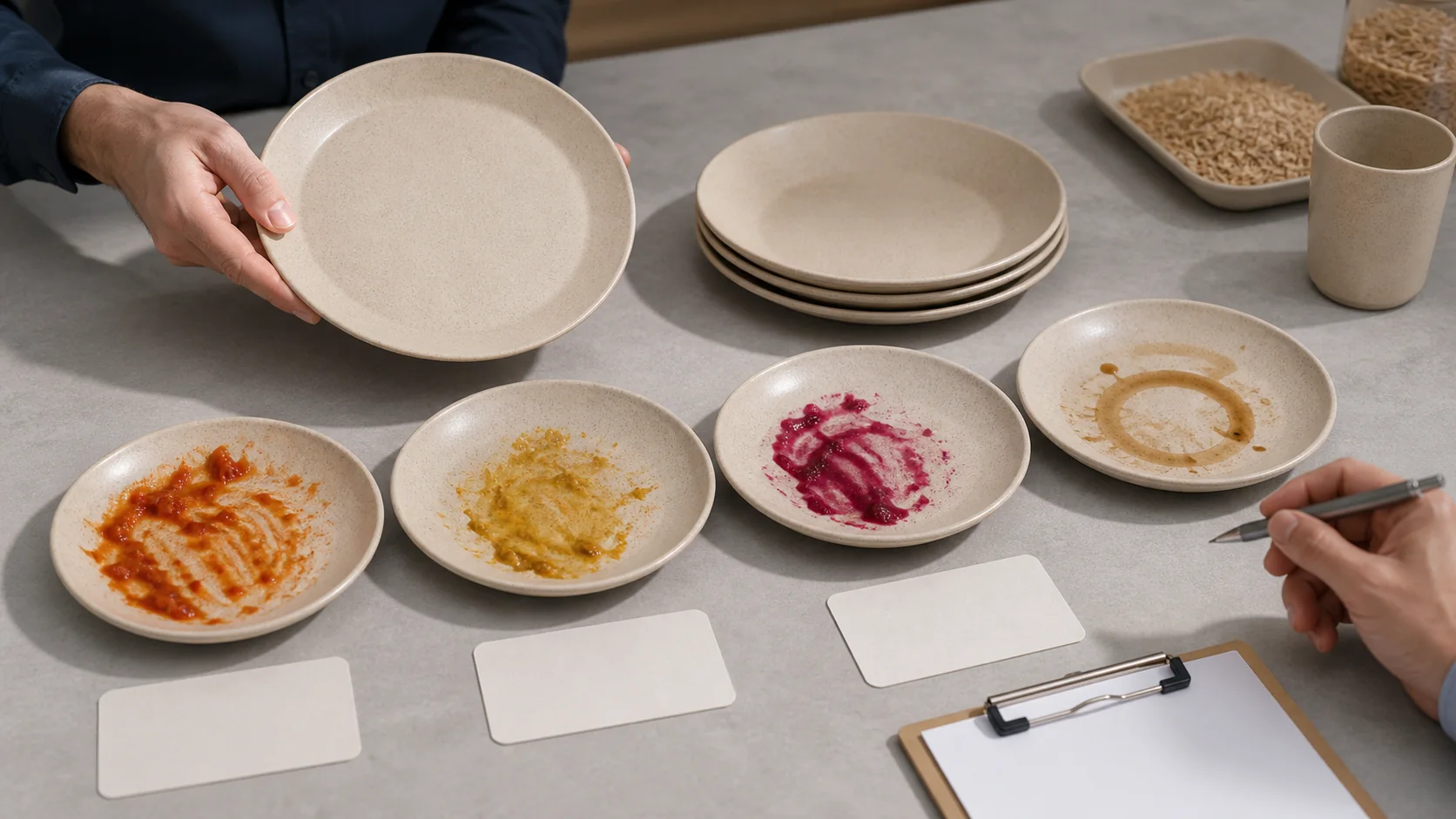
Wheat straw tableware stain smell issues usually come from pigmented or oily food left on a textured surface, residue trapped in details, incomplete washing or drying, odor absorbed during hot contact, or packaging and storage—not simply from the presence of wheat fiber. Diagnose the stage and condition first, then adjust surface finish, cleaning instructions, use limits, packaging, or process controls.
For buyers, the important question is not whether one sample looks or smells different after an undefined kitchen trial. The useful question is whether production-intent articles meet an agreed result after named foods, temperatures, contact times, wash cycles, drying conditions, and storage intervals.
That distinction protects both product quality and accurate customer communication. It prevents a removable tomato film from being labeled permanent discoloration, and it prevents a persistent formulation or packaging odor from being dismissed as ordinary use.
Quick Answer: Separate Residue From Material Change
Start with an unexposed control and compare the affected article before washing, after the specified wash, after full drying, and again after ventilated or sealed storage. Record the food, temperature, time, cleaning delay, detergent, water, cycle, and assessor result so the investigation can be repeated.
If a buyer has a recurring complaint or a new private-label specification, send the product, use case, photographs, packaging, and cleaning routine for an initial factory review. A useful review identifies the likely mechanism and the next confirming check rather than promising that every mark or odor has one universal cure.
Why Pigmented Foods Leave Visible Stains
Tomato sauce, curry spices, beet, coffee, tea, berries, and strongly colored oils can leave visible color when pigments remain in a surface film or interact with a rough, scratched, or porous-looking area. Heat can increase wetting and contact, while oil can carry pigments across a hydrophobic polymer surface and make ordinary rinsing less effective. A light natural base color also makes a small residue more visible than it would be on dark tableware.
Wheat straw tableware is normally a composite rather than compressed straw alone. The polymer matrix, fiber content, pigment package, processing, surface finish, and molded geometry work together, so two products sold under the same broad material label may behave differently. Buyers should therefore evaluate the exact formulation and finished article instead of transferring a result from an unrelated wheat straw product.
Cleaning delay is a major variable because warm residue can dry into texture, scratches, embossed logos, rim details, or stacking feet. A test that leaves curry on a plate for four hours before washing is not comparable with a test that rinses it immediately. Both may be commercially relevant, but the intended user scenario and acceptance rule must be stated.
Visible change also needs a defined observation method. Use the same lighting, background, viewing distance, sample orientation, and dry condition, and compare with an unexposed control from the same color lot. Photographs should include a color reference and sample code, because phone auto-correction can exaggerate or hide a difference.
Do not use aggressive bleach, abrasives, solvents, or unusually concentrated cleaner merely to make a trial pass unless those conditions are part of the approved care instructions. A cleaning method can remove color while creating whitening, gloss change, scratches, cracking, or a new odor. The final judgment must include both cleanliness and surface integrity.
Define stain as a measurable post-cleaning condition
A buyer specification can distinguish removable residue, slight visible shadow, unacceptable discoloration, and physical surface damage after the agreed cleaning cycle. If an instrument is used, define the measurement locations, control, conditioning time, color difference calculation, and limit. If a trained visual panel is used, define assessor count and decision rule so one person’s expectation does not become the entire method.
This makes corrective action more precise. Removable residue may point to instructions or geometry, while repeatable permanent discoloration may justify a formulation, pigment, finish, process, or intended-use review.

Why Odor Can Remain After Washing
An odor noticed after use may come from residual food, detergent, rinse water, incomplete drying, microbial growth on retained soil, the base material, processing volatiles, printing, packaging, or warehouse conditions. These sources require different actions, so “the product smells” is not yet a root-cause statement. The first investigation should locate when the odor appears and whether it transfers to food or water.
Hot, fatty, spicy, or long-duration contact can expose an article more severely than a quick cold-water rinse. Odor can also become noticeable only after the article is washed, nested while damp, and stored in a closed cabinet. A test that evaluates a warm sample immediately after food removal can produce a different result from one evaluated after full drying and overnight conditioning.
Packaging odor can be confused with product odor when newly opened articles have been sealed soon after production or packed beside printed material, adhesive, inserts, or treated cartons. Ventilate one sample under controlled clean conditions while retaining another in the original pack. If the odor declines only in the ventilated sample, the packaging and pack-out timeline deserve targeted review.
Detergent fragrance is another confounder. Use a documented low-odor or unscented cleaner where appropriate, standardize the concentration and water temperature, and include clean glass or a known inert control. The goal is not to create a laboratory fantasy but to stop the cleaning agent from masking or creating the effect being assessed.
Human odor evaluation should be coded and organized to reduce expectation bias. Assessors should not be told which sample is the complaint article, and they should evaluate at defined intervals in a neutral environment without perfume, food, smoke, or solvent background. When commercial risk is material, use a qualified laboratory method rather than relying on an informal factory-room sniff.
Separate article odor from odor transfer
An article may have a detectable odor while producing no noticeable change in water or food, or it may transfer an off-note under a demanding condition even when the dry article seems neutral. Treat those as separate endpoints with separate controls and acceptance language. The tableware odor transfer evidence guide explains how to structure a broader controlled sensory comparison.
For this wheat straw-specific investigation, connect any result to formulation lot, molding date, drying, packaging lot, warehouse time, and wash history. That traceability helps distinguish one contaminated or under-conditioned batch from an inherent product limitation.
Use a Simple Diagnosis Before Changing the Product
Begin with five matched production-intent groups: an untouched control, food-exposed unwashed samples, food-exposed samples washed immediately, food-exposed samples washed after a defined delay, and washed samples held through defined open and sealed storage. Use enough specimens to see whether the result is repeatable rather than a single-part anomaly. Retain a counterpart from the same molding and packaging lot.
Record appearance and odor at baseline, after exposure, after washing, after complete drying, and after storage. If a mark disappears after the standard wash, it was removable residue under that condition; if it remains but fades after a second approved cycle, the care routine may need clarification. If it grows worse without new food contact, trapped moisture, storage, or contamination deserves attention.
Inspect molded details with neutral lighting and magnification. Look for scratches, matte patches, incomplete fill, exposed fiber clusters, weld lines, rough gates, embossed recesses, tight radii, and areas that remain wet. Map the complaint location because a repeated ring, logo recess, or foot contact pattern often reveals geometry or stacking behavior.
Compare lots rather than mixing history. A result limited to one color, resin or fiber lot, tool cavity, shift, packaging batch, or storage period can lead to a focused containment plan. A result repeated across controlled lots and use conditions may require a specification, formulation, design, or claim decision.
Use the diagnosis to choose the smallest credible next test. There is little value in changing pigment when the source is a damp nested stack, or changing packaging when the actual issue is dried curry lodged in a textured logo. Each corrective action should predict a changed result that the confirmation test can verify.
Build an evidence chain a buyer can review
The record should connect complaint sample, order, production date, cavity or line where available, material and color lots, packaging, use exposure, wash conditions, images, assessor results, disposition, corrective action, and confirmation. The wheat straw composite material guide provides useful context for discussing formulation and processing variables without treating the fiber label as a complete specification.
Keep assumptions visibly labeled. If the customer cannot reconstruct the original food temperature or wash delay, run a bounded range and report what the experiment proves instead of presenting the most severe trial as a recreation of the complaint.
Check Design, Finish, and Cleaning Access
A product can use a suitable composite and still be difficult to clean because soil remains in geometry the normal user cannot reach. Deep branding, sharp internal corners, hollow seams, textured bands, undercuts, narrow straw openings, and tightly nested wet parts deserve a cleaning-access review. Drainage and drying are as important as brush or dishwasher access.
Inspect the as-molded finish across every cavity. Local roughness, flow marks, exposed fibers, gate trimming, flash, scratches from handling, or polishing differences can affect visible residue and perceived cleanliness. Approve finish references and viewing conditions with the sample instead of relying on a broad phrase such as “smooth surface.”
Stacking can create hidden moisture contact and transfer residue between parts. Test the product in the actual household or food-service stack after the intended wash and drying time, then inspect contact rings and enclosed areas. Packaging inserts and retail nesting should also be evaluated because pressure and long storage can change how new articles smell when opened.
Care instructions must match the geometry and the validated routine. If a groove requires prompt rinsing, brush access, complete drying, or separation before storage, communicate that clearly and verify that the instruction is practical for the target user. Instructions should not be used to excuse an avoidable design trap that makes ordinary cleaning unrealistic.
When evaluating dishwasher use, separate cleaning result from heat deformation, gloss change, print damage, fiber exposure, and retained water. Use the declared rack position, detergent, program, temperature, load, and cycle count. The wheat straw dishwasher test guide helps buyers align cycle conditions with a defensible reusable claim.
Approve surfaces with real production samples
Prototype prints, hand-finished models, and first trial shots may not represent mass-production texture, cooling, packing, or handling. Repeat the stain and odor screen on samples produced with the intended material, pigment, tool, settings, decoration, and pack-out. Link the approved result to the golden sample and controlled specification.
Include both cleanability and cosmetic acceptance in sample sign-off. A surface can be hygienically cleaned yet remain commercially unacceptable for a light-color retail program, while a visually clean surface can still retain an odor or hidden residue that needs further assessment.
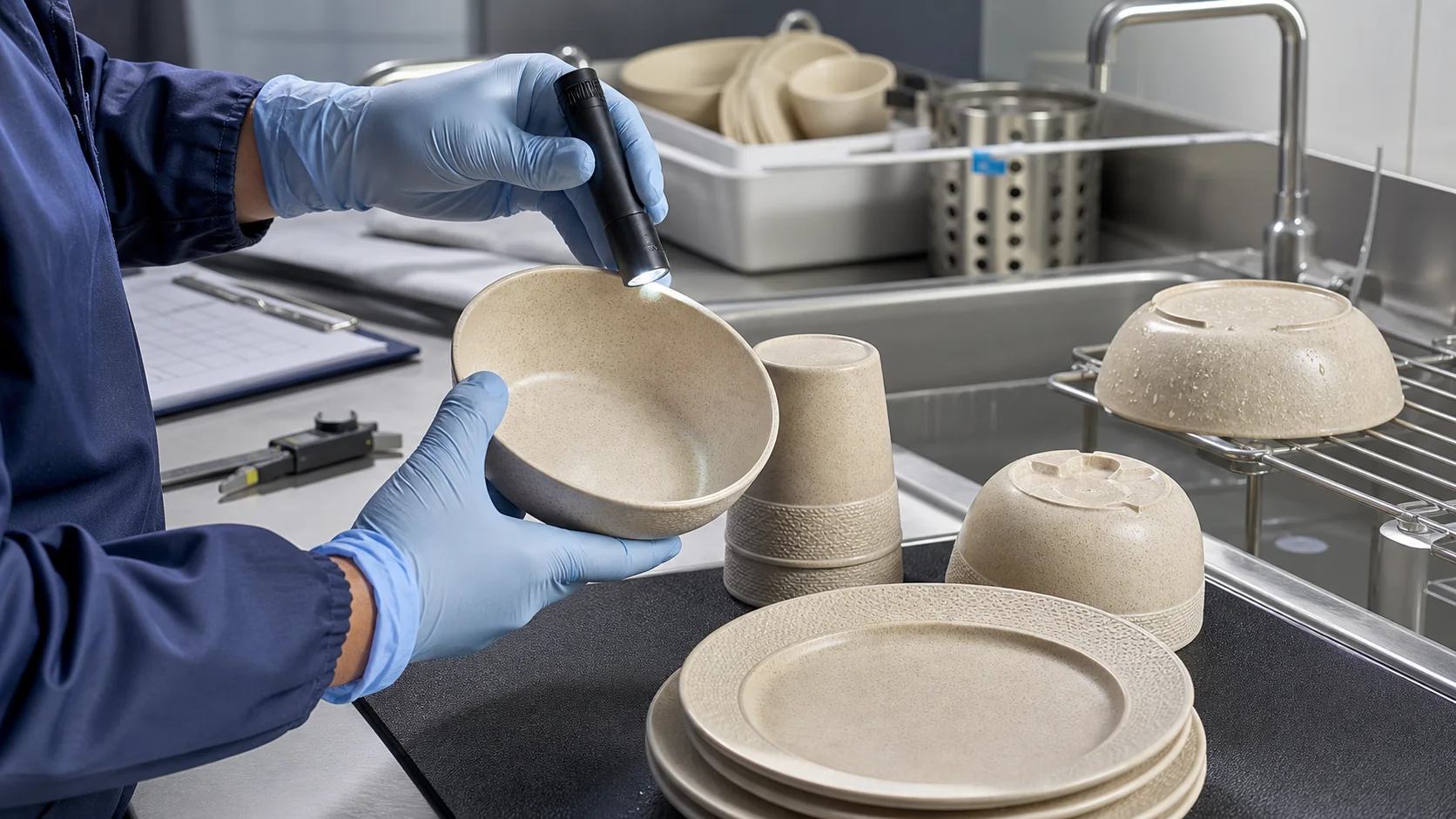
Test Real Foods, Temperatures, and Wash Cycles
Select challenge foods from the intended market and product function. A lunch box for tomato pasta, a children’s bowl for pumpkin puree, a coffee cup, and a serving tray for curry oil do not have the same exposure. Include a neutral control food or water so assessors can distinguish general article odor from a food-specific interaction.
Define food amount, temperature at filling, contact area, duration, lid condition, heating, cooling, and time before cleaning. Standardize the wash with detergent identity and concentration, water hardness where relevant, tool or dishwasher program, rinse, and drying method. Small differences in these variables can explain apparently conflicting supplier and customer results.
Use repeated cycles when the product carries a reusable or dishwasher claim. Check at planned intervals rather than only at the end, because a threshold may be crossed after a small number of uses or may stabilize after initial conditioning. Inspect appearance, odor, transfer, dimensions, cracking, deformation, print, and function together.
Build acceptance rules before seeing the result. Rules can combine no unacceptable odor transfer, no persistent article odor after defined conditioning, limited visual change against a control, no tackiness or surface damage, and continued function. Avoid “no smell” without a method because nearly any material can be described as having some odor under uncontrolled close inspection.
Use a qualified external laboratory when the decision affects regulatory evidence, retailer protocol, a high-risk claim, or a disputed sensory result. Factory screening is valuable for formulation and process development, but it should not be presented as independent compliance evidence. Record which facility performed each check and the competence expected for the decision.
Make the Wheat Straw Tableware Stain Smell Check Repeatable
Issue one worksheet that names the article revision, lot, food, exposure, wash, drying, storage, observation, assessor, pass rule, and deviations. Use randomized sample codes and consistent photography, then keep raw observations rather than only a pass label. The exact keyword belongs in the buyer specification because it makes the complaint category easy to retrieve, but the individual endpoints must remain separate.
Run a small method-confirmation trial before the formal approval set. If controls vary widely or assessors cannot distinguish the agreed reference levels, improve the method before using it to accept or reject a shipment.
Set Buyer Specifications for Stain and Odor Performance
The purchase specification should identify the exact finished construction, approved color range, surface reference, intended foods, maximum use temperature and time, cleaning method, reuse claim, packaging, and storage. It should then state which stain, article-odor, and odor-transfer checks apply at development, production approval, periodic verification, and complaint investigation. Each check needs a pass rule and an evidence owner.
Separate design acceptance from routine inspection. A full repeated-use stain or sensory study may belong at golden-sample approval and after material or process changes, while shipment inspection can verify appearance, odor on opening, packaging condition, workmanship, and retained sample identity. Do not ask an AQL inspector to improvise a laboratory-scale sensory method during a short visit.
Define change triggers around the variables that can alter performance: resin or fiber source, fiber ratio, additives, pigments, processing window, tool surface, cavity repair, printing, cleaner recommendation, packaging ink or adhesive, pack-out delay, and storage. A change review can authorize focused confirmation when the technical rationale is strong, but the rationale and approval must be recorded.
Write complaint handling into the commercial workflow. The buyer should preserve affected and unaffected samples, photographs, batch and pack codes, use details, cleaning history, and remaining packaging; the supplier should identify traceable records and propose a controlled comparison. Agree who pays for independent analysis when the source remains disputed.
If a project needs a new acceptance protocol, request a production-intent stain and odor review before mass production. Share the product drawing, formulation status, colors, target foods, temperature, washing claim, packaging, markets, and the commercial consequence of failure so the scope matches the decision.
Keep claims inside the verified boundary
A pass under named tomato, curry, coffee, wash, and storage conditions does not prove universal stain-proof or odor-proof performance. Use precise language such as “evaluated under the specified conditions” and retain the approved method with marketing records. Broad absolute claims can create expectations no reusable surface can meet in every kitchen.
Review customer-facing care text alongside laboratory and factory evidence. Marketing, packaging, product pages, inserts, and sales teams should describe the same temperature, heating, cleaning, and storage boundary that procurement approved.
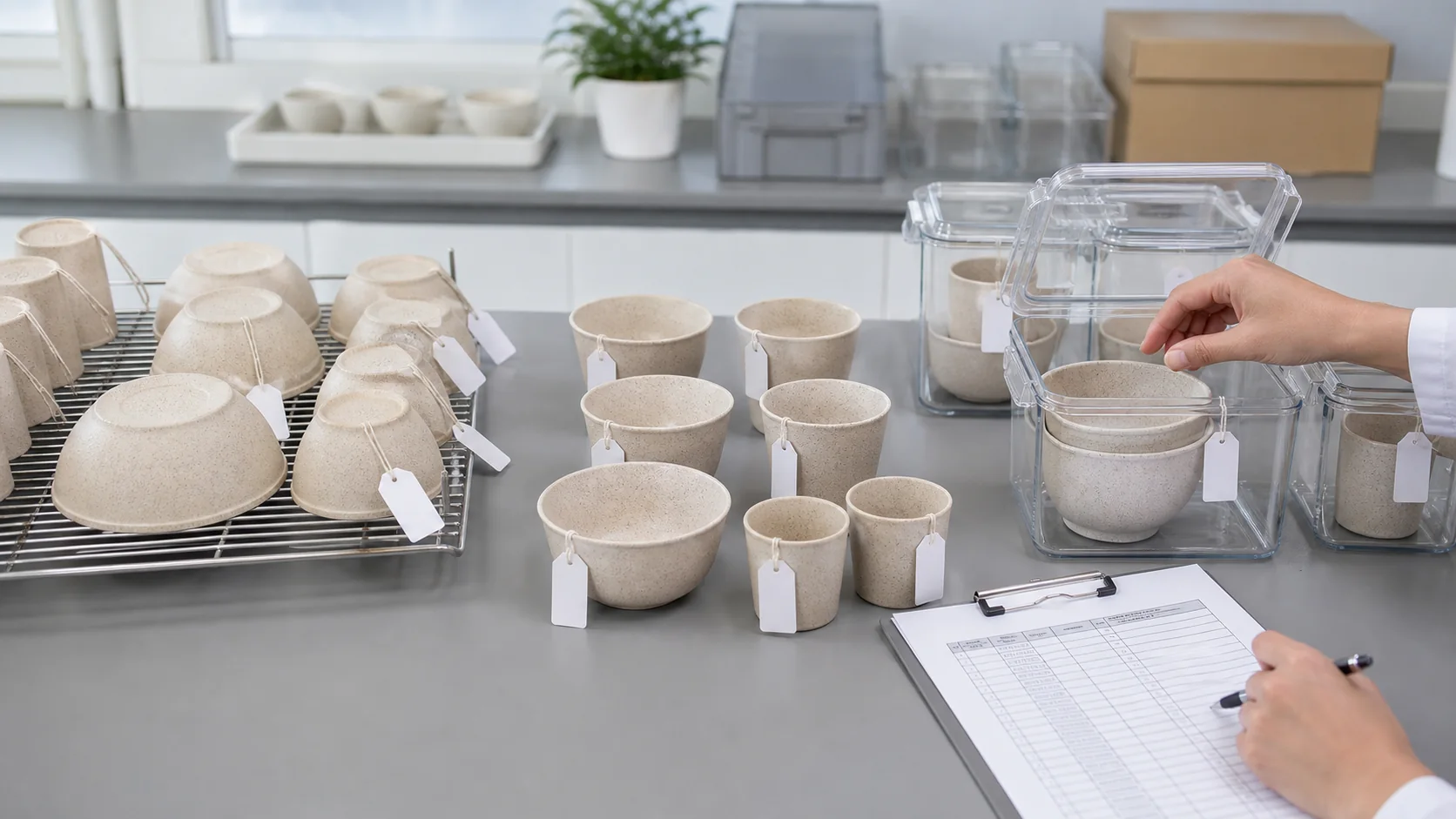
Compare Symptoms Before Choosing Corrective Action
The same complaint phrase can point to very different mechanisms. Use this diagnostic table to select the next confirming check, then update the product or instructions only after evidence supports the cause.
More than one mechanism can occur together. For example, textured geometry may retain oily pigment while damp nesting creates a separate storage odor, so closing only one action will not resolve the full complaint.
| Observed condition | Likely mechanism | Confirming check | Buyer action |
|---|---|---|---|
| Color wipes off during approved washing | Removable food film on the surface | Controlled immediate and delayed wash comparison | Clarify care steps and review cleaning access |
| Dry color remains in one recessed feature | Trapped pigment or inaccessible texture | Location map, magnified inspection, and geometry comparison | Revise detail, finish, or acceptance reference |
| Color appears only on one production lot | Material, pigment, process, or handling variation | Lot and cavity comparison with retained controls | Contain lot and review traceable process records |
| Odor appears only when package is first opened | Packaging, pack-out, or closed-storage volatiles | Ventilated versus sealed matched samples | Review packaging materials and conditioning time |
| Odor appears after damp nested storage | Retained moisture, soil, or restricted drying | Controlled wash, dry, open, and nested storage study | Improve drainage, drying guidance, or stack design |
| Article seems neutral but water or food changes | Transfer under a defined contact condition | Blind control and exposed-food sensory comparison | Review formulation, condition-of-use limit, and independent testing |
| Surface changes after aggressive cleaning | Cleaner, abrasion, or heat damage rather than food stain | Approved-care control versus aggressive method | Restrict care instructions and verify surface durability |
Buyer Checklist for Stain and Odor Approval
Complete all eight rows before approving the result or issuing corrective action. A missing answer means the evidence cannot yet connect the observed effect to the ordered production article.
Store the worksheet with sample approval, test reports, change records, and retained sample references. This turns a subjective complaint into a repeatable quality decision.
| Check | Question | Why It Matters |
|---|---|---|
| Product identity | Are formulation, color, tool cavity, production lot, decoration, and packaging traceable? | Performance differences cannot be contained or corrected without the exact article history. |
| Baseline control | Is there an unexposed control from the same lot and color? | A matched control separates pre-existing variation from use-related change. |
| Food exposure | Are food, amount, temperature, contact time, heating, and lid condition recorded? | Pigment and odor behavior depends on the actual contact scenario. |
| Cleaning delay | Was the time between use and washing defined and realistic? | Dried residue can produce a different outcome from immediate rinsing. |
| Wash and dry | Are detergent, concentration, water, tool or program, rinse, drying, and stacking fixed? | Cleaning chemistry and retained moisture can create, hide, or remove the observed effect. |
| Assessment | Are sample codes, conditioning, lighting, assessor method, and pass rule agreed? | Standard observation reduces bias and makes supplier and buyer results comparable. |
| Surface integrity | Were scratches, roughness, exposed fiber, deformation, gloss, and print checked after cleaning? | Removing residue does not count as success if the approved method damages the product. |
| Change control | Do the specification, retest triggers, owner, evidence, and complaint workflow reflect the result? | A one-time trial has little value unless production and future changes remain controlled. |
Use Official Sources Without Overstating Their Scope
Official sources help buyers define food-contact responsibility, exposure variables, and hygienic cleaning principles. They do not certify an individual wheat straw article, prescribe a universal stain limit, or replace product-specific assessment.
Apply the guidance to the target market and intended use, then have qualified regulatory and laboratory specialists confirm the applicable rules and methods. Keep source revision dates and professional decisions with the project record.
The European Commission’s official food-contact materials overview identifies tableware and kitchenware as food-contact materials and links the EU framework, good manufacturing practice, and material-specific measures. It supports traceable review of the complete composite, additives, manufacturing, and intended use rather than assuming the marketing name “wheat straw” defines compliance. The page does not provide a finished-product stain or odor acceptance test.
The U.S. Food and Drug Administration’s official food types and conditions of use shows that food character and processing or storage temperature are necessary variables when evaluating food-contact substances. This supports precise challenge-food, time, and temperature definitions in a buyer protocol. It does not approve the finished article or establish a universal sensory or discoloration limit.
The FDA’s official Food Code is a model for safeguarding public health in retail and food-service operations and provides a useful hygiene context for cleaning and sanitizing food-contact equipment and utensils. Buyers can use that context to avoid treating visible appearance as the only cleanliness question, while recognizing that the Food Code is not a private-label tableware material specification or a substitute for applicable product regulation.
Practical disclaimer: this article is a procurement and quality framework, not legal advice, medical advice, a migration assessment, or a universal laboratory method. Requirements and guidance can change, and the responsible manufacturer or importer must confirm applicable market rules, intended-use limitations, qualified laboratories, and final acceptance criteria for the exact article.
Choose the Control Level That Matches the Risk
For an established low-risk SKU with stable formulation, packaging, and normal household use, a controlled factory screen may be enough to confirm a minor complaint and verify a care-text improvement. Keep matched controls, repeat the customer scenario as closely as possible, and document why broader testing was not triggered.
For a new private-label program, approve a production-intent stain and odor protocol before mass production. Include the most relevant foods, realistic cleaning delay, declared wash cycle, complete drying, package-opening observation, repeated use where claimed, and a retained golden sample.
For child-oriented, food-service, high-temperature, broad-claim, multi-market, or disputed complaint cases, use qualified independent expertise and stronger traceability. Add blinded assessment, multiple lots, appropriate analytical or food-contact review, and a written release decision that distinguishes sensory quality from regulatory compliance.
Whatever the level, do not convert a narrow pass into an absolute “stain-proof” or “odor-free” promise. Approve the product for named conditions, control the variables that matter, and reopen the assessment when a defined change or complaint trigger occurs.
Buyer FAQs About Wheat Straw Stains and Odors
Does wheat fiber automatically make tableware absorb stains?
No. Finished performance depends on the complete composite, fiber distribution, polymer matrix, additives, pigment, molding, finish, geometry, use, and cleaning. Buyers should compare production-intent articles under controlled conditions instead of judging from the fiber label alone.
Can tomato or curry marks always be removed safely?
Not always, and the method matters. Test the approved detergent and cleaning routine first, then confirm that any stronger permitted step does not create whitening, scratches, gloss change, cracking, print damage, or a new odor.
Why can a new product smell when the carton is opened?
Closed packaging can retain odor associated with the article, production, print, adhesive, insert, carton, pack-out timing, or warehouse conditions. Compare matched ventilated and sealed samples and trace packaging lots before assigning the cause.
Is an informal smell check enough for buyer approval?
It can support early screening but is weak evidence for a disputed or high-risk decision. Use coded samples, controls, defined conditioning, multiple suitable assessors, separate article-odor and transfer endpoints, and a qualified laboratory where required.
When should stain and odor testing be repeated?
Repeat or review it after relevant material, fiber, additive, pigment, supplier, process, tool-surface, decoration, packaging, care-instruction, use-claim, or market changes. Repeated complaints, long production gaps, or a failed incoming or production check can also trigger reassessment.
Wheat Straw Tableware Stain Smell: Control the Cause
A credible wheat straw tableware stain smell decision begins by separating removable food film, persistent discoloration, article odor, odor transfer, damp-storage effects, packaging odor, and surface damage. Connect each observation to the exact article, lot, exposure, wash, drying, storage, control, and assessor method. Then choose the corrective action that the evidence predicts will change the result.
For sourcing teams, the durable solution is a product-specific boundary: approved formulation and finish, realistic challenge conditions, practical care instructions, traceable packaging, clear acceptance rules, and defined retest triggers. That boundary gives factories a repeatable production target and gives buyers evidence they can use when a new color, customer claim, or complaint appears.
Request a Wheat Straw Product Review
Share the product drawing, formulation status, colors, target foods, use temperature, wash and drying routine, package format, complaint evidence, and launch market. The Naike Group manufacturing team can help organize a production-intent stain and odor review around the decision your team needs to make.
Request a Custom Quote
Share your product, quantity, target market and customization needs. Our factory team will reply with the next practical step.
Continue Your Sourcing Research
The six newest factory-side articles are updated automatically by publication date.

Wheat Straw vs Bagasse Tableware: Buyer Comparison
A B2B decision guide comparing reusable wheat-straw polypropylene composite tableware with molded bagasse fiber formats across use, evidence, operations and end of life.

Can Wheat Straw Tableware Be Recycled? Buyer Q&A
A practical buyer answer on whether reusable wheat-straw composite tableware can enter PP recycling streams, which evidence matters, and how to qualify market claims.

Global SKU vs Regional SKU: Tableware Decision Guide
A buyer decision framework for choosing one global tableware SKU or controlled regional variants across compliance, packaging, logistics, inventory and change control.

Australia Food Packaging Evidence: Buyer Guide
A practical evidence guide for Australian food-packaging buyers covering intended use, migration risk, supplier assurance, testing, hygiene, release and change control.

EU PPWR Tableware Packaging vs Conventional Packs
A buyer comparison of PPWR-ready and conventional tableware packaging across product protection, material choices, empty space, evidence, labeling and release timing.

Prop 65 Tableware Requirements: Buyer Q&A
A practical buyer Q&A for defining California Proposition 65 exposure scenarios, evidence, warning decisions, supplier records and release controls for tableware.