
EU PPWR Tableware Packaging vs Conventional Packs
Compare packaging systems by legal role, protection, material structure, minimisation, recyclability, data, labeling, cost and implementation timing—not by appearance alone.

The buyer question is how PPWR-ready packaging differs from a conventional tableware pack. The direct answer is that EU PPWR tableware packaging must be managed as a regulated product system with defined economic-operator roles, conformity evidence, minimisation, phased recyclability and labeling controls; a conventional pack is often approved mainly for appearance, unit cost, and product protection without that complete evidence chain.
That does not mean the smallest or thinnest pack automatically wins. Regulation (EU) 2025/40 preserves packaging functionality, including protection, safety, hygiene, logistics, legal information, and other performance criteria, so buyers need evidence for both resource reduction and adequate protection.
The commercial comparison should therefore cover the full packaging hierarchy: retail box or sleeve, inserts and bags, grouped cartons, transport cartons, e-commerce shippers, labels, inks, adhesives, and any reusable element. It should also separate requirements that apply now from milestones whose detailed methods or implementation dates fall in 2028, 2030, 2035, or later.
Buyer Comparison: Which Packaging Route Fits an EU Launch?
Choose a PPWR-controlled route for any packaging intended for the EU market, because the Regulation has applied since 12 August 2026 and introduces direct obligations for packaging and economic operators. Use conventional packaging only as a design starting point: map its components, remove unsupported material and environmental claims, test protection, and convert the selected structure into a documented PPWR conformity and change-control file.
For an immediate launch, prioritize current applicable duties and a forward-compatible design rather than claiming that every 2030 target already applies. Freeze responsibilities with the EU importer or other relevant operator, identify the manufacturer of the packaging, and plan how delegated or implementing acts will be monitored before later milestones take effect.
Start With the PPWR Regulatory Baseline, Not a Green Claim
Regulation (EU) 2025/40 entered into force on 11 February 2025 and applies from 12 August 2026. Unlike the former directive-based framework, the Regulation is directly applicable across Member States, while national systems still matter for areas such as producer registration, extended producer responsibility, collection, fees, and enforcement. Buyers should obtain market-specific advice rather than assume one factory file completes every national obligation.
The PPWR covers all packaging and packaging waste regardless of material, with defined exceptions and phased provisions. A retail box around a silicone feeding set, a paper sleeve around reusable cutlery, an inner plastic bag, a molded pulp insert, a master carton, stretch wrap, and an e-commerce shipper can each be part of the review. The packaged tableware and the packaging remain separate regulated subjects even when sold together.
Conventional procurement often begins with a dieline, artwork, material callout, price, and drop-test request. The PPWR route adds questions about the packaging manufacturer, applicable requirements under Articles 5 to 12, conformity assessment, technical documentation, the EU declaration of conformity, operator identification, traceability, and the effect of later delegated or implementing acts. These are data and governance differences, not merely sustainability language.
Do not claim PPWR compliant because a box uses kraft-colored paper, recycled-looking texture, less ink, or a recycling symbol. Visual cues do not establish recyclability performance, recycled content, minimisation, substance restrictions, or conformity. Environmental claims about regulated packaging properties also need to satisfy Article 14 and be supported in technical documentation.
Identify who designs or manufactures the packaging and who places it on the Union market. For imported tableware, the buyer should map the packaging manufacturer, importer, distributor, fulfilment provider, brand owner, and producer-responsibility entity, then assign each deliverable. Contract language should not erase statutory roles or turn a vague supplier warranty into the only control.
Before committing to new packaging, buyers can send the EU packaging brief for a factory-side scope review. The EU operator and qualified adviser should still confirm the applicable PPWR duties, national registration and EPR steps, and any product-specific exceptions.
EU PPWR tableware packaging is a controlled market file
The file begins with the exact packaging configuration, market date, responsible operators, and applicable legal provisions. It should also list requirements that are not yet effective and the event that will trigger their implementation.
The custom solutions pathway can coordinate dielines, materials, printing, inserts, and carton development. Buyer approvals need to connect those factory records with EU legal and commercial decisions.

Map Sales, Grouped, Transport, and E-commerce Packaging
Create a packaging bill of materials by level rather than describing everything as one box. Identify sales packaging presented to the consumer, grouped packaging that combines sales units, transport packaging used for handling and distribution, and e-commerce packaging used for online delivery. Record whether one structure performs more than one role because that affects empty-space and labeling analysis.
For each component, capture dimensions, weight, predominant material, coatings, laminates, windows, closures, labels, inks, adhesives, fillers, separability, supplier, and production process. Include apparently minor elements such as twist ties, protective films, silica packets, paper wraps, corner protectors, tape, pallets, and stretch film where they form part of the packaging system. Hidden components can change recyclability or substance conclusions.
Define the protection problem at each level. Silicone products may need shape retention and clean presentation; brittle composite or ceramic-like products may need impact and compression protection; utensils can damage adjacent surfaces; and retail packs may require tamper evidence, hygiene, or hanging strength. The design should use only the material and space needed for those functions, supported by evidence rather than habit.
Measure the baseline pack before redesign. Record pack-to-product mass, external volume, empty space, number of components, material combinations, packing time, pallet utilization, damage rate, and returns for the intended route. These values let procurement compare genuine reductions with costs or risks shifted into freight damage and replacement stock.
Map claims and consumer information at the same time. Recycling statements, recycled-content percentages, reusable claims, disposal instructions, material symbols, QR codes, country-specific text, and product claims can occupy limited artwork space. A later mandatory harmonised label should not be treated as final until the relevant implementing specifications and applicable date are confirmed.
Keep one drawing and version tree across retail, export, and online variants. A marketplace shipper that replaces the master carton or a promotional sleeve added by a distributor may change the packaging system after factory approval. Require the EU channel owner to return those variants to the conformity and minimisation review.
A component map prevents partial PPWR comparisons
Comparing only the retail box can miss more material in grouped cartons, fillers, overwrap, or e-commerce packaging. A credible decision uses a system boundary that follows the actual distribution route.
The tableware product portfolio helps define shapes and set configurations that packaging must protect. Each selected SKU still needs its own packaging-level evidence.
Compare Minimisation With Product Protection and Packing Efficiency
A conventional redesign may chase the lowest grammage or smallest dieline without documenting why the remaining pack is sufficient. PPWR minimisation asks the manufacturer or importer, under the phased Article 10 requirements, to reduce weight and volume to the minimum necessary for functionality. Annex IV identifies performance criteria that keep legitimate protection, logistics, information, hygiene, safety, and consumer acceptance in the decision.
Begin with removable complexity. Challenge duplicate sleeves, decorative trays, unnecessary windows, multi-material laminates, oversized inserts, filler, redundant labels, and air created by a standard carton that does not fit the product. Quantify each proposal so the team can see whether it reduces total packaging, merely shifts material between components, or creates more transport packaging.
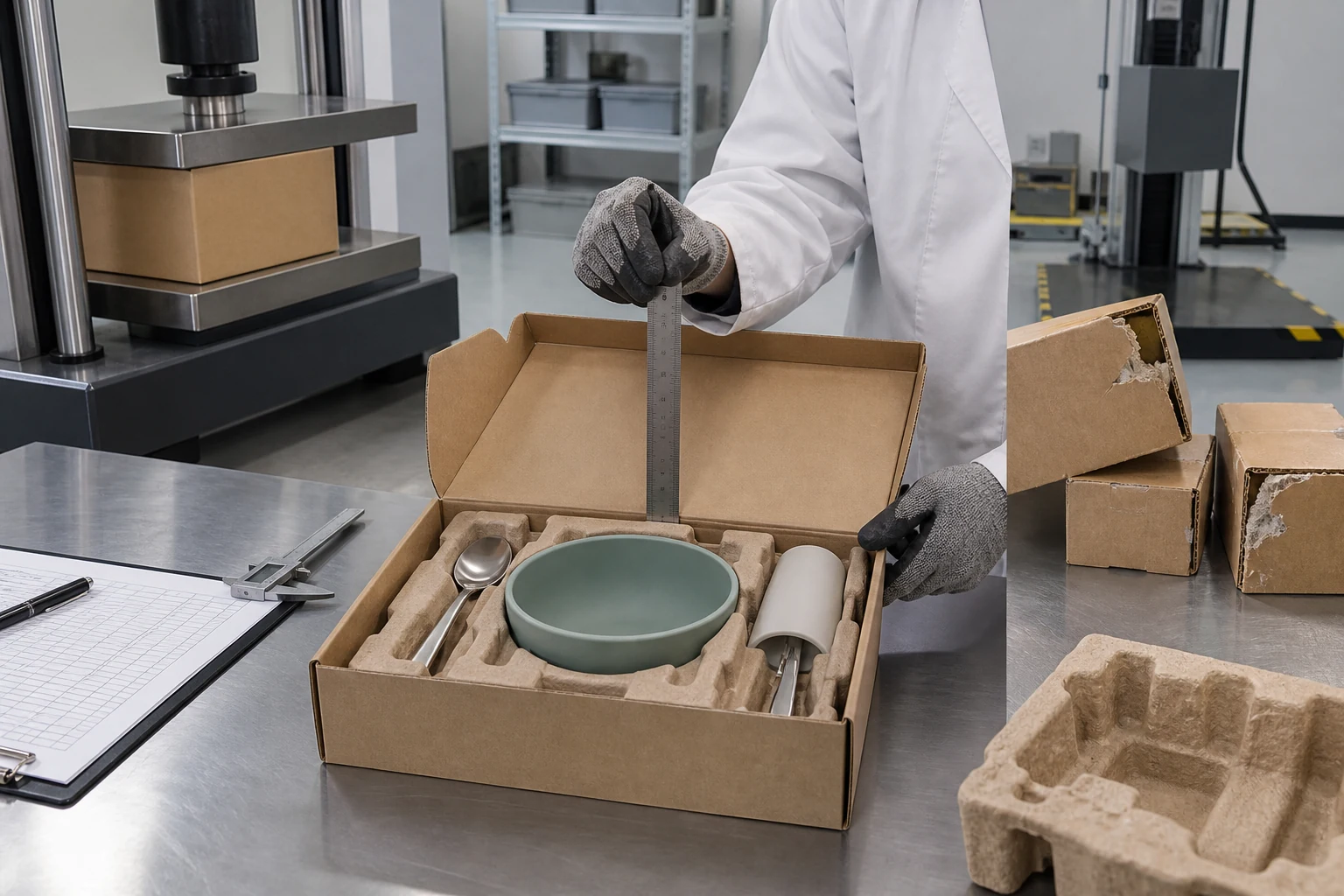
Then verify performance along the real route. Use drop, vibration, compression, stacking, humidity, abrasion, seal, and packing-line trials as relevant to the product and channel. Record sample revisions, conditions, acceptance criteria, damage modes, and retest results so protection is not defended only by opinion.
Article 24 creates a phased empty-space framework. Grouped, transport, and e-commerce packaging face a maximum 50 percent empty-space ratio by 1 January 2030 or three years after the relevant implementing act enters into force, whichever is later, while sales-packaging empty space must be reduced to the minimum necessary by 12 February 2028. Filling material generally counts as empty space for these calculations.
Do not apply the 50 percent number mechanically to every retail box today. The Commission must establish calculation methodology, and special product-protection characteristics can matter. Buyers should measure baseline volume now, preserve inputs, and design margin for later rules without presenting an unfinished methodology as a certified result.
Compare labor and logistics as well as material weight. A compact pack that doubles assembly time, reduces pallet stability, causes barcode obstruction, or increases breakage may not be the better system. The best-fit route meets verified product protection with the least necessary weight and volume while remaining repeatable in production.
Minimisation evidence should explain every retained gram and gap
A design rationale can link each packaging feature to a performance criterion and test record. That is stronger than a general statement that the pack is already optimized.
Use the factory capability overview as manufacturing context, then require SKU-specific packing trials and lot records. General capability does not replace the packaging conformity file.
Compare Recyclability and Recycled-Content Readiness
Conventional packaging specifications often use broad instructions such as recyclable paper box or plastic tray with recycled content. The PPWR route needs the packaging category, predominant material, complete component structure, design-for-recycling criteria, performance grade, recycled-content calculation basis where applicable, and evidence linked to the responsible manufacturer. Several detailed criteria still depend on delegated or implementing acts, so buyers should maintain a monitored design assumption rather than claim a final grade prematurely.
Article 6 states that packaging must be recyclable and introduces phased market-access criteria. Design-for-recycling requirements and grades A, B, or C become relevant from 1 January 2030 or the later trigger specified in the Regulation, while recycled-at-scale requirements follow from 2035 or a later act-based date. By 2038, packaging generally needs to reach grade A or B, subject to the Regulation’s detailed conditions and exceptions.
Design choices made now can reduce future rework. Favor separable components, compatible labels and adhesives, limited coatings, identifiable material streams, and structures that do not make the predominant material difficult to sort or recycle. Avoid assuming that a paper outer surface makes a plastic-laminated or windowed pack recyclable in every collection and recycling system.
Plastic packaging also faces minimum post-consumer recycled-content targets under Article 7 from 2030 or later act-based triggers, with different percentages by packaging type and contact sensitivity. Food-contact and other safety law can constrain suitable recycled material. Buyers should classify the packaging correctly, confirm exclusions or adjustments, and avoid inserting an unsupported percentage into an RFQ.
A tableware pack can combine paperboard, molded pulp, polyethylene bag, PET window, elastic band, coated label, and pressure-sensitive adhesive. Each component may be light, but the combined structure can create sorting or compatibility problems. Ask the packaging supplier for material specifications, construction drawings, separability instructions, and evidence relevant to the intended recycling stream.
Evaluate cost across conversion, testing, documentation, scrap, packing time, freight, EPR fees, and future redesign. A low-cost conventional laminate may become expensive when artwork, tooling, material qualification, and inventory must change before a phased deadline. A slightly higher-cost mono-material or easily separable route can be the better fit when evidence and supply continuity are stronger.
EU PPWR tableware packaging decisions need dated design assumptions
Record which PPWR criteria are already applicable, which are scheduled, and which depend on future acts or standards. Give one owner responsibility for reviewing each dependency before the pack is reordered.
Do not promise a recyclability grade that cannot yet be assessed under the final category-specific criteria. State the present evidence and the redesign margin instead.
Compare Conformity Evidence and Labeling Workflows
A conventional pack file may stop at artwork approval, supplier specification, and inspection standard. Under the PPWR, manufacturers must assess conformity for applicable requirements under Articles 5 to 12, prepare technical documentation under Annex VII, and draw up an EU declaration of conformity when compliance is demonstrated. Importers must verify key manufacturer steps and required documentation before placing packaging from third countries on the market.
Build the technical file around the approved packaging design. Include a general description, design and manufacturing information, component specifications, risk and requirement assessment, standards or specifications used, calculations, test reports, drawings, labels, supplier evidence, and production-control method. The depth should match the requirement and risk instead of becoming a folder of unrelated certificates.
Keep product food-contact documentation separate but coordinated. The PPWR includes substances-of-concern provisions and restrictions for certain PFAS in food-contact packaging, while food-contact-material law and product rules may impose additional requirements. A packaging EU declaration under the PPWR does not replace the tableware product’s own conformity, safety, or food-contact evidence.
Plan operator identification and traceability on the packaging or accompanying documents as required. Names, registered trade names or marks, postal and electronic addresses, type or batch identifiers, and importer information should be controlled in artwork and data records. The factory should not improvise these fields after mass printing begins.
Article 12 introduces harmonised material-composition labels from 12 August 2028 or the later act-based trigger and sets additional requirements for reusable packaging and digital information. The implementing specifications determine final pictograms and formats. Leave artwork space and data capacity now, but do not invent a harmonised label before its official design and date are confirmed.
Online information matters when packaging is sold through distance channels. Label and digital-carrier information required by the Regulation may also need to be available before purchase. Assign the EU seller or channel owner to synchronize product pages with the physical pack and to update both when specifications change.
The evidence route is broader than a supplier material certificate
Technical documentation should explain how each applicable requirement was assessed and how production keeps matching the approved design. A test report without packaging identity or a declaration without evidence is not enough.
Ask the packaging manufacturer and EU importer to agree document ownership, retention, language, access, and correction timing. For an EU packaging evidence alignment discussion, provide the full component list and planned market date rather than a single dieline.
Choose the Best-Fit Transition Route for Each Tableware Program
A new premium retail launch with custom tooling is best suited to a forward-compatible PPWR route from the first brief. The team can minimize components, reserve label space, select separable materials, test the shipping route, and assemble technical evidence before inventory grows. This reduces the chance that a distinctive but complex pack becomes stranded near a later milestone.
An existing EU SKU with stable sales may need a controlled conversion rather than an immediate full redesign. Start with a gap assessment against current applicable duties, then quantify future recyclability, recycled-content, minimisation, empty-space, and labeling dependencies. Use inventory run-out dates and artwork cycles to schedule changes without creating unnecessary waste.
A multi-market pack needs modular information and documented market variants. The EU version may need PPWR operator and labeling data that a North American or Australian pack does not, while language and producer-responsibility information can vary within Europe. A common structural platform can work when market-specific artwork panels and evidence are controlled separately.
E-commerce programs should examine whether the sales pack doubles as the shipper and whether protective fillers are counted as empty space. Reducing a retail carton while adding a large delivery carton can worsen the system result. Compare damage and volume at the order level, including mixed-SKU fulfillment and return flows.
Reusable packaging is not automatically the best fit. It must be conceived and designed for multiple rotations, meet applicable requirements, and operate within a system that enables reuse; cleaning, reverse logistics, loss rates, consumer participation, and tracking affect performance. Compare a credible reuse system with an optimized single-use pack rather than comparing labels alone.
Approve the route through a dated decision record. State the market, packaging roles, baseline, design option, material and volume changes, protection evidence, applicable current duties, future trigger dates, conformity owner, cost impact, and unresolved dependencies. Release production only when the selected option has a clear path through those controls.
Best fit depends on launch timing, channel, and evidence maturity
There is no universal winning material or format. The strongest route is the one that meets product protection and current law while preserving a credible path to scheduled PPWR milestones.
Treat every reorder as a checkpoint for changed acts, standards, suppliers, artwork, or distribution. That keeps a 2026 transition plan from becoming an unsupported 2030 claim.

PPWR-Controlled vs Conventional Tableware Packaging
Compare routes by decision criteria and evidence, not by a universal winner. Conventional packaging can be converted, but only after its assumptions are mapped and the applicable PPWR controls are added.
| Decision criterion | PPWR-controlled route | Conventional route | Best-fit implication |
|---|---|---|---|
| Regulatory basis | Maps Regulation (EU) 2025/40 duties, phased dates, actors, and dependencies | Often relies on legacy directives, retailer manuals, or generic supplier claims | Use PPWR control for EU placement; treat legacy files as gap-assessment inputs |
| Design objective | Minimizes weight and volume while documenting required functionality | Optimizes appearance, protection, line efficiency, and unit price without a formal minimisation rationale | Retain protection evidence but challenge every component and gap |
| Material structure | Records predominant material, components, separability, coatings, labels, and recycling assumptions | May describe only outer material or marketing category | Choose a structure whose complete composition can be assessed |
| Recyclability timing | Plans for phased 2030 design grades and later recycled-at-scale criteria | May call packaging recyclable without category-specific evidence | Avoid premature grades; preserve redesign margin and monitoring |
| Empty space | Measures sales, grouped, transport, and e-commerce levels against phased rules | Uses standard cartons and fillers based on habit or convenience | Optimize the full route without weakening damage protection |
| Evidence | Maintains conformity assessment, Annex VII technical documentation, and EU declaration | May retain only dieline, inspection sheet, and material certificate | Use a technical file linked to the exact packaging revision |
| Labeling | Reserves data and artwork capacity for phased harmonised labels and operator information | Uses existing recycling marks or retailer symbols that may not meet future formats | Wait for official specifications while controlling interim artwork |
| Change control | Reassesses affected requirements when materials, suppliers, dimensions, or labels change | Allows substitutions after sample approval if appearance remains similar | Make supplier notification and reapproval a purchase condition |
B2B Buyer EU Packaging Decision Checklist
Complete these eight checks before approving the packaging purchase order. Every answer should name the responsible operator, evidence revision, milestone date, and release blocker.
| Check | Question | Why It Matters |
|---|---|---|
| Market scope | Which EU countries, channels, placement dates, packaging levels, and economic operators are involved? | Defines current PPWR and national EPR responsibilities. |
| Component bill | Are dimensions, weights, materials, coatings, labels, adhesives, fillers, and suppliers recorded? | Prevents hidden components from escaping assessment. |
| Function baseline | Which protection, hygiene, logistics, information, and presentation functions justify each feature? | Supports minimisation without creating product damage. |
| Route testing | Do packing-line, drop, vibration, compression, humidity, and pallet trials match distribution risk? | Connects lower material use with verified performance. |
| Phased roadmap | Are 2028, 2030, 2035, and later act-dependent requirements assigned and monitored? | Avoids treating future targets as either immediate or irrelevant. |
| Conformity file | Does Annex VII documentation link requirements, methods, evidence, declaration, and production control? | Makes the market decision reviewable and traceable. |
| Artwork data | Are operator identities, batch data, claims, languages, online information, and label space controlled? | Keeps physical and digital market information aligned. |
| Change release | Which material, supplier, dimension, print, regulation, or damage changes require reassessment? | Protects repeat orders from drifting outside approved scope. |
Official EU Sources for the Packaging Comparison
Use the current official text and guidance at every review. The PPWR contains multiple dates and dependencies, so a commercial checklist should cite the provision and trigger rather than repeat a simplified headline.
The authoritative Regulation (EU) 2025/40 text on EUR-Lex establishes scope, packaging requirements, economic-operator duties, conformity assessment, minimisation, excessive-packaging rules, labels, and phased application dates. Article 71 confirms that the Regulation applies from 12 August 2026.
The European Commission’s Packaging and Packaging Waste Regulation overview summarizes the policy direction for less waste, recyclability, labels, reuse, recycled content, and safer packaging. It is useful orientation, while procurement decisions should cite the legal text and applicable secondary acts.
The Commission’s official 2026 PPWR guidance notice explains transition questions including packaging minimisation, empty-space rules, reusable packaging, and specific application issues. It also shows why buyers must distinguish the Regulation’s text from later criteria, methodologies, and standards.
Practical disclaimer: this article provides manufacturing and procurement information, not legal, environmental, conformity-assessment, EPR, customs, labeling, food-contact, or market-access advice. Duties depend on packaging classification, materials, product, operator role, Member State, placement date, secondary acts, standards, and current law, so obtain qualified EU and national advice before placing packaged goods on the market.
Use a Four-File Transition Decision
File one is the packaging system map: identify every sales, grouped, transport, and e-commerce component, its material, weight, volume, function, supplier, and revision. Without this baseline, the buyer cannot compare reduction or recyclability options consistently.
File two is the performance case: connect each retained component and space allowance to protection, hygiene, logistics, legal information, or another legitimate function, then record route-specific trials. Reject designs that save material on paper but increase breakage or secondary packaging.
File three is the phased compliance roadmap: list current applicable duties and each later trigger for labels, minimisation, empty space, recyclability, recycled content, and other relevant provisions. Assign an owner to monitor official acts and update the design before inventory decisions lock the old structure.
File four is the conformity and release record: combine the requirement assessment, technical documentation, EU declaration, operator data, approved artwork, supplier controls, inspection criteria, and lot evidence. Release the packaging only when the physical sample and all four files carry the same revision.
EU PPWR Tableware Packaging FAQ
Does the PPWR already apply to tableware packaging?
Yes. Regulation (EU) 2025/40 applies from 12 August 2026 and covers packaging placed on the EU market, subject to its scope and specific provisions. Many detailed design, labeling, recyclability, and recycled-content milestones are phased or depend on later acts.
Must every tableware carton meet the 50 percent empty-space limit now?
No. Article 24 sets the grouped, transport, and e-commerce threshold for 1 January 2030 or a later act-based trigger, while sales-packaging minimisation has a separate 12 February 2028 date. Buyers should still measure and reduce unnecessary space now.
Is a paper box automatically recyclable under the PPWR?
No. Coatings, windows, adhesives, labels, inks, separability, and the applicable recycling stream can affect the assessment. Final PPWR performance grading follows detailed criteria and phased dates.
Does an FSC or supplier certificate replace the PPWR technical file?
No. Chain-of-custody or material certificates may support specific sourcing facts, but they do not replace conformity assessment, Annex VII technical documentation, or the EU declaration required for applicable PPWR requirements.
Should buyers print the future harmonised label now?
Not unless the official format and applicable trigger have been confirmed. Reserve suitable artwork space and structured material data, then implement the harmonised label according to the relevant implementing acts and date.
Can one global package serve the EU and other markets?
Potentially, when the structure and modular artwork satisfy each market and operator role. Control EU-specific labels, languages, EPR information, claims, and technical documentation as a distinct approved variant.
Select the Packaging Route That Can Survive the Next Reorder
A strong EU PPWR tableware packaging decision does not replace product protection with a sustainability slogan. It documents why the chosen structure uses the minimum necessary material and volume, how it performs in the actual route, and how its components can move through phased recyclability, labeling, and recycled-content requirements.
Compare the PPWR-controlled option with the conventional baseline across roles, materials, empty space, evidence, artwork, cost, and timing. The winning route is the one whose assumptions can be verified today and updated when official criteria or the commercial configuration changes.
Before the next reorder, reopen the roadmap and match the pack, technical file, declaration, labels, supplier records, and tests to the same revision. That disciplined checkpoint turns regulatory transition into a manageable sourcing program instead of an emergency redesign.
Request an EU Packaging Transition Review
Share the tableware SKUs, packaging levels, materials, dimensions, weights, EU markets, channels, target dates, artwork, claims, protection tests, and existing supplier documents. The Naike Group manufacturing team can map factory packaging records and prototype options for your importer’s independent PPWR, EPR, labeling, and conformity review.
Request a Custom Quote
Share your product, quantity, target market and customization needs. Our factory team will reply with the next practical step.
Continue Your Sourcing Research
The six newest factory-side articles are updated automatically by publication date.

Wheat Straw vs Bagasse Tableware: Buyer Comparison
A B2B decision guide comparing reusable wheat-straw polypropylene composite tableware with molded bagasse fiber formats across use, evidence, operations and end of life.

Can Wheat Straw Tableware Be Recycled? Buyer Q&A
A practical buyer answer on whether reusable wheat-straw composite tableware can enter PP recycling streams, which evidence matters, and how to qualify market claims.

Global SKU vs Regional SKU: Tableware Decision Guide
A buyer decision framework for choosing one global tableware SKU or controlled regional variants across compliance, packaging, logistics, inventory and change control.

Australia Food Packaging Evidence: Buyer Guide
A practical evidence guide for Australian food-packaging buyers covering intended use, migration risk, supplier assurance, testing, hygiene, release and change control.

Prop 65 Tableware Requirements: Buyer Q&A
A practical buyer Q&A for defining California Proposition 65 exposure scenarios, evidence, warning decisions, supplier records and release controls for tableware.

Silicone Baby Tableware CPSIA: US Buyer Decision Guide
A procurement decision guide for classifying silicone baby tableware under US children’s-product rules and building the testing, certificate, label and import file.