
Can You Move a Custom Mold to Another Factory?
Treat mold relocation as a controlled engineering handover, not a simple freight pickup, so the receiving factory can protect the tool and reproduce an approved part.
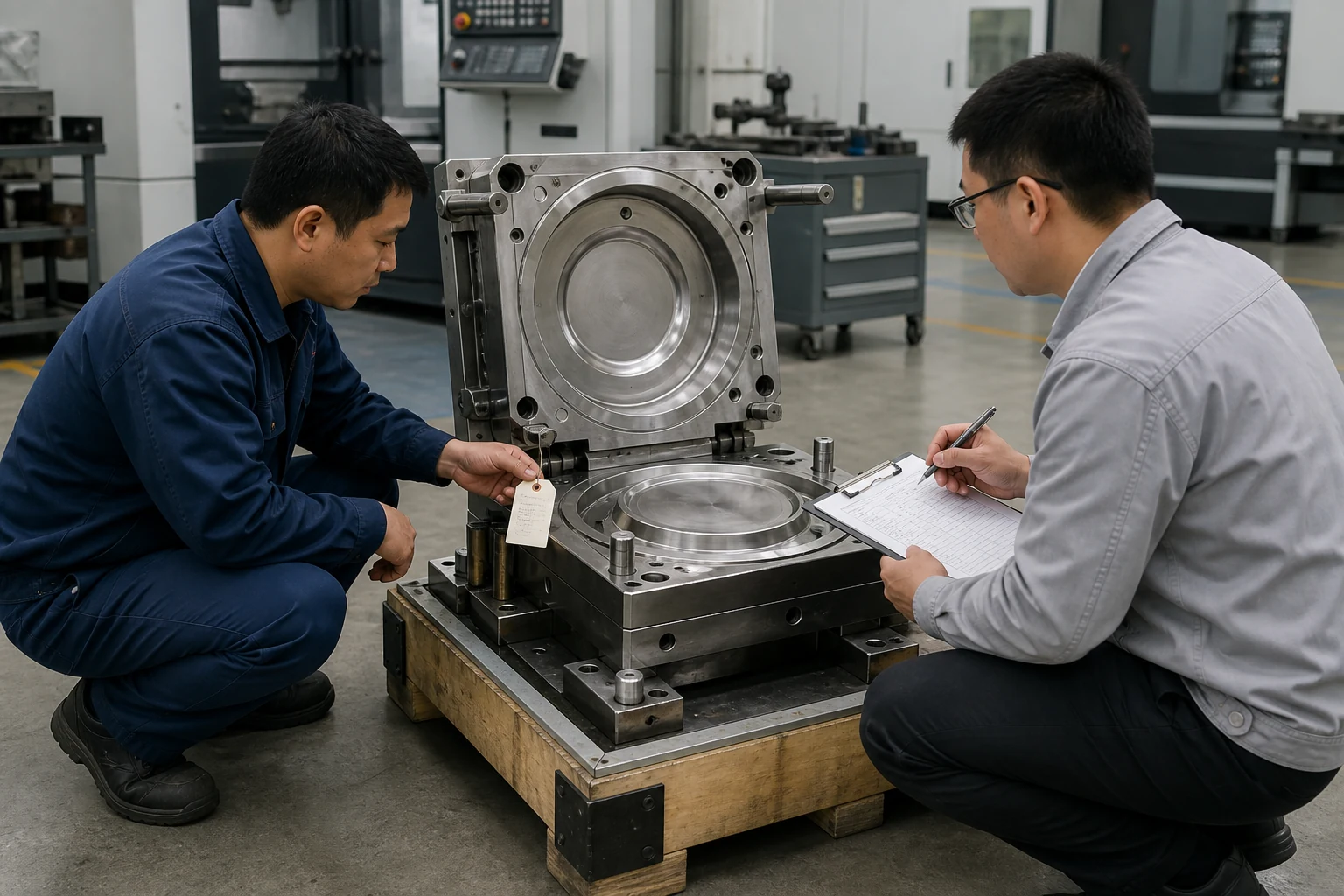
The buyer question is whether a company can move a custom mold to another factory after paying for the tool. Usually the practical answer depends on the signed contract, payment status, physical tool identification, design-data rights, unpaid obligations, confidentiality terms, and whether the receiving factory can safely install and validate the tool.
Payment alone does not make relocation automatic. A responsible transfer needs written release authority, a reconciled asset and data list, a witnessed condition record, lifting and transport controls, compatible equipment at the destination, and a restart plan tied to the last approved product sample and specification.
This guide is factory-side commercial and manufacturing guidance rather than legal advice. Buyers should have qualified counsel confirm ownership, intellectual-property, customs, tax, export-control, insurance, and dispute terms for the actual jurisdictions and contracts involved.
Quick Answer: Can You Move a Custom Mold to Another Factory?
A buyer may be able to relocate a paid custom mold when the governing agreement gives the buyer possession or transfer rights and all release conditions are satisfied. Before arranging collection, obtain written confirmation that identifies the exact tool, included design and process records, authorized recipient, release date, condition, open balances, and continuing confidentiality or use restrictions.
From a manufacturing perspective, the transfer is complete only after the receiving factory installs the tool, confirms machine and utility compatibility, conducts controlled trials, compares parts with the approved standard, and documents deviations. A truck receipt proves movement, but it does not prove the mold can reproduce the approved product.
Separate Ownership, Possession, Use Rights, and Data Access
Buyers often use the word ownership to describe several different rights. The contract may address title to the physical mold, the right to possess it, permission to use it for named products, restrictions on third-party use, access to drawings, and the ability to move it. Those rights should be read together because possession of steel does not necessarily grant unrestricted rights to every drawing, process setting, or supplier-owned standard component.
The first transfer question is therefore documentary rather than logistical. Procurement should identify the purchase order, tooling agreement, invoices, payment receipts, design approvals, change orders, confidentiality agreement, and any amortization arrangement. Each document should be checked for inconsistent language about title, custody, release conditions, storage, maintenance, data, improvements, and termination.
A tooling charge can also represent different commercial structures. It may purchase a dedicated mold, reimburse only part of development, amortize cost through product orders, or reserve capacity without transferring title. The invoice label is not enough to settle the result, so buyers should avoid presenting a legal conclusion until the complete agreement has been reviewed.
Design data needs its own inventory. Product CAD supplied by the buyer, factory-created mold design, electrode files, machining programs, drawings, bills of materials, trial parameters, inspection fixtures, and process knowledge can have different creators and permitted uses. The transfer list should state which files will be delivered, their native and neutral formats, revision, owner, confidentiality status, and license or use limits.
Continuing obligations may survive relocation. Non-disclosure, non-use, record retention, warranty, maintenance, spare-parts, and dispute clauses can remain relevant even after the physical tool leaves. The releasing and receiving parties should know which obligations follow the asset and which require a separate written arrangement.
If the contract is unclear, pause the pickup and obtain written resolution. A hurried collection can turn a manageable commercial issue into a possession, data, or production dispute. Buyers can request a factory-side transfer readiness review while their legal advisers address contractual rights.
How to move a custom mold to another factory with clear authority
A release letter should identify the mold by asset number, product, cavity configuration, material, approximate dimensions or weight, current location, and photographs. It should also name the collecting party, receiving factory, authorized date window, included loose components, and the people permitted to sign the handover.
This precision prevents the wrong insert, fixture, hot-runner controller, gauge, or spare component from being left behind. It also helps the receiving factory compare what arrives with what the buyer believed it was acquiring.
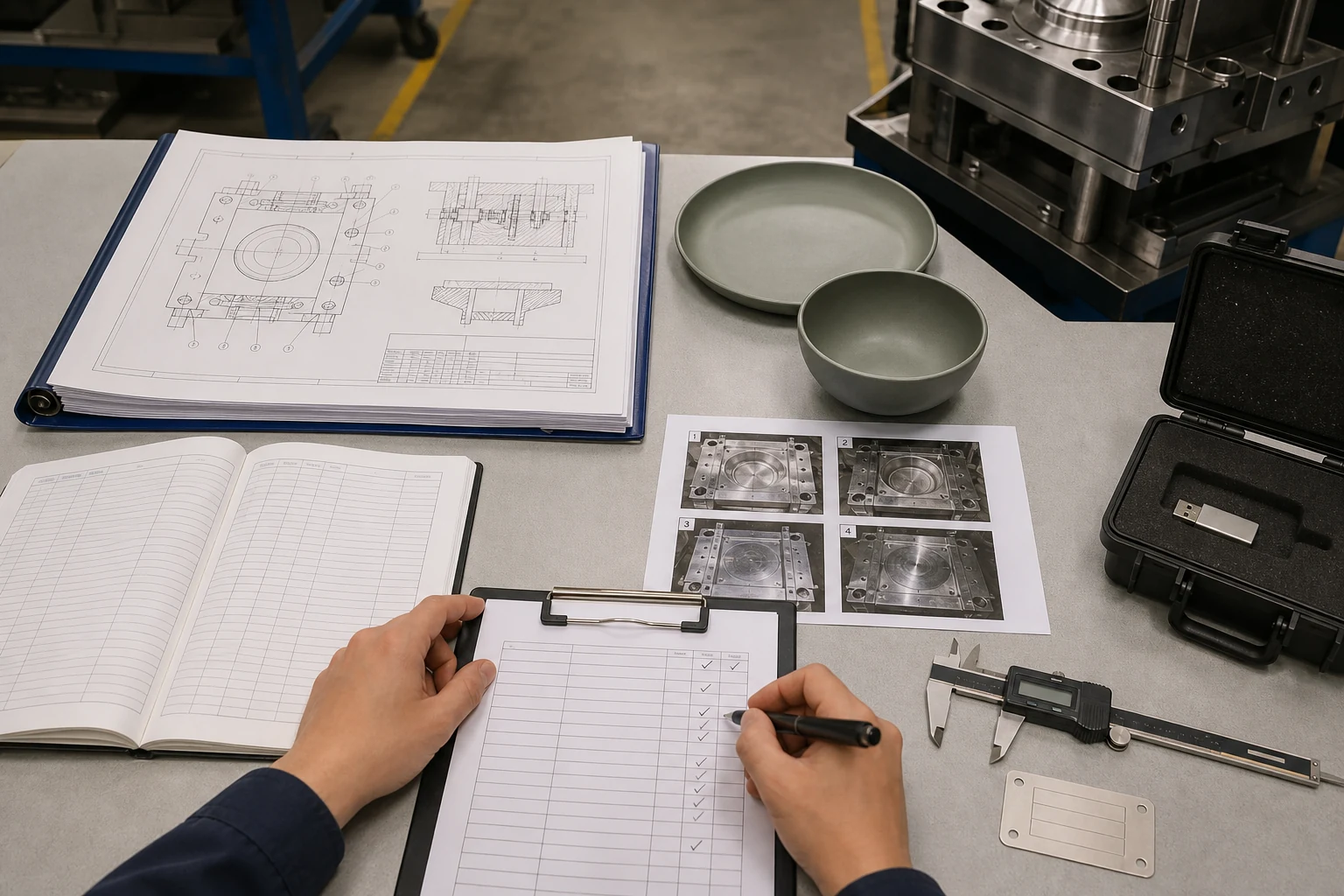
Build a Transfer Package Before Anyone Books Freight
The transfer package should let a competent receiving team understand what the tool is, how it was operated, what condition it is in, and which product result was last approved. At minimum, buyers should request the tool identification sheet, general assembly drawing, cavity and core information, component list, utility map, maintenance history, repair history, approved sample, current product drawing, and the latest dimensional or functional report.
Process information must be handled carefully. Machine type, clamping requirement, injection or compression settings, temperatures, cycle sequence, cooling or heating connections, controller details, material preparation, and demolding practice can shorten restart work. These records are a starting basis rather than a guarantee, because a different machine, environment, material lot, or operator may require controlled adjustment.
The buyer should distinguish required deliverables from useful cooperation. Some information may be explicitly included in the agreement, some may belong to the supplier, and some may be provided only under a license or confidentiality control. A clear register records requested, received, unavailable, restricted, and not-applicable items without pretending that every production detail automatically transfers.
File integrity matters as much as file count. Native CAD should open, neutral files should import, drawings should show units and revision, and reports should identify the measured part and method. Screenshots, unlabeled exports, or a folder of obsolete revisions can create more risk than an honest statement that a record does not exist.
The approved product basis must be tangible. Use a signed golden sample or controlled reference sample where appropriate, plus the corresponding product drawing, color or appearance standard, critical-to-quality list, test methods, packaging interactions, and known concessions. Without that basis, the receiving factory cannot tell whether a trial result reproduces the accepted product or merely makes a usable-looking part.
Create a transfer index with one row per asset and file. Assign an owner, format, revision, confidentiality class, delivery status, verification result, and open action. This index becomes the handover evidence and the starting checklist for the receiving factory.
Missing records change the restart route
A missing drawing does not always make relocation impossible, but it changes cost, timing, and confidence. The receiving factory may need to measure the tool, recreate interfaces, map utilities, inspect components, or reverse-engineer non-confidential information that the buyer is authorized to use.
Those recovery activities should be quoted and approved as engineering work. They should not be hidden inside a production promise, because the first trial may reveal additional information gaps.
Record Mold Condition at the Releasing Factory
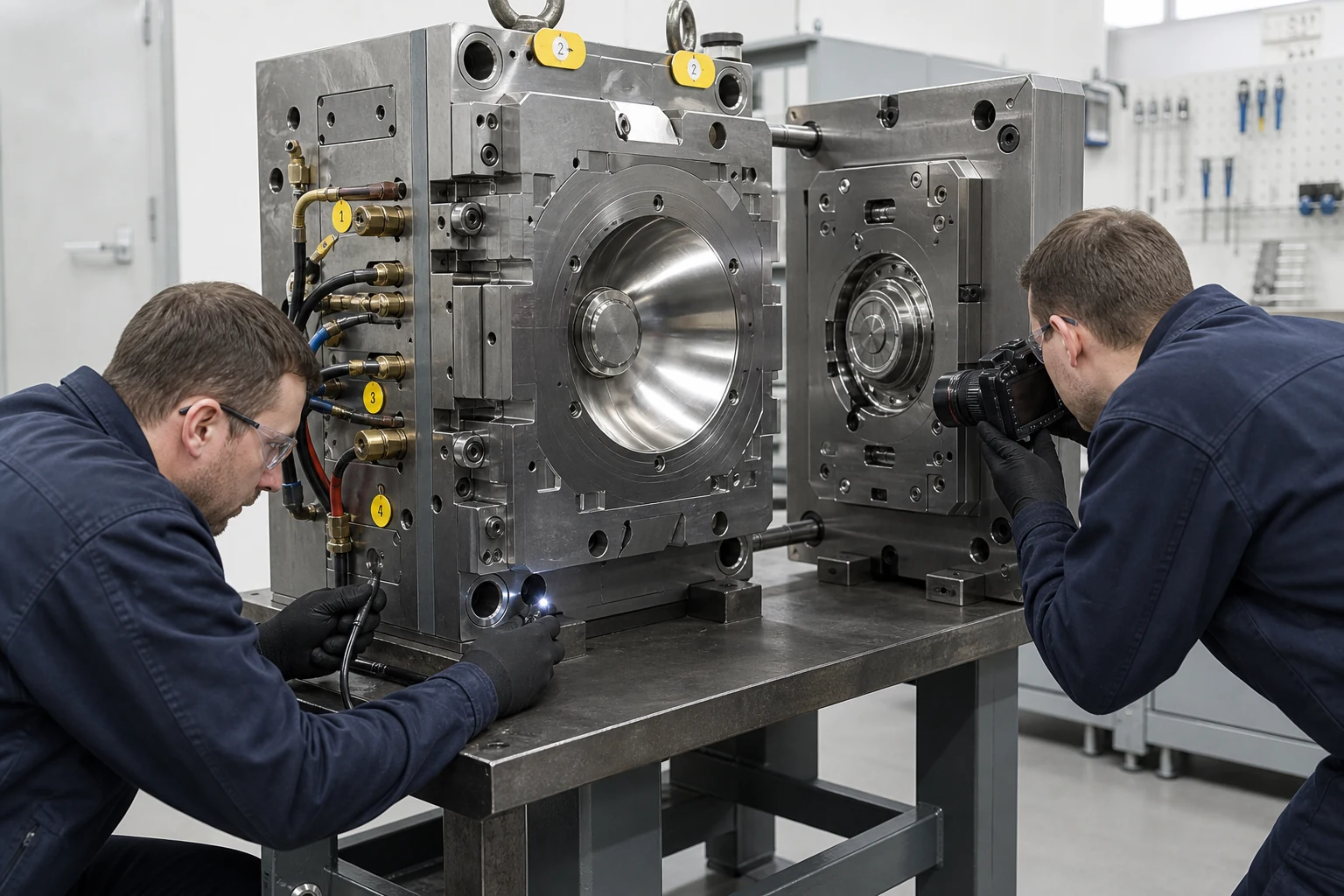
A condition inspection should occur before cleaning, preservation, crating, and pickup. Photograph every side, identification plate, cavity and core, parting surface, gates, vents, slides, lifters, ejectors, connectors, controllers, inserts, loose parts, and visible damage. Record date, location, participants, tool status, and whether the mold was opened under safe conditions.
The inspection should identify wear rather than relying on a general statement such as good condition. Look for corrosion, scratches, dents, pitting, flash evidence, worn shutoffs, seized movement, damaged threads, leaking channels, blocked vents, broken heaters or sensors, missing fasteners, altered inserts, and repairs. Each finding needs a photo reference and agreed disposition.
Maintenance history adds context to visible condition. Buyers should ask when the mold last ran, approximate cycles if documented, most recent preventive maintenance, repairs, component replacements, preservation method, storage conditions, and unresolved production issues. An unsupported lifetime estimate should not be treated as measured remaining life.
When practical, run a witnessed final trial at the releasing factory. Record machine identification, material, setup, process window, cycle, cavity balance, part weight, appearance, dimensions, and functional results. Retain labeled samples from that trial so the receiving factory has a relocation baseline rather than only an older approval sample.
The handover record should separate accepted pre-existing condition from damage that must be repaired before release. It should also state who pays for agreed repairs, who confirms completion, and whether the tool can be collected before the correction is verified. Ambiguous photos taken after crating are poor evidence for either party.
A neutral inspection specialist may be useful when the tool value, dispute risk, or technical complexity is high. The scope should be agreed in advance and should distinguish visual observation, functional testing, dimensional inspection, and legal conclusions.
Condition evidence protects the restart decision
A receiving factory needs to know whether a later defect is pre-existing, transport-related, installation-related, or process-related. The signed condition record creates a reference point for that investigation without guaranteeing future performance.
Buyers should preserve the original files and photographs in controlled storage. Edited summaries may help communication, but the source evidence should remain traceable.
Protect, Pack, Insure, and Document the Physical Move
Tool preparation should follow the mold maker or qualified technician’s preservation requirements. Cavities and cores may need cleaning, approved rust prevention, movement locks, protective covers, drained or protected circuits, secured loose parts, and moisture control. The team should document the mold after preparation so hidden surfaces and included components remain traceable.
Lifting and crating plans should use verified weight, center of gravity, lifting points, orientation, dimensions, and support requirements. A mold can be damaged by an undersized forklift, an improvised lifting point, uncontrolled slide movement, or a crate that carries load through a vulnerable connector. The logistics provider should receive a factual handling sheet rather than a generic instruction to handle carefully.
The crate should identify the asset without exposing confidential product information unnecessarily. Internal packing lists can record mold, inserts, controllers, hoses, fittings, gauges, samples, and documents, while external marks support safe routing and orientation. Tamper seals and numbered photographs can strengthen chain-of-custody evidence when risk justifies them.
Insurance scope must be checked before pickup. Buyers should ask what events, locations, loading operations, temporary storage, declared value, deductibles, exclusions, and evidence requirements are covered. A freight forwarder’s general liability statement may not equal coverage for tool repair, data loss, production delay, or consequential loss.
Domestic and cross-border moves create different documentation needs. Commercial descriptions, value, origin, tariff classification, temporary or permanent export treatment, importer responsibility, and controlled technology questions should be reviewed by qualified customs and trade professionals. The factory should not invent a declaration merely to make the shipment appear simple.
Handover signatures should occur at defined control points. The releasing party can sign the condition and packing record, the carrier can acknowledge collection and seal status, and the receiving factory can record arrival, visible crate condition, and unpacking results. These signatures document custody without substituting for contractual acceptance.
Do not let the crate become the only evidence
A closed wooden case reveals little about preparation or included assets. Keep dated photographs of preservation, restraints, loose-component packing, labels, seals, and the final crate condition with the transfer index.
If damage is visible on arrival, preserve packaging and notify the relevant parties before repair or trial. The receiving team should follow insurer and contract notice requirements while protecting the tool from further deterioration.
Confirm the Receiving Factory Can Use the Mold Safely
A mold that ran at one factory is not automatically compatible with another. The receiving team should review platen and tie-bar clearance, clamping method, daylight, opening stroke, ejection, injection unit or press capacity, controller channels, heating or cooling media, connectors, electrical requirements, lifting capacity, and robot or manual handling. Silicone compression, liquid silicone, and thermoplastic injection routes can require substantially different equipment and controls.
Material and process compatibility also need confirmation. The intended resin or compound, drying or conditioning, color system, runner method, cure or cooling behavior, release practice, and expected cycle should match the tool and approved product basis. A receiving factory should not substitute a material or process assumption merely because the mold physically fits its machine.
Utilities are common transfer surprises. Cooling circuits may use different thread standards, manifolds, water quality, flow, or temperature control, while heated tools may require matching voltage, plugs, thermocouples, and controller logic. An adapter can solve a connection mismatch, but it does not prove that flow, pressure, temperature, or safety remains adequate.
Tooling interfaces should be reviewed before arrival where drawings permit. The factory can prepare clamps, locating rings, ejector connections, hoses, lifting equipment, storage space, and trial material without opening confidential files to people who do not need access. This reduces idle time and avoids rushed modifications during installation.
The receiving factory should also assess capability to maintain the tool. Required polishing, welding, spare inserts, hot-runner support, controller service, gauge calibration, and preventive maintenance may exceed local resources. The buyer needs to know which support will be internal, subcontracted, or unavailable before transferring production responsibility.
Any modification proposed for compatibility requires written approval. Drilling plates, changing connectors, replacing controls, grinding components, or altering inserts can affect value, function, warranty, and future mobility. The change record should state reason, drawing, responsible engineer, cost, verification, and updated data deliverables.
A desktop compatibility review can prevent a failed pickup
Share controlled interface information with the proposed receiving factory before freight is committed. The custom mold and tooling pathway shows the project context for factory-side tool review, while actual compatibility remains specific to the mold and equipment.
If critical dimensions or utilities are unknown, plan an inspection or measurement stage. Uncertainty should appear in the quotation and schedule rather than being converted into an unconditional start date.
Revalidate the Tool Before Releasing Production
Arrival inspection begins before the crate is opened. Photograph impact indicators, seals, moisture evidence, external damage, orientation, and unloading. During unpacking, reconcile every item with the transfer index and condition record, then quarantine unexplained damage or missing components for investigation.
Installation should follow documented safety and equipment procedures. Technicians should inspect lifting points, movements, fasteners, circuits, electrical components, preservation residue, vents, gates, ejectors, slides, and sensors before cycling. A slow controlled setup is less costly than damaging a transferred tool during the first hour at its new location.
The first trial should reproduce the approved material and product scenario as closely as practical. Record machine, tool setup, material identity, lot, conditioning, temperatures, pressures, times, cycle sequence, cavity output, part weight, appearance, dimensions, and functional checks. Changes needed to stabilize the process should remain visible in the trial report.
Comparison uses more than visual similarity. The receiving team should compare current parts with the controlled drawing, approved sample, critical-to-quality list, color or surface standard, functional methods, and any known concessions. A difference should be classified as tool condition, machine or process, material, method, measurement, or product-specification issue before corrective action is selected.
Production release requires agreed evidence. Depending on risk, that may include a dimensional report, capability study, functional test, material confirmation, sample approval, packaging fit check, pilot run, or buyer signoff. The handover plan should say who reviews each result and whether approval covers one trial, one cavity, one material, or the full production configuration.
Do not discard the releasing-factory baseline after a successful restart. Keep the transfer index, condition reports, samples, trial data, corrections, approvals, and updated maintenance record together. This file supports future repeat orders, repairs, and any later relocation.
Relocation ends at evidence-based release, not delivery
The buyer should authorize production only after the receiving factory has demonstrated the defined product result. If your team needs a structured restart plan, send the mold transfer brief for technical review before approving a production date.
A conditional release may be appropriate for limited engineering trials, but it should state quantity, purpose, deviations, disposition, and authority. Trial material or parts should not enter normal supply without the required approval.

Transfer Status: Ready, Conditional, or Stop
This decision table helps buyers distinguish a controlled relocation from a pickup that transfers uncertainty. A conditional status can still proceed when every gap has an owner, commercial effect, and verification step.
| Decision area | Ready to transfer | Conditional transfer | Stop and resolve |
|---|---|---|---|
| Authority | Written release identifies tool and recipient | One approval or balance remains dated | Rights or release authority disputed |
| Tool identity | Asset plate, photos and components reconciled | Minor loose-item gap has an owner | Tool or inserts cannot be identified |
| Condition | Witnessed record and final-run evidence available | Known repair is scoped before pickup | Damage or operating state is unknown |
| Data package | Controlled product, tool and maintenance records verified | Recovery work is quoted and authorized | Critical files are unusable or unauthorized |
| Logistics | Weight, lifting, preservation, crate and insurance confirmed | One route detail awaits carrier confirmation | Unsafe handling or coverage gap remains |
| Receiving factory | Machine, utilities, skills and restart plan reviewed | Adapters or approved modifications are required | Tool cannot be safely installed or validated |
| Production release | Trial and acceptance evidence are defined | Engineering trial only, with limits | Shipment is treated as automatic production approval |
B2B Buyer Mold Transfer Checklist
Use the checklist before authorizing collection. Each answer should point to a controlled document, responsible person, or dated action rather than an informal assurance.
| Check | Question | Why It Matters |
|---|---|---|
| Authority | Does the signed release name the exact mold and receiving party? | Prevents unauthorized or mistaken collection. |
| Identity | Are plates, inserts, controllers, gauges and loose parts reconciled? | Keeps the complete tooling system together. |
| Data | Are approved product and tool records readable and revision-controlled? | Gives the new factory a valid restart basis. |
| Condition | Is pre-transfer wear, damage and final-run status documented? | Separates existing condition from later events. |
| Packing | Are preservation, lifting, restraint and crate instructions approved? | Reduces handling and corrosion risk. |
| Compliance | Have customs, export, tax and insurance questions reached qualified owners? | Avoids unsupported shipment assumptions. |
| Compatibility | Has the destination checked equipment, utilities and service capability? | Prevents arrival of an unusable tool. |
| Release | Are trial evidence, approvers and production limits written? | Stops delivery from becoming false acceptance. |
Official Context for Confidential Data and Export Controls
Official sources help buyers frame information-security and cross-border questions, but they do not decide a private tooling contract or approve a specific shipment. Apply them as issue-spotting context and obtain project-specific professional advice.
The World Intellectual Property Organization trade-secrets overview explains that confidential technical information can include designs and manufacturing processes and that reasonable protection measures may matter. For a mold transfer, that supports controlled access, identified files, confidentiality terms, and documented permitted use rather than indiscriminate sharing.
The United States Patent and Trademark Office trade-secret policy page describes secrecy, economic value, and reasonable efforts as core concepts in U.S. trade-secret policy. Buyers should use qualified counsel to determine whether particular CAD, process, supplier, or commercial information is protected and how a cross-company handover should be structured.
The U.S. Bureau of Industry and Security export-compliance guidance emphasizes risk assessment and procedures for organizations engaged in export, reexport, or in-country transfer activities subject to the EAR. It does not mean every mold shipment requires a BIS license, but it reinforces the need to assign classification and export-control questions to qualified personnel before a cross-border move.
Practical disclaimer: this article is manufacturing and procurement guidance, not a determination of ownership or advice on law, intellectual property, customs, tax, export controls, insurance, product compliance, or contract enforcement. Obtain qualified professional advice for the governing agreement, locations, technology, product, parties, and shipment before authorizing transfer.
A Seven-Gate Mold Relocation Sequence
Gate one is authority. Assemble the governing documents, confirm payment and release conditions, identify unresolved claims, and obtain a written instruction that names the exact tool, releasing party, recipient, and permitted date. If authority is disputed, stop physical planning until qualified advisers and the parties resolve it.
Gate two is asset identity. Reconcile the mold plate, cavities, inserts, controllers, fixtures, gauges, spare parts, approved samples, and related records against a numbered register. Photograph identifiers and exceptions so collection staff cannot substitute memory for evidence.
Gate three is information control. Classify buyer-owned files, supplier-created files, licensed information, confidential material, and unavailable records, then define who may access each item and for what purpose. Test that files open and revisions match before a truck is booked.
Gate four is condition. Complete the witnessed inspection, review maintenance and repairs, and conduct a final controlled trial when practical. Agree how existing wear, required repair, preservation, and outstanding corrections will be recorded and funded.
Gate five is physical logistics. Confirm weight, center of gravity, lifting, restraints, moisture protection, crate, route, customs responsibilities, insurance, handover signatures, and incident notification. A named logistics owner should close every action before pickup authorization.
Gate six is destination readiness. The receiving factory reviews equipment, utilities, interfaces, material route, maintenance capability, confidentiality access, and modification needs. Required adapters or engineering work should have approved drawings, cost, timing, and verification criteria.
Gate seven is revalidation. Inspect arrival, install safely, run a controlled trial, compare against the approved basis, close deviations, and obtain the named buyer approval before production release. Archive the relocation evidence with the tool history so the next order does not depend on personal recollection.
For supplier comparison, ask each proposed receiving factory to state assumptions and exclusions against the same transfer index. A lower restart price may exclude data recovery, repair, adapters, trials, dimensional evidence, or maintenance work, so compare deliverables and decision risk rather than totals alone.
Custom Mold Transfer FAQ for B2B Buyers
Does paying the tooling invoice automatically allow the buyer to move the mold?
Not necessarily, because the result depends on the complete agreement, payment structure, release conditions, custody terms, and applicable law. Confirm rights and obligations in writing with qualified advisers before arranging collection.
What should travel with a transferred mold?
The package commonly includes identified loose components, controllers or fixtures, controlled product and tool records, maintenance and repair history, approved samples, condition evidence, and agreed process information. The actual deliverables depend on the contract, authorized rights, and project needs.
Should the releasing factory run the mold before transfer?
A witnessed final trial is valuable when practical because it creates a dated operating baseline and labeled samples. If a trial cannot be completed, record the reason, last-run evidence, current condition, and additional receiving-factory inspection work.
Can the receiving factory modify the mold so it fits its machine?
Only through an authorized engineering change. The parties should review effects on function, value, warranty, confidentiality, future transfer, and acceptance, then document the approved drawing and validation result.
When is the transfer considered complete?
Commercial handover may occur at a contractually defined point, but manufacturing transfer is not complete merely because the crate arrives. The safer production milestone is successful installation, controlled trial, evidence review, deviation closure, and authorized release against the approved product basis.
Decide the Mold Transfer on Evidence, Not Urgency
The practical ability to move a custom mold to another factory depends on more than proof of payment. Buyers need aligned release authority, an identifiable tool, permitted data access, documented condition, controlled logistics, a compatible receiving site, and a revalidation route that protects the approved product outcome.
Treat every unknown as a transfer action with an owner, deadline, consequence, and closing record. That structure allows procurement to distinguish a manageable conditional move from a dispute, unsafe pickup, incomplete handover, or restart promise that cannot yet be supported.
Authorize the next evidence-backed gate rather than the entire relocation in one email. A disciplined sequence preserves leverage, protects confidential information, and gives the receiving factory a fair basis for rebuilding stable production.
Request a Mold Transfer Readiness Check
Share the tool identification, current location, receiving factory, governing deliverables, available drawings and records, condition history, product approval basis, and target timing. Our manufacturing team can review technical readiness and identify the evidence needed before quotation, pickup, or restart.
Request a Custom Quote
Share your product, quantity, target market and customization needs. Our factory team will reply with the next practical step.
Continue Your Sourcing Research
The six newest factory-side articles are updated automatically by publication date.

Wheat Straw vs Bagasse Tableware: Buyer Comparison
A B2B decision guide comparing reusable wheat-straw polypropylene composite tableware with molded bagasse fiber formats across use, evidence, operations and end of life.

Can Wheat Straw Tableware Be Recycled? Buyer Q&A
A practical buyer answer on whether reusable wheat-straw composite tableware can enter PP recycling streams, which evidence matters, and how to qualify market claims.

Global SKU vs Regional SKU: Tableware Decision Guide
A buyer decision framework for choosing one global tableware SKU or controlled regional variants across compliance, packaging, logistics, inventory and change control.

Australia Food Packaging Evidence: Buyer Guide
A practical evidence guide for Australian food-packaging buyers covering intended use, migration risk, supplier assurance, testing, hygiene, release and change control.

EU PPWR Tableware Packaging vs Conventional Packs
A buyer comparison of PPWR-ready and conventional tableware packaging across product protection, material choices, empty space, evidence, labeling and release timing.

Prop 65 Tableware Requirements: Buyer Q&A
A practical buyer Q&A for defining California Proposition 65 exposure scenarios, evidence, warning decisions, supplier records and release controls for tableware.