
Silicone Baby Tableware CPSIA: US Buyer Decision Guide
Classify the finished feeding product before quotation, then align accessible components, applicable CPSC rules, third-party testing, CPC data, tracking marks and import records.

The buyer question is whether silicone baby tableware is a US children’s product. For most bowls, plates, bibs, cups, and utensils designed and marketed primarily for babies or young children, the practical answer is yes: treat silicone baby tableware CPSIA classification as a children’s-product decision, then identify each applicable CPSC rule for the finished design before testing, certification, labeling, or import filing.
Material alone does not decide the classification, and the word baby on a supplier quotation is not the legal analysis. Product design, intended age, reasonable manufacturer statements, packaging, promotion, consumer recognition, and CPSC age guidance together determine whether the article is primarily intended for children 12 or younger.
Procurement therefore needs an early gate, not a certificate collected after production. The importer should freeze the intended user, product functions, accessible components, artwork, claims, and sales channel, then approve a rule matrix and evidence owner before releasing the purchase order.
Buyer Answer: Should the Project Use the Children’s-Product Path?
Use the children’s-product path when the finished tableware is designed or represented primarily for children 12 or younger, which commonly includes baby feeding products. For feeding articles intended for children age three and under, also assess whether the item is a child care article under the phthalates rule; do not assume every silicone component, decoration, package, or accessory has the same regulatory treatment.
Before RFQ approval, assign the US importer to own the final classification, applicable-rule list, Children’s Product Certificate, and current import filing duties. Ask the factory to support product identity, component traceability, production records, test samples, tracking information, and change notices, while a qualified US compliance professional confirms product-specific obligations.
Classify the Finished Product Before Asking for a CPSIA Quote
Start with the statutory question: is the consumer product designed or intended primarily for a child 12 years of age or younger? CPSC identifies four factors, including reasonable manufacturer statements, how packaging and promotion represent the product, whether consumers commonly recognize it as intended for children, and the Commission’s age determination guidance. No single factor should be isolated from the finished commercial presentation.
A suction bowl scaled for infant portions, paired with a soft-tip spoon, shown in baby-feeding scenes, and marketed with an early-feeding age range will usually point toward a children’s-product classification. A plain household bowl that adults and children are equally likely to use may follow a different analysis. Silicone chemistry does not transform one scenario into the other.
Record the decision in a classification memo before tooling or artwork approval. Identify the SKU, dimensions, functions, intended and foreseeable users, age grade, packaging statements, product-page language, images, sales channel, and reasons for the conclusion. Preserve screenshots and approved copy so later marketing edits cannot silently change the regulatory premise.
Do not try to convert an obviously child-directed item into a general-use product merely by printing an adult-use disclaimer. CPSC guidance explains that a label is only one factor and must be reasonably consistent with expected use patterns. Procurement should align design, claims, imagery, instructions, and age grading rather than rely on contradictory fine print.
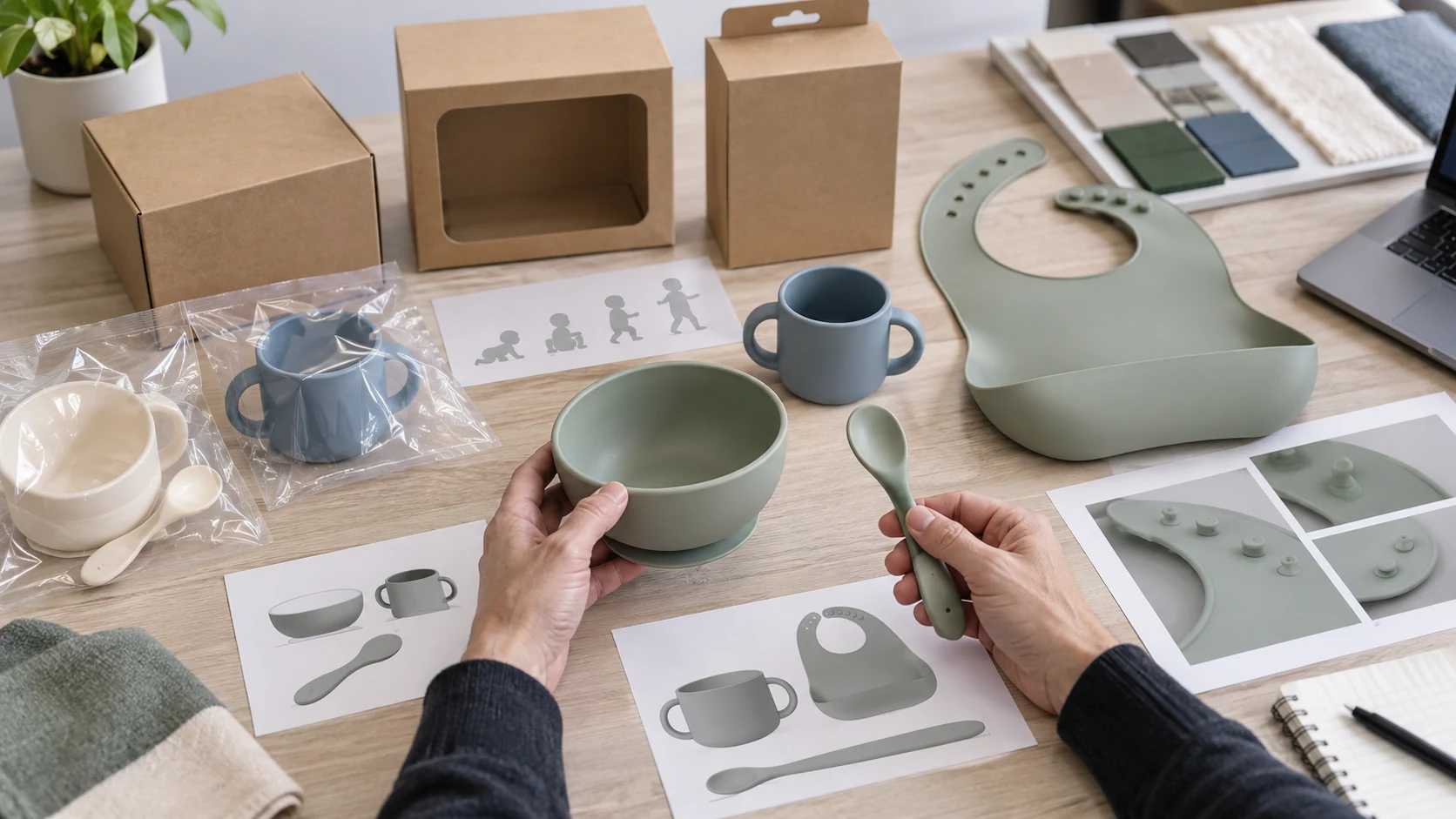
Include all pieces sold together in the analysis. A feeding set can combine a plate, bowl, cup, lid, straw, utensils, bib, storage case, printed sleeve, and detachable accessories, and each can introduce different accessible materials or hazards. The compliance file should describe the complete retail configuration rather than a generic silicone sample.
If the buyer’s channel, decoration, or age claim changes, reopen classification before shipment. Teams can send the intended-use and artwork brief for factory record mapping, but the US importer should retain responsibility for the final legal classification and market release.
Silicone baby tableware CPSIA decisions follow intent and presentation
A durable classification memo helps the laboratory understand the intended user and helps the factory select representative components. It also makes disputes visible before money is committed to tests, packaging, or inventory.
The custom silicone products overview can define product families and customization choices. Every selected configuration still needs its own US rule and evidence review.
Define Whether the Item Is Also a Child Care Article
Children’s product and child care article are related but different concepts. CPSC describes a child care article for the phthalates rule as a consumer product designed or intended to facilitate sleep or feeding of children age three and younger, or to help those children with sucking or teething. Infant and toddler bottles, sippy cups, utensils, bibs, pacifiers, and teethers are among the official examples.
That definition makes intended age and feeding function commercially important. A silicone spoon sold for six-month feeding, a bib for toddlers, or a sippy-cup component may fall within the child care article analysis even if it is not a toy. A product can be a children’s product without being a toy, and a feeding article should not be tested only against a toy checklist by habit.
Map every accessible plasticized component, not only the main silicone body. Consider flexible plastic lids, straws, valves, decorative attachments, printed or coated surfaces, adhesives, packaging items that remain part of the product, and any bought-in accessory. Document why a component is within scope, outside scope, inaccessible, or covered by a recognized determination or exclusion.
Avoid statements such as silicone is naturally CPSIA compliant. Even when a base material is not intentionally formulated with a restricted substance, the finished article can include pigments, catalysts, prints, coatings, plastics, metals, or assembly aids from different sources. Compliance depends on the applicable rule, component composition, accessibility, and reliable evidence for the supplied production configuration.
The procurement specification should identify the age range and function in plain language, then control bill-of-material codes and approved suppliers. Require written notice before substitutions to silicone grade, pigment, plastic accessory, metal insert, coating, ink, adhesive, or packaging component. A silent substitution can invalidate both the test rationale and the certificate data.
If the product combines feeding and play features, do not assume the feeding function removes toy requirements. Review play value, intended use, marketing, and component hazards separately. Keep unresolved product types out of the purchase-order release until the applicable-rule matrix is approved.
Feeding function can trigger a narrower phthalates analysis
The rule map should say which requirement applies to which component and why. A blanket row labeled CPSIA is too vague for a laboratory request or a defensible Children’s Product Certificate.
Component-level reasoning also improves quotation accuracy. It prevents the factory and laboratory from pricing tests for the wrong materials while missing a bought-in part that affects the finished product.
Build the Applicable-Rule Matrix for the Exact SKU
After classification, create a matrix with rows for each potentially applicable CPSC rule, ban, standard, and labeling duty. Columns should identify the legal citation, covered component or feature, age and use condition, test or assessment method, CPSC-accepted laboratory scope where required, evidence owner, certificate treatment, and release status. This becomes the purchasing control document.
For children’s products, total lead content generally applies to accessible components, while lead in paint and similar surface coatings is a distinct requirement when such coatings are present. The phthalates prohibition applies to accessible components of children’s toys and child care articles. Other rules may depend on product geometry, detachable parts, play features, included accessories, or specific durable infant-product categories.
Do not cite requirements merely because they are familiar. For example, ASTM F963 is a mandatory toy standard, but a feeding bowl without play value is not automatically a toy. Conversely, adding toy-like features or packaging claims may change the analysis. The decision record should explain both included and reasonably considered but excluded rules.
Separate CPSC consumer-product obligations from food-contact obligations overseen by other authorities. A migration or food-contact assessment does not replace children’s-product lead, phthalate, mechanical, labeling, testing, or certification duties, and a CPC does not prove suitability for food contact. Procurement should maintain connected but distinct workstreams for each market claim.
Ask the laboratory to confirm its CPSC acceptance for every test method used to support certification, not simply that the company is accredited. Scope can vary by laboratory location and rule. The quote and final report should identify the test citation, sample, component, method, result, and laboratory identity that will appear in the certificate record.
Freeze the matrix before approving production samples. The factory capability page offers general manufacturing context, while the project file must connect the exact SKU, materials, process revision, samples, and evidence to the importer’s approved US requirements.
A rule matrix turns classification into a testable purchase condition
A good matrix is specific enough that procurement can tell what blocks release and what is supporting information only. It should never let a generic pass report substitute for an omitted legal citation.
Review the matrix again when colors, logos, packaging, accessories, age claims, or sales channels change. These commercial changes can alter component scope or the way the product is reasonably understood by consumers.

Approve Representative Samples and a Continuing Test Plan
Third-party testing must represent the finished children’s product and the applicable components covered by the rule matrix. Define how colors, materials, suppliers, decorations, and accessories are grouped, then document why selected samples represent the production family. A clear rationale is more defensible than testing one convenient color and assuming every variant is identical.
The test request should state the product name, SKU, age grade, intended function, material and color codes, bill-of-material revision, factory, production or pilot lot, and every legal citation to be evaluated. Attach photographs and component maps so the laboratory can identify where each specimen came from. Require the report to preserve the same identifiers used by the purchase order and CPC.
Component-part testing can reduce duplication when the conditions in CPSC rules are met and the certifying party exercises due care. Supplier evidence should provide access to underlying reports and attestations, identify the component and source, and remain connected to the finished product record. A generic certificate without traceable test evidence is not a sound basis for reliance.
Plan production testing and material-change controls rather than treating the initial report as permanent. The responsible manufacturer or importer needs a reasonable program for continued compliance, including periodic testing where applicable, production testing, remedial-action planning, and records. Procurement should translate that program into supplier obligations, review frequencies, and hold points.
Control sample custody from factory selection through laboratory receipt. Record who selected the samples, whether they came from pilot or mass production, the lot and date, seals or shipment references, and any preparation performed. A beautiful report is weak when nobody can show that its specimen matches the goods released for sale.
When a result fails, document the affected components and lots, root cause, correction, disposition, and retest basis. Do not discard the failed file or test a hand-made substitute without explaining the difference. The purchasing decision should remain on hold until the corrected production state and representative evidence are approved.
Representative evidence must follow the manufactured configuration
Testing is a controlled evidence chain, not a sample-shopping exercise. Family grouping, component reliance, and exclusions should be written before samples are sent.
For custom colors or decorations, use the custom manufacturing pathway to align artwork and material revisions. The importer’s test plan must still cover the final commercial combinations and applicable US rules.
Prepare the CPC and 2026 Import Certificate Data Together
A Children’s Product Certificate is issued by the responsible domestic manufacturer or importer, not by the laboratory. For imported products, the importer certifies that the children’s product complies with all applicable CPSC-enforced rules based on qualifying passing evidence. The factory and laboratory can supply data, but they do not transfer that legal responsibility by drafting a convenient PDF.
Build the certificate record from the rule matrix and final test file. Identify the finished product, each applicable citation, certifying party, custodian of records, manufacture date and place, test date and place, and each CPSC-accepted third-party laboratory associated with the relevant test. Ensure names, addresses, model numbers, and dates are consistent across the CPC, reports, labels, purchase order, and shipment records.
As of July 8, 2026, CPSC’s updated certificate and electronic filing requirements affect most imported regulated consumer products. Importers should prepare required certificate data for submission through the CBP entry process and coordinate early with their customs broker or filing service. Products entered from a Foreign Trade Zone have a later effective date identified by CPSC, so route-specific advice still matters.
Do not wait until cargo departure to discover that a laboratory, citation, product identifier, or test date is missing from the data set. Create a broker-ready field map during sample approval and test it against the importer’s filing workflow. The shipment release gate should require both a technically valid certificate basis and operationally complete entry data.
Treat CPC data as controlled product data, not a reusable marketing certificate. If the finished product, component source, rule list, test basis, factory, date range, or laboratory changes, review whether the certificate and eFiling record must change. A certificate can cover defined production only when its scope and supporting evidence remain accurate.
The importer should keep access to the certificate and supporting records for the period required by applicable rules and be able to furnish them when requested. Procurement contracts should specify delivery timing, correction responsibility, confidentiality handling, and record access instead of assuming the supplier owns the complete US compliance file.
Silicone baby tableware CPSIA records must support the importer’s certificate
A laboratory pass and a CPC serve different functions. The report supplies evidence for specified tests, while the responsible firm’s certificate identifies the finished product and affirms compliance with every applicable cited rule.
eFiling adds a logistics dependency to the evidence chain. The importer, customs broker, laboratory data, and factory identifiers should be reconciled before the shipment reaches the entry deadline.
Release Tracking Marks, Artwork, and Lot Traceability as One System
Children’s products require distinguishing tracking information on the product and packaging to the extent practicable. CPSC guidance expects the marks to make the manufacturer or importer, production location and date, detailed manufacturing information such as a batch or run, and the specific source ascertainable. Codes may be used when the consumer can identify whom to contact for interpretation.
Decide the marking method while the product and packaging are still editable. A molded code, laser mark, printed mark, label, or packaging field must remain legible and durable for the expected use, and product and package records should reconcile. If marking the product is not practicable, preserve the documented reasoning rather than omitting it without review.
Connect the consumer-facing code to the factory’s internal traceability structure. The lookup should identify the SKU revision, production lot, factory line or process, material and color batches, inspection and test status, packaging version, and shipment. A code printed on every item has limited value when its database cannot retrieve the source records.
Approve packaging and online content against the classification memo. Age claims, feeding-stage language, child-directed graphics, included accessories, use instructions, warnings, and product naming should not conflict with the certified configuration. A late marketing change can alter consumer understanding or introduce a component that was never assessed.
Use a change-request form that asks whether classification, applicable rules, representative samples, test reports, CPC fields, tracking marks, or eFiling data are affected. Require written approval before implementing a new grade, pigment, supplier, mold, logo, coating, accessory, factory site, age claim, or package. This keeps repeat orders inside the evidence scope.
Before shipment, conduct a lot release review using production photos, code samples, packaging proofs, inspection results, test and CPC references, and entry data. Buyers can request a pre-shipment document alignment review so factory records are organized, while the importer and its advisers retain the US compliance decision.
Tracking information should retrieve the evidence behind the shipment
The objective is not merely to place a batch code on silicone. It is to create a durable bridge between the consumer article, retail package, importer file, factory lot, and corrective-action process.
A release checklist should compare actual marks against approved artwork and database fields. Photograph every location and retain the verification with the lot record.

Children’s-Product Decision Paths for Baby Tableware
Choose a path by intended user and finished-product presentation rather than silicone material alone. The table highlights procurement consequences, but the importer should document the four-factor classification and product-specific rule review.
| Decision criterion | Child-directed feeding product | General-use household tableware | Unresolved or changing concept |
|---|---|---|---|
| Primary intent | Designed or intended mainly for children 12 or younger | Designed for consumers generally, with adult use equally or more likely | Intent, age grade, design, or promotion is not yet consistent |
| Typical presentation | Baby scale, feeding-stage claims, child imagery, age-specific accessories | Neutral household sizing, claims, channels, and presentation | Conflicting label, artwork, product page, or accessory plan |
| Procurement path | Map applicable children’s-product rules, third-party testing, CPC, tracking marks, and filing | Map applicable general-use and food-contact duties without assuming CPSIA children’s rules | Hold tooling, artwork, testing, and PO release until classified |
| Phthalates question | Assess child care article status for feeding children age three and under | Not automatically within child care article scope | Resolve intended age, feeding function, and accessible plasticized parts |
| Certificate owner | US importer for an overseas children’s product subject to covered rules | Responsible manufacturer or importer if a general-use certification rule applies | Name the responsible party before laboratory booking |
| Change sensitivity | Colors, accessories, child claims, sources, and age grading can reopen evidence | New child-directed marketing can reopen classification | Every unresolved change remains a release blocker |
| Best-fit action | Approve a SKU-level rule matrix and representative evidence plan | Keep a written general-use rationale and applicable requirement map | Escalate for qualified US review before commercial commitment |
B2B Buyer CPSIA Purchase-Order Checklist
Complete these eight controls before approving the US purchase order. Each answer should name an owner, record revision, due date, and blocking condition so the factory, laboratory, importer, and broker work from the same release basis.
| Check | Question | Why It Matters |
|---|---|---|
| Classification | Does the four-factor memo cover the finished SKU, intended age, packaging, promotion, and channel? | Prevents material-only or label-only classification. |
| Product scope | Are every component, accessory, color, print, coating, and retained package element identified? | Defines what must be assessed and sampled. |
| Rule matrix | Are applicable and excluded CPSC rules documented with reasons and citations? | Turns CPSIA language into testable requirements. |
| Laboratory scope | Is each certification test assigned to a CPSC-accepted laboratory for that rule? | Supports a valid CPC evidence basis. |
| Representative samples | Do test specimens trace to approved materials, production revision, factory, and lot? | Connects passing results to goods sold. |
| Certificate data | Are CPC fields, citations, testing dates, laboratories, and record custodian complete? | Avoids an incomplete or inaccurate certification record. |
| Marks and filing | Do tracking codes, package data, CPC information, and broker eFiling fields reconcile? | Protects recall traceability and import readiness. |
| Change release | Which design, source, artwork, claim, or route changes trigger review or retesting? | Keeps repeat orders inside approved scope. |
Official CPSC Sources for the Procurement Decision
These CPSC pages establish the classification, certification, and labeling principles used in this guide. They are official starting points, but buyers must confirm the current rule text and obtain product-specific advice for the finished configuration and import route.
The CPSC Children’s Products guidance defines a children’s product as one designed or intended primarily for children 12 or younger and explains the four factors used in the determination. It also distinguishes general-use products and states why classification matters for identifying applicable safety standards, testing, and certification.
The CPSC Children’s Product Certificate guidance explains that children’s products subject to covered safety rules require third-party testing and a written CPC. It identifies the domestic manufacturer or importer as the responsible certifier and notes the July 8, 2026 electronic filing requirement for most imported regulated products.
The CPSC Tracking Label Business Guidance lists the identifying information that must be ascertainable from permanent distinguishing marks on children’s products and packaging to the extent practicable. It connects manufacturer or private-labeler identity, production place and date, batch or run details, and source information to effective traceability.
Practical disclaimer: this article provides manufacturing and procurement information, not legal, regulatory, laboratory, customs, certification, or market-access advice. Requirements depend on the finished article, intended age and use, accessible components, claims, packaging, importer role, shipment route, and current law, so obtain qualified US advice before testing, certification, entry, or sale.
Use a Three-Gate PO Release Decision
Gate one is classification: approve the SKU-level memo and freeze the age grade, function, presentation, accessories, and sales claims. If the intended user or product type is unresolved, do not authorize tooling, artwork, or a laboratory package.
Gate two is evidence: approve the applicable-rule matrix, representative-sample rationale, accepted laboratory scope, passing reports, production testing plan, and component reliance records. If evidence cannot be tied to the supplied configuration, hold the affected color, accessory, or SKU.
Gate three is shipment readiness: reconcile CPC information, tracking marks, lot records, packaging, and current eFiling data with the importer and broker. Release cargo only when all three gates name the same product, factory, dates, components, and responsible parties.
Price the gates into the quotation instead of hiding them in a generic compliance allowance. Separate one-time classification and setup work, variant testing, production controls, marking, documentation, and broker data preparation so a buyer can compare offers on equal scope.
Use the strictest unresolved gate as the project status. A completed mold or passing material screen should not override missing classification, omitted components, an incomplete CPC, or a tracking code that cannot retrieve its lot.
Record every approval and revision with its owner and date. This gives procurement a repeatable decision path and tells the factory exactly which change requires review before the next order.
Silicone Baby Tableware CPSIA FAQ
Is every silicone bowl sold in the United States a children’s product?
No. Classification depends on whether the finished consumer product is designed or intended primarily for children 12 or younger using the four CPSC factors. Baby-specific dimensions, claims, imagery, accessories, and channels commonly support a children’s-product conclusion.
Is baby feeding tableware automatically a toy under ASTM F963?
No. A children’s feeding product is not automatically a toy merely because a child uses it. Play features, intended use, marketing, and the finished design should be reviewed before including or excluding toy requirements.
Who issues the CPC for silicone baby tableware made overseas?
The US importer is generally responsible for issuing the CPC for an imported children’s product subject to covered rules. The factory and laboratory can supply supporting information, but the laboratory does not issue the certificate.
Can one color test cover every custom color?
Only when a documented representative or component-testing rationale supports the grouping and applicable rules permit the reliance. Pigments, coatings, prints, and suppliers can change the relevant composition, so buyers should approve color-family logic before sampling.
Do tracking labels need a third-party laboratory test?
CPSC states that the tracking-label requirement itself is not a rule requiring third-party assessment or a CPC citation. The required marks still need to be present and useful, while other applicable children’s-product rules require their own testing and certification evidence.
Release the US Order Only When the Evidence Chain Closes
A sound silicone baby tableware CPSIA decision begins with the finished product’s intended user and presentation, not a material slogan. The resulting classification must flow into a component-level rule map, representative tests, production controls, certificate data, tracking marks, and shipment records.
Procurement should use the three gates in sequence: classification, evidence, then shipment readiness. If one gate cannot identify the exact SKU, responsible party, applicable rules, and supporting revision, hold that product version instead of asking a generic certificate to cover the gap.
This approach gives buyers a clearer quotation and a safer release decision. It also gives the manufacturing team precise inputs for samples, lot traceability, artwork, and change control without implying that factory paperwork replaces the importer’s US obligations.
Request a US Baby Tableware Compliance File Review
Share the intended age, feeding function, SKU list, materials, colors, accessories, artwork, sales claims, test reports, importer details, and shipment plan. The Naike Group manufacturing team can organize product and factory records for your classification, laboratory, CPC, tracking, and broker review.
Request a Custom Quote
Share your product, quantity, target market and customization needs. Our factory team will reply with the next practical step.
Continue Your Sourcing Research
The six newest factory-side articles are updated automatically by publication date.

Wheat Straw vs Bagasse Tableware: Buyer Comparison
A B2B decision guide comparing reusable wheat-straw polypropylene composite tableware with molded bagasse fiber formats across use, evidence, operations and end of life.

Can Wheat Straw Tableware Be Recycled? Buyer Q&A
A practical buyer answer on whether reusable wheat-straw composite tableware can enter PP recycling streams, which evidence matters, and how to qualify market claims.

Global SKU vs Regional SKU: Tableware Decision Guide
A buyer decision framework for choosing one global tableware SKU or controlled regional variants across compliance, packaging, logistics, inventory and change control.

Australia Food Packaging Evidence: Buyer Guide
A practical evidence guide for Australian food-packaging buyers covering intended use, migration risk, supplier assurance, testing, hygiene, release and change control.

EU PPWR Tableware Packaging vs Conventional Packs
A buyer comparison of PPWR-ready and conventional tableware packaging across product protection, material choices, empty space, evidence, labeling and release timing.

Prop 65 Tableware Requirements: Buyer Q&A
A practical buyer Q&A for defining California Proposition 65 exposure scenarios, evidence, warning decisions, supplier records and release controls for tableware.