
Australia Food Packaging Evidence: Buyer Guide
Build a use-specific packaging evidence file that connects the Australian Food Standards Code to materials, migration risk, factory controls, testing, artwork and repeat orders.

The direct answer is that Australia food packaging evidence is not one universal certificate. A defensible buyer file identifies the finished packaging and intended food-contact conditions, shows why the material is fit for purpose and unlikely to contaminate food, supports relevant chemical and physical risks with appropriate evidence, and proves production continues to match the approved specification.
Australia’s rules place practical responsibility on the food business and supply chain. Evidence may combine the Food Standards Code, supplier declarations, composition and specification records, targeted migration or contaminant testing, hygiene controls, packaging trials, inspection results, artwork approval, traceability, and documented change control.
The right file is SKU- and use-specific. A report for dry food at room temperature does not automatically support hot, fatty, acidic, frozen, microwaved, or repeated-use contact, and a raw-material statement does not prove the finished printed, coated, glued, or recycled-content package is suitable.
What Should an Australian Packaging Evidence File Contain?
Start with a signed intended-use statement covering the food, direct or indirect contact, time, temperature, storage, reheating, reuse, and distribution route. Add a component bill of materials, supplier food-contact assurance, applicable specifications, risk assessment, relevant analytical or performance reports, manufacturing and hygiene controls, incoming and finished-pack inspections, approved artwork, lot traceability, and rules for material or supplier changes.
The legal requirement is the decision basis; certificates and test reports are supporting evidence, not substitutes for judgment. If the supplier cannot connect evidence to the exact finished packaging revision and use conditions, treat the gap as an approval blocker and request a packaging evidence scope review before mass production.
Start With the Australian Obligation and the Intended Use
The Australian Food Standards Code does not turn packaging approval into a hunt for a single logo. FSANZ states that food businesses must use packaging that is fit for its intended purpose, is not likely to cause food contamination, and does not make contamination likely during the packaging process. The buyer therefore needs a reasoned safety case for the actual packaging system rather than a generic food-grade claim.
Write the intended-use statement before asking for certificates. Name the food or tableware application, whether contact is direct or indirect, the contact surface, duration, temperature, storage life, transport conditions, and whether consumers may heat, freeze, wash, or reuse the article. Include foreseeable misuse that cannot be eliminated by clear instructions, because a technically narrow test may miss the real consumer exposure.
Separate the packaged product from the package while mapping their interface. A reusable lunch container, cup, utensil, or bowl can itself be a food-contact article, while its printed sleeve, bag, insert, label, adhesive, master carton, and e-commerce shipper form a second system. Each component deserves a role, contact classification, specification, supplier, and revision so evidence is not attached to the wrong object.
Determine who relies on the evidence and who makes the Australian market decision. The overseas factory can provide manufacturing records and test samples, but the importer, brand owner, food business, retailer, and local adviser may hold separate duties or specifications. Record the responsible reviewer, approval date, limitations, and unresolved assumptions instead of allowing “customer to confirm” to become an invisible gap.
Scope makes evidence relevant
A test result becomes commercially useful only when its sample identity and conditions cover the product being ordered. Connect the report number to the material code, supplier, formulation or grade, colour, print and coating system, construction, dimensions, and approved golden sample.
For custom products, the custom solutions process can coordinate product, pack, print, and assembly variables. Australian suitability still requires a buyer-approved evidence scope and current professional advice.
Map Every Material, Process, and Food-Contact Path
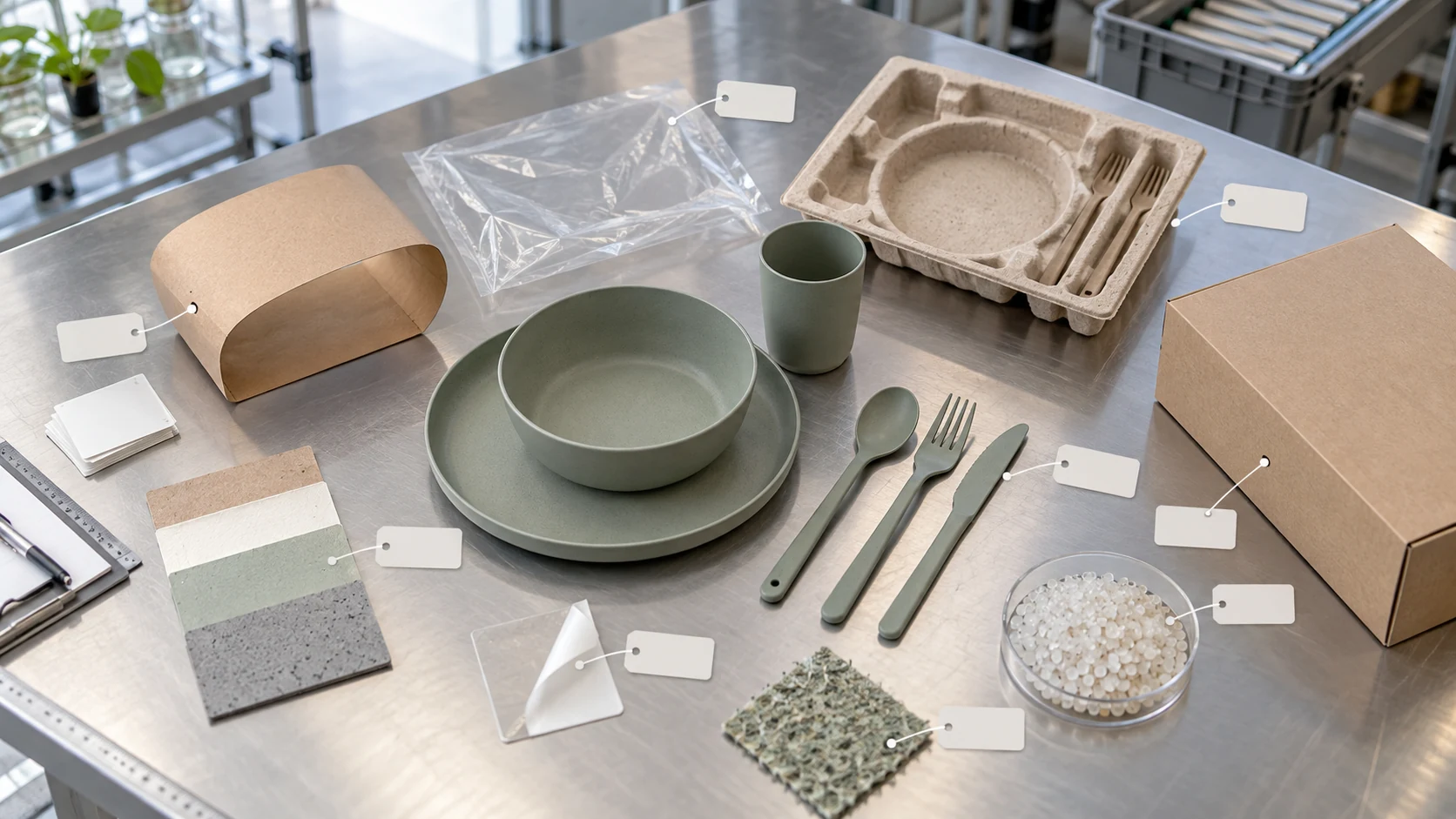
Create a packaging bill of materials that goes beyond paper, plastic, or silicone. Record resin or fibre grade, recycled-content claim, colorant, coating, ink, varnish, adhesive, laminate, window, closure, absorbent, insert, label, tape, and any treatment applied after the base material was produced. A low-mass component can still introduce a chemical, fragment, odour, or hygiene risk.
Map direct, indirect, and foreseeable transfer paths. Ink printed on the outside can set off against a food-contact surface while rolls or cartons are stacked; adhesive constituents can migrate through a thin substrate; recycled fibre can carry mineral oils or other contaminants; and a loose window, staple, or desiccant can create a physical hazard. The assessment should explain why each path is controlled, not merely assert that the outer face does not touch food.
Ask suppliers for a controlled specification and declaration tailored to the actual grade. Useful documents identify the manufacturer, plant, material code, composition restrictions, intended food types and conditions, applicable standards, test basis, manufacturing date or validity, and authorised signatory. Reject undated letters, unrelated catalogue sheets, and declarations that say food grade without defining what that means.
Control printing and converting as part of the finished article. Cure conditions, coat weight, ink coverage, lamination ratio, residual solvents, drying time, storage, and roll orientation can affect migration or sensory performance. A base-film report cannot automatically represent the converted pouch, and a paperboard declaration cannot automatically cover an unknown barrier coating or adhesive.
The finished construction is the evidence unit
Build one drawing or specification tree that shows component position and contact status. Link each supplier document and report to that tree so reviewers can see which risks are covered and which remain assumptions.
The custom tableware portfolio illustrates varied shapes, materials, and set configurations. Packaging contact and protection conditions must be rechecked for each selected configuration.
Select Chemical Evidence by Risk, Not by Certificate Count
Chemical evidence should begin with the material, food, time, and temperature combination. Fatty, acidic, aqueous, alcoholic, dry, and high-temperature uses can create different extraction or migration challenges, while repeated use may require multiple exposure cycles. Define the rationale for simulants, contact conditions, analytes, detection limits, and acceptance criteria before a laboratory begins work.
Use the Code to identify relevant legal limits and obligations, then add risk-based screening for substances reasonably associated with the formulation and process. FSANZ notes that Standard 1.4.1 sets maximum levels for certain contaminants that may result from packaging contact. A report covering only those named limits may still be insufficient when inks, adhesives, recycled inputs, degradation products, or other migrants present a credible risk.
Laboratory competence and report integrity matter. Prefer an appropriately accredited laboratory and check the accredited scope, method, sample receipt, photographs, condition, preparation, quality controls, units, uncertainty where relevant, and conclusion. A pass statement without results or a method that does not match the matrix gives procurement little ability to evaluate a later material change.
Do not automatically demand every possible test. Start with composition disclosure and a documented hazard assessment, then target testing where supplier knowledge, regulatory limits, exposure, formulation complexity, recycled content, or change history justify it. This approach produces stronger evidence than a large bundle of unrelated reports and makes retesting triggers easier to define.
Migration evidence must match exposure
Record why the chosen test is sufficiently conservative for the declared use and where it is not. If evidence covers cold dry food only, place that limitation in the purchase specification, artwork instructions, and release checklist.
A buyer can review the factory capability overview for manufacturing context. Plant capability does not replace finished-pack chemical evidence.

Prove Physical Integrity, Hygiene, and Packaging-Process Control
Chemical migration is only one part of packaging safety. FSANZ identifies risks from dirty or damaged packaging, microorganisms, fragments, and contamination during packing. The approval plan should therefore cover cleanliness, pest and foreign-material controls, storage, handling, line clearance, damage prevention, and the condition of surfaces that touch food or food-contact products.
Translate foreseeable failures into measurable checks. Depending on the pack, evaluate seal strength, leaks, closure retention, sharp edges, delamination, coating rub, print set-off, odour, moisture resistance, compression, drop, vibration, abrasion, temperature cycling, and pallet stability. The acceptance criteria should reflect distribution and consumer use rather than a convenient in-house demonstration.
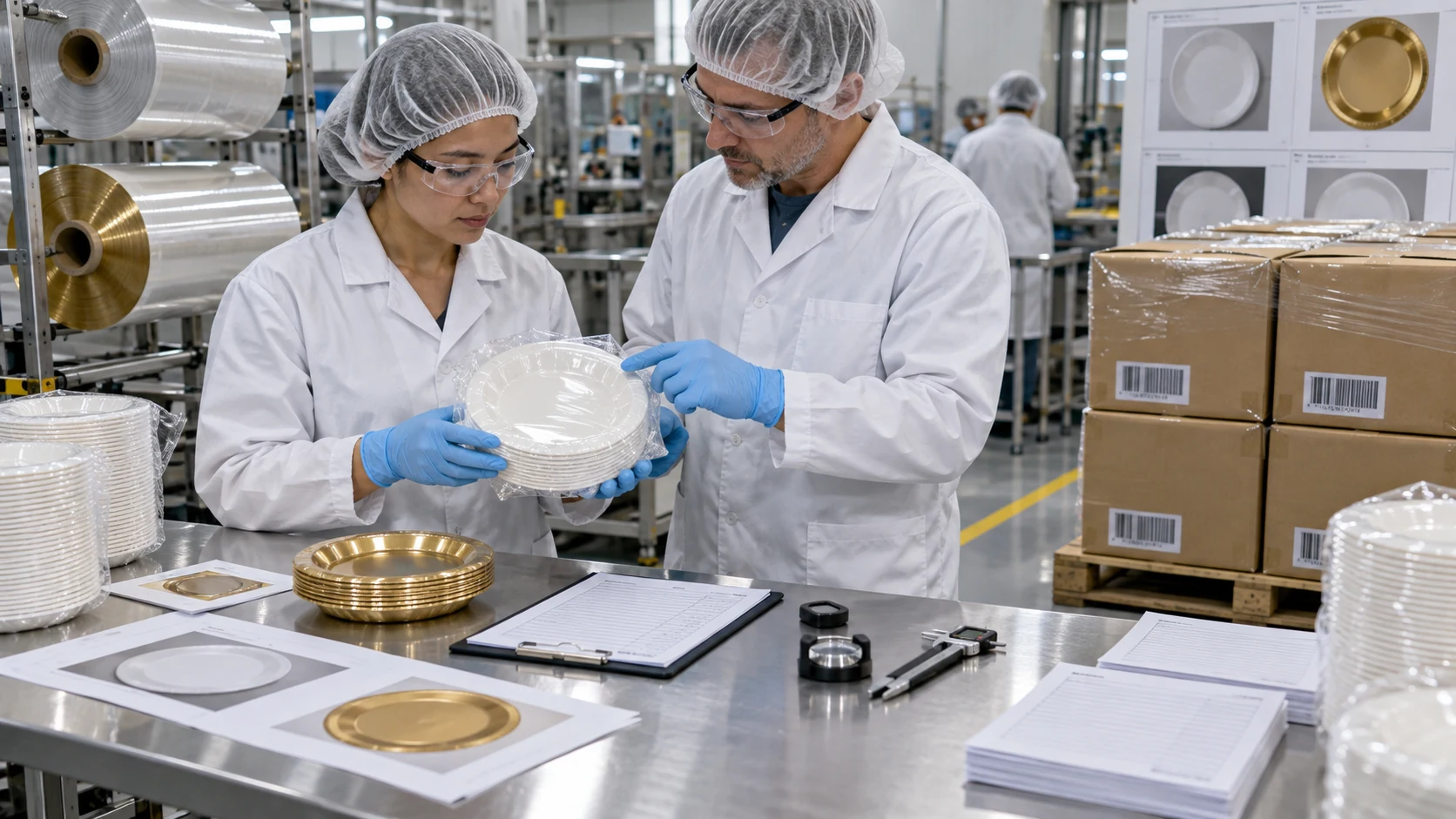
Inspect both incoming materials and converted output. Incoming controls can verify identity, dimensions, basis weight or thickness, colour, surface condition, supplier lot, and required documents; in-process checks can cover printing, curing, bonding, sealing, cutting, cleanliness, and code legibility; finished inspection can confirm construction, function, appearance, count, carton protection, and traceability.
Document the packaging process itself. Line layout, covered storage, personnel practices, equipment condition, cleaning, rejected-material segregation, glass and brittle-plastic controls, pest management, and corrective actions all help show that suitable material remains suitable when packed. Photographs and audit summaries are useful, but routine lot records demonstrate repeatability more directly.
Safety continues after material approval
Approve a control plan that names the characteristic, method, frequency, sample size, limit, record, and reaction plan. Make critical document or hygiene failures capable of stopping release even when appearance is acceptable.
For a new construction, conduct a supervised pilot that uses intended packing equipment, product configuration, labels, cartons, and shipping route. Retain samples and photographs under the same revision as the evidence file.
Build a Traceable Supplier, Laboratory, and Factory Evidence Chain
Organise evidence by claim and decision instead of placing every PDF in one folder. For each requirement, identify the legal or buyer basis, hazard, control, supporting document, sample or material identity, reviewer, result, limitation, and approval status. A matrix immediately shows whether several certificates repeat one fact while a different risk remains uncovered.
Supplier evidence establishes what was purchased and under what conditions it is represented as suitable. Laboratory evidence measures selected properties under stated methods and conditions. Factory evidence shows that approved inputs, processes, and inspections were used. Buyer evidence records the intended market, risk decision, artwork, limitations, and release authorisation; no single layer replaces the others.
Check dates and version alignment. A current declaration tied to material code A does not support an order silently switched to code B, and an old migration report may not cover a revised formulation, recycled-content level, ink system, or manufacturing site. Set document review dates based on risk and supplier change controls rather than assuming certificates expire on one universal schedule.
Require lot traceability from finished packaging back to material and conversion batches. Retain purchase orders, certificates of analysis where meaningful, receiving checks, production and inspection records, deviation approvals, and shipment identity. If a complaint or regulatory question arises, the team should be able to define affected lots and retrieve the evidence without reconstructing the history from email.
Evidence quality depends on linkage
A strong file answers five questions: what exactly was assessed, for which use, against what requirement, using which evidence, and how production remained equivalent. Any document that cannot answer at least one should not be treated as a release gate.
When the construction is still being developed, share the SKU, intended use, and existing reports. Factory-side gaps can then be mapped before sampling.
Release Artwork, Production, and Repeat Orders Under Change Control
Artwork can change the safety and compliance profile. Control ink coverage, food-contact warnings, use and reuse instructions, temperature restrictions, traceability codes, importer or brand information, environmental claims, and any declarations requested by the channel. Legal label review and packaging-safety review should use the same dieline revision before plates or cylinders are released.
Define change categories in the purchase agreement and quality plan. Material grade, resin or fibre source, recycled content, colorant, coating, ink, adhesive, converter, plant, process condition, dimensions, contact surface, intended food, temperature, and artwork can all require notification. The buyer should decide whether the response is documentary review, targeted testing, pilot production, full reapproval, or rejection.
Use a release dossier for each commercial order. It should identify the approved master specification and sample, current supplier assurances, required reports, incoming and in-process results, finished inspection, deviations, carton and shipping checks, production lots, and authorised disposition. Do not allow an urgent ship date to convert an expired or mismatched document into an automatic waiver.
Reassess after complaints, failures, regulatory changes, supplier notifications, unexplained odour or colour shifts, damage trends, or production moves. Preserve the original decision and add a dated review rather than overwriting history. That audit trail lets Australian buyers explain why the pack was accepted at first sale and how later changes were controlled.
Australia food packaging evidence must stay repeatable
The commercial objective is not a perfect sample supported by a polished report. It is a repeatable packaging system whose materials, conversion, hygiene, artwork, inspections, and records remain within the approved scope for every shipment.
Schedule a periodic evidence review before reorder planning. That timing gives the team room to obtain updated declarations, investigate changes, run targeted tests, or qualify an alternative without delaying the shipment.
Which Packaging Evidence Proves What?
Use evidence by function and read its limitations. The strongest Australian file combines complementary records tied to the same finished packaging revision and intended use.
| Evidence type | What it can support | What it cannot prove alone | Buyer control |
|---|---|---|---|
| Intended-use statement | Food, contact, temperature, time, storage, reuse and route | Material safety or production conformity | Approve before testing and purchasing |
| Supplier declaration | Material identity, represented suitability and stated conditions | Unknown migrants or unchanged future production | Verify issuer, grade, scope, date and limitations |
| Composition and specification | Inputs, construction and controlled properties | Finished-pack migration or hygiene performance | Link every component to a drawing and supplier |
| Laboratory report | Measured results for identified samples and conditions | Uses, substances or revisions outside the method | Review competence, scope, method and raw results |
| Factory audit and controls | Systems for hygiene, process and traceability | Every lot was produced correctly | Combine with routine batch and inspection records |
| Performance trial | Integrity through defined packing and distribution stresses | Chemical safety or a different route | Record conditions, criteria, failures and retest |
| Lot release dossier | Order-specific conformity to approved controls | Suitability of a flawed master specification | Require authorised disposition and traceability |
| Change notification | Visibility of variables that may affect approval | Impact without technical reassessment | Classify changes and define reapproval actions |
Australian Food Packaging Buyer Checklist
Complete these eight checks before mass-production release. Record the evidence reference, revision, owner, limitation, and disposition for every answer.
| Check | Question | Why It Matters |
|---|---|---|
| Intended use | Are food type, contact, time, temperature, storage, heating, freezing and reuse defined? | Sets the boundaries for every declaration and test. |
| Complete construction | Are substrates, inks, coatings, adhesives, labels, closures and recycled inputs mapped? | Prevents hidden components and transfer paths from escaping review. |
| Code basis | Which Food Standards Code duties, limits and buyer requirements govern the decision? | Separates legal requirements from voluntary supporting standards. |
| Chemical rationale | Do composition review, migration conditions, analytes and acceptance criteria match the use? | Makes laboratory evidence relevant and reviewable. |
| Physical and hygiene controls | Are fragments, damage, cleanliness, storage and packing-process risks controlled? | Covers contamination pathways beyond chemical migration. |
| Document linkage | Do declarations and reports identify the exact grade, supplier, site and finished-pack revision? | Stops generic or obsolete evidence from supporting the wrong order. |
| Lot release | Can each shipment trace inputs, production, inspections, deviations and disposition? | Shows that commercial production matches the approved sample. |
| Change control | Which material, supplier, process, artwork or use changes trigger notification and reassessment? | Protects later orders from silent evidence drift. |
Official Australian Sources for Packaging Decisions
Use current official sources at the time of approval. A buyer file should cite the exact obligation and explain how supplier, laboratory, and factory evidence support it.
FSANZ’s official Food packaging guidance for businesses states that packaging must be fit for intended purpose, not likely to contaminate food, and handled so contamination is not likely during packaging. It also recommends knowing the food composition and obtaining appropriate supplier assurance.
The Federal Register of Legislation version of Standard 1.1.1 is the authoritative source for the Code’s general provisions and packaging requirements. Use the current compilation and follow linked standards, including relevant contaminant and food-safety provisions, rather than relying on an undated summary.
FSANZ’s Safe Food Australia guidance for Standard 3.2.2 explains practical packaging controls, including suitability, contamination prevention, supplier assurance, storage, and considerations for chemicals migrating into food. Guidance helps implementation, but the Code and applicable Australian law remain the decision basis.
Practical disclaimer: this article provides manufacturing and procurement information, not legal, toxicological, laboratory, food-safety, labeling, recall, import, retailer, or market-access advice. Requirements and evidence depend on the food, packaging construction, contact conditions, business role, Australian jurisdiction, current Code, and other applicable laws, so obtain qualified Australian advice before sale.
Use a Five-Link Evidence Release
Link one is scope: freeze the SKU, finished packaging construction, intended food, contact, time, temperature, route, consumer use, and responsible Australian decision maker. Evidence collected before scope approval is provisional.
Link two is material knowledge: obtain controlled specifications, composition disclosures, supplier assurances, and risk information for every substrate, ink, coating, adhesive, closure, and recycled input. Resolve contradictions before choosing tests.
Link three is verification: select chemical, sensory, physical, hygiene, and distribution evidence according to risk. Make every report traceable to the sample and state exactly which use conditions it supports.
Link four is production control: approve incoming, converting, packing, inspection, deviation, and lot-traceability records. Release only when the manufactured pack matches the evidence-bearing specification.
Link five is lifecycle control: monitor regulation, supplier, material, process, artwork, use, and complaint changes. Reassess before the next order whenever a change can affect the original approval.
Australia Food Packaging Evidence FAQ
Is there one mandatory Australian food-grade certificate for packaging?
No single universal certificate establishes suitability for every package and use. Buyers should build a use-specific file that links the current legal basis, material and supplier records, risk assessment, targeted verification, factory controls, and release evidence.
Does an overseas migration report automatically support Australia?
Not automatically. It may be useful supporting evidence when the material, finished construction, food or simulant, time, temperature, analytes, method, and acceptance basis fit the Australian decision, but the buyer must document that relevance and any gaps.
Must every packaging component be laboratory tested?
Not necessarily. Use composition knowledge and risk assessment to decide which components, substances, and exposure conditions need testing, while controlling lower-risk items through specifications, supplier assurance, hygiene, inspection, and change notification.
Can a raw-material declaration cover printed and laminated packaging?
Only for the facts within its scope. Printing, coatings, adhesives, curing, set-off, recycled inputs, and converting conditions can introduce or change risks, so the finished construction needs a separate assessment and sometimes targeted testing.
How often should packaging evidence be renewed?
There is no universal renewal interval for every record. Set risk-based review dates and reassess after relevant material, supplier, site, process, artwork, intended-use, legal, complaint, or performance changes.
What should block shipment?
Block release when critical evidence is missing, expired without review, mismatched to the ordered construction, or contradicted by results. An unapproved change or failed hygiene, integrity, traceability, or inspection control should also block shipment.
Turn Packaging Proof Into a Repeatable Australian Release
Reliable Australia food packaging evidence begins with intended use and ends with traceable production. It connects current Australian requirements to the exact finished pack, explains chemical and physical risks, and shows why supplier assurances, laboratory results, hygiene controls, inspections, and artwork are sufficient within defined limits.
Judge evidence by relevance, identity, authority, completeness, and linkage—not by the thickness of the certificate folder. A narrow but well-reasoned file can be stronger than many generic reports, while any unsupported contact condition, unknown component, or silent substitution remains a release risk.
Before each reorder, confirm that the packaging drawing, material codes, approved sample, reports, declarations, artwork, process controls, and lot records still share one revision. That discipline turns compliance evidence into a usable quality system for Australian buyers.
Request an Australia Packaging Evidence Review
Share the product or food, contact conditions, packaging construction, materials, suppliers, artwork, reports, target channel, order timing, and known limitations. Naike Group can map factory-side specifications, samples, process controls, testing inputs, and lot records for your Australian adviser and importer to assess.
Request a Custom Quote
Share your product, quantity, target market and customization needs. Our factory team will reply with the next practical step.
Continue Your Sourcing Research
The six newest factory-side articles are updated automatically by publication date.

Wheat Straw vs Bagasse Tableware: Buyer Comparison
A B2B decision guide comparing reusable wheat-straw polypropylene composite tableware with molded bagasse fiber formats across use, evidence, operations and end of life.

Can Wheat Straw Tableware Be Recycled? Buyer Q&A
A practical buyer answer on whether reusable wheat-straw composite tableware can enter PP recycling streams, which evidence matters, and how to qualify market claims.

Global SKU vs Regional SKU: Tableware Decision Guide
A buyer decision framework for choosing one global tableware SKU or controlled regional variants across compliance, packaging, logistics, inventory and change control.

EU PPWR Tableware Packaging vs Conventional Packs
A buyer comparison of PPWR-ready and conventional tableware packaging across product protection, material choices, empty space, evidence, labeling and release timing.

Prop 65 Tableware Requirements: Buyer Q&A
A practical buyer Q&A for defining California Proposition 65 exposure scenarios, evidence, warning decisions, supplier records and release controls for tableware.

Silicone Baby Tableware CPSIA: US Buyer Decision Guide
A procurement decision guide for classifying silicone baby tableware under US children’s-product rules and building the testing, certificate, label and import file.