
First Article Inspection Report: What It Must Prove
Use a controlled first-article record to prove that the reviewed samples match the released design under identified conditions—not to make unsupported claims about every future unit.

A first article inspection report should prove that identified pre-production samples were made to the released product definition and checked with recorded methods, equipment, results, and acceptance decisions. It should also show the material, tooling, cavity, process, revision, and deviation status that produced those samples, so a buyer can make a controlled production-release decision.
The report does not prove that every later unit will conform, that a factory process is statistically capable, or that the product meets every legal requirement in every destination market. Those conclusions need separate production controls, sampling plans, capability evidence, and applicable compliance documentation.
For custom tableware, first-article evidence often connects a drawing, appearance standard, food-contact material specification, functional method, packaging interface, and approved sample. The commercial value comes from making those connections explicit before mass production amplifies an unresolved error.
Quick Answer: What Must a First Article Inspection Report Prove?
It must identify the exact part and revision inspected, demonstrate results against each agreed requirement, reveal the methods and instruments used, record nonconformities and authorized deviations, and state the scope of approval. A reviewer should be able to trace a reported pass back to a sample, characteristic, tolerance, result, method, date, and responsible person.
A strong report supports one bounded decision: whether the documented configuration is ready for the next manufacturing gate. Buyers should reject vague summaries such as “all dimensions OK” when the underlying values, sample identity, or applicable revision cannot be verified.
Define the First Article Inspection Report Decision Before Sampling
First article inspection is most useful when the parties define what decision the report will support. It may release a new mold for a pilot run, approve a decoration process, confirm a material change, close a tooling correction, or revalidate a transferred tool. Each purpose changes the characteristics, samples, records, and approvers that belong in the evidence pack.
The purchase specification should name the controlled inputs before the factory creates samples. These include the product drawing, bill of materials, material grade, color standard, artwork revision, surface-finish standard, tooling configuration, functional methods, packaging fit requirements, and any market-specific documents. A report cannot establish conformity when the acceptance basis is still changing.
Buyers should identify critical, major, and reference characteristics rather than asking the inspector to treat every dimension as equally important. Food-contact surfaces, fit interfaces, sealing or nesting features, load-bearing areas, sharp edges, volume, wall thickness, decoration position, and packaging constraints may have different risks. The report should preserve that priority so a cosmetic note cannot obscure a functional failure.
The sample plan also needs a rationale. One piece from one cavity may demonstrate a dimensional setup but cannot establish cavity balance, process stability, or lot quality. If multiple cavities, tools, colors, materials, or decoration stations are intended for production, the report should say which configurations were represented and which remain unverified.
Approval authority must be named. Engineering may accept dimensions, quality may disposition defects, brand teams may approve color and artwork, regulatory specialists may review compliance records, and procurement may release the order. A single unchecked “approved” box is not enough when different risks belong to different owners.
Treat the inspection plan as a contract deliverable. If your team is defining a new custom program, the custom solutions pathway provides the broader manufacturing context, while the report itself should remain specific to the actual product, revision, and release gate.
Use a controlled characteristic register
Build one numbered register that maps every requirement to its drawing zone, specification source, classification, method, sample quantity, acceptance rule, and required evidence. That register prevents an attractive report from silently omitting a difficult characteristic.
When a requirement is not applicable or cannot be measured at the first-article stage, mark it openly and assign the later verification route. Blank cells and assumed passes create ambiguity precisely where buyers need an auditable decision.
Prove Sample Identity, Revision, Material, Tool, and Cavity Traceability
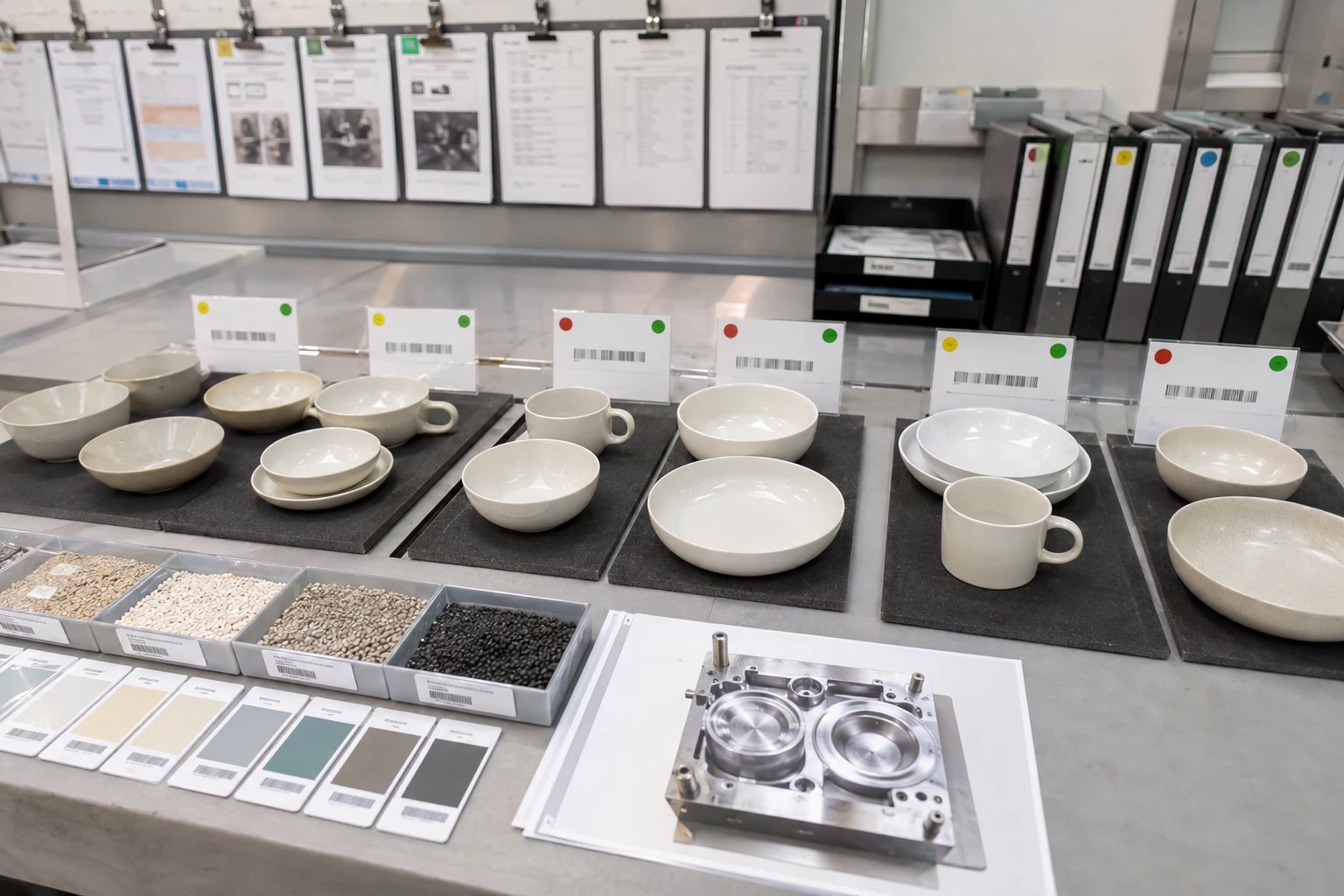
Every result must belong to an identifiable sample. The report should record part number, description, revision, sample number, manufacturing date, inspection date, factory location, order or project number, and the person or system that assigned the identity. Photographs should show distinguishing features and labels without exposing unnecessary confidential information.
Revision traceability is fundamental because first articles are often produced while drawings, artwork, and molds are still changing. The report should name the exact revision of every source used and identify any approved redlines or temporary specifications. If a drawing changed after inspection, the earlier report should remain historically intact and be superseded rather than silently edited.
Material evidence should connect the sample to the actual compound or substrate. Record supplier, grade, color or masterbatch, lot or batch, recycled-content claim where relevant, preparation conditions, and available certificates. A generic statement such as “food grade” does not prove identity, suitability for intended use, or compliance with a named market requirement.
Tooling traceability matters for molded tableware. The report should identify mold or tool number, cavity, insert configuration, repair or engineering-change status, and whether production-intent tooling was used. Prototype tooling can answer design questions, but it should not be represented as evidence of a production tool that has not yet run.
Process identity belongs beside product identity. Machine, line, fixture, decoration equipment, key settings, operator or shift, and any intentional deviation should be recorded at a level appropriate to the risk. The aim is not to publish proprietary know-how; it is to preserve enough context to understand and reproduce the approved result.
Chain-of-custody practices should continue after inspection. Retained samples, photographs, raw readings, and signed approvals need controlled names and storage locations. A buyer reviewing a PDF months later should be able to locate the corresponding physical or digital evidence without relying on one employee’s memory.
Traceability limits the claim to the inspected configuration
If only cavity two was inspected, the report proves results for cavity two under the documented conditions. It does not automatically release cavity one, a second color, a new resin lot, or a different decoration station.
This boundary is commercially useful rather than restrictive. It tells procurement exactly what can proceed and which configurations need additional first-article or validation evidence.
Record Actual Results, Methods, Instruments, and Acceptance Logic
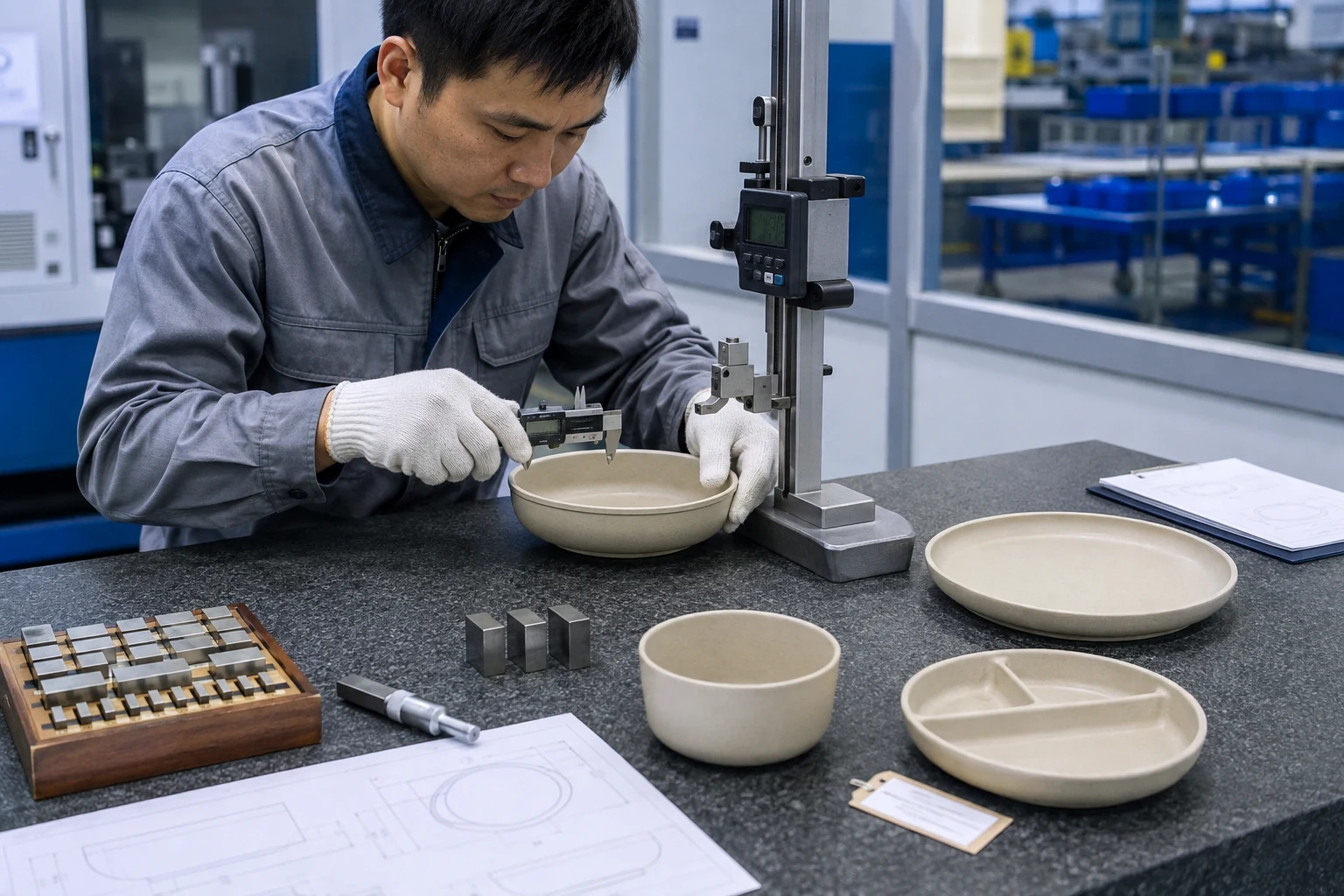
A first-article table should list the nominal requirement, tolerance or acceptance criterion, actual result, unit, method or gauge, sample identifier, and pass-fail disposition. Variable data such as diameter, height, mass, capacity, flatness, or wall thickness should show measured values rather than only pass marks. Attribute checks should describe the observation standard and defect outcome.
Measurement methods must fit the characteristic. Flexible silicone, thin molded fiber, polished plastic, ceramic glaze, and textured wheat-straw composites can behave differently under contact force, temperature, conditioning, or fixture pressure. The report should state relevant conditioning and fixture details so another qualified reviewer can understand the result.
Instrument records should include an identifier and calibration status appropriate to the task. A photograph of a caliper display can support evidence, but it does not replace the link between that tool, its current calibration, the measurement method, and the reported characteristic. Where uncertainty is significant relative to tolerance, the decision rule should be agreed rather than hidden.
Appearance evidence needs controlled references. Color can be compared against a named sample, tolerance system, viewing condition, or instrument method; gloss and texture also need a defined basis. Photographs are valuable for location and pattern, but screen rendering and uncontrolled lighting make them weak substitutes for a physical or quantified color standard.
Functional results should state setup, load, duration, temperature, cycles, medium, and acceptance outcome. “Leak test passed” is incomplete if the fill volume, temperature, time, orientation, closure, or allowable leakage is unknown. Packaging fit checks should similarly identify the tray, carton, count, orientation, and compression or movement criteria used.
Raw data should remain available. Calculated summaries, dashboards, and signed PDFs are easier to review, while original readings, photos, machine output, and worksheets preserve the audit trail. Corrections should show who changed what and why instead of overwriting an inconvenient result.
A pass requires a result and a rule
A value without a tolerance cannot support acceptance, and a tolerance without an actual value cannot demonstrate conformity. The report should present both in the same traceable row whenever quantitative measurement is required.
Buyers can request a first-article evidence review when the report format, critical-characteristic list, or production-release logic needs factory-side clarification before mass production. Resolve those questions before authorizing the volume run.
Connect Product Results to Production-Intent Process Evidence
A conforming sample can be made through extraordinary adjustment that is unsuitable for routine production. The report should therefore show whether production-intent tooling, equipment, material, fixtures, personnel, and cycle conditions were used. Any hand finishing, sorting, rework, or special adjustment needs explicit disclosure.
For multicavity tooling, report results by cavity and preserve cavity markings where possible. A pooled average can hide one undersized or cosmetically weak cavity. Cavity-level weight, critical dimensions, appearance, and functional checks provide a clearer basis for correction and later monitoring.
Process settings should be controlled enough to reproduce the trial. Relevant items may include material conditioning, mold or platen temperature, pressure, cure or cooling time, cycle sequence, decoration parameters, trimming fixture, and inspection timing. The level of detail should follow risk and confidentiality rules, but an unexplained sample cannot become a reliable production baseline.
The factory should state how many consecutive acceptable parts were produced and whether the reported pieces were selected before or after sorting. A single showpiece taken from an unstable run is weak evidence. A short consecutive run under documented settings gives buyers a more honest view of repeatability without pretending to be a full capability study.
Known process limits and failure observations are valuable evidence. Flash during warm-up, color shift after dwell, sticking at a narrow temperature, decoration loss at an edge, or packaging scuffing after handling can shape controls even when final submitted samples pass. Deleting those observations makes the report less useful for production planning.
The production control plan should reference the approved characteristics and methods. First-article evidence establishes the initial baseline; incoming checks, in-process controls, final inspection, maintenance, and change control then protect it. Buyers can review the wider factory capability framework when assessing whether those controls match the program risk.
Do not confuse an approved sample with proven capability
Capability needs enough representative data from a stable process and an appropriate statistical method. A first-article run may reveal obvious variation, but a few selected results cannot support a broad capability claim.
State the limit directly in the report. That honesty makes the evidence stronger because buyers know which later production studies or lot inspections remain necessary.
Separate First Article Evidence from Compliance and Lot Acceptance
A first-article inspection verifies agreed product characteristics for identified samples. Legal compliance can require formulation review, migration or chemical testing, declarations, labeling, traceability, and records defined by the destination market and intended use. A dimensionally conforming plate is not automatically compliant for hot, fatty, acidic, or repeated food contact.
Third-party laboratory reports answer their own scoped questions. They should identify sample, method, conditions, result, laboratory, and report status, but they may apply only to the submitted material and construction. The first-article pack can reference those reports without claiming that factory dimensional inspection performed a chemical safety assessment.
Supplier certificates are supporting records, not replacements for buyer-defined verification. A certificate of analysis can connect a lot to listed properties; a declaration may state regulatory conformity under defined conditions; and a safety data sheet communicates hazards for a substance or mixture. Each document has a purpose and should not be stretched beyond it.
Lot acceptance is another distinct decision. AQL or another sampling plan can help decide whether to accept a production lot based on observed nonconformities, but it does not validate the design or guarantee zero defects. First-article approval should occur before a large lot exists, while production inspection checks whether released requirements were maintained.
Process audits and management-system certificates provide additional context. They can demonstrate that controls exist or that a system was assessed, but they do not prove the measurements on a specific first article. A coherent evidence pack shows how system, process, product, and compliance records complement one another.
Buyers should assign each open claim to the correct owner and gate. Engineering handles product definition, quality handles inspection and disposition, regulatory specialists address market requirements, and procurement controls commercial release. This avoids asking one attractive first-article PDF to serve as every form of assurance.
What the first article inspection report does not prove
It does not guarantee future output, eliminate incoming inspection, certify a management system, establish legal compliance in all markets, or prove that untested cavities and variants conform. Those limits should appear in the release note when stakeholders might otherwise infer a broader approval.
A narrow, accurate claim is more defensible than an expansive promise. It lets the buyer add targeted evidence instead of discovering later that an assumed requirement was never verified.
Control Deviations, Corrections, and the Final Release Decision
Every nonconforming result should receive a unique reference, description, sample link, risk classification, containment action, cause or investigation status, responsible owner, due date, and disposition. The report should not turn a red value green because a correction is planned. Original evidence remains visible while the corrective action creates a new verification record.
A deviation is an authorized departure from a requirement, not informal acceptance. It should state the affected characteristic, magnitude, quantity or configuration, technical and commercial rationale, approvers, validity period, and whether drawings or specifications will change. Temporary concessions must expire or close through a controlled decision.
Rework requires its own traceability. Record which samples were reworked, the method, responsible person, inspection after rework, and whether production will use the same route. A hand-polished first article may be acceptable as an engineering study yet unsuitable as the released production process.
The final status should be unambiguous: approved, conditionally approved, rejected, or pending evidence. Conditional approval needs explicit limits such as pilot quantity, named cavity, color, material lot, correction, inspection frequency, or shipment hold. “Proceed with caution” is not an operational release instruction.
Changes after approval trigger a defined response. Tool repair, cavity modification, material substitution, supplier change, equipment relocation, artwork revision, process change, or long production interruption may require partial or complete reinspection. The control plan should say who decides the scope based on risk.
Store the signed report, controlled data, retained-sample references, deviations, corrections, and release record together. The custom mold and tooling pathway can support broader supplier discussions, while the actual evidence pack remains tied to the buyer’s product and approved configuration.
Release only the scope supported by evidence
A production release should name the part, revision, material, color, tool and cavities, process or site, quantity or order scope, outstanding conditions, and effective date. This prevents approval for one configuration from migrating to another through assumption.
If the evidence is incomplete, keep the gate pending and record the missing item. A documented pause is cheaper than producing inventory against an approval that no one can later explain.

Evidence Map: What a First Article Inspection Report Can and Cannot Prove
Use this map to keep each evidence claim within its proper boundary. The buyer should add a separate control whenever the desired conclusion extends beyond the inspected samples and documented configuration.
| Evidence type | What it can prove | What it cannot prove | Buyer action |
|---|---|---|---|
| Identity and revision | Which product definition and samples were reviewed | That later revisions are equivalent | Lock revision and change-control triggers |
| Dimensional results | Measured conformity for named samples and characteristics | Process capability or all-unit conformity | Plan capability and routine inspection separately |
| Appearance approval | Acceptance against a defined visual or color standard | Consistency under every light, lot, or process shift | Retain standards and define monitoring |
| Functional trial | Performance under the recorded method and conditions | Performance under untested uses or abuse | Map methods to intended use and risk |
| Material records | Identity and listed properties of the documented lot | Universal food-contact or market compliance | Obtain applicable declarations and test evidence |
| Process record | Conditions used to create the submitted parts | Long-term stability without representative data | Link the baseline to a control plan |
| Signed release | The authorized scope and conditions of approval | Approval for unlisted variants, sites, or cavities | Name every boundary and open condition |
B2B Buyer First Article Evidence Checklist
Use the checklist before releasing tooling, pilot production, or a purchase order. Each answer should point to a controlled record rather than an unsupported assurance.
| Check | Question | Why It Matters |
|---|---|---|
| Decision | Is the exact release decision and approver defined? | Keeps inspection evidence tied to an operational gate. |
| Revision | Are drawings, artwork, materials, and specifications revision-controlled? | Prevents approval against obsolete requirements. |
| Identity | Can every result be traced to sample, tool, cavity, material lot, and date? | Limits the claim to what was actually inspected. |
| Results | Are actual values, tolerances, methods, units, and dispositions recorded? | Makes each pass independently reviewable. |
| Equipment | Are gauges and calibration status identified where relevant? | Supports confidence in measurement results. |
| Process | Were production-intent conditions used and special handling disclosed? | Reveals showpiece or prototype limitations. |
| Exceptions | Are deviations, rework, corrective actions, and retests visible? | Protects the audit trail and release scope. |
| Boundaries | Are compliance, capability, lot acceptance, and future changes handled separately? | Stops the report from supporting claims it cannot prove. |
Three Official Evidence Principles Buyers Should Apply
Official sources clarify measurement, sampling, and food-contact evidence boundaries. They do not approve a specific supplier, product, report, test plan, or production release, so buyers must translate the principles into project-specific requirements.
The NIST guidance on metrological traceability explains that traceability is a property of a measurement result connected to a reference through a documented calibration chain, not a blanket quality of an instrument or laboratory. For first articles, that supports recording the measured property, result, method, instrument, calibration context, and uncertainty considerations rather than relying on a “calibrated” sticker alone.
The ISO 28590 overview of attribute sampling describes the ISO 2859 family as sampling systems for inspection by attributes and guidance for choosing an appropriate inspection system. This helps buyers separate production-lot acceptance sampling from first-article verification: an AQL decision about a lot does not replace a complete check of the defined first-article characteristics.
The European Commission food-contact materials overview states that kitchenware and tableware are food-contact materials and identifies safety, legislation, good manufacturing practice, and traceability considerations. That official context reinforces why a dimensional first-article pass must not be presented as complete food-contact compliance evidence.
Practical disclaimer: this article is manufacturing and procurement guidance, not legal, regulatory, laboratory, metrology, statistical, or product-safety advice. Define the applicable standards, markets, intended use, test methods, decision rules, sampling plans, and required professional review for the actual product before release.
An Eight-Step First Article Evidence Playbook
Step one is to freeze the review basis. Issue controlled drawings, artwork, material requirements, appearance standards, functions, packaging interfaces, compliance responsibilities, and the change record that created the first-article requirement. Name the decision and approvers before samples are made.
Step two is to build the characteristic register. Map each requirement to its source, risk class, method, sample quantity, acceptance rule, and evidence type. Mark genuinely non-applicable characteristics and assign a later gate for anything that cannot yet be verified.
Step three is to label the manufacturing configuration. Record factory, line or machine, tool, cavity, insert, material lot, color, process date, and key production-intent conditions. Identify prototypes, manual operations, rework, sorting, or temporary fixtures so the report does not imply a mature process.
Step four is to collect actual evidence. Record variable values, attribute outcomes, methods, instruments, units, conditions, photographs, raw data, and calibration context appropriate to risk. Keep samples and files linked by stable identifiers.
Step five is to review failures without rewriting history. Log each nonconformity, classify risk, contain affected items, determine action, and record retest evidence. Use authorized deviations only when their scope, rationale, approvers, and expiry are explicit.
Step six is to separate adjacent claims. Route legal and food-contact compliance to applicable declarations and laboratory evidence, process capability to representative statistical studies, and production-lot acceptance to a defined sampling plan. Reference those records from the pack without merging their conclusions.
Step seven is to issue a scoped decision. State approved, conditional, rejected, or pending, then name the exact part, revision, material, color, tool, cavities, site, order scope, and open conditions. Prevent distribution of an unsigned draft as if it were a release.
Step eight is to preserve the baseline and define reinspection triggers. Archive the report, raw evidence, retained-sample reference, deviations, approvals, and production control links. State which future changes require a full or partial first-article review before more goods are made.
First Article Inspection Report FAQ for B2B Buyers
Is a first article inspection report the same as an AQL inspection report?
No. First-article inspection verifies defined characteristics on an identified pre-production configuration, while AQL sampling is commonly used to make an acceptance decision about a production lot. A buyer may need both at different gates.
Must every drawing dimension appear in the report?
The inspection plan should account for every defined requirement, especially when a complete dimensional layout is required. Any characteristic intentionally excluded, deferred, or marked not applicable should have a documented reason and approval rather than disappearing from the report.
Can a supplier certificate replace first-article measurement?
A supplier certificate may support material identity or listed properties, but it does not normally demonstrate the dimensions, appearance, function, or tooling result of the finished first article. Use each record only for the claim within its stated scope.
Does first-article approval authorize mass production?
Only if the named approver issues that scope of release and all stated conditions are closed. Buyers may instead approve engineering correction, a limited pilot, one cavity, or one material while holding broader production.
When should first article inspection be repeated?
Repeat all or relevant parts after changes that could affect conformity, such as tool repair, cavity modification, material or supplier substitution, site or equipment relocation, artwork revision, process change, or a significant production interruption. The control plan should define who evaluates the trigger and scope.
Release Production Only on Traceable First-Article Evidence
A reliable first article inspection report proves a bounded set of facts: which configuration was made, which requirements were checked, how the checks were performed, what the actual results were, how exceptions were controlled, and who authorized the next gate. Its strength comes from traceability and honest limits rather than the number of pages.
The report should never be used as a shortcut around compliance review, stable-process evidence, production sampling, or change control. Those controls build on the first-article baseline and protect it as materials, tools, equipment, people, and orders change.
Before releasing volume, ask whether another qualified reviewer could reconstruct the decision from the retained records. If the answer is no, close the evidence gap while corrections are still measured in samples instead of finished inventory.
Request a First Article Evidence Review
Share the released drawing, characteristic register, material and tooling identity, available results, deviations, compliance responsibilities, and intended production gate. Our manufacturing team can help organize the factory-side evidence needed for a clear approval decision.
Request a Custom Quote
Share your product, quantity, target market and customization needs. Our factory team will reply with the next practical step.
Continue Your Sourcing Research
The six newest factory-side articles are updated automatically by publication date.

Wheat Straw vs Bagasse Tableware: Buyer Comparison
A B2B decision guide comparing reusable wheat-straw polypropylene composite tableware with molded bagasse fiber formats across use, evidence, operations and end of life.

Can Wheat Straw Tableware Be Recycled? Buyer Q&A
A practical buyer answer on whether reusable wheat-straw composite tableware can enter PP recycling streams, which evidence matters, and how to qualify market claims.

Global SKU vs Regional SKU: Tableware Decision Guide
A buyer decision framework for choosing one global tableware SKU or controlled regional variants across compliance, packaging, logistics, inventory and change control.

Australia Food Packaging Evidence: Buyer Guide
A practical evidence guide for Australian food-packaging buyers covering intended use, migration risk, supplier assurance, testing, hygiene, release and change control.

EU PPWR Tableware Packaging vs Conventional Packs
A buyer comparison of PPWR-ready and conventional tableware packaging across product protection, material choices, empty space, evidence, labeling and release timing.

Prop 65 Tableware Requirements: Buyer Q&A
A practical buyer Q&A for defining California Proposition 65 exposure scenarios, evidence, warning decisions, supplier records and release controls for tableware.