
Tableware Odor Transfer Test: Evidence Guide
Separate legal requirements, sensory methods, laboratory reports, supplier records, and factory controls before approving an odor-free claim.
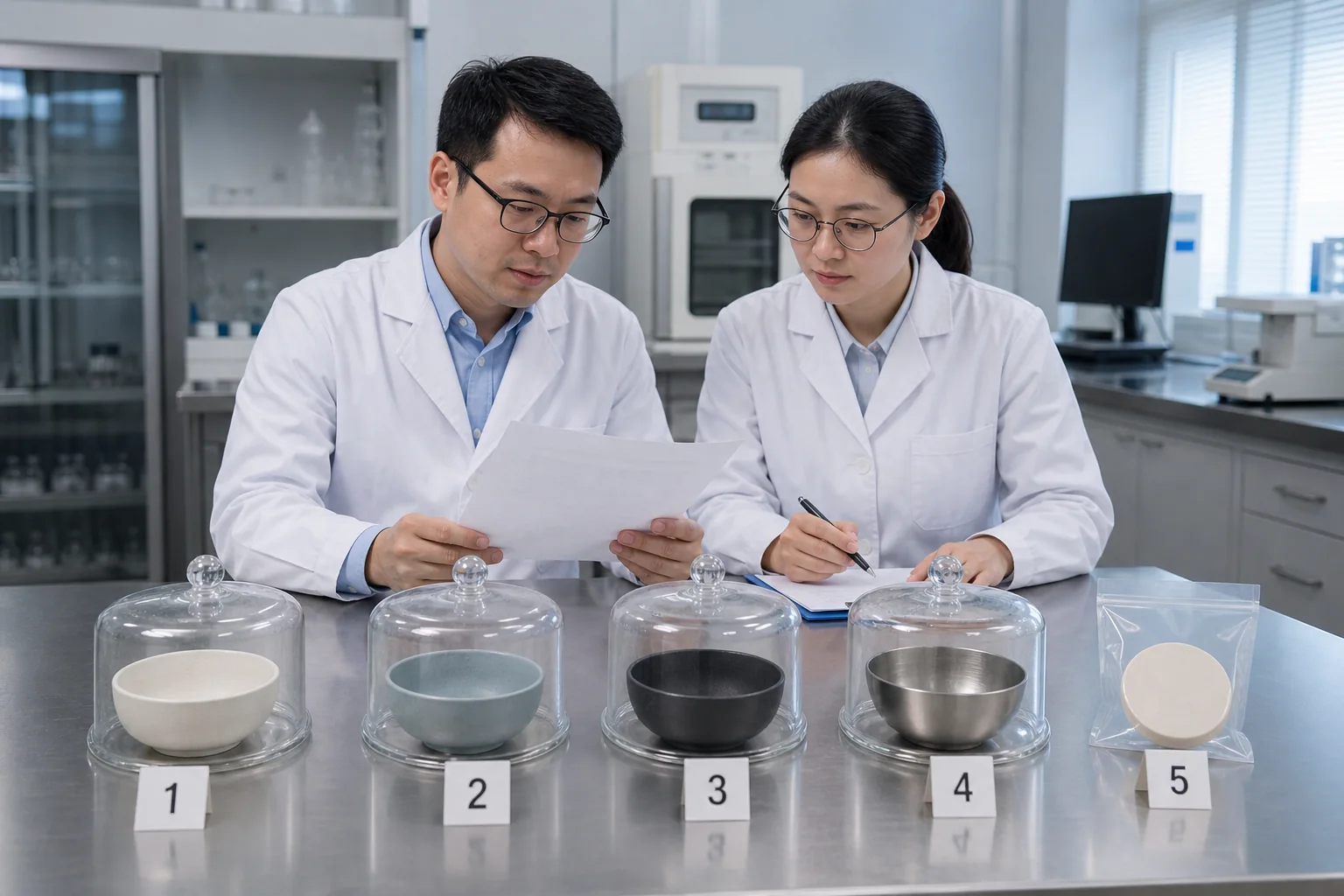
Tableware odor transfer test evidence is strongest when a traceable production-intent article is exposed to representative foods or simulants under defined time, temperature, cleaning, and reuse conditions, then compared with controlled blanks by a documented sensory method. A passing report supports only the tested material, color, construction, batch, and conditions; it cannot prove that every future lot will remain odor-free in every use.
B2B buyers therefore need more than a supplier declaration or an isolated sniff test. The defensible evidence package connects the legal requirement, a suitable test method, sample identity, results, production records, packaging controls, and a rule for handling changes or complaints.
This guide explains what each evidence layer can prove, where its boundary lies, and how to turn an odor claim into a purchasing decision. It is designed for reusable silicone, plastic, wheat-straw composite, and other food-contact tableware programs, while recognizing that the appropriate scope depends on the material and sales market.
Buyer Answer: Require a Linked Chain of Evidence
Ask for a report that identifies the exact finished article, material and color, sample source, conditioning, food or simulant, contact time and temperature, cleaning or reuse cycles, sensory procedure, control sample, assessor approach, acceptance rule, result, and test date. Then link that report to the approved sample and production lot through batch, process, and packaging records.
No single certificate proves universal absence of odor transfer. Buyers can send their use conditions and current evidence set for a factory-side gap review before approving a sample or placing a repeat order.
Define the Claim Before Collecting Evidence
“Odor-free” can describe several different observations: the empty article has no noticeable smell, the article does not make food smell different, the food does not leave a persistent odor in the article, or packaging does not introduce an off-odor before use. These are related commercial risks, but they require different exposure, assessment, and acceptance conditions.
A useful claim names the direction of transfer and the intended scenario. For example, a buyer may require that a production-intent plate impart no detectable off-odor to a neutral food simulant after hot contact, or that a reusable bowl retain no unacceptable garlic odor after a specified wash and conditioning sequence.
The specification also needs the target market, food types, maximum contact temperature, duration, storage state, and expected number of reuse cycles. Without these inputs, a laboratory may run a technically valid procedure that does not represent the product claim the buyer intends to make.
Treat color, decoration, adhesive, coating, and packaging as part of the scope when they can influence the result. A report on an unprinted natural-color plaque does not automatically support a heavily pigmented finished article packed in a printed retail box.
Frame the Tableware Odor Transfer Test Question Precisely
Write the question as a decision: which specimen must pass, after what preparation and contact, against which control, using what acceptance rule? This format forces purchasing, quality, the laboratory, and the factory to agree before samples are submitted.
Keep consumer language separate from the controlled test statement. Marketing may want a simple claim, but the approval file should preserve the narrower conditions that the evidence actually supports.
Separate Legal Requirements From Product Proof
A regulation can establish that food-contact materials must not cause an unacceptable deterioration in organoleptic characteristics. That legal principle explains why odor and flavor transfer matter, yet it does not declare a particular SKU compliant merely because the regulation is cited in a supplier document.
Official guidance can help define food types, time-temperature conditions, intended use, and migration principles. It is an input to the test plan, not a substitute for traceable results from the production-intent article.
A standard method gives laboratories a common technical framework for preparing specimens, exposing food or simulant, controlling comparisons, and assessing sensory change. Method recognition improves comparability, but the buyer still has to confirm scope, laboratory competence, deviations, acceptance criteria, and whether the tested conditions cover the intended use.
A declaration of compliance or raw-material letter may support formulation and regulatory status. It cannot demonstrate the sensory performance of every molded, decorated, washed, stored, and packaged finished product because manufacturing and pack-out can introduce variables absent from the material record.
Use law, guidance, and standards for different jobs
Legal text defines obligations, guidance helps teams choose relevant conditions, and a standard describes a repeatable assessment approach. Finished-product evidence then answers whether the named sample met the agreed rule under the chosen conditions.
Do not label an official publication as a product certificate. Preserve the exact report, sample linkage, and production records that connect general requirements to the article being purchased.
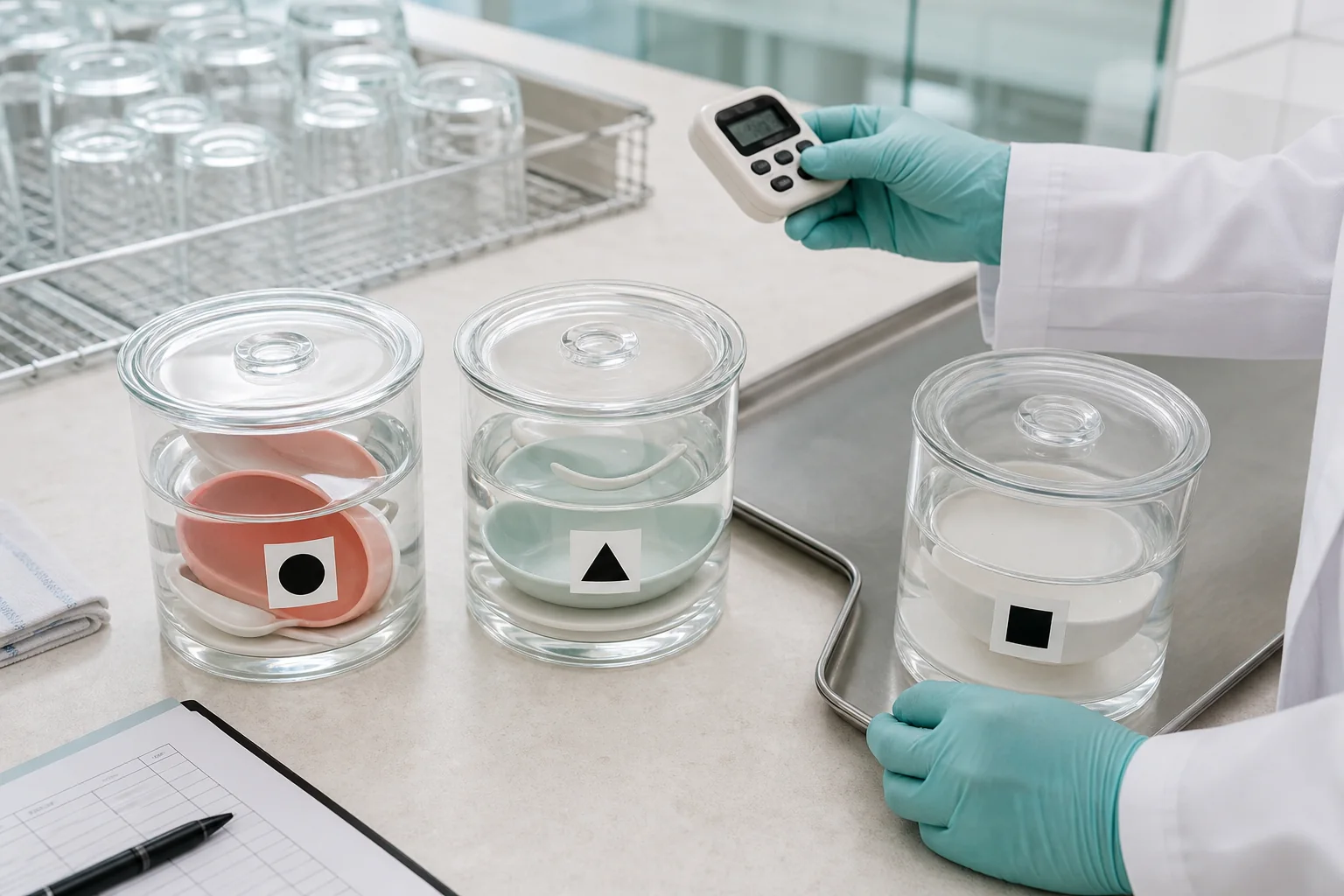
Design a Sensory Protocol That Can Answer the Claim
The protocol should define specimen preparation, washing, conditioning, surface-area-to-volume relationship, contact medium, temperature, time, and whether the assessment concerns the article, the food or simulant, or both. It should also define blank controls and any reference sample so assessors are not judging an unexplained odor in isolation.
Coded samples and controlled presentation reduce expectation bias. The report should state whether assessors were screened or trained, how many participated, what scale or discrimination method was used, how samples were randomized, and how disagreements or invalid observations were handled.
Neutral media may make transferred odor easier to detect, while fatty, acidic, aromatic, or high-temperature foods may represent more severe or commercially relevant exposure. A broad claim may need more than one condition, but adding conditions without a decision rule creates data volume rather than clear proof.
Define acceptance before testing, including whether any detectable difference fails, whether a score threshold applies, and how repeat tests are treated. Changing the rule after viewing the result undermines the credibility of the approval decision.
Build controls that reveal false confidence
Include an unexposed blank, a vessel blank, and a retained approved reference when appropriate. Controls help distinguish odor from the tableware, the test container, handling, cleaning chemistry, storage environment, or the food itself.
Document ventilation, assessor environment, sample temperature, and time between exposure and evaluation. Sensory evidence is practical and valuable, but its interpretation becomes fragile when basic handling conditions are missing from the record.
Read the Laboratory Report Beyond the Pass Line
Start with identity: applicant, manufacturer when shown, sample description, material, color, size, decoration, condition on receipt, and photographs. A generic “silicone product” description or cropped result page cannot establish that the tested article matches the buyer’s SKU.
Next read the method and conditions. Confirm the test medium, contact surface, ratio, temperature, duration, number of specimens, preparation, controls, sensory procedure, acceptance scale, and any deviation from the cited method; a pass statement without these fields has little decision value.
Check dates and document integrity, including sample receipt, test period, issue date, report number, page count, laboratory identity, authorization marks, and any amendment history. Where risk justifies it, verify the report directly with the issuing laboratory rather than relying on a forwarded PDF.
Finally compare the scope with the commercial claim. A one-time ambient test may support that narrow condition, but it does not cover microwave heating, fatty food, long storage, repeated dishwashing, or a different pigment unless the documented program provides that coverage.
Understand what a third-party pass can and cannot prove
A competent third-party result can provide independent evidence about the submitted specimens under stated conditions. It does not prove how the specimens were selected, whether every production lot matches them, or whether later material, process, and packaging changes remain equivalent.
Require the factory and buyer to preserve the submission record, approved construction, and test-sample chain of custody. Independence is valuable, but traceability determines whether the result applies to the goods being purchased.
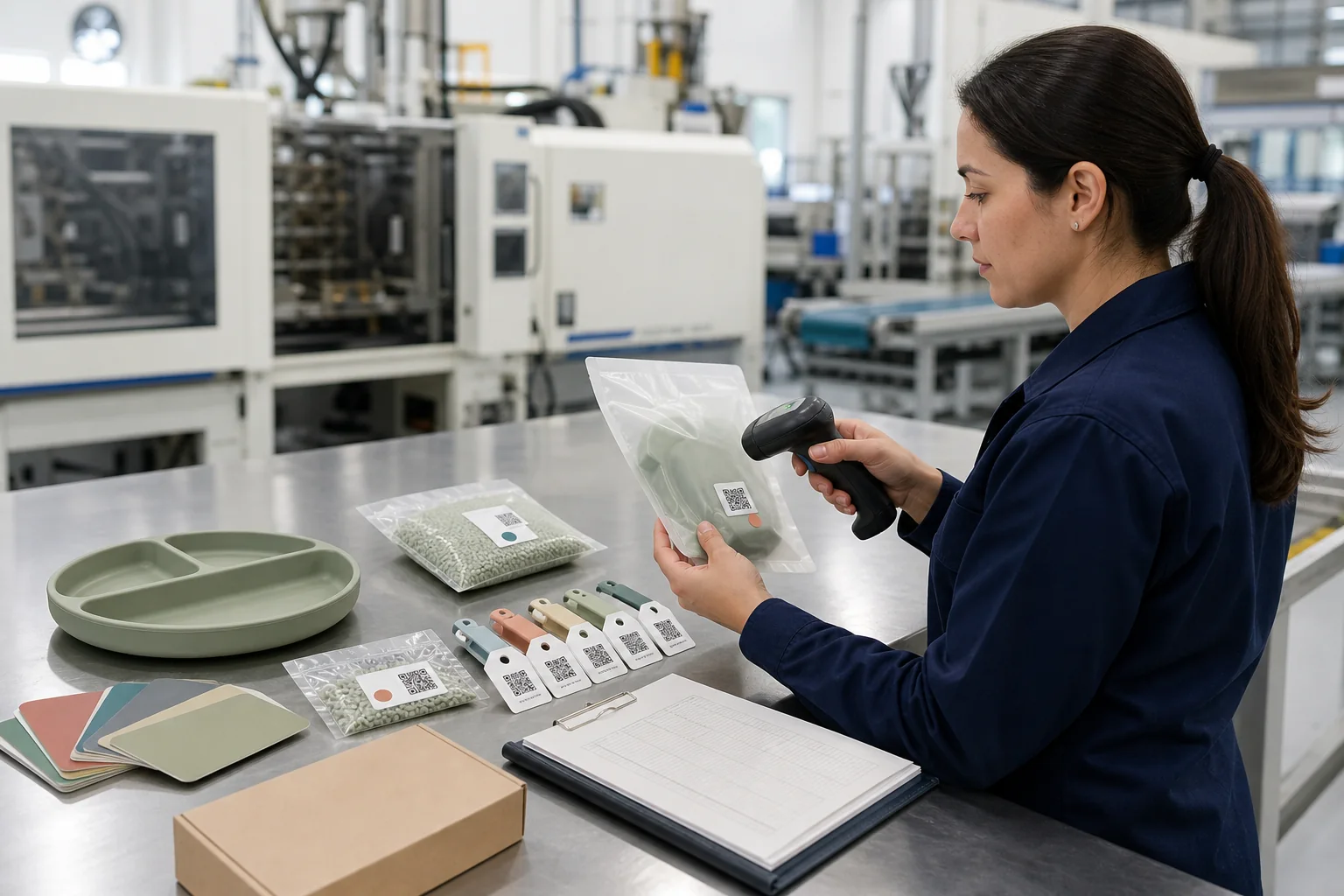
Link Tested Specimens to Approved Samples and Batches
Create a test-sample record before the article leaves the factory. It should identify purchase or development project, drawing revision, part number, material supplier and grade, compound or resin batch, pigment or masterbatch, decoration, cavity when relevant, molding date, post-treatment, cleaning, and packaging configuration.
Photographs should show the full article, traceable label, critical markings, and packaging rather than only an attractive front view. Retain counterpart specimens from the same sampling event under controlled storage so an unexpected result or customer complaint can be investigated later.
The approved golden sample is an important visual and functional reference, but it is not permanent chemical or sensory proof. Golden samples age, absorb ambient odors, lose labels, and may not represent every batch, so they should sit inside a revision-controlled approval system rather than act as the only evidence.
For production, connect incoming material lots to mixing or molding records, finished-lot IDs, inspection records, and shipment cartons. The same discipline described in a tableware AQL inspection plan can support sample selection and lot traceability, although ordinary appearance inspection does not replace sensory testing.
Use change control to protect the evidence chain
Define which changes trigger review or retesting: material supplier or grade, recycled-content policy, pigment, catalyst, curing cycle, decoration, cleaning chemical, production location, packaging ink or adhesive, and claimed use conditions. Minor-looking changes can alter volatile residues or odor interactions even when dimensions remain acceptable.
Record the technical rationale when evidence is bridged from one variant to another. Family grouping may reduce testing, but the file should identify the worst-case selection and explain why untested variants are covered rather than assuming every color or size behaves identically.
Use Factory and Packaging Records to Sustain the Result
Factory controls should address material segregation, sealed storage, batch identification, mixing, molding or forming conditions, curing or post-curing where specified, cooling, cleaning, drying, and protection from volatile chemicals. These records show whether the production system repeated the conditions behind the approved sample.
Investigate the surrounding environment as well as the polymer. Mold-release products, maintenance chemicals, inks, adhesives, cartons, warehouse treatments, and nearby strongly scented materials can create an odor that was absent from a laboratory-tested unpacked component.
Packaging validation should compare unpacked controls with articles stored in final printed bags, cartons, dividers, and accessories for a representative period and temperature. Record whether odor appears on opening, dissipates after ventilation, transfers to a neutral medium, or persists after the specified wash, because these observations point to different corrective actions.
Routine release checks can include documented sensory screening by trained staff under controlled conditions, supported by periodic external verification based on risk. A quick line-side smell check may detect gross contamination, but it should not be presented as equivalent to the complete approval protocol.
Turn a complaint into traceable corrective evidence
When a buyer reports odor, capture lot code, product variant, package condition, storage history, food, time, temperature, cleaning, reuse history, and whether the concern is article odor, transfer to food, or retained food odor. Compare the complaint sample, retained production sample, approved reference, packaging blank, and relevant material controls using a predefined investigation plan.
The investigation should end with a documented cause, containment scope, corrective action, and effectiveness check rather than an unsupported assurance. Buyers can request a traceability and process-record review when the evidence gap involves current production or packaging.
Evidence Matrix: What Each Record Actually Proves
Use the matrix to prevent a strong document in one area from being treated as universal proof. A defensible approval normally combines several layers because each answers a different buyer question.
Evidence strength also depends on identity, conditions, date, and independence. A detailed record disconnected from the ordered SKU may be less useful than a narrower result with complete traceability.
| Evidence layer | What it can support | What it cannot prove | Buyer verification |
|---|---|---|---|
| Applicable law or regulation | The legal expectation for food-contact materials and organoleptic characteristics | That a named SKU passed or that one method covers every market | Confirm market, material scope, current text, and responsible legal review |
| Official guidance | Selection of relevant food types, intended uses, and time-temperature concepts | A finished article’s absence of odor or flavor transfer | Map guidance conditions to the actual use statement and test plan |
| Recognized sensory method | A structured approach to specimen exposure, controls, and sensory assessment | A pass result without product-specific execution and criteria | Check edition, scope, laboratory procedure, deviations, and acceptance rule |
| Third-party test report | Independent results for identified submitted specimens under stated conditions | Every production lot, untested variant, use condition, or future material change | Verify issuer, complete report, sample identity, dates, method, conditions, and result |
| Supplier material records | Grade, formulation control, declarations, and incoming batch identity | Effects of molding, cleaning, decoration, storage, or final packaging | Link supplier document and batch to the actual production order |
| Factory process records | Whether approved manufacturing and handling controls were repeated | Sensory performance without a finished-product assessment | Review critical parameters, deviations, cavity or line identity, and release records |
| Packaging and retained-sample evidence | Whether final pack-out or storage introduces odor and whether a lot can be rechecked | Performance outside the tested pack, storage, food, or reuse scenario | Compare packed and unpacked controls and preserve traceable retention samples |
Eight-Point Buyer Checklist for Odor Evidence
Complete all eight checks before approving an odor-related claim or closing a complaint. A “no” answer does not always mean the product fails, but it identifies an evidence gap that needs a recorded disposition.
Attach the checklist to the approved specification, sample record, and order revision. That connection lets the buyer determine whether a later color, package, or process change requires a focused review.
| Check | Question | Why It Matters |
|---|---|---|
| Claim | Does the specification distinguish article odor, transfer to food, retained food odor, and packaging odor? | Different claims require different exposure and assessment conditions. |
| Use conditions | Are food types, time, temperature, storage, cleaning, and reuse cycles defined? | A report supports only the conditions represented by its test program. |
| Method | Does the protocol identify specimens, controls, coding, assessors, scale, and acceptance rule? | Controlled methods reduce bias and make the decision reproducible. |
| Sample identity | Can the tested item be linked to material, color, decoration, drawing, batch, date, and package? | A valid result is commercially weak when the submitted specimen is unknown. |
| Report integrity | Are the issuing laboratory, complete pages, dates, methods, conditions, deviations, and result verifiable? | A cropped pass page can hide exclusions or describe another construction. |
| Production linkage | Do incoming material and process records connect the approved evidence to the shipped lot? | Future-lot confidence depends on controlled repetition, not one historical sample. |
| Packaging control | Were final bags, cartons, inks, adhesives, storage, and unpacking conditions evaluated? | Pack-out can introduce off-odor absent from an unpackaged laboratory specimen. |
| Change and complaint plan | Are retest triggers, retained samples, containment, investigation, and corrective-action rules defined? | Evidence must remain usable after a change or a market complaint. |
How to Use Official Sources Without Overclaiming
The following sources anchor the legal principle, a relevant sensory framework, and U.S. condition-of-use discipline. They do not certify Naike Group, a material family, or a buyer’s finished article.
The practical task is to translate those sources into a product-specific protocol and traceable production decision. Buyers can review manufacturing and quality controls through our factory capability overview, then require current evidence for the exact order rather than relying on website descriptions.
The European Commission’s official food-contact materials overview explains that tableware is a food-contact material and that transferred constituents can affect food safety, quality, taste, smell, and appearance. It also identifies Regulation (EC) No 1935/2004 and good manufacturing practice as core European requirements. This establishes the legal framework to protect, but it does not prescribe one universal tableware protocol or prove that a particular article meets every applicable requirement.
The German Federal Institute for Risk Assessment publishes an official food-contact method collection that includes sensory testing for odor and taste transfer. Its stated scope is paper, cardboard, and paperboard, so buyers should not copy those procedures onto silicone or plastic without a qualified laboratory confirming suitability. The collection is useful evidence that sensory questions require defined methods, while a product-specific report must still show the actual specimen, conditions, controls, procedure, and result.
The U.S. Food and Drug Administration’s official food-contact chemistry recommendations emphasize intended food types, single or repeat use, and maximum time-temperature conditions, and explain that migration protocols should represent anticipated end use. This guidance addresses chemistry information for food-contact submissions rather than serving as a finished-tableware odor certificate. It reinforces why buyers must define use conditions and avoid applying a narrow test to a broader claim.
Practical disclaimer: this guide is a procurement and quality framework, not legal advice, laboratory accreditation, or a guarantee that a product will never transfer odor. Qualified laboratories and market specialists should determine the applicable regulatory and test scope. Limit commercial claims to the materials, constructions, batches, packaging, conditions, and evidence actually reviewed.
Build an Approval Package That Survives the Next Order
For initial supplier qualification, approve the claim, conditions, protocol, production-intent specimens, and complete third-party report as one connected package. Add the material and color records, factory process route, packaging configuration, retained sample, and signed buyer decision so future teams can see what was actually accepted.
For routine orders, verify incoming batches and critical process records, run the agreed release screen, and schedule periodic external verification based on material, supplier, market, complaint, and change risk. This layered approach is more reliable than commissioning a full test for every shipment or treating one old report as permanent coverage.
For a new color or package, perform a documented change assessment before deciding whether the existing result can be bridged. If the change introduces a new pigment, ink, adhesive, storage condition, or odor source, use targeted testing with appropriate controls rather than approving by appearance alone.
For a complaint, avoid asking only whether the sample smells. Reconstruct the direction of transfer, exposure, cleaning, pack history, and lot identity, then compare complaint, retention, approved reference, and packaging controls so corrective action addresses the actual source.
Buyer FAQs About Tableware Odor Evidence
Does an LFGB or FDA report prove that tableware will never transfer odor?
No single report proves a universal “never” claim. Review the exact test scope, specimen identity, conditions, sensory result, market basis, and production linkage before deciding what the evidence supports.
Should every color be included in an odor test program?
Not automatically, but colorants and processing differences can affect the risk. Use a documented worst-case rationale or test separate variants when their formulations, loading, cure behavior, decoration, or evidence differ materially.
Can factory staff perform the sensory check?
Controlled in-house screening is useful for routine release and detecting gross contamination. It should use trained staff, coded controls, recorded conditions, and escalation rules, while independent testing remains appropriate for approval, verification, or higher-risk changes.
What should a buyer do if packaging smells but the unpacked article passed?
Test packed and unpacked controls and examine bags, printing, adhesives, cartons, accessories, warehouse exposure, and ventilation behavior. Determine whether the package odor merely surrounds the item or transfers persistently to the article or contact medium before selecting corrective action.
How long can an odor-transfer report remain valid?
A report has no universal commercial expiry date independent of change and risk. Review it when the material, supplier, color, process, plant, packaging, intended use, regulation, method, or complaint history changes, and set periodic verification in the quality plan.
Tableware Odor Transfer Test: Decide From Traceable Evidence
A credible tableware odor transfer test decision begins with a narrow claim and representative conditions, then follows the article from material batch and production record through laboratory exposure, sensory assessment, packaging, and shipment. The most impressive certificate in the file cannot fill a missing sample identity or an irrelevant use condition. Conversely, a well-scoped result becomes much more useful when the process and change records show why it should remain applicable.
Approve only what the evidence demonstrates: the named material, color, construction, batch or validated family, package, food-contact scenario, cleaning sequence, and reuse state. Record what remains untested, which changes trigger review, and how a complaint will be investigated. This keeps compliance language, test evidence, and commercial claims aligned.
The buyer’s goal is not a larger document folder; it is a chain of proof that can survive a repeat order, a packaging revision, and a customer question. When that chain is complete, teams can release production with clear limits instead of relying on an odor-free promise that no one can reproduce.
Request an Odor-Evidence Factory Review
Share the target market, material, food-contact conditions, reuse claim, colors, packaging, current reports, and known evidence gaps. Our team can map those inputs to sample traceability, manufacturing controls, test-sample preparation, and a quotation-ready quality brief.
Request a Custom Quote
Share your product, quantity, target market and customization needs. Our factory team will reply with the next practical step.
Continue Your Sourcing Research
The six newest factory-side articles are updated automatically by publication date.
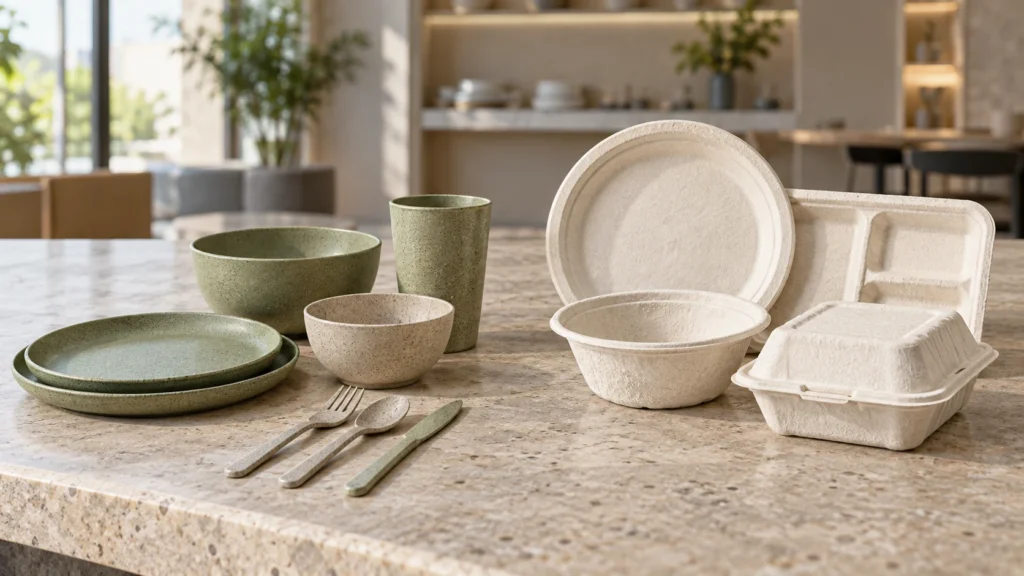
Wheat Straw vs Bagasse Tableware: Buyer Comparison
A B2B decision guide comparing reusable wheat-straw polypropylene composite tableware with molded bagasse fiber formats across use, evidence, operations and end of life.

Can Wheat Straw Tableware Be Recycled? Buyer Q&A
A practical buyer answer on whether reusable wheat-straw composite tableware can enter PP recycling streams, which evidence matters, and how to qualify market claims.

Global SKU vs Regional SKU: Tableware Decision Guide
A buyer decision framework for choosing one global tableware SKU or controlled regional variants across compliance, packaging, logistics, inventory and change control.

Australia Food Packaging Evidence: Buyer Guide
A practical evidence guide for Australian food-packaging buyers covering intended use, migration risk, supplier assurance, testing, hygiene, release and change control.
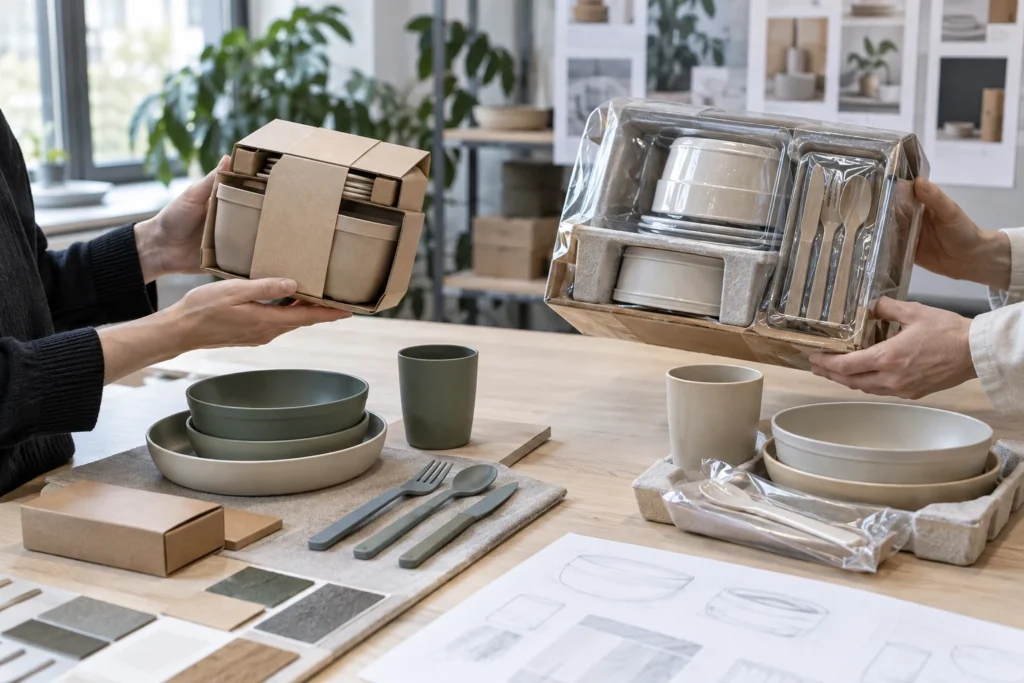
EU PPWR Tableware Packaging vs Conventional Packs
A buyer comparison of PPWR-ready and conventional tableware packaging across product protection, material choices, empty space, evidence, labeling and release timing.

Prop 65 Tableware Requirements: Buyer Q&A
A practical buyer Q&A for defining California Proposition 65 exposure scenarios, evidence, warning decisions, supplier records and release controls for tableware.