
Wheat Straw Tableware Dishwasher Test Guide
A scenario-based quality guide for importers and private-label brands that need wheat-straw composite tableware to survive realistic cleaning without unsupported durability claims.

A wheat straw tableware dishwasher test should answer a defined buyer question, not merely produce a photograph of products beside a dishwasher. For B2B sourcing, the useful result is whether the selected composite, geometry, color and production process remain acceptable after cleaning conditions that represent the intended market and product claim.
Wheat-straw tableware is normally a composite in which plant-based filler works with a polymer matrix and other controlled ingredients. Buyers should connect repeat-use performance to the material principles explained in our wheat-straw composite guide, because fiber ratio alone cannot predict dishwasher behavior.
This factory-side guide follows a common failure scenario: a sample looks acceptable before launch, then repeated hot washing reveals warpage, lid mismatch, color change, odor or surface roughness. The solution is a staged test plan linked to factory process controls, approved samples and an honest statement of intended use.
Factory insider takeaway: Define the claim before the cycle count. A useful dishwasher program records the finished construction, machine, detergent, temperature, cycle, loading, conditioning, measurement points, acceptance limits and action after failure.
Diagnose Why a Wheat Straw Tableware Dishwasher Test Fails
Imagine a retailer approves a lunch set after a short hand-wash review, then customers report that the lid no longer fits after several dishwasher cycles. The visible complaint is deformation, but the root cause could involve resin selection, filler moisture, wall balance, molding stress, cooling, dishwasher temperature or an unsupported use claim.
A second product may remain flat yet develop odor or a chalky surface. That result points toward a different investigation involving compound stability, processing, trapped volatiles, cleaning chemistry, pigment behavior or residue retained by texture and geometry.
The factory should not respond by changing several variables at once. Preserve affected and unaffected samples, verify batch records, reproduce the test and separate material, design, process and cleaning influences before selecting corrective action.
Turn a consumer complaint into a controlled test question
Translate phrases such as dishwasher safe or durable into measurable conditions and failure modes. The project team should know whether it is protecting appearance, fit, sealing, stackability, odor, food-contact evidence or all of those functions.
Record the target user, dishwasher type, regional practice and expected service life. A promotional picnic plate and a daily-use children’s lunch box should not inherit the same test claim without reviewing their different geometries and exposure patterns.
Define the Dishwasher Protocol before Testing Samples
Specify machine type, program, water temperature, drying stage, detergent, rinse aid, loading position and cycle count. A report that states only fifty cycles cannot be reproduced when the thermal and chemical conditions are unknown.
Use a consistent rack location and prevent samples from nesting in a way that shields surfaces from water. Where the product includes lids, seals or multiple materials, test the complete use configuration and also inspect components individually.
Include an unwashed control from the same production lot. Side-by-side comparison makes gradual color, gloss, odor and dimensional changes easier to identify than relying on memory of the original sample.
Select cycle checkpoints instead of waiting for the end
Inspect at planned intervals so the team can identify when change begins and whether it progresses steadily or appears suddenly. Early checkpoints also protect limited samples by allowing investigation before every unit reaches final failure.
Photograph and measure samples at the same conditioned state after each checkpoint. Hot or wet parts can distort readings, while inconsistent rest time can make one test series appear less stable than another.
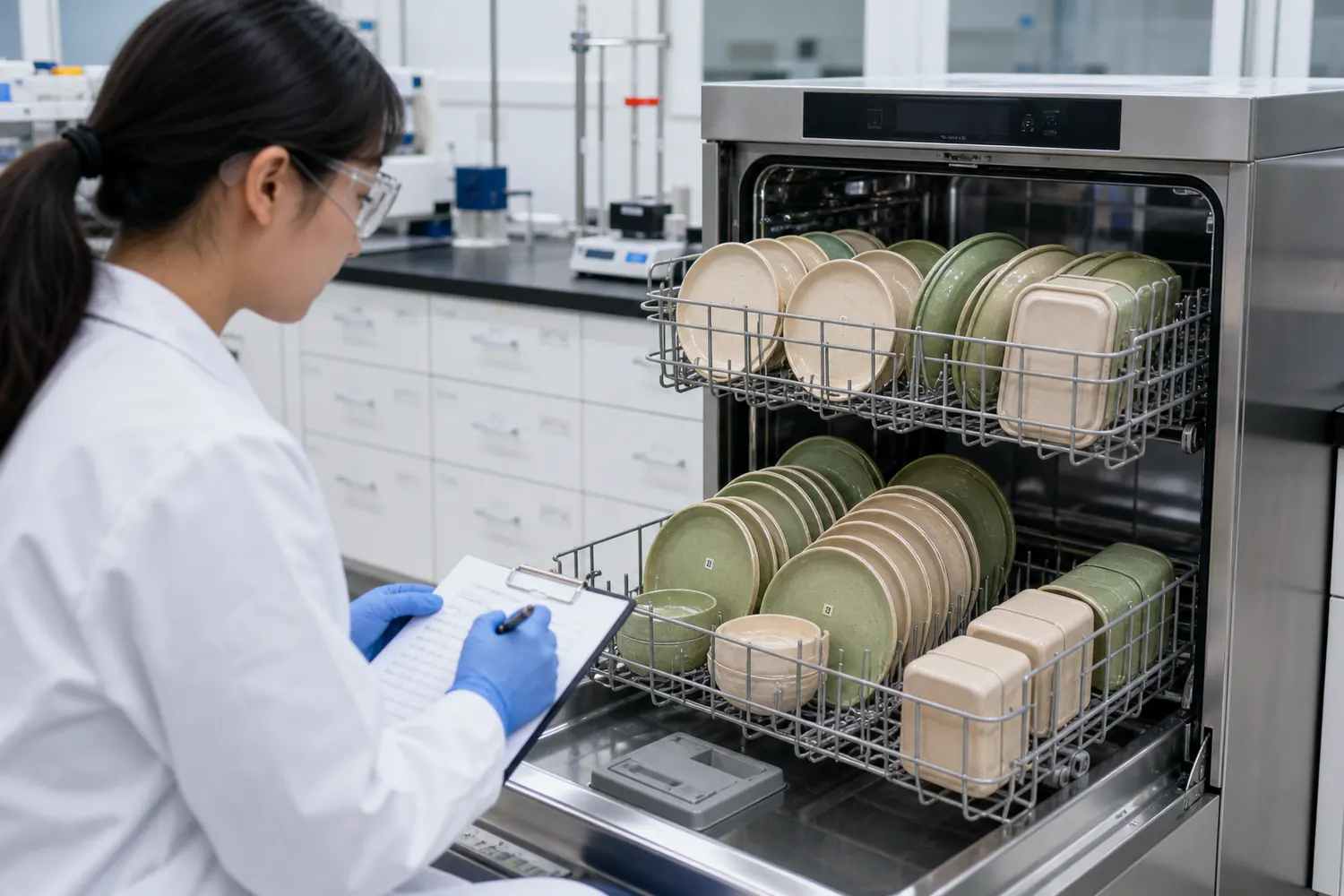
Control Sample Identity, Conditioning and Production Intent
Test specimens should represent the material, mold, cavity, settings and cooling route planned for mass production. Hand-prepared development samples may be useful for screening, but they cannot by themselves prove that a stable production process will deliver the same result.
Label every specimen with project, revision, batch, cavity and test position while keeping the mark away from evaluation surfaces. The test record should link each item to incoming material and molding data so abnormal results can be investigated rather than averaged away.
Condition products before baseline measurement and between inspection points. Temperature and moisture history can affect dimensions, stiffness and odor, especially when a composite contains plant-derived filler.
Compare material screening with finished-product validation
Flat plaques help compare formulations under a common thickness, but they do not reveal stresses created by ribs, deep walls, thin hinges or snap-fit lids. Finished-product tests are needed to evaluate how the chosen material behaves in the actual structure.
For private-label projects, freeze the production-intent construction through the approvals described in our private-label wheat-straw dinnerware guide. This prevents a passing development sample from being disconnected from the shipped product.
Measure Warpage, Fit and Functional Change after Washing
Create baseline dimensions for flatness, overall size, lid interface and critical mating features. Use fixtures and measurement points that can be repeated after each checkpoint without compressing a flexible part or selecting a different edge.
Functional limits should reflect use. A small dimensional change may be acceptable on an open bowl but unacceptable when it causes rocking, prevents stacking, weakens a snap fit or breaks a seal.
Inspect each cavity separately during product development and first production. Cavity balance, cooling and local wall variation can produce different dishwasher responses that disappear when results are combined into one average.
Separate reversible movement from permanent deformation
Measure after a defined cooling and conditioning period, then recheck suspect samples later if the specification recognizes recovery. The report should state which measurement controls acceptance rather than choosing the most favorable time point after testing.
When deformation is permanent, review material conditioning, molding stress, cooling fixtures, ejection, wall balance and dishwasher severity. Corrective trials should change one controlled factor or use a planned experiment so the team learns which action actually works.
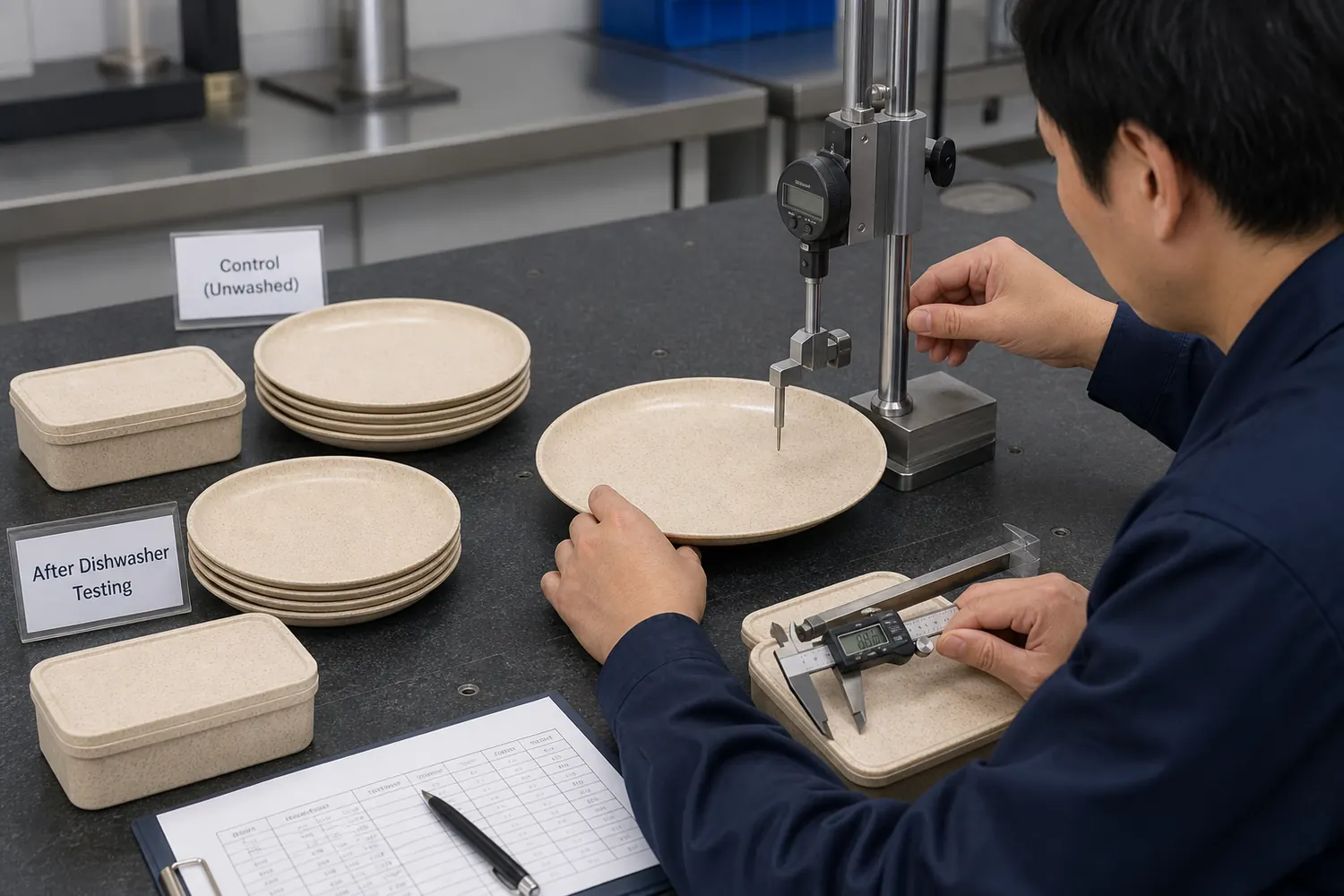
Evaluate Color, Surface, Odor and Cleaning Residue
Use controlled lighting and retained references to inspect color, whitening, gloss, spotting, fiber visibility and surface roughness. Define whether the decision concerns a uniform overall shift, localized streaks, edge damage or residue that can be removed by a specified rinse.
Odor evaluation needs coded samples, a neutral environment and agreed descriptors. Reviewers should distinguish material odor, detergent fragrance, retained food soil, packaging odor and thermal degradation rather than recording only pass or fail.
Textured surfaces, deep corners and embossed branding can hold water or residue. Product design review should consider drainage and cleanability before tooling release, because a material change cannot always correct a geometry that traps soil.
Connect sensory findings to material and process records
Compare affected samples with unwashed controls and, when useful, with a known reference material. Check compound lot, moisture control, residence time, processing temperature, storage and packaging before assuming the plant filler is the only cause.
If a corrective process reduces odor, confirm that it does not create brittleness, color shift, energy claims or migration concerns elsewhere. A balanced product specification protects the full intended-use profile rather than optimizing one symptom in isolation.
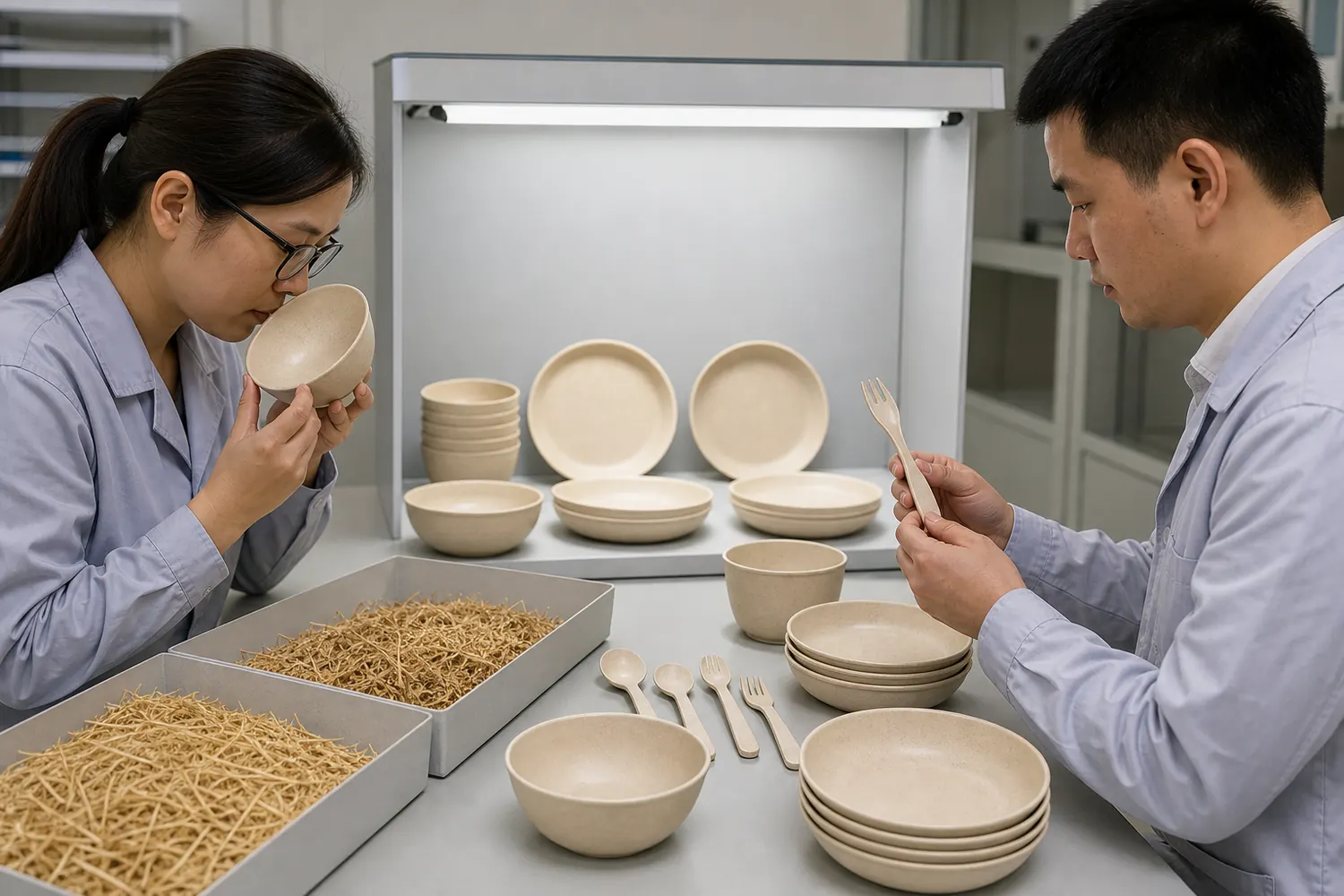
Release Repeat-Use Claims with Production Verification
A passed development test supports only the construction and conditions represented by the samples. The buyer should decide what production verification, retention sampling and change review are needed to keep later lots connected to that evidence.
Write consumer instructions that match the tested conditions and known limitations. Avoid expanding a controlled dishwasher result into broad claims about unlimited lifetime, all temperatures or every commercial cleaning environment.
Before shipment, verify product identity, appearance, dimensions, lid fit and packaging while retaining enough samples for complaint investigation. Dishwasher cycling is one part of the quality file, not a replacement for incoming, in-process and final inspection.
Use factory change control to protect the dishwasher result
Changes to polymer grade, filler system, additives, pigment, supplier, mold, wall thickness or process window can alter repeat-use performance. Define which changes require document review, comparison testing or full revalidation before shipment.
Naike Group manufacturing team links those decisions to the project route on Custom Solutions. Buyers receive a clearer connection between the tested sample, approved construction and production release.
Dishwasher Test Approaches Compared for Wheat-Straw Tableware
No single approach answers every risk question. Use screening to learn quickly, standardized methods to improve comparability and product-specific validation to protect the actual commercial claim. Record the selected comparison assumptions in the wheat straw tableware dishwasher test project brief before quotation.
| Approach | Primary Question | Advantage | Limitation | Best Decision Stage |
|---|---|---|---|---|
| Short internal screening | Does the construction show an obvious weakness? | Fast and useful for early iteration | Limited service-life evidence | Material and design development |
| Reference dishwasher method | Can samples be compared under defined repeatable conditions? | Improves protocol discipline | May not equal every consumer machine | Qualification and customer alignment |
| Product-specific cycle plan | Does the finished item meet the stated use claim? | Targets geometry, fit and market risk | Requires agreed acceptance limits | Production-intent validation |
| Complaint reproduction | Can the reported failure be recreated? | Supports root-cause investigation | Consumer conditions may be incomplete | Corrective action |
| Production verification sample | Does the shipped lot remain connected to approval? | Confirms current construction | Not a substitute for full development work | Lot release and monitoring |
B2B Buyer Checklist for a Wheat Straw Tableware Dishwasher Test
Use this checklist before the laboratory or factory begins cycling samples. Every answer should be written into the test request and linked to the approved product revision. Record every answer against the current wheat straw tableware dishwasher test project assumptions and approval owner.
| Check | Question | Why It Matters |
|---|---|---|
| Intended claim | Which exact dishwasher and repeat-use statement must the evidence support? | A defined claim determines exposure, cycle count and acceptance priorities. |
| Finished construction | Are material, filler, additives, pigment, geometry and components frozen? | Results cannot control production when the tested construction is still changing. |
| Sample traceability | Can every specimen be linked to material lot, cavity and process record? | Traceability allows abnormal results to be investigated by source and process. |
| Machine protocol | Are program, temperature, drying, detergent, rinse aid and loading defined? | Cycle count alone cannot make tests repeatable or comparable. |
| Control samples | Is an unwashed retained control available from the same lot? | A matched reference makes gradual appearance and odor changes easier to judge. |
| Checkpoint plan | At which cycles will samples be conditioned, inspected and measured? | Intermediate data show when degradation begins and how it progresses. |
| Dimensional limits | Which flatness, fit, stack and lid measurements control acceptance? | Functional limits distinguish harmless movement from commercial failure. |
| Sensory method | How will color, surface, residue and odor be evaluated? | Coded and controlled reviews reduce vague or biased sensory decisions. |
| Failure response | Who holds release and approves corrective trials after a failure? | A test adds value only when its result controls the next project gate. |
| Change triggers | Which material, mold and process changes require revalidation? | Later lots must remain connected to the construction that generated the evidence. |
Factory Control Notes for wheat straw tableware dishwasher test
The control notes below convert a cycle plan into factory records and release decisions. They also help the buyer compare suppliers using equivalent assumptions instead of headline cycle numbers. Each wheat straw tableware dishwasher test decision should identify its owner, evidence and release condition.
1. Intended claim control for wheat straw tableware dishwasher test
For wheat straw tableware dishwasher test, the intended claim checkpoint must become a dated project record rather than an informal chat instruction. The resulting intended claim record must name its owner, source evidence, revision authority and the commercial consequence of a late change after the buyer asks, “Which exact dishwasher and repeat-use statement must the evidence support?”
A defined claim determines exposure, cycle count and acceptance priorities. For the intended claim decision in this wheat straw tableware dishwasher test project, our factory links the checkpoint to the quotation, approved sample, purchase order or inspection standard that governs the next approval. If the wheat straw tableware dishwasher test evidence is incomplete, the team holds that approval gate, closes the information gap and records the revised assumption before production continues.
2. Finished construction control for wheat straw tableware dishwasher test
For wheat straw tableware dishwasher test, the finished construction checkpoint must become a dated project record rather than an informal chat instruction. The resulting finished construction record must name its owner, source evidence, revision authority and the commercial consequence of a late change after the buyer asks, “Are material, filler, additives, pigment, geometry and components frozen?”
Results cannot control production when the tested construction is still changing. For the finished construction decision in this wheat straw tableware dishwasher test project, our factory links the checkpoint to the quotation, approved sample, purchase order or inspection standard that governs the next approval. If the wheat straw tableware dishwasher test evidence is incomplete, the team holds that approval gate, closes the information gap and records the revised assumption before production continues.
3. Sample traceability control for wheat straw tableware dishwasher test
For wheat straw tableware dishwasher test, the sample traceability checkpoint must become a dated project record rather than an informal chat instruction. The resulting sample traceability record must name its owner, source evidence, revision authority and the commercial consequence of a late change after the buyer asks, “Can every specimen be linked to material lot, cavity and process record?”
Traceability allows abnormal results to be investigated by source and process. For the sample traceability decision in this wheat straw tableware dishwasher test project, our factory links the checkpoint to the quotation, approved sample, purchase order or inspection standard that governs the next approval. If the wheat straw tableware dishwasher test evidence is incomplete, the team holds that approval gate, closes the information gap and records the revised assumption before production continues.
4. Machine protocol control for wheat straw tableware dishwasher test
For wheat straw tableware dishwasher test, the machine protocol checkpoint must become a dated project record rather than an informal chat instruction. The resulting machine protocol record must name its owner, source evidence, revision authority and the commercial consequence of a late change after the buyer asks, “Are program, temperature, drying, detergent, rinse aid and loading defined?”
Cycle count alone cannot make tests repeatable or comparable. For the machine protocol decision in this wheat straw tableware dishwasher test project, our factory links the checkpoint to the quotation, approved sample, purchase order or inspection standard that governs the next approval. If the wheat straw tableware dishwasher test evidence is incomplete, the team holds that approval gate, closes the information gap and records the revised assumption before production continues.
5. Control samples control for wheat straw tableware dishwasher test
For wheat straw tableware dishwasher test, the control samples checkpoint must become a dated project record rather than an informal chat instruction. The resulting control samples record must name its owner, source evidence, revision authority and the commercial consequence of a late change after the buyer asks, “Is an unwashed retained control available from the same lot?”
A matched reference makes gradual appearance and odor changes easier to judge. For the control samples decision in this wheat straw tableware dishwasher test project, our factory links the checkpoint to the quotation, approved sample, purchase order or inspection standard that governs the next approval. If the wheat straw tableware dishwasher test evidence is incomplete, the team holds that approval gate, closes the information gap and records the revised assumption before production continues.
6. Checkpoint plan control for wheat straw tableware dishwasher test
For wheat straw tableware dishwasher test, the checkpoint plan checkpoint must become a dated project record rather than an informal chat instruction. The resulting checkpoint plan record must name its owner, source evidence, revision authority and the commercial consequence of a late change after the buyer asks, “At which cycles will samples be conditioned, inspected and measured?”
Intermediate data show when degradation begins and how it progresses. For the checkpoint plan decision in this wheat straw tableware dishwasher test project, our factory links the checkpoint to the quotation, approved sample, purchase order or inspection standard that governs the next approval. If the wheat straw tableware dishwasher test evidence is incomplete, the team holds that approval gate, closes the information gap and records the revised assumption before production continues.
7. Dimensional limits control for wheat straw tableware dishwasher test
For wheat straw tableware dishwasher test, the dimensional limits checkpoint must become a dated project record rather than an informal chat instruction. The resulting dimensional limits record must name its owner, source evidence, revision authority and the commercial consequence of a late change after the buyer asks, “Which flatness, fit, stack and lid measurements control acceptance?”
Functional limits distinguish harmless movement from commercial failure. For the dimensional limits decision in this wheat straw tableware dishwasher test project, our factory links the checkpoint to the quotation, approved sample, purchase order or inspection standard that governs the next approval. If the wheat straw tableware dishwasher test evidence is incomplete, the team holds that approval gate, closes the information gap and records the revised assumption before production continues.
8. Sensory method control for wheat straw tableware dishwasher test
For wheat straw tableware dishwasher test, the sensory method checkpoint must become a dated project record rather than an informal chat instruction. The resulting sensory method record must name its owner, source evidence, revision authority and the commercial consequence of a late change after the buyer asks, “How will color, surface, residue and odor be evaluated?”
Coded and controlled reviews reduce vague or biased sensory decisions. For the sensory method decision in this wheat straw tableware dishwasher test project, our factory links the checkpoint to the quotation, approved sample, purchase order or inspection standard that governs the next approval. If the wheat straw tableware dishwasher test evidence is incomplete, the team holds that approval gate, closes the information gap and records the revised assumption before production continues.
9. Failure response control for wheat straw tableware dishwasher test
For wheat straw tableware dishwasher test, the failure response checkpoint must become a dated project record rather than an informal chat instruction. The resulting failure response record must name its owner, source evidence, revision authority and the commercial consequence of a late change after the buyer asks, “Who holds release and approves corrective trials after a failure?”
A test adds value only when its result controls the next project gate. For the failure response decision in this wheat straw tableware dishwasher test project, our factory links the checkpoint to the quotation, approved sample, purchase order or inspection standard that governs the next approval. If the wheat straw tableware dishwasher test evidence is incomplete, the team holds that approval gate, closes the information gap and records the revised assumption before production continues.
10. Change triggers control for wheat straw tableware dishwasher test
For wheat straw tableware dishwasher test, the change triggers checkpoint must become a dated project record rather than an informal chat instruction. The resulting change triggers record must name its owner, source evidence, revision authority and the commercial consequence of a late change after the buyer asks, “Which material, mold and process changes require revalidation?”
Later lots must remain connected to the construction that generated the evidence. For the change triggers decision in this wheat straw tableware dishwasher test project, our factory links the checkpoint to the quotation, approved sample, purchase order or inspection standard that governs the next approval. If the wheat straw tableware dishwasher test evidence is incomplete, the team holds that approval gate, closes the information gap and records the revised assumption before production continues.
Authoritative References and Practical Limits
BS EN 12875 addresses mechanical dishwashing resistance of utensils, including a reference test method for domestic articles. Review the official BSI standard series overview when deciding whether a recognized method belongs in the buyer specification. Buyers should confirm how this reference applies to the named product, target market and current wheat straw tableware dishwasher test project.
FDA chemistry guidance discusses intended-use conditions and migration considerations for repeated-use food-contact articles. See the official FDA food-contact chemistry guidance when building a United States compliance review. Buyers should confirm how this reference applies to the named product, target market and current wheat straw tableware dishwasher test project.
Commission Regulation (EU) No 10/2011 includes requirements relevant to plastic materials and repeated food contact. Use the current EUR-Lex regulation record to support an EU-market assessment with qualified specialists. Buyers should confirm how this reference applies to the named product, target market and current wheat straw tableware dishwasher test project.
Dishwasher resistance and food-contact compliance are related but separate decisions. A cycle result does not replace legal assessment, migration planning, product specifications, consumer instructions or verification that mass production matches the tested construction.
Wheat Straw Tableware Dishwasher Test FAQ
How many dishwasher cycles should wheat-straw tableware pass?
There is no universal number for every product and claim. The buyer should define intended use, protocol severity, checkpoints and acceptance criteria before selecting a cycle target.
Does a PP-based wheat-straw composite behave like standard PP?
Not automatically. Filler system, additives, moisture control, geometry and processing can change stiffness, appearance, odor and dimensional response, so the finished construction needs validation.
Can a flat material plaque prove a lunch box is dishwasher safe?
A plaque can screen formulations, but it does not represent ribs, hinges, lids, seals or molding stresses. Finished-product testing is needed for functional claims.
Why does odor sometimes appear after hot washing?
Potential contributors include compound condition, processing history, retained residue, detergent, storage and thermal exposure. Use controls and batch records to separate them before changing the formula.
Should every repeat order undergo the full cycle program?
Not necessarily, but every lot should remain linked to the approved construction and change-control system. The buyer and factory should define routine verification and revalidation triggers according to risk.
Conclusion: Make the Wheat Straw Tableware Dishwasher Test Decision-Ready
A reliable wheat straw tableware dishwasher test begins with a precise intended-use claim and ends with a release decision tied to a traceable finished construction. Machine settings, sample identity, checkpoints and acceptance limits matter more than a cycle number presented without context.
Our factory recommends combining dimensional, functional, visual and odor review while keeping food-contact assessment in its proper compliance file. That structure helps importers defend product instructions and investigate field complaints without guessing.
Send the target product, material direction, intended market, dishwasher claim, quantity and launch schedule through Contact Us. Naike Group manufacturing team will define the sample and validation route before bulk release.
Prepare a Repeat-Use Wheat-Straw Product Brief
Share your product geometry, target market, cleaning claim, quantity and packaging direction for a factory feasibility and testing review. Our manufacturing team will use those details to define the next review step for your wheat straw tableware dishwasher test project.
Request a Custom Quote
Share your product, quantity, target market and customization needs. Our factory team will reply with the next practical step.
Continue Your Sourcing Research
The six newest factory-side articles are updated automatically by publication date.

How to Verify Wheat Straw Fiber Content Claims
A factory-side evidence guide for buyers assessing wheat straw percentage claims, mass-balance records, laboratory methods and change control.

Platinum Cured vs Peroxide Cured Silicone: Buyer Comparison
A decision-focused comparison of platinum-addition and peroxide cure systems for custom silicone tableware, including process, evidence and sourcing tradeoffs.
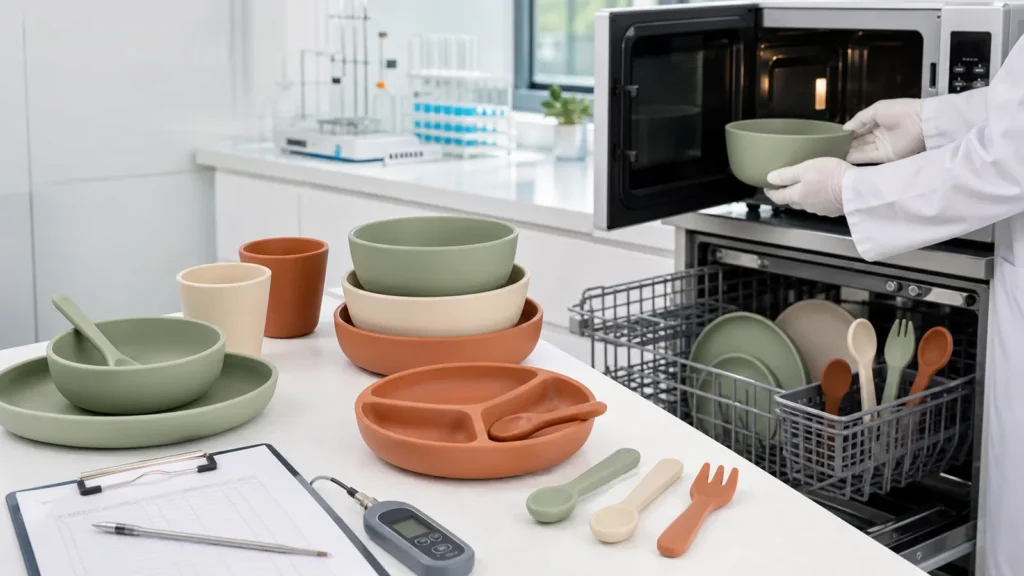
Is Silicone Tableware Microwave Safe and Dishwasher Safe?
A buyer-focused answer on when silicone tableware can be used in microwaves and dishwashers, what evidence matters, and how to validate a custom product.

Custom Tableware Sample Approval: Golden Sample Guide
A stage-gate factory guide to drawings, prototypes, tooling trials, packaging samples, golden samples and production release for custom tableware.

Tableware AQL Inspection: Buyer Guide
A factory-side guide to defect classification, sampling levels, acceptance limits and evidence for silicone and wheat-straw tableware shipments.

Food Contact Tableware Traceability: Buyer Guide
A factory-insider guide to material identity, declarations, test reports, batch records, change control and shipment traceability for B2B tableware buyers.