
Silicone Baby Feeding Set Components: Buyer Guide
A scenario-based guide for importers and brands choosing between compact starter sets, complete mealtime kits and packaging-ready retail assortments.

Silicone baby feeding set components should be selected as a commercial system, not as a race to include the highest piece count. The right combination depends on child stage, intended use, retail price position, packaging volume, cleaning behavior, approval workload and the buyer claim set.
Naike Group manufacturing team reviews component strategy through our custom product development process. We connect assortment decisions to drawings, samples, packaging, quality checkpoints and the target-market brief before a buyer locks the purchase order.
This guide compares practical set architectures without inventing one universal configuration. Buyers can send our factory a channel and product brief when they need a project-specific component recommendation and quotation basis.
Factory insider takeaway: Choose each component because it solves a named feeding, cleaning, storage, merchandising or gifting requirement. Every added piece also adds tooling, color, packaging, testing, inspection and inventory decisions that must be controlled.
Why Silicone Baby Feeding Set Components Need a Buyer Strategy
A set is experienced by the consumer as one product even when it contains several molds and functions. If the plate, bowl, cup, spoon and bib do not share a coherent age range, cleaning routine and visual language, a larger bundle can feel less useful than a focused smaller kit.
For the buyer, every component creates a specification and approval path. Materials, dimensions, suction behavior, closure fit, surface finish, color, decoration, packaging position and inspection points must be defined at the correct revision.
Channel economics also matter. A marketplace listing may benefit from a visually complete bundle, while a compact retail shelf position may reward a smaller pack with clearer use and lower freight volume.
The decision should begin with the intended user and sale rather than the supplier catalog. Product links are useful references, but the final RFQ must identify which components are required, optional or expected to be developed.
How silicone baby feeding set components change project risk
Adding one component can introduce another mold, cavity plan, color-matching surface, functional interface and packaging support requirement. The apparent unit-price gain from a larger set should be reviewed against this additional control work.
Removing a component can also weaken the offer if it breaks the intended meal routine or gift presentation. Buyers need a documented reason for each inclusion and exclusion.
Match the Set Architecture to the Sales Scenario
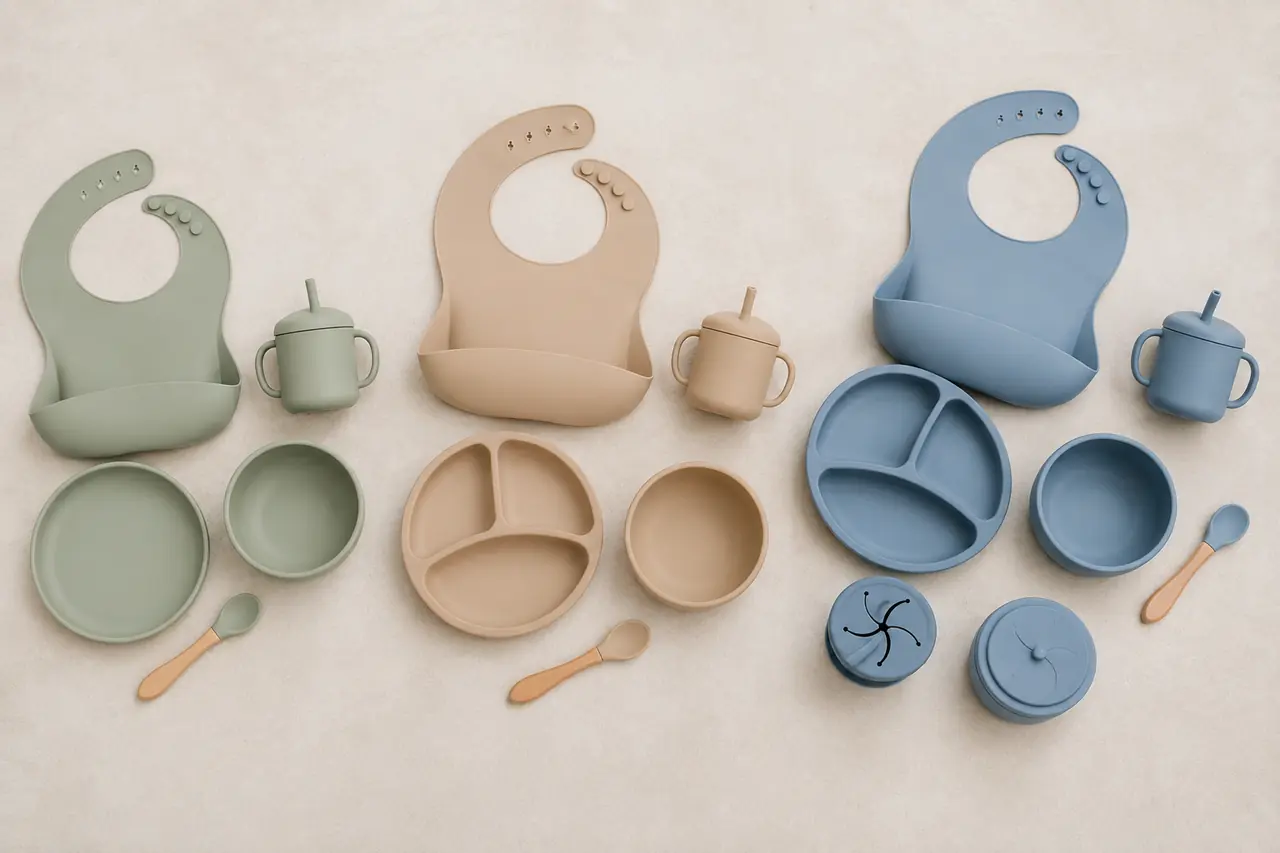
A starter set often centers on a plate or bowl, one utensil and a bib. It can simplify the buying message and packaging, but it must still deliver a complete use case for the intended feeding stage.
A standard mealtime set may add a second vessel, cup or coordinated utensils. This improves assortment depth while keeping component count manageable for sampling, color approval and replenishment.
An expanded gift set may include several vessels, a cup, bib, utensils and a storage or snack component. It provides stronger unboxing impact but increases package volume, insert design, inventory balance and the number of buyer-visible interfaces.
A travel-oriented configuration prioritizes compact nesting, closures and transport. Those benefits require specific fit, leakage, handling and cleaning reviews that should not be inferred from a tabletop-only set.
Which component mix belongs in an OEM baby feeding set?
Use the consumer task, channel, target retail position and packaging limit to define the minimum complete experience. Then evaluate optional additions against incremental value and approval cost.
Browse our custom tableware product catalog for real component directions, but treat the final project as a controlled set specification rather than a collection of unrelated listing titles. Record every selected item in the RFQ by product reference and intended role.
Define the Function of Each Feeding Component
Plates and bowls should be chosen by meal type, portion architecture, table contact and caregiver handling. A divided plate supports separation, while a bowl may better serve foods that require scooping or mixing.
Bibs influence coverage, neck adjustment, pocket geometry, comfort and cleaning. A visually matching bib is not automatically compatible with the same age range or pack size as the other components.
Cups introduce grip, rim, straw, lid and transition-stage decisions. If a lid or straw is included, fit and repeated assembly become system-level checkpoints rather than cosmetic accessories.
Spoons and forks should match the intended user and feeding method. Handle size, tip geometry, softness, stiffness and storage position all affect the buyer brief and should be reviewed with actual samples.
Do more silicone baby feeding set components create more value?
Only when the additional pieces solve relevant needs and remain easy to explain, pack and replenish. Unnecessary accessories can increase cost and inspection work while making the offer harder to understand.
A buyer should compare complete consumer tasks covered per set, not only pieces per package. This produces a more defensible assortment and clearer quotation.
Inspect Interfaces before Approving the Complete Set
Components that touch or connect need interface specifications. Lids, straws, plugs, utensil rests, stacking features and packaging inserts should be checked across normal production variation rather than on one ideal development sample.
Suction performance depends on product geometry, material behavior, table surface and use conditions. Buyers should define the intended surface and evaluation method instead of relying on an absolute marketing phrase.
Nesting can reduce packaging volume but may create deformation, scuffing or difficult removal if not evaluated. The packaging trial should reproduce the planned packing duration and transport orientation.
Color coordination should be reviewed after components are assembled. Different thicknesses, textures and curvatures can change perceived color even when one pigment direction is used.
How should a factory document component compatibility?
The record should identify product revisions, interface dimensions, test or use conditions, sample quantity, result and approval owner. Photographs can support the file when linked to the actual sample identity.
A new interface or proprietary geometry may require the controlled stages described on our custom mold tooling page. Drawing approval must happen before trial conclusions can govern production.

Map Claims and Compliance to the Real Configuration
The target-market review should begin with intended use, user age, food-contact conditions and the exact component construction. A report for one material or product does not automatically cover a different item, colorant, accessory or claim.
Buyers should maintain a bill of materials and component list that match the tested and purchased configuration. Marketing copy, packaging and technical files should use the same product identity and revision.
Where a set combines silicone with plastic, metal, textile, paper or another material, each relevant component needs its own evidence path. The word set does not turn different materials into one compliance decision.
Changes to color, supplier, formulation, geometry or intended use require review before old evidence is reused. The responsible compliance professional should determine the scope needed for the destination market.
What evidence should accompany silicone baby feeding set components?
Request documents that identify the tested sample, material, standard or method, laboratory, result and applicable market. Confirm that the report identity maps to the exact component and claim being sold.
Avoid treating a logo on a certificate as proof of every product statement. Evidence quality comes from scope, traceability and relevance to the current configuration.
Separate Private Label Changes from New Component Development
A private-label project may use existing product geometry with approved color, logo and packaging changes. This route can reduce development complexity, but the buyer still needs a controlled sample and configuration list.
A new component shape or functional interface moves the project into tooling and engineering review. Drawings, tolerances, mold route, trial revisions and production release must be quoted as part of the development plan.
Logo methods should be selected by surface, visibility, cleaning exposure and brand requirement. Debossing, embossing or printing create different tooling, appearance and repeat-order implications.
Color allocation across components influences minimum quantities and production planning. A set with many colors may require more material preparation, changeovers and packaging control than a coordinated single-color program.
When should buyers request custom silicone feeding components?
Request new development when the required function, brand distinction or component integration cannot be achieved responsibly with an existing item. Define measurable user and commercial outcomes before asking for a new shape.
Use our custom project review form to share sketches, reference products and must-have functions. Our factory can separate existing options, modifications and true new-mold work in the quotation.
Test Packaging with the Final Component Mix
Packaging must hold the approved set securely and present it clearly. A sleeve, folding carton, window box or other structure should be selected after component dimensions, nesting and retail requirements are stable.
The insert or restraint system should prevent unwanted movement without deforming soft parts during storage. Packing trials need the actual product, not only estimated dimensions from early drawings.
Carton optimization should consider package orientation, master-carton count, protection and handling. Removing empty space can improve logistics, but over-compression may affect presentation or product condition.
Artwork must match the final component count, material claims, warnings and market information. Late assortment changes can make approved packaging inaccurate and should trigger a controlled revision.
How packaging changes the component decision
A component that adds little consumer value but forces a much larger box may weaken the commercial case. Conversely, a well-nested addition may strengthen the offer with limited freight impact.
Our private label packaging workflow connects dielines, samples, packing checks and export preparation. Review packaging before the assortment is commercially locked.

Prepare a Component-Level RFQ and Quotation Basis
List every required component with product reference, material direction, color, logo, quantity and packaging position. Mark optional items separately so the factory can quote meaningful alternatives rather than guess the intended set.
For existing products, provide the verified product link and identify which visible attributes are references rather than final specifications. For custom items, include drawings, target dimensions, functions and interface requirements.
Ask the quotation to separate product, mold or tooling, sample, packaging and testing assumptions where relevant. MOQ, lead time and cost depend on the selected configuration, colors, quantity and evidence plan and should be confirmed per project.
State the approval sequence and responsible buyer contacts. A project moves more reliably when commercial, design, compliance and quality decisions have named owners and due dates.
Send a silicone baby feeding set component brief
When the scenario and must-have components are clear, request an OEM configuration review with quantities, colors, market and packaging direction. Naike Group manufacturing team will identify missing specifications before a fixed quotation.
Review our factory capability overview to see how sampling, molding, assembly, inspection and packing connect. The best component plan is one the production and quality systems can control.
Compare Three Silicone Feeding Set Architectures
The best choice depends on the named customer and channel. This table frames the tradeoffs buyers should validate before requesting a final quote. Record the selected comparison assumptions in the silicone baby feeding set components project brief before quotation.
| Architecture | Typical Purpose | Buyer Advantage | Control Burden | Decision Question |
|---|---|---|---|---|
| Compact starter set | Focused first-stage or entry offer | Clear use and smaller pack | Fewer components but use case must be complete | Does it solve one full feeding routine? |
| Standard mealtime set | Core retail or marketplace assortment | Balanced utility and presentation | More color and component coordination | Which pieces drive repeatable daily value? |
| Expanded gift set | Premium gifting or broad bundle | Strong visual and perceived value | Higher packaging and inventory complexity | Does every added item justify its space and approval work? |
| Travel configuration | Mobile feeding and storage | Compact portable use | Fit closure and transport checks | Which interfaces must remain secure in use? |
| Existing-geometry private label | Faster brand customization route | Lower development complexity | Color logo packaging still need approval | Can existing functions meet the channel need? |
| New-mold integrated set | Distinct function or brand architecture | Proprietary product direction | Engineering tooling and revision control | Is the differentiation measurable and commercially justified? |
B2B Buyer Checklist for Feeding Set Components
Complete this checklist before comparing supplier quotations. Each answer should be reflected in the component list, samples and packaging brief. Record every answer against the current silicone baby feeding set components project assumptions and approval owner.
| Check | Question | Why It Matters |
|---|---|---|
| User scenario | Which feeding stage task and caregiver routine must the set support? | The use case determines whether the component mix is coherent. |
| Channel position | Is the offer entry core premium gift or travel focused? | Channel and price position change the appropriate bundle size. |
| Component identity | Does every item have a product reference revision and required function? | Piece counts cannot replace controlled specifications. |
| Interfaces | Which lids straws nesting features or utensils must fit together? | Connected items require system-level approval. |
| Material map | Are all materials colors and suppliers identified per component? | Different constructions need separate evidence and change control. |
| Claim scope | Do intended-use and marketing claims map to the tested configuration? | Evidence for one item may not cover the entire set. |
| Customization route | Which items are existing private label modifications or new molds? | The development path changes cost timing and approval gates. |
| Color coordination | How will components be matched and allocated across the set? | Different surfaces can create visible mismatch. |
| Packaging trial | Has the final component mix been packed in the intended structure? | Real packing reveals movement deformation and volume problems. |
| Quotation basis | Are quantity color split testing packaging and tooling assumptions explicit? | Comparable quotations require the same project scope. |
Factory Control Notes for silicone baby feeding set components
Together, these decisions turn a visually attractive assortment into a configuration that can be quoted, approved, produced and replenished. Each silicone baby feeding set components decision should identify its owner, evidence and release condition.
1. User scenario control for silicone baby feeding set components
For silicone baby feeding set components, the user scenario checkpoint must become a dated project record rather than an informal chat instruction. The resulting user scenario record must name its owner, source evidence, revision authority and the commercial consequence of a late change after the buyer asks, “Which feeding stage task and caregiver routine must the set support?”
The use case determines whether the component mix is coherent. For the user scenario decision in this silicone baby feeding set components project, our factory links the checkpoint to the quotation, approved sample, purchase order or inspection standard that governs the next approval. If the silicone baby feeding set components evidence is incomplete, the team holds that approval gate, closes the information gap and records the revised assumption before production continues.
2. Channel position control for silicone baby feeding set components
For silicone baby feeding set components, the channel position checkpoint must become a dated project record rather than an informal chat instruction. The resulting channel position record must name its owner, source evidence, revision authority and the commercial consequence of a late change after the buyer asks, “Is the offer entry core premium gift or travel focused?”
Channel and price position change the appropriate bundle size. For the channel position decision in this silicone baby feeding set components project, our factory links the checkpoint to the quotation, approved sample, purchase order or inspection standard that governs the next approval. If the silicone baby feeding set components evidence is incomplete, the team holds that approval gate, closes the information gap and records the revised assumption before production continues.
3. Component identity control for silicone baby feeding set components
For silicone baby feeding set components, the component identity checkpoint must become a dated project record rather than an informal chat instruction. The resulting component identity record must name its owner, source evidence, revision authority and the commercial consequence of a late change after the buyer asks, “Does every item have a product reference revision and required function?”
Piece counts cannot replace controlled specifications. For the component identity decision in this silicone baby feeding set components project, our factory links the checkpoint to the quotation, approved sample, purchase order or inspection standard that governs the next approval. If the silicone baby feeding set components evidence is incomplete, the team holds that approval gate, closes the information gap and records the revised assumption before production continues.
4. Interfaces control for silicone baby feeding set components
For silicone baby feeding set components, the interfaces checkpoint must become a dated project record rather than an informal chat instruction. The resulting interfaces record must name its owner, source evidence, revision authority and the commercial consequence of a late change after the buyer asks, “Which lids straws nesting features or utensils must fit together?”
Connected items require system-level approval. For the interfaces decision in this silicone baby feeding set components project, our factory links the checkpoint to the quotation, approved sample, purchase order or inspection standard that governs the next approval. If the silicone baby feeding set components evidence is incomplete, the team holds that approval gate, closes the information gap and records the revised assumption before production continues.
5. Material map control for silicone baby feeding set components
For silicone baby feeding set components, the material map checkpoint must become a dated project record rather than an informal chat instruction. The resulting material map record must name its owner, source evidence, revision authority and the commercial consequence of a late change after the buyer asks, “Are all materials colors and suppliers identified per component?”
Different constructions need separate evidence and change control. For the material map decision in this silicone baby feeding set components project, our factory links the checkpoint to the quotation, approved sample, purchase order or inspection standard that governs the next approval. If the silicone baby feeding set components evidence is incomplete, the team holds that approval gate, closes the information gap and records the revised assumption before production continues.
6. Claim scope control for silicone baby feeding set components
For silicone baby feeding set components, the claim scope checkpoint must become a dated project record rather than an informal chat instruction. The resulting claim scope record must name its owner, source evidence, revision authority and the commercial consequence of a late change after the buyer asks, “Do intended-use and marketing claims map to the tested configuration?”
Evidence for one item may not cover the entire set. For the claim scope decision in this silicone baby feeding set components project, our factory links the checkpoint to the quotation, approved sample, purchase order or inspection standard that governs the next approval. If the silicone baby feeding set components evidence is incomplete, the team holds that approval gate, closes the information gap and records the revised assumption before production continues.
7. Customization route control for silicone baby feeding set components
For silicone baby feeding set components, the customization route checkpoint must become a dated project record rather than an informal chat instruction. The resulting customization route record must name its owner, source evidence, revision authority and the commercial consequence of a late change after the buyer asks, “Which items are existing private label modifications or new molds?”
The development path changes cost timing and approval gates. For the customization route decision in this silicone baby feeding set components project, our factory links the checkpoint to the quotation, approved sample, purchase order or inspection standard that governs the next approval. If the silicone baby feeding set components evidence is incomplete, the team holds that approval gate, closes the information gap and records the revised assumption before production continues.
8. Color coordination control for silicone baby feeding set components
For silicone baby feeding set components, the color coordination checkpoint must become a dated project record rather than an informal chat instruction. The resulting color coordination record must name its owner, source evidence, revision authority and the commercial consequence of a late change after the buyer asks, “How will components be matched and allocated across the set?”
Different surfaces can create visible mismatch. For the color coordination decision in this silicone baby feeding set components project, our factory links the checkpoint to the quotation, approved sample, purchase order or inspection standard that governs the next approval. If the silicone baby feeding set components evidence is incomplete, the team holds that approval gate, closes the information gap and records the revised assumption before production continues.
9. Packaging trial control for silicone baby feeding set components
For silicone baby feeding set components, the packaging trial checkpoint must become a dated project record rather than an informal chat instruction. The resulting packaging trial record must name its owner, source evidence, revision authority and the commercial consequence of a late change after the buyer asks, “Has the final component mix been packed in the intended structure?”
Real packing reveals movement deformation and volume problems. For the packaging trial decision in this silicone baby feeding set components project, our factory links the checkpoint to the quotation, approved sample, purchase order or inspection standard that governs the next approval. If the silicone baby feeding set components evidence is incomplete, the team holds that approval gate, closes the information gap and records the revised assumption before production continues.
10. Quotation basis control for silicone baby feeding set components
For silicone baby feeding set components, the quotation basis checkpoint must become a dated project record rather than an informal chat instruction. The resulting quotation basis record must name its owner, source evidence, revision authority and the commercial consequence of a late change after the buyer asks, “Are quantity color split testing packaging and tooling assumptions explicit?”
Comparable quotations require the same project scope. For the quotation basis decision in this silicone baby feeding set components project, our factory links the checkpoint to the quotation, approved sample, purchase order or inspection standard that governs the next approval. If the silicone baby feeding set components evidence is incomplete, the team holds that approval gate, closes the information gap and records the revised assumption before production continues.
Authoritative References and Practical Limits
The U.S. FDA maintains official information on food contact substances and the regulatory framework for materials intended to contact food. Review the FDA food contact substances page. Buyers should confirm how this reference applies to the named product, target market and current silicone baby feeding set components project.
The European Commission describes EU legislation for food contact materials, including the general framework and good manufacturing practice. Review the official European Commission legislation overview. Buyers should confirm how this reference applies to the named product, target market and current silicone baby feeding set components project.
The Australian Competition and Consumer Commission explains mandatory standards and bans that businesses must check when supplying consumer products. Review the official Product Safety Australia standards resource for the intended product and claims. Buyers should confirm how this reference applies to the named product, target market and current silicone baby feeding set components project.
This guide supports sourcing decisions and does not define a universal set, age grade, safety claim, certification or legal conclusion. Buyers must confirm the actual component construction, intended use, instructions, target markets and applicable requirements with qualified product and compliance professionals.
Silicone Baby Feeding Set Components FAQ
How many components should an OEM feeding set include?
There is no universal count. Choose the smallest coherent mix that supports the intended feeding routine, channel value and packaging plan.
Can components from different existing products be combined?
Often they can be reviewed as a proposed set, but fit, use, color, evidence and packaging must be evaluated together before approval. The final component list should use controlled product references.
Does adding a lid or straw require extra checks?
Yes. Connected parts introduce fit, assembly, repeated-use, cleaning and change-control considerations that should be defined for the real configuration.
When is a custom mold justified?
New tooling is appropriate when a measurable function, interface or brand requirement cannot be met responsibly with existing geometry and the business case supports development. Buyers should define the expected outcome before engineering review.
Should all components use exactly the same color?
That depends on the design intent. If they must coordinate, approve the assembled set because thickness, texture and geometry can change perceived color.
What information is needed for a reliable quotation?
Provide component references, quantities, colors, logo methods, market, packaging, testing expectations and identify which items require modification or new tooling. Separate required and optional components so alternatives remain comparable.
Conclusion: Choose a Set That Can Be Controlled and Reordered
The best silicone baby feeding set components form one understandable consumer solution and one traceable factory specification. Each included piece should justify its function, package space and added approval work.
Our factory reviews the assortment through component identity, interfaces, materials, color, customization route, evidence and packaging trials. This exposes hidden complexity before it becomes a late quotation or production problem.
Bring your channel, target quantity and must-have component list to discuss a silicone feeding set configuration. Naike Group manufacturing team can compare practical existing options and identify where custom development adds real value.
Turn the Component List into a Quotable Program
Share your target customer, market, quantities, required functions, colors and packaging direction for a structured factory review. Our manufacturing team will use those details to define the next review step for your silicone baby feeding set components project.
Request a Custom Quote
Share your product, quantity, target market and customization needs. Our factory team will reply with the next practical step.
Continue Your Sourcing Research
The six newest factory-side articles are updated automatically by publication date.

Wheat Straw vs Bagasse Tableware: Buyer Comparison
A B2B decision guide comparing reusable wheat-straw polypropylene composite tableware with molded bagasse fiber formats across use, evidence, operations and end of life.

Can Wheat Straw Tableware Be Recycled? Buyer Q&A
A practical buyer answer on whether reusable wheat-straw composite tableware can enter PP recycling streams, which evidence matters, and how to qualify market claims.

Global SKU vs Regional SKU: Tableware Decision Guide
A buyer decision framework for choosing one global tableware SKU or controlled regional variants across compliance, packaging, logistics, inventory and change control.

Australia Food Packaging Evidence: Buyer Guide
A practical evidence guide for Australian food-packaging buyers covering intended use, migration risk, supplier assurance, testing, hygiene, release and change control.

EU PPWR Tableware Packaging vs Conventional Packs
A buyer comparison of PPWR-ready and conventional tableware packaging across product protection, material choices, empty space, evidence, labeling and release timing.

Prop 65 Tableware Requirements: Buyer Q&A
A practical buyer Q&A for defining California Proposition 65 exposure scenarios, evidence, warning decisions, supplier records and release controls for tableware.