
How to Verify Wheat Straw Fiber Content Claims
A practical evidence framework for importers and private-label teams that need to approve a wheat-straw composite claim without confusing recipe percentage, biobased carbon and product performance.

Quick Answer: To verify wheat straw fiber content, a B2B buyer should match a clearly defined percentage claim to the current formulation, supplier identity, receiving records, batch weighing data, production yield and a representative finished-product sample. Laboratory testing can strengthen the file, but no single test automatically proves both the exact mass percentage and the botanical identity of wheat straw.
The first commercial question is what the stated percentage actually measures, not whether the product merely looks natural. Naike Group manufacturing team separates dry wheat-straw input, total plant-derived content, biobased carbon and finished-product mass because those values can differ even when each calculation is technically correct.
Buyers can compare the claim with our published explanation of wheat-straw composite material and the available custom wheat-straw product options. When a project needs a claim-specific evidence plan, send your sourcing brief for a factory review before artwork or packaging language is approved.
This guide is an evidence framework, not a promise that every formulation contains one standard fiber percentage. The approved claim must follow the actual product code, color, production route, market wording and evidence available for that specific order.
Factory Insider takeaway: Define the claim first, then build a traceable evidence chain that connects the declared basis, current recipe, controlled batch and representative product. Treat radiocarbon, microscopy and chemical analysis as purpose-specific tools with limits rather than automatic certificates of an exact wheat-straw percentage. For this material claim, the sign-off file must identify who owns each proof item and which unresolved gap stops release.
Define What “Wheat Straw Fiber Content” Actually Means
A claim such as “30% wheat straw” can refer to the dry fiber added during compounding, the proportion of a purchased masterbatch, the mass of all plant-derived ingredients, or the percentage of biobased carbon measured in a laboratory. Those bases are not interchangeable, so the specification must state the numerator, denominator, moisture condition and production stage used for the percentage.
For example, a compounder may weigh dry straw powder against the total charged batch, while a laboratory reports modern carbon as a share of total organic carbon. Mineral fillers, pigments, processing aids, water and non-carbon components affect total product mass without appearing in a carbon-only result.
The buyer should also distinguish wheat straw from generic plant fiber. A result showing biogenic carbon supports the presence of recent biological carbon, but it does not by itself identify wheat, the agricultural source, the harvest region or the physical form of the plant material.
Write a claim definition before trying to verify wheat straw fiber content
A usable claim definition identifies dry wheat-straw powder charged as a percentage of total dry compound input by mass. Another project may legitimately use a different basis, but the wording must remain consistent across the bill of materials, test request, artwork and buyer approval record.
If the marketing team wants to say “made with wheat straw,” the file should still identify the minimum controlled addition and the parts of the product covered by the claim. Packaging, removable components and accessories should not be implied to share the same composition unless their evidence is included.
Build an Evidence Ladder Instead of Relying on One Certificate
The strongest verification file combines evidence from several levels. Commercial specifications define the claim, supplier documents identify the straw material, factory records show what entered the batch, production traceability links that batch to finished goods, and an appropriate laboratory method challenges a specific part of the claim.
A supplier statement alone is useful but incomplete because it may describe a standard material rather than the lot used for the order. A laboratory report alone can also be incomplete when the method measures biobased carbon but the artwork claims an exact mass percentage of wheat-straw powder.
Evidence should be assessed for relevance, identity, date, sample selection and scope. A technically valid report on another color, another resin system or an earlier formulation cannot automatically release the current SKU.
Use independent and factory evidence for different questions
Independent testing is valuable when the buyer needs an impartial measurement or a market-recognized method. Factory evidence remains essential because it explains material identity, batch handling, recipe control, production loss and the relationship between the tested specimen and the goods shipped.
Our Factory Capability process connects incoming material, compounding or molding records and final release checkpoints. The goal is not to create the thickest document pack, but to make every document answer a defined buyer question.
Reconcile the Formula with a Batch Mass Balance
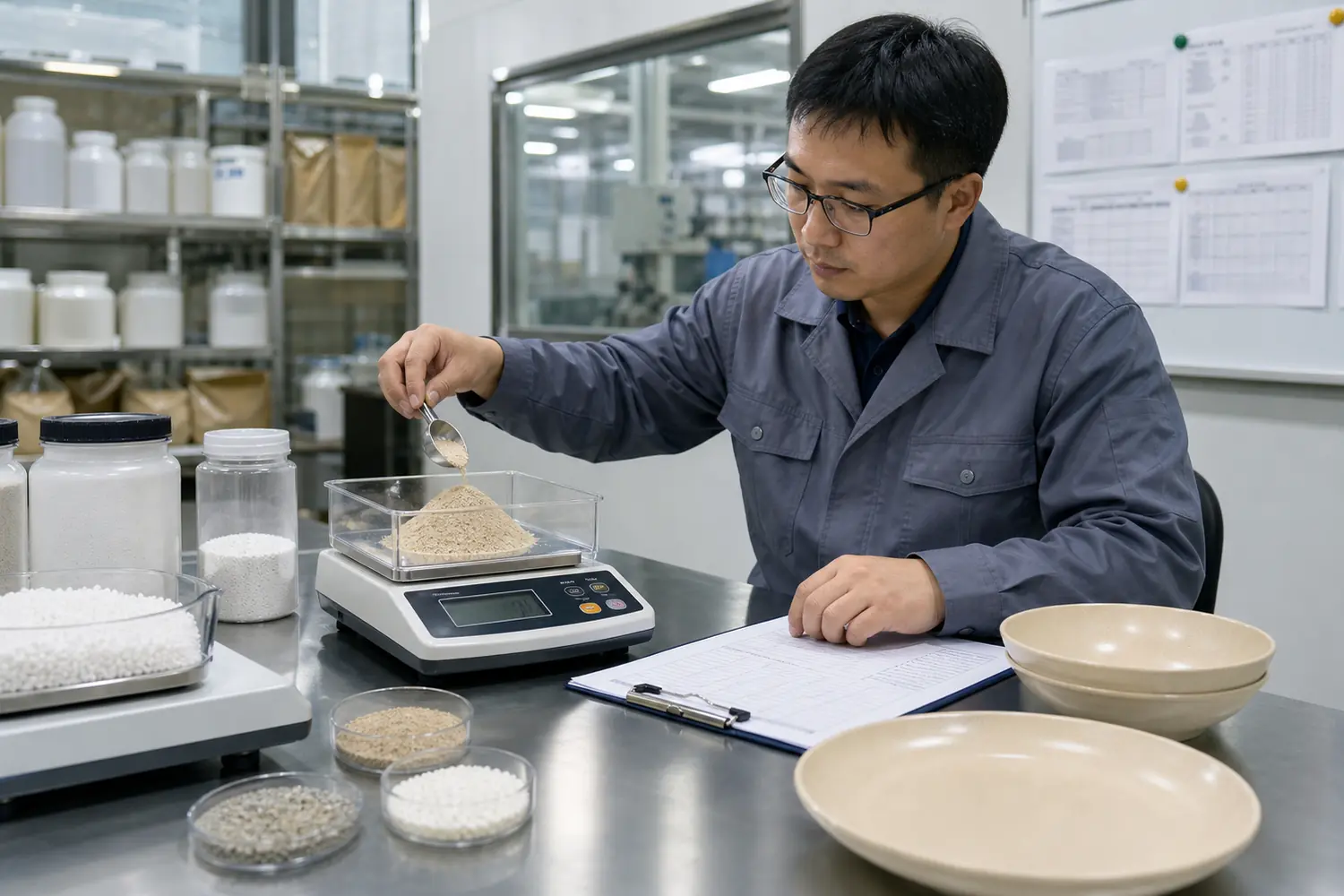
A recipe review begins with controlled material codes and target weights for straw powder, polymer matrix, pigments, fillers and processing aids. The reviewer confirms whether percentages total correctly and whether the declared straw basis matches the units and moisture condition used on the production floor.
The mass balance then compares issued inputs with acceptable output, retained material, scrap, purge and normal process loss. It should not be manipulated to force a marketing percentage; its purpose is to show that a plausible controlled batch produced the sampled goods.
Moisture matters because agricultural powder can gain or lose water during storage and conditioning. If the claim is on a dry basis, the procedure should define how moisture is controlled or corrected rather than treating every incoming kilogram as identical dry fiber.
Challenge the numbers before approving a percentage claim
Ask whether the formula uses pure straw powder or a pre-compounded concentrate. When a masterbatch is used, the calculation must expand its internal composition; calling the full masterbatch weight “wheat straw” would overstate the plant-fiber input.
Review tolerances and scale capability as well as targets. A claimed minimum near the lower edge of normal dosing variation requires a control strategy that prevents routine production from falling below the approved wording.
Confirm Material Identity from Supplier Lot to Finished Carton
The incoming straw material should have a stable internal code, supplier name, lot number and receiving record. Supporting documents may include a specification, certificate of analysis, delivery record and botanical declaration, but each should be checked for the exact material and lot rather than accepted by filename.
During production, the batch or work order should record which material lots were issued and which finished-product lots they produced. This link supports investigation, targeted hold and repeat-order comparison when a claim or appearance changes.
Finished-carton traceability does not need to expose confidential formula details to every downstream party. It does need a controlled path by which the factory can connect a carton code to the relevant records, consistent with the principles in our food-contact tableware traceability guide.
Protect wheat straw identity when substitutions are possible
Plant powders can look similar after milling, so visual inspection is not a reliable botanical release method. Approved-supplier controls, labeled storage, line clearance and documented material issue reduce the risk that wheat straw is replaced by another fiber without a formal review.
A substitution may be technically workable while still invalidating artwork, laboratory scope or buyer approval. The change-control procedure should therefore treat plant source and material grade as claim-critical attributes.
Select Laboratory Methods for the Claim They Can Prove
Radiocarbon methods such as ASTM D6866 distinguish contemporary biogenic carbon from fossil carbon. They can support a biobased-carbon statement for a carbon-containing composite, but they do not directly report the total mass percentage of wheat-straw powder and do not identify wheat as the botanical source.
ISO 16620-2 similarly addresses determination of biobased carbon content in plastics using carbon-14 measurement. The result is useful when the buyer has defined a biobased-carbon claim, yet the report must not be relabeled as an exact fiber-by-weight result.
Microscopy, spectroscopy, thermal analysis or targeted chemical methods may help compare morphology or composition, but their suitability depends on the matrix, particle processing and claim. Buyers should ask a qualified laboratory to state detection limits, reference materials, sample preparation, uncertainty and whether the method can distinguish wheat from other plant sources.
Specify the sample before asking a laboratory to verify wheat straw fiber content
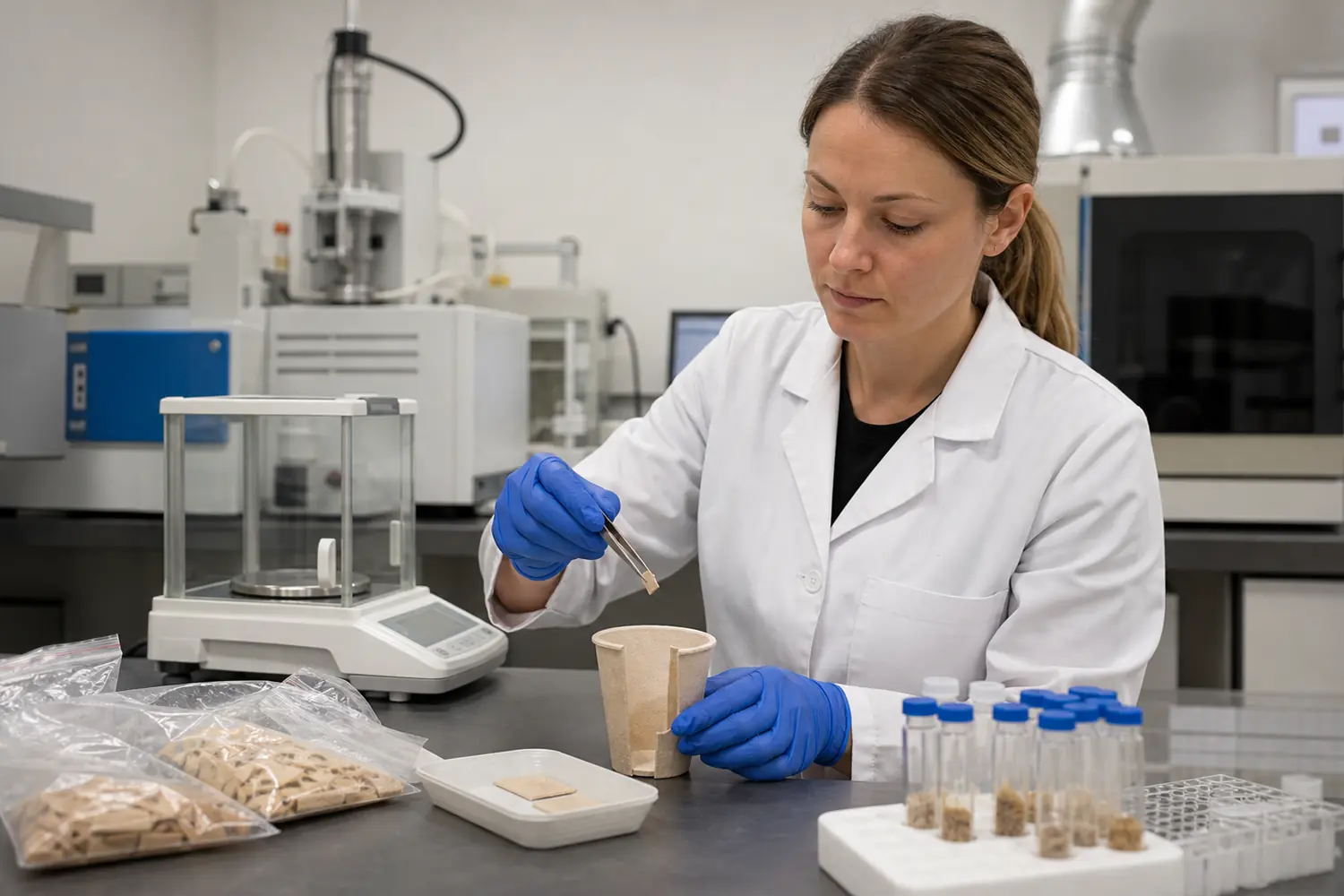
The laboratory request should identify the finished SKU, color, batch and sampling method. Sending loose straw powder can confirm a raw-material characteristic, but it does not prove how much of that material entered the finished article.
Where a destructive test uses a small specimen, the sampling plan should address product and batch variation. Retained duplicate samples and chain-of-custody records help the buyer connect the report to the production lot under review.
Interpret Results without Converting One Metric into Another
A laboratory percentage must be read exactly as defined by the method and report. Biobased carbon percentage, total biobased content, organic carbon, ash, fiber input by mass and finished-product plant fraction describe different quantities and can produce different numbers for the same article.
Uncertainty and natural variation should be considered before setting pass or fail limits. A claim written at the formulation target with no allowance for measurement uncertainty or process variation can turn a normal batch into an apparent failure.
The result should also be checked against plausibility. If the measured biobased carbon is inconsistent with the declared recipe, the team should review sample identity, formulation, carbon-bearing additives and method scope before deciding whether the discrepancy means substitution or calculation error.
Record a buyer decision, not just a laboratory number
The approval memo should state which claim the result supports, which claim it does not support and what additional factory records complete the evidence. This prevents a test report from being reused later for broader statements than the original reviewer accepted.
When evidence remains ambiguous, narrow the claim or obtain better evidence before printing packaging. Buyers can discuss a claim-specific sampling plan with our factory team before committing to a test method.
Translate Technical Evidence into Defensible Market Wording
Environmental wording should be specific about the material and the verified attribute. Broad terms such as “eco-friendly,” “green,” “natural” or “biodegradable” can imply benefits that a fiber-content file does not establish.
The U.S. Federal Trade Commission Green Guides emphasize truthful substantiation and qualification of environmental claims. A claim about renewable materials should identify the material and avoid implying recyclability, biodegradability or total renewable composition when those separate attributes have not been substantiated.
For European and Australian markets, buyers should obtain local regulatory and legal review for final consumer wording. The evidence file should make that review easier by showing the claim basis, product scope, test limitations and person responsible for approval.
Keep the artwork claim aligned with the approved wheat straw evidence
Artwork control should lock the exact wording, product codes and evidence reference. A designer should not convert “contains wheat-straw fiber” into “100% wheat straw,” “plastic-free” or “compostable” because those statements require different facts.
Private-label packaging and logo changes can be managed through our Custom Solutions workflow. The commercial file should preserve the approved claim even when colors, set composition or packaging formats change.
Maintain Wheat Straw Content Evidence across Repeat Orders
A one-time verification does not control every future shipment. Repeat-order release should confirm that the approved supplier, material code, recipe revision and relevant process route remain unchanged or have completed the required reapproval.
Incoming checks can verify labels, lot documents, appearance, moisture or other agreed attributes, while production records confirm dosing and traceability. The level of periodic third-party testing should reflect claim risk, order frequency, material variability and buyer policy rather than an arbitrary calendar interval.
When a result drifts, the factory should preserve affected samples and records before changing the formula. Corrective action may involve supplier investigation, scale verification, moisture review, sample retesting or claim revision, but the response should follow evidence rather than guesswork.
Use change control as continuing evidence for wheat straw content claims
A change in straw supplier, fiber grade, polymer, filler, pigment or dosing route can affect the relevance of previous evidence. The supplier and process review methods in our tableware supplier evaluation guide help assign the correct reapproval level.
The final release record should identify what changed, which documents were reviewed, whether retesting was required and who approved the disposition. That dated decision keeps the claim connected to the goods actually shipped.

Compare Evidence Used to Verify Wheat Straw Fiber Content
No single evidence type answers every composition question. Buyers should combine methods according to the wording, commercial risk and product revision being approved.
| Evidence Type | What It Can Support | What It Cannot Prove Alone | Best Use | Buyer Risk |
|---|---|---|---|---|
| Controlled formulation | Target dry straw input and other recipe components | That every production batch followed the recipe | Define the claim basis and target | Outdated or uncontrolled recipe revision |
| Supplier and lot records | Declared identity and source of the incoming straw material | Exact amount incorporated in finished goods | Material qualification and traceability | Generic documents unrelated to the lot |
| Batch weighing and yield | Actual issued weights and production reconciliation | Botanical identity without supplier control | Verify production execution | Unrecorded rework, moisture or loss |
| ASTM D6866 or ISO 16620-2 | Biobased carbon relative to total organic carbon | Exact wheat-straw mass or wheat identity | Challenge biobased-carbon claims | Converting carbon percentage into fiber percentage |
| Microscopy or analytical comparison | Selected structural or chemical indicators when method is suitable | Universal quantitative wheat identification in every matrix | Investigate identity or anomalies | Overstating a qualitative observation |
| Finished-product traceability | Connection between evidence, batch and shipped SKU | Composition without the underlying records | Release and repeat-order control | Testing a sample not linked to shipment |
B2B Buyer Checklist for Wheat Straw Content Evidence
Use this checklist before approving a percentage, environmental statement, package artwork or repeat order. Each answer should refer to the current SKU and revision.
| Check | Question | Why It Matters |
|---|---|---|
| Claim basis | Does the percentage specify dry fiber input, total product mass, plant-derived content or biobased carbon? | Different bases produce different values and require different evidence. |
| Material identity | Is the wheat-straw powder tied to an approved supplier, grade and lot record? | A generic plant-fiber statement cannot establish the claimed botanical source. |
| Formula control | Is the current recipe revision approved and mathematically reconciled? | An obsolete or incomplete formulation cannot substantiate current production. |
| Batch execution | Do weighing, issue, yield and loss records support the sampled production batch? | Target percentages do not prove that the batch followed the intended recipe. |
| Sample identity | Can the tested specimen be traced to the finished SKU, color and batch? | A valid method on the wrong sample is irrelevant to the shipment. |
| Method scope | Does the laboratory state what the method measures and its uncertainty? | A biobased-carbon result must not be presented as exact wheat-fiber mass. |
| Artwork wording | Is the consumer claim limited to the attribute actually supported? | Fiber content does not automatically prove biodegradability, recyclability or safety. |
| Change control | Which material, supplier, formula or process changes trigger reapproval? | Evidence loses relevance when claim-critical inputs change without review. |
An Eight-Control Evidence Playbook for B2B Buyers
The following controls turn a material claim into repeatable procurement gates. They can be scaled to the risk of the claim without replacing qualified laboratory or legal advice.
1. Claim basis control for verify wheat straw fiber content
For Claim basis, buyer and factory teams answer “Does the percentage specify dry fiber input, total product mass, plant-derived content or biobased carbon?” using the currently approved product revision. Write the declared calculation basis beside the approved wording so purchasing, testing and artwork teams evaluate the same statement.
Different bases produce different values and require different evidence. If the basis remains ambiguous, quarantine the claim from packaging approval until its denominator and measurement route are agreed. Close the item with a dated definition sheet rather than a verbal percentage confirmation.
2. Material identity control for verify wheat straw fiber content
For Material identity, buyer and factory teams answer “Is the wheat-straw powder tied to an approved supplier, grade and lot record?” using the currently approved product revision. Link the powder supplier, material grade and incoming lot to the production traveler used for the reviewed SKU.
A generic plant-fiber statement cannot establish the claimed botanical source. Missing source identity breaks the botanical evidence chain even when the molded article visibly contains fibers. Resolve the gap through supplier documentation, retained input samples or a restricted claim that matches available proof.
3. Formula control control for verify wheat straw fiber content
For Formula control, buyer and factory teams answer “Is the current recipe revision approved and mathematically reconciled?” using the currently approved product revision. Reconcile every dry compound input to one hundred percent and keep the approved revision beside the buyer specification.
An obsolete or incomplete formulation cannot substantiate current production. When totals, units or revisions conflict, treat the recipe calculation as unverified and stop claim-dependent artwork. Engineering should issue a corrected mass-balance record before the commercial team relies on the percentage.
4. Batch execution control for verify wheat straw fiber content
For Batch execution, buyer and factory teams answer “Do weighing, issue, yield and loss records support the sampled production batch?” using the currently approved product revision. Match issued quantities, return weights, yield and documented process loss to the exact batch selected for review.
Target percentages do not prove that the batch followed the intended recipe. A target formula without execution records cannot demonstrate what operators actually charged during production. Production control must explain deviations and obtain quality disposition before that batch represents the claim.
5. Sample identity control for verify wheat straw fiber content
For Sample identity, buyer and factory teams answer “Can the tested specimen be traced to the finished SKU, color and batch?” using the currently approved product revision. Use a chain-of-custody label that connects each laboratory specimen to SKU, color, cavity, batch and sampling date.
A valid method on the wrong sample is irrelevant to the shipment. An unidentified test piece can produce a technically valid result that has no defensible relationship to the shipment. Repeat sampling under witnessed identification when traceability cannot be reconstructed with confidence.
6. Method scope control for verify wheat straw fiber content
For Method scope, buyer and factory teams answer “Does the laboratory state what the method measures and its uncertainty?” using the currently approved product revision. Ask the laboratory to state the measurand, preparation route, reporting basis and uncertainty next to every result.
A biobased-carbon result must not be presented as exact wheat-fiber mass. Do not convert biobased-carbon data into wheat-fiber mass unless a qualified method and defensible calculation support that conversion. The technical review should record both what the method proves and the claims it cannot prove.
7. Artwork wording control for verify wheat straw fiber content
For Artwork wording, buyer and factory teams answer “Is the consumer claim limited to the attribute actually supported?” using the currently approved product revision. Map each package phrase to a specific controlled record, calculation or test conclusion before artwork sign-off.
Fiber content does not automatically prove biodegradability, recyclability or safety. Remove or qualify any environmental implication that extends beyond the documented material attribute. Legal and commercial reviewers can then approve wording without turning one fiber fact into several unsupported promises.
8. Change control control for verify wheat straw fiber content
For Change control, buyer and factory teams answer “Which material, supplier, formula or process changes trigger reapproval?” using the currently approved product revision. Define notification and reapproval triggers for supplier, powder grade, carrier resin, percentage, colorant and processing changes.
Evidence loses relevance when claim-critical inputs change without review. A previous evidence package becomes stale when a claim-critical input changes outside the approved window. Change control should specify whether document review, recalculation, new sampling or laboratory retesting is required.
Authoritative References and Practical Limits
ASTM D6866-24a describes radiocarbon methods for determining biobased carbon content and explicitly limits what the result addresses. Review the official ASTM D6866 record before specifying the method.
ISO 16620-2:2019 specifies calculation of biobased carbon content in plastics based on carbon-14 measurement. Consult the official ISO 16620-2 overview for its stated scope.
The USDA BioPreferred testing process uses accepted laboratories and ASTM D6866 for biobased-content certification within that program. The official BioPreferred testing page also distinguishes a program result from an unsupported supplier label.
The U.S. Federal Trade Commission Green Guides explain that environmental marketing claims should be truthful, substantiated and appropriately qualified. Review the official FTC Green Guides before using broad renewable-material or environmental wording.
This article explains evidence planning and manufacturing controls; it does not certify a product, prescribe one laboratory method or provide legal advice. Final claims, food-contact compliance and market wording require review against the actual product and destination market.
Wheat Straw Fiber Content Buyer FAQ
Can ASTM D6866 prove an exact wheat-straw percentage?
No. It measures biobased carbon relative to total organic carbon under its method, not the exact dry mass of wheat-straw powder or its botanical identity.
Is a supplier declaration enough for private-label artwork?
It can support material identity, but buyers should also connect it to the current recipe, lot, batch execution and finished SKU. Higher-risk percentage claims may need appropriate independent testing or additional analysis.
Can visible brown fiber specks prove wheat straw content?
No. Appearance can support consistency checks, but color and particles cannot reliably identify the plant source or quantify its percentage in a polymer composite.
Does verified wheat straw content mean the product is biodegradable?
No. Biodegradability depends on the entire construction and defined disposal conditions, and it requires separate evidence from a fiber-content or biobased-carbon result.
When should a repeat order be retested?
Retesting frequency should follow claim risk, buyer policy, material variability and change history. A supplier, grade, recipe or process change should trigger a documented impact review even when routine periodic testing is not yet due.
Turn Wheat Straw Evidence into a Release Decision
To verify wheat straw fiber content, begin with a precise claim and connect it to material identity, formula control, batch records, representative samples and a method whose scope matches the wording. This evidence chain is stronger than either a supplier declaration or laboratory percentage used alone.
The practical release decision should state what is proven, what remains outside scope and which changes require reapproval. That discipline protects buyer artwork, supplier accountability and repeat-order consistency without making claims broader than the evidence.
Naike Group manufacturing team can review the proposed composition statement alongside the intended product, packaging and target market. Use our custom tableware catalog to define the product family before preparing the evidence brief.
Contact Naike Group for a Claim-Specific Factory Review
Contact our manufacturing team: Share the product link, proposed wheat-straw wording, target percentage basis, market and expected order quantity. Our factory team will identify the records, sample controls and decision points needed before quotation or artwork release.
Request a Custom Quote
Share your product, quantity, target market and customization needs. Our factory team will reply with the next practical step.
Continue Your Sourcing Research
The six newest factory-side articles are updated automatically by publication date.

Platinum Cured vs Peroxide Cured Silicone: Buyer Comparison
A decision-focused comparison of platinum-addition and peroxide cure systems for custom silicone tableware, including process, evidence and sourcing tradeoffs.

Is Silicone Tableware Microwave Safe and Dishwasher Safe?
A buyer-focused answer on when silicone tableware can be used in microwaves and dishwashers, what evidence matters, and how to validate a custom product.

Custom Tableware Sample Approval: Golden Sample Guide
A stage-gate factory guide to drawings, prototypes, tooling trials, packaging samples, golden samples and production release for custom tableware.

Tableware AQL Inspection: Buyer Guide
A factory-side guide to defect classification, sampling levels, acceptance limits and evidence for silicone and wheat-straw tableware shipments.

Food Contact Tableware Traceability: Buyer Guide
A factory-insider guide to material identity, declarations, test reports, batch records, change control and shipment traceability for B2B tableware buyers.

Silicone Shore Hardness: Tableware Buyer Guide
A factory-side guide to Shore A measurement, thickness effects, functional tradeoffs and approval controls for custom silicone tableware.