
Silicone Tableware Durability Test: Evidence Guide
Connect a precise reusable claim to baseline data, controlled cycles, interval checks, retained samples, production records, and change triggers.

A silicone tableware durability test proves only what its controlled reuse claim, production-intent samples, baseline measurements, cycle conditions, interval checks, and acceptance limits cover. Strong evidence combines repeated washing, heating, cooling, food contact, flexing, storage, and functional use as relevant, then compares traceable samples with uncycled controls and confirms that material, geometry, appearance, and function remain inside the buyer-approved boundary.
A statement such as reusable for years cannot be supported by ten undefined dishwasher cycles or a supplier brochure. Buyers need a claim-to-evidence file that explains why the selected stresses represent foreseeable use, which properties were measured, who performed each check, and what change would trigger review or retesting.
Durability evidence is also different from basic regulatory status. A food-contact authorization, declaration, or migration report may address a legal or chemical question, while repeated-use performance needs its own product-specific protocol and production controls.
Evidence Answer: Define the Claim Before Counting Cycles
Write the intended foods, temperatures, heating methods, cleaning chemistry, dishwasher program, cycle count, flexing, closure, suction, storage, and expected cosmetic condition before testing. Establish new-sample controls, examine results at intervals, and approve limits for dimensions, mass, hardness where relevant, color, odor, tackiness, cracks, deformation, print, seal, suction, stacking, and other claimed functions.
Buyers can send the reuse claim, product drawing, material status, markets, and care instructions for a durability-evidence scoping review. The output should be a controlled test question and evidence plan, not a universal cycle number promised for every silicone product.
Define the Reuse Claim and Its Failure Endpoints
Start with the exact product and user promise. Microwave reheating, dishwasher cleaning, freezer storage, boiling exposure, repeated sealing, suction performance, flexible handling, print retention, stain resistance, and cosmetic life are different claims with different stresses and endpoints. A broad reusable label does not identify which of those behaviors must remain unchanged.
Describe the user, food types, maximum and routine temperatures, contact time, cleaning delay, detergent, wash program, drying, storage, and expected number or frequency of uses. The food-contact conditions of use framework helps convert marketing language into exposure variables. Durability adds repetition and cumulative change to that same disciplined use definition.
List unacceptable outcomes before the samples are conditioned. These can include cracks, tears, permanent set, warpage, swelling, tackiness, oil bleed, color change, odor or flavor transfer, residue retention, print loss, lid or seal failure, reduced suction, unstable stacking, sharp damage, or dimensional drift. Separate safety-critical, functional, cosmetic, and documentation endpoints so a minor appearance shift is not treated like a structural failure.
Avoid absolute no-change requirements unless a measurement method and tolerance make them meaningful. Every real instrument and material has variation, and some benign conditioning may occur early. The buyer should define the maximum acceptable change and the commercial reason for that limit.
Turn the silicone tableware durability test into a controlled question
Write one sentence connecting the product, claim, cycles, environment, measurements, and pass rule. For example, the protocol may ask whether a named production-intent bowl retains dimensions, surface integrity, color boundary, and lid fit after a defined wash-and-heat sequence under the approved care instructions.
That sentence prevents method drift when suppliers or laboratories quote alternatives. Any deviation should state which part of the claim is no longer represented and who approved the change.
Create a Traceable Baseline Before Reuse Cycling
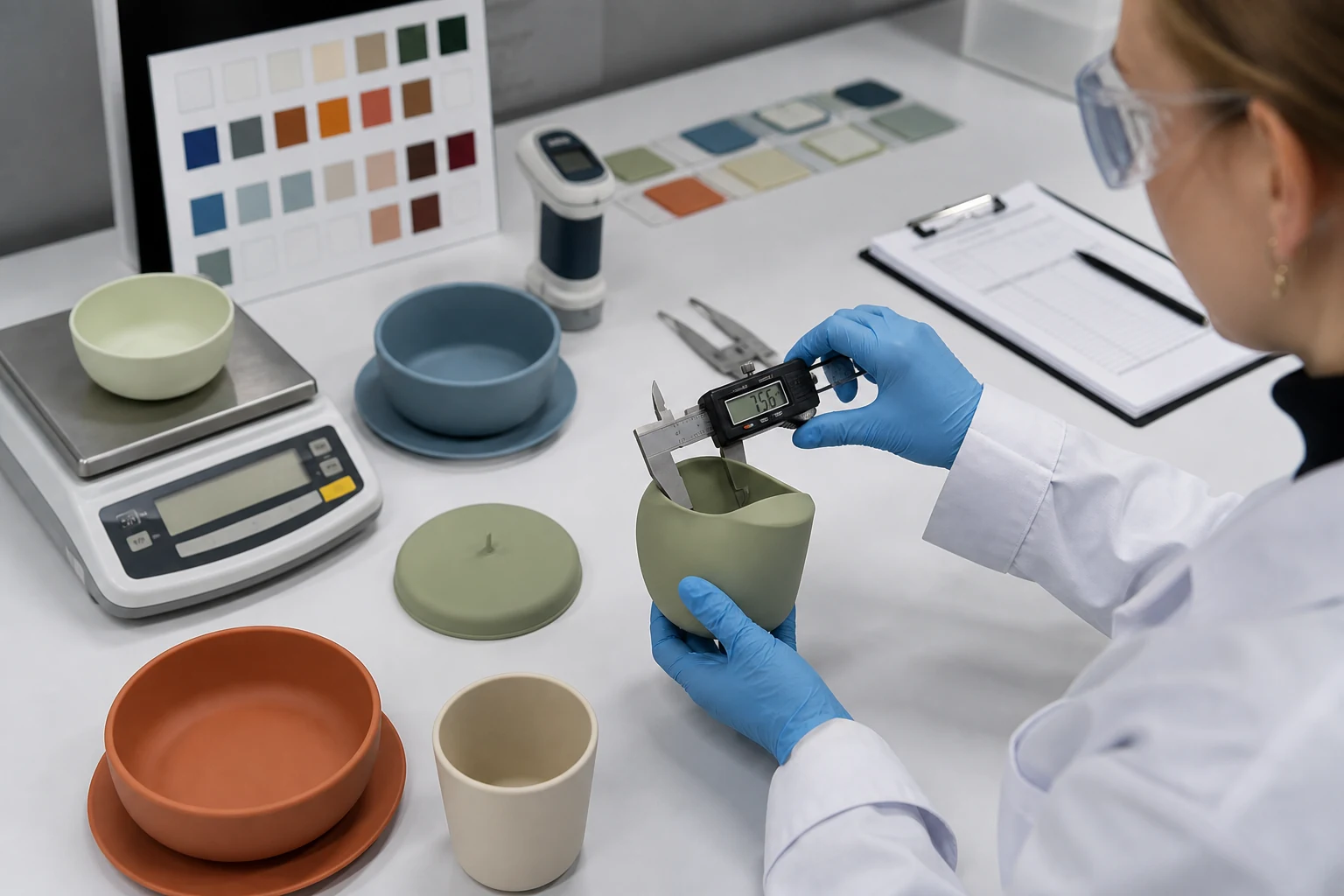
Use production-intent samples made with the approved silicone grade, pigment, additives, tool, cavity, process, post-cure where applicable, decoration, assembly, and packaging. Prototype material plaques can answer narrow material questions, but they do not reproduce molded geometry, knit areas, wall transitions, surface texture, closures, or final handling. Record batch, cavity, date, revision, and pack history for every specimen.
Measure the properties that the cycle could change. Depending on the article, baseline data may include dimensions, mass, hardness using an appropriate method, color under controlled conditions, surface gloss or texture, odor, tear-prone features, seal force, leakage, suction setup and release, lid fit, stack height, print adhesion, and photographs against approved references. Do not collect numbers that have no acceptance or diagnostic purpose.
Keep uncycled controls from the same lot under defined storage. Controls reveal ordinary measurement variation, color drift in storage, assessor differences, or a pre-existing defect that might otherwise be blamed on reuse. They also help when the conditioned article looks different but remains inside the approved commercial range.
Randomize sample codes and define measurement locations. Silicone flexes under handling, so fixture, dwell time, compression, temperature, and operator technique can affect results. Repeatable setup is essential if small dimensional or functional changes will drive a release decision.
Connect baseline approval to the golden product file
Link the protocol and baseline to the controlled sample approval described in the custom tableware sample guide. The file should include drawing revision, material identification, color reference, functionality, care text, packaging, photographs, signatures, and retained counterparts.
If the final cycle specimens differ from the approved sample, stop and resolve identity before interpreting performance. A technically good result on the wrong pigment, tool revision, or component set is not evidence for the purchase order.
Select Cycles That Represent Foreseeable Reuse
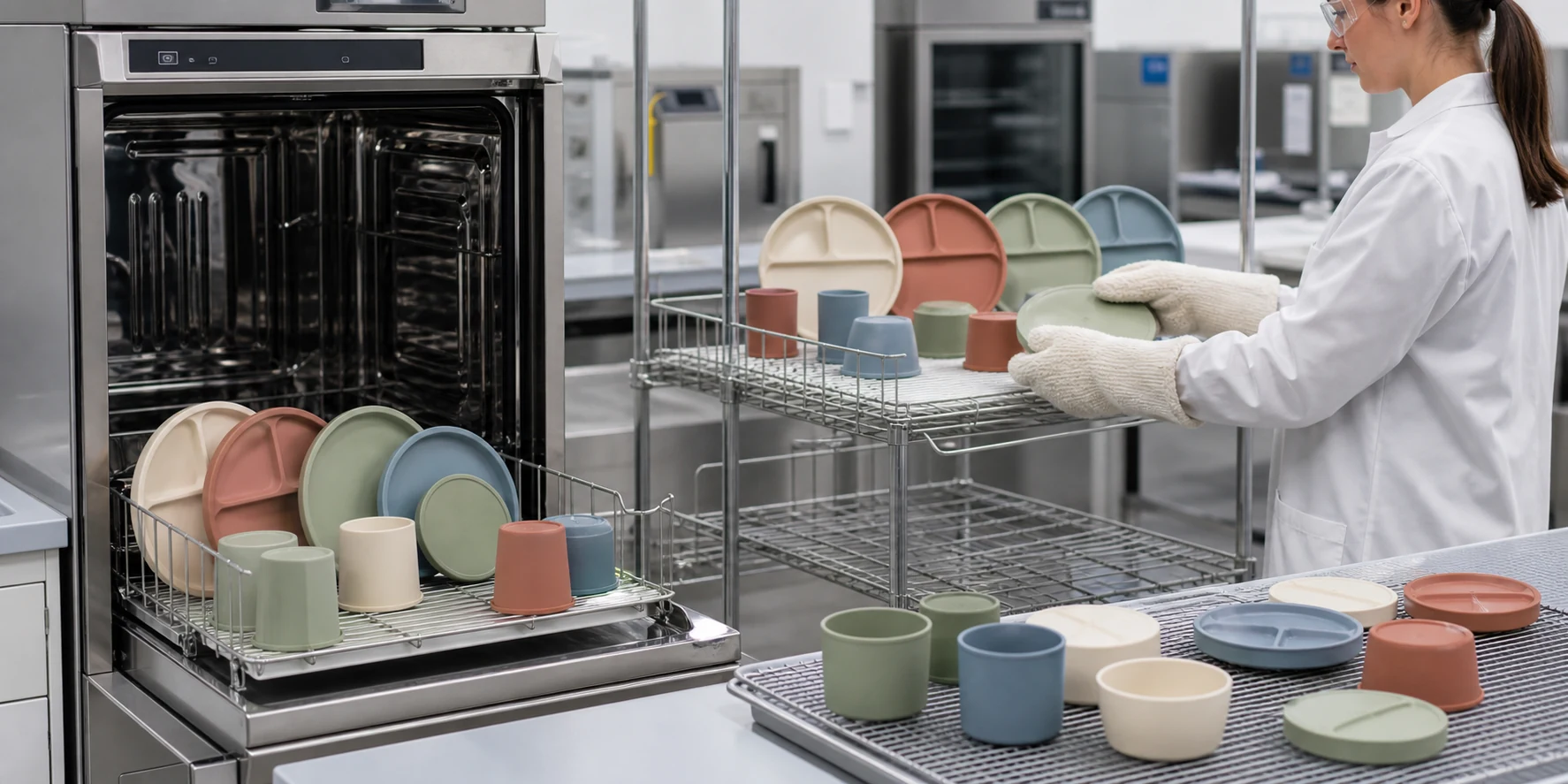
Build cycles from the marketed use rather than a convenient appliance program. A dishwasher claim needs the rack position, detergent, program, temperature, drying, load, and cycle count, while microwave or hot-food use needs food or simulant, fill level, power or temperature, duration, rest, cooling, and handling. Freezer-to-heat transitions may need a separate sequence because thermal change and user handling occur together.
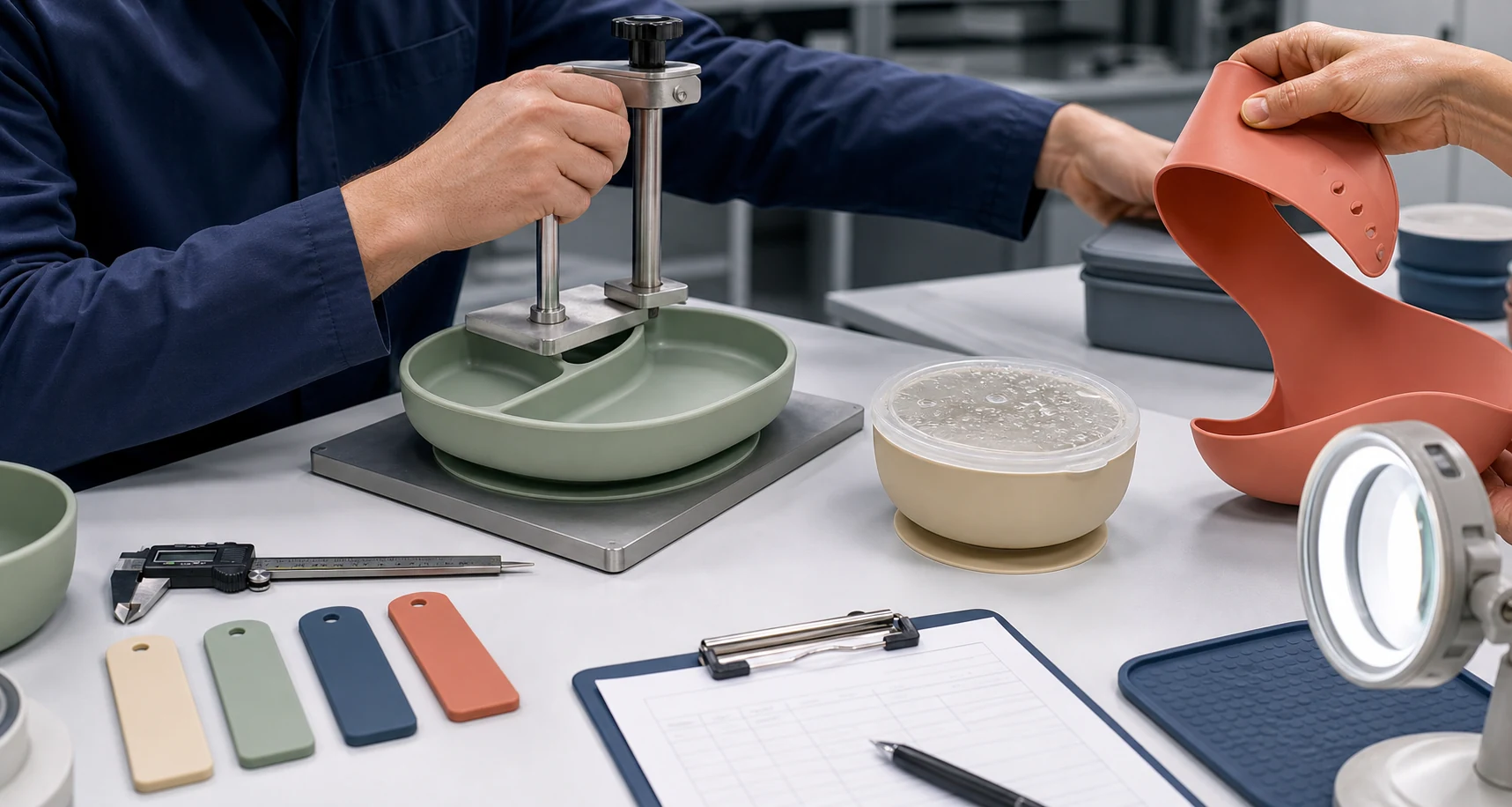
Add mechanical actions when the product depends on them. Lids are opened and closed, suction bases are applied and released, bibs and mats are flexed or rolled, handles are gripped, divided plates are scraped with utensils, and nested sets are separated and stacked. Automating the motion can improve consistency, but the fixture and force must still represent foreseeable use.
Use interval inspections to find when and how change begins. A product that passes at cycle one hundred but develops a problem at cycle twenty and later stabilizes needs a different explanation from one that degrades steadily. Interval data also prevents a final destructive failure from erasing earlier evidence.
Conditioning severity must stay connected to the claim. An extreme engineering screen can expose weak features quickly, but accelerated cycles may introduce mechanisms that do not occur in normal use. Label screening, accelerated comparison, and claim-validation evidence separately.
Keep dishwasher and microwave evidence inside its verified boundary
The silicone microwave and dishwasher guide explains why formulation, article geometry, use, and care conditions matter. A durability program should use those declared boundaries and record any harsher margin as an additional engineering challenge.
Do not convert a limited cycle result into a lifetime prediction without a validated relationship. State what was tested, what remained acceptable, and which real-use uncertainties remain outside scope.
Inspect Change at Planned Intervals
Inspect enough specimens at defined checkpoints to distinguish an isolated defect from a repeatable trend. Record every sample code, completed cycle, conditioning time, recovery time, instrument, method revision, assessor, and result. Photographs should use fixed lighting, scale, angle, and background so a later reviewer can compare evidence rather than impressions.
Combine quantitative, visual, functional, and sensory observations. Dimensions, mass, hardness, color difference, leak rate, seal force, or suction retention can show direction and magnitude, while controlled visual review can identify whitening, cracks, tack, staining, deformation, decoration loss, or residue. Sensory work requires a defined assessor method, blank controls, and careful language because odor and flavor observations are easily overstated.
Allow a documented recovery period when the property is sensitive to heat, moisture, or temporary deformation. Measure both immediately after conditioning and after recovery if those states matter to use. Otherwise a transient warm-state change may be mistaken for permanent damage, or a short-lived failure may be hidden by waiting too long.
Investigate unexpected improvement as carefully as deterioration. Apparent better lid fit or lower odor may reflect conditioning, moisture, measurement drift, or sample mix-up. Evidence is strongest when raw observations, calculations, photographs, deviations, and disposition remain reviewable.
Use a result matrix instead of a final pass label
A useful matrix places each specimen and checkpoint against its baseline, control, acceptance limit, and disposition. It makes missing measurements visible and shows whether change is abrupt, progressive, scattered, or linked to one cavity or batch.
Keep failures in the record even if a replacement passes. The buyer needs the investigation, root cause, corrective action, and controlled retest scope before deciding whether the claim is supported.
Separate Evidence Types and Their Limits
Treat regulatory, material, laboratory, factory, inspection, and field evidence as complementary layers rather than substitutes. A declaration may identify applicable food-contact rules, a laboratory report may document named specimens and methods, factory records may show process consistency, and complaints may reveal use conditions the protocol missed. None alone proves an unlimited product lifetime.
Check whether each document names the article, material, revision, color, lot, method, conditions, dates, results, and responsible organization. A report for a generic silicone plaque or another shape can support a narrow material question but cannot establish durability of a finished suction plate, seal, lid, print, or thin flexible feature.
Third-party testing can increase independence when scope, specimen identity, competence, and methods are appropriate. It does not repair a vague claim, unrepresentative sample, unsuitable cycle, or missing acceptance rule. Buyers should approve the protocol before specimens are sent and reconcile every deviation before using the result.
Use supplier and factory evidence to show how the tested configuration will be reproduced. Material purchase records, batch traceability, mixing and molding controls, post-cure records where relevant, tool maintenance, in-process checks, retained samples, and nonconformance handling connect a one-time report to ongoing orders.
Match the confidence statement to the evidence level
State whether an item is a supplier assertion, internal screen, controlled factory test, independent laboratory result, production inspection, or field observation. Explain the sample size and uncertainty instead of collapsing every layer into certified or proven.
The final commercial statement should be no broader than the combined evidence. A named product passing a defined sequence supports that sequence and its justified use boundary, not every detergent, appliance, food, temperature, or user behavior.
Carry the Approved Boundary Into Production
Freeze the material grade, pigment system, additives, tool and cavity status, molding window, post-cure condition where applicable, decoration, component fit, care instructions, and packaging features that can influence durability. Put those controls in the purchase specification and approved sample file. A report loses relevance when production changes silently.
Select routine checks from the most sensitive endpoints found during development. Production inspection may confirm identity, dimensions, appearance, fit, seal, suction, flex, print, or a short functional screen, while periodic verification repeats a longer cycle sequence on retained lot samples. The frequency should reflect risk, order history, process capability, claim importance, and change exposure.
Define change triggers before launch. New material suppliers, formulation or pigment changes, tooling repair, cavity replacement, process-window shifts, post-cure changes, decoration revisions, new appliances or detergents in the care claim, complaint trends, and significant packaging changes can require documented review and partial or full retesting.
Keep a decision trail for deviations and complaints. Product identity, use details, photographs, returned samples, batch records, and comparison with retains help separate misuse, isolated damage, transport effects, and systematic durability loss. Feed credible field evidence back into the protocol and acceptance limits.
Create an evidence package that purchasing can use
The release package should contain the approved claim, protocol, specimen map, raw and summarized results, photographs, deviations, report approvals, retained-sample location, production controls, and retest triggers. Purchasing can then confirm that a reorder still matches the evidence boundary rather than relying on an old report title.
For a product-specific plan, share the reuse claim, drawings, approved materials, care instructions, target markets, and current reports with the manufacturing team. A useful response should identify evidence gaps and control actions without promising that one generic cycle count proves every configuration.
Silicone Durability Evidence Layers Compared
The strongest file uses several evidence layers and states what each can and cannot establish. This comparison helps buyers choose the right proof for the decision instead of asking one document to answer every question.
Evidence should become more product-specific as the decision moves from material screening to claim approval and production release. Identity and traceability remain necessary at every level.
| Evidence layer | Best use | What it should identify | Main limitation |
|---|---|---|---|
| Official regulatory source | Define applicable legal framework | Jurisdiction, product scope, conditions, obligations | Does not prove finished-product reuse durability |
| Supplier material record | Confirm supplied grade and batch | Material, supplier, lot, specification, date | May not cover molded geometry or finished function |
| Internal engineering screen | Compare designs and expose weak features | Samples, fixtures, cycles, observations, deviations | May be accelerated or unsuitable for a market claim |
| Independent laboratory report | Document controlled product-specific testing | Specimen identity, method, conditions, results, laboratory | Only supports its named scope and tested configuration |
| Factory process record | Show repeatable manufacturing control | Lot, tool, cavity, settings, checks, disposition | Control evidence is not a lifetime prediction |
| Pre-shipment inspection | Verify released order against specification | Order, sample plan, visual and functional checks | Cannot reproduce a long reuse program at shipment |
| Complaint and field record | Detect real-use patterns and missed conditions | Product, lot, use, time, symptom, investigation | Uncontrolled exposure complicates causal conclusions |
Buyer Checklist for a Reuse-Durability Evidence File
Use this checklist before approving the claim, sample, purchase specification, or production release. A no answer should trigger a named action, owner, and due date rather than a vague promise to test later.
The questions deliberately connect marketing, engineering, compliance, sourcing, and factory control. Durability evidence fails when those teams use different product identities or use boundaries.
| Check | Question | Why It Matters |
|---|---|---|
| Claim boundary | Are foods, temperatures, appliances, cleaning, cycle count, handling, storage, and care text defined? | The protocol cannot represent an undefined promise. |
| Specimen identity | Do samples match the approved material, color, tool, cavity, process, components, and decoration? | Results on another configuration may not support the order. |
| Baseline and controls | Are initial measurements, photographs, methods, locations, and uncycled controls recorded? | Change must be separated from ordinary variation. |
| Cycle rationale | Does every conditioning step represent declared use or a clearly labeled engineering margin? | Convenient severity can create irrelevant damage or false confidence. |
| Acceptance rules | Are safety, function, cosmetic, sensory, and documentation limits approved before testing? | Post-result rules invite bias and inconsistent disposition. |
| Interval evidence | Are planned checkpoints, recovery times, raw results, photos, deviations, and failures retained? | A final pass label hides trend, onset, and uncertainty. |
| Evidence scope | Does each official, supplier, factory, or laboratory document state what it proves and does not prove? | Different evidence layers answer different questions. |
| Production continuity | Are routine checks, retained samples, periodic verification, change triggers, and complaint escalation controlled? | A one-time report must remain connected to future orders. |
Official Sources and a Practical Evidence Playbook
Official sources establish regulatory context and testing responsibilities, but a buyer still needs a product-specific durability protocol. Use the sources below to define legal and evidence boundaries, then document the commercial reuse claim separately.
Verify the current rule set for every sales market and intended user before release. Market, age grading, food type, temperature, and product claims can change the applicable obligations.
The European Commission food-contact materials overview explains the EU framework for materials intended to contact food. Use it to identify regulatory context and applicable measures; it does not supply a universal silicone reuse-cycle protocol or prove the durability of a named finished article.
The U.S. Food and Drug Administration food types and conditions-of-use resource describes food-contact categories and use conditions relevant to regulatory assessment. Those categories help define exposure, while repeated mechanical and functional performance still requires product-specific evidence.
The U.S. Consumer Product Safety Commission third-party testing guidance describes testing and certification responsibilities for applicable children’s product requirements. It should be used only when relevant to the product and market, and it does not replace durability-claim validation or factory process control.
Practical disclaimer: this guide is a sourcing and evidence-planning framework, not legal advice, a laboratory method, or a certification. Applicable food-contact, consumer-product, labeling, chemical, and children's-product requirements vary by market and use; confirm them with qualified regulatory and testing professionals, and validate the exact production-intent article under an approved protocol.
Recommended Evidence Sequence for B2B Buyers
First, freeze a narrow claim and the production-intent configuration. Approve endpoints, methods, controls, intervals, sample quantity, cycle rationale, and decision rules before conditioning begins so the result can be interpreted consistently.
Second, run development screens early enough to change design or process, then execute the controlled claim-validation program on traceable samples. Resolve every deviation and preserve raw results, not only the report summary.
Third, translate sensitive endpoints into production controls, inspection, retained-sample review, periodic verification, and change triggers. Revisit the protocol when field evidence reveals a meaningful condition that the original plan did not represent.
Silicone Tableware Durability Test FAQ
How many reuse cycles are enough for silicone tableware?
There is no universal number. The buyer should connect the cycle count and stresses to a defined claim, expected frequency, product risk, foreseeable use, and acceptance limits, then state exactly what the completed program supports.
Does a dishwasher-safe report prove long-term durability?
Only within its named specimens, method, programs, detergents, conditions, cycles, and endpoints. It does not automatically prove microwave, freezer, staining, suction, seal, printing, or lifetime performance.
Should every color and cavity be tested?
Use a documented risk assessment covering formulation, pigment, geometry, wall sections, tool and cavity variation, decoration, and process. Test worst-case and representative configurations, then justify any grouping rather than assuming all variants are equivalent.
Can a factory report replace third-party testing?
A controlled factory report can be useful development or production evidence when identity, methods, raw data, competence, and approvals are clear. Independent testing may still be appropriate or required for particular claims, contracts, standards, products, or markets.
When should the durability program be repeated?
Review after material, pigment, supplier, tooling, process, post-cure, decoration, component, claim, care-instruction, or market changes, and after meaningful complaints or verification failures. The change assessment should determine whether targeted or complete retesting is needed.
Silicone Tableware Durability Test: Build a Claim-to-Evidence File
A reusable claim becomes defensible when the use boundary, product identity, cycle rationale, baseline, controls, measurements, interval results, acceptance rules, and evidence limits all point to the same decision. The file should show what remained acceptable, what changed, how uncertainty was handled, and which uses remain outside scope.
A silicone tableware durability test is therefore not a ceremonial pass label or a universal cycle count. It is a traceable comparison between a precise commercial claim and a controlled body of product-specific evidence, followed by production controls that preserve the tested configuration.
Ask suppliers, laboratories, quality teams, and marketers to work from one revision-controlled brief. That discipline makes the evidence easier to review, the claim easier to qualify, and every later change easier to assess before another order reaches the market.
Request a Silicone Reuse-Evidence Review
Share the claim, production-intent product details, markets, care instructions, cycle idea, and current evidence. Naike can help organize the sourcing and factory-control questions that should be resolved before a claim or order is released.
Request a Custom Quote
Share your product, quantity, target market and customization needs. Our factory team will reply with the next practical step.
Continue Your Sourcing Research
The six newest factory-side articles are updated automatically by publication date.

Wheat Straw vs Bagasse Tableware: Buyer Comparison
A B2B decision guide comparing reusable wheat-straw polypropylene composite tableware with molded bagasse fiber formats across use, evidence, operations and end of life.

Can Wheat Straw Tableware Be Recycled? Buyer Q&A
A practical buyer answer on whether reusable wheat-straw composite tableware can enter PP recycling streams, which evidence matters, and how to qualify market claims.

Global SKU vs Regional SKU: Tableware Decision Guide
A buyer decision framework for choosing one global tableware SKU or controlled regional variants across compliance, packaging, logistics, inventory and change control.

Australia Food Packaging Evidence: Buyer Guide
A practical evidence guide for Australian food-packaging buyers covering intended use, migration risk, supplier assurance, testing, hygiene, release and change control.

EU PPWR Tableware Packaging vs Conventional Packs
A buyer comparison of PPWR-ready and conventional tableware packaging across product protection, material choices, empty space, evidence, labeling and release timing.

Prop 65 Tableware Requirements: Buyer Q&A
A practical buyer Q&A for defining California Proposition 65 exposure scenarios, evidence, warning decisions, supplier records and release controls for tableware.