
Packaging Drop Compression Vibration Tests Compared
Match each distribution hazard to a distinct test question before approving retail packs, master cartons, pallet patterns, or shipment release.
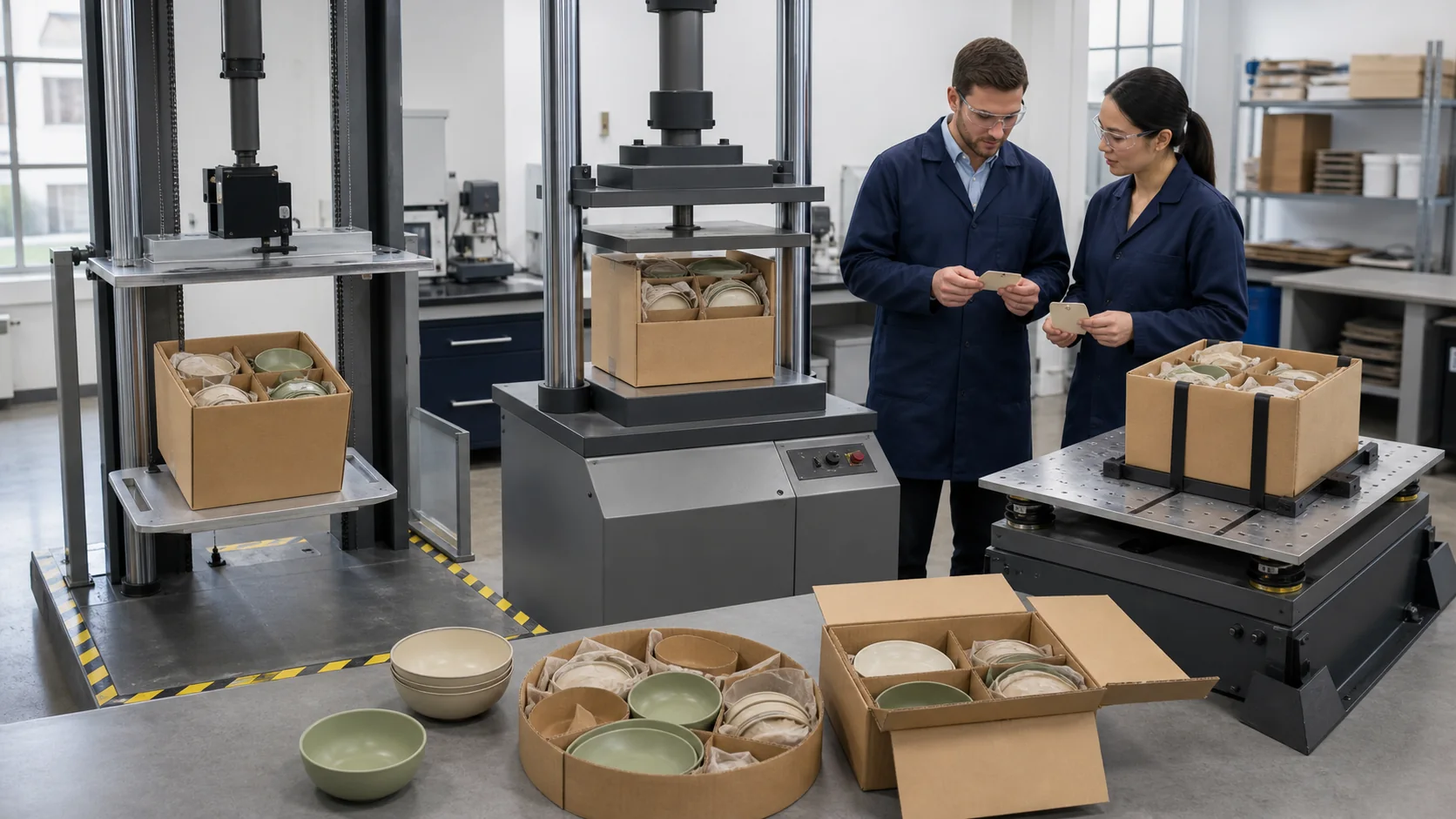
Packaging drop compression vibration tests answer different buyer questions: drop tests challenge sudden handling impacts, compression tests challenge stacking and sustained load, and vibration tests challenge repeated transport motion. None is a universal substitute for the others; choose severity from the actual pack, product fragility, distribution route, handling unit, and acceptance criteria, then run the tests in a sequence that represents the shipment risk.
A carton can pass a single drop and still fail in a warehouse stack, or survive static compression and then allow bowls to rub after hours of truck vibration. Buyers therefore need a distribution-risk comparison rather than a generic request for an undefined packaging test certificate.
The commercial decision is equally important. The test plan should identify what may change if a failure occurs—product geometry, retail packaging, inserts, divider layout, master-carton board, pack count, pallet pattern, handling marks, or route assumptions—while there is still time to correct it.
Buyer Answer: Match the Test to the Hazard
Use drop testing when uncontrolled handoffs and impacts dominate, compression when warehouse or container stacking controls the risk, and vibration when repeated vehicle motion can cause migration, abrasion, loosening, or fatigue. Combine them when the same shipping unit will experience several hazards, and condition the pack before final evaluation.
For a project-specific starting point, send the Naike Group manufacturing team your product, retail pack, master carton, pallet, route, and damage concern. A useful review defines the distribution unit and failure criteria before selecting a named method or laboratory quotation.
Drop Testing Compares Impact Protection and Pack Integrity
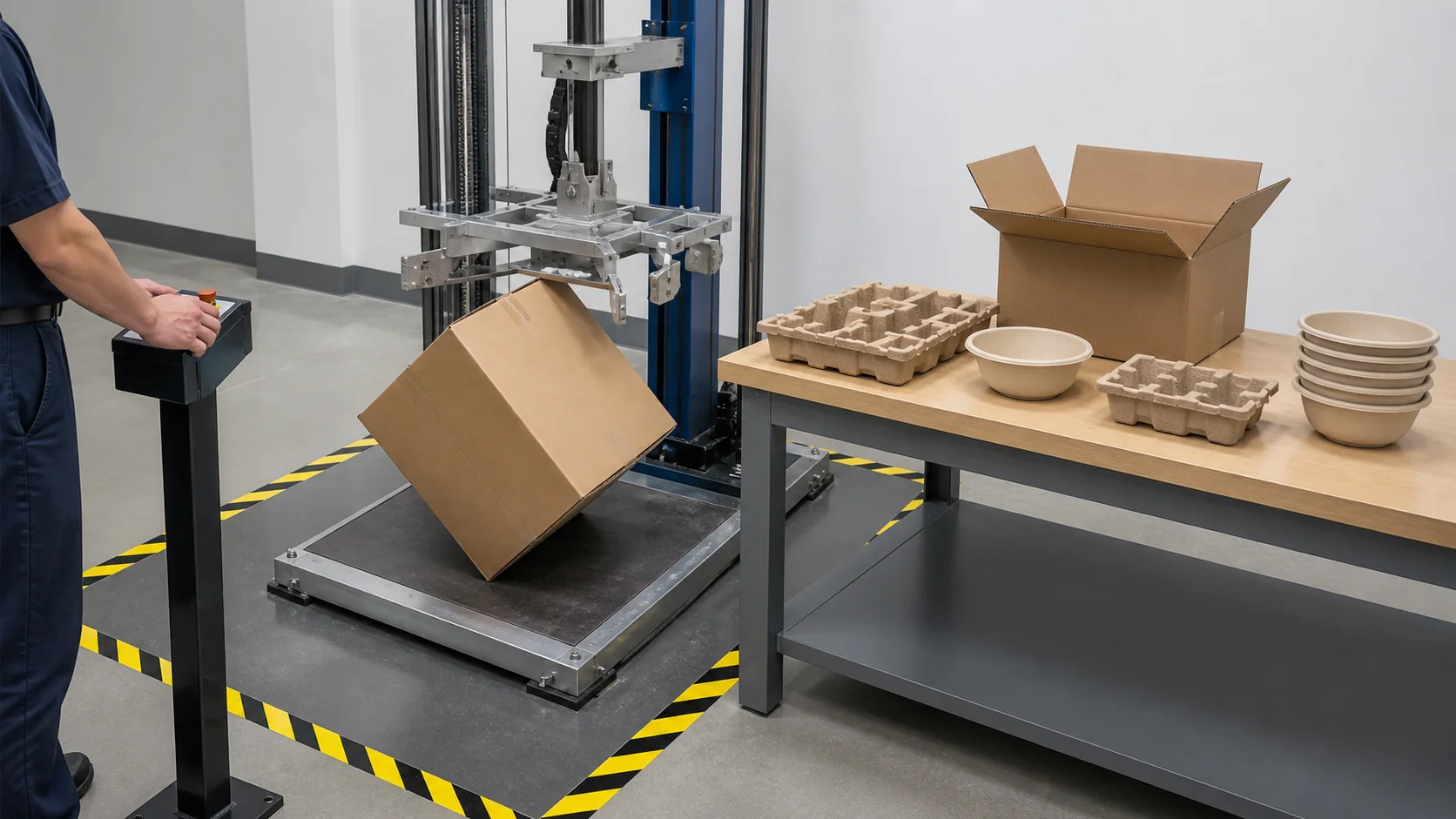
A drop test exposes a packaged product to a short, high-energy event that represents manual handling, transfer, sorting, loading, or an accidental fall. The test can target faces, edges, and corners because impact orientation changes the force path through the carton, inserts, retail pack, and product. A corner impact often concentrates load more severely than a broad face impact even at the same height.
The buyer must define the test unit. A retail box, inner carton, master carton, and unitized pallet have different masses, handling modes, drop opportunities, and protection systems, so one result cannot automatically cover the others. The test report should identify the exact pack revision, contents, gross mass, dimensions, conditioning, orientation sequence, drop height, equipment, and any deviations.
For tableware, acceptable performance may include more than no broken product. Inspect chips, cracks, deformation, loose lids, scuffs, print damage, divider collapse, retail-box crushing, seal opening, product migration, and the master carton’s continued ability to protect and stack. Cosmetic acceptance should reflect the sales channel because an e-commerce shipment and a retail shelf pack can have different commercial limits.
Drop height is not a free severity dial that should be increased until a preferred pack fails. It should come from the applicable distribution method, customer protocol, package mass range, and intended handling environment. If a buyer wants an engineering margin beyond the selected method, label it separately so the formal result and the development challenge are not confused.
Use drop evidence to locate the impact path
After each orientation, map damage to the product location and pack feature that carried the load. Crushed corner cells, shifted dividers, nested-part contact marks, or a detached lid can show whether the corrective action belongs in cushioning, geometry, closure, count, orientation, or outer-carton strength.
Photograph the unit before testing, after each defined impact when the method allows inspection, and after final opening. Keep an untested control and record any pre-existing carton or product damage so the test does not become an argument about sample condition.
Compression Testing Compares Stack Strength and Deformation
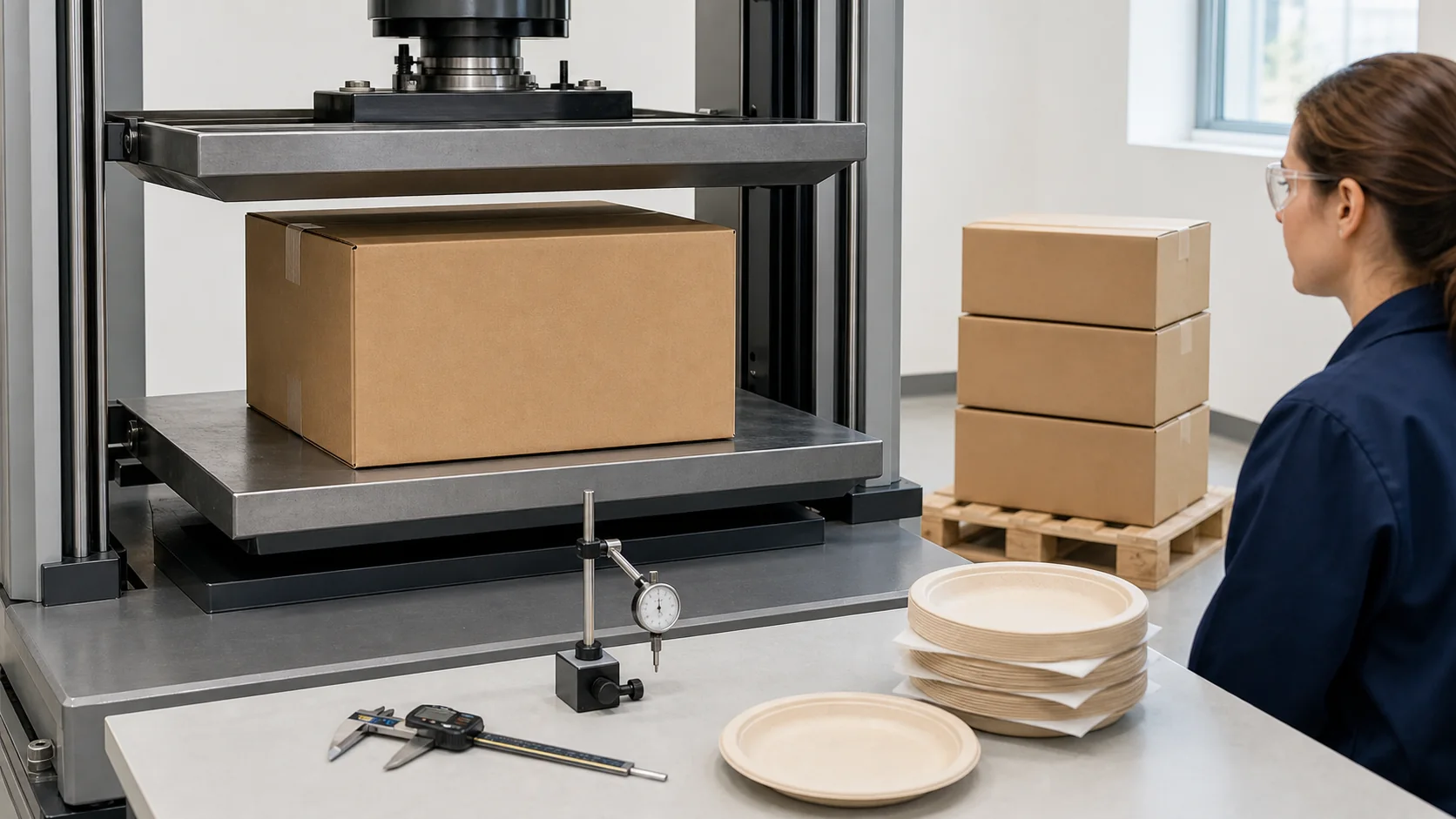
Compression testing applies a controlled vertical load to a package or stack to evaluate strength, deflection, buckling, and protection under warehouse, container, or retail stacking. It addresses a slower load path than a drop, even though both can crush corners or damage products. The relevant question is whether the complete package sustains the specified load and duration without exceeding agreed deformation or damage limits.
Box compression strength depends on board grade, flute, moisture, dimensions, score lines, joints, printing and converting, hand holes, ventilation, contents, internal supports, and load alignment. A strong paper specification does not guarantee a strong erected carton, while the product and inserts can sometimes contribute meaningful support. Test the final construction rather than relying only on a supplier’s board certificate.
Stack calculations require explicit assumptions about carton count, pallet pattern, stack height, storage time, humidity, load sharing, overhang, pallet deck gaps, transport acceleration, and safety factor. A simple top-load number without those assumptions can be technically impressive but commercially unusable. Buyers should distinguish a short laboratory compression-to-failure test from a sustained stack or creep evaluation.
Inspect how deformation affects the product and downstream operations. A carton may retain its walls but compress enough to mark retail packs, jam a lid, load a bowl rim, reduce pallet stability, or make automated handling unreliable. Acceptance should therefore combine outer-carton behavior, dimensional change, product condition, and any required residual strength.
Relate compression results to the real stack
Use the tableware carton optimization guide to connect pack count and container use with protection decisions, but treat compression qualification as a separate evidence question. Cost savings from a lighter carton are real only when the final pack still meets the approved load and distribution conditions.
When a result fails, review load concentration before simply increasing board weight. Divider walls, product orientation, voids, pallet support, score placement, and case dimensions may offer a more stable correction than adding material without changing the force path.
Vibration Testing Compares Motion, Abrasion, and Fatigue Risk
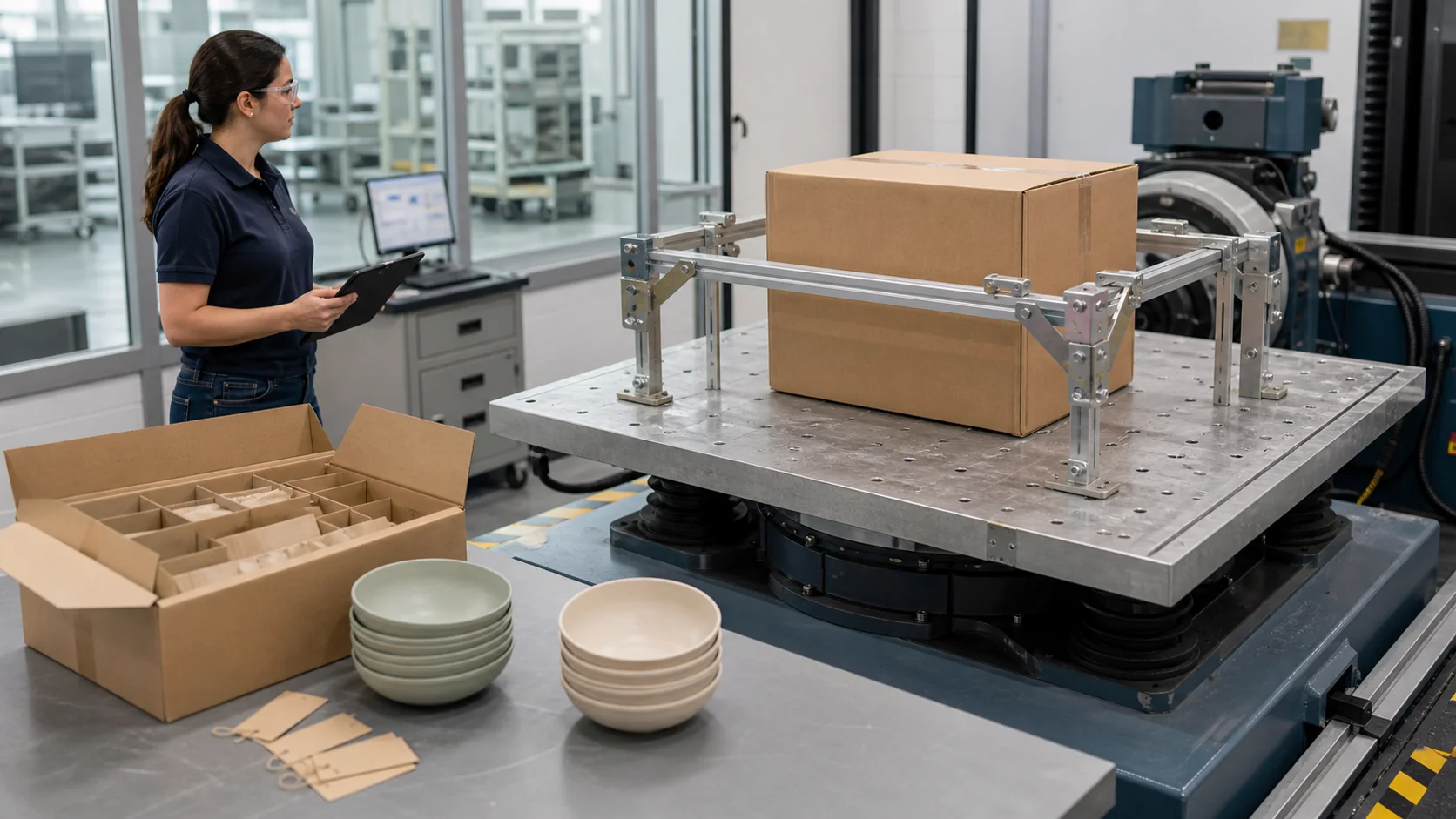
Vibration testing exposes the packaged unit to repeated motion intended to represent transport on trucks, rail, aircraft, or other distribution segments. Random vibration uses a frequency spectrum and intensity profile, while fixed or repetitive motion approaches may address a different simulation question. The selected method, axis, duration, restraint, load, and profile must match the reason for testing.
Repeated motion can reveal failures that a static inspection cannot predict. Nested plates may fret against each other, silicone parts may migrate or pick up marks, lids may loosen, ties may cut into surfaces, dividers may fatigue, retail packs may polish or scuff, and small components may settle into voids. A pack can look strong before testing yet lose protection gradually as its contents rearrange.
Resonance matters because a package or product can respond strongly at particular frequencies. The purpose of a distribution simulation is not to find any frequency that destroys the product, but to expose credible route energy and observe how the complete pack responds. Development investigations may add a sweep or dwell, but the report must distinguish that work from the formal distribution profile.
Restraint conditions can change the result. A carton fixed tightly to a table, allowed to move within a fixture, stacked under load, or tested as a pallet will experience different motion and interfaces. Record the setup with photographs and explain how it represents the shipment being approved.
Inspect products for cumulative contact damage
Open the pack carefully and preserve the final positions before moving parts. Map abrasion, nesting shift, divider wear, dust, loosened closures, surface gloss change, print transfer, and product-to-product contact, then compare with the untested control. Small repeated marks can matter commercially even when no item breaks.
If the product is reusable or has an appearance-sensitive finish, include the relevant surface and functional checks after vibration. A product that looks intact but no longer seals, stacks, nests, or meets approved cosmetics has not met the full buyer requirement.
Choose the Test Sequence From the Distribution Story
Real shipments experience hazards in a sequence, and earlier events can weaken the pack before later ones occur. Vibration can settle contents and fatigue dividers before a final delivery drop, while humidity and compression can reduce carton strength before unloading. A combined plan should explain why its order represents the route rather than arranging tests only for laboratory convenience.
Begin with the distribution unit at each handoff. Retail boxes may be packed into inners, master cartons may be palletized for line-haul movement, and units may be removed for parcel delivery, so the same product can need several clearly linked evaluations. Mark when the pack configuration changes and which result approves each stage.
Conditioning belongs in the sequence because paper-based packaging responds to temperature and humidity. If the selected protocol calls for conditioning, control the environment and exposure time, then limit uncontrolled delay before the test. Record actual conditions rather than assuming a label such as “standard laboratory” is enough.
Do not open and repair the unit between sequential hazards unless the method or development plan explicitly allows it. If interim inspection is necessary, document what was disturbed and use a parallel specimen for the uninterrupted sequence. Hidden cumulative damage is often the reason a combined program reveals more than three isolated demonstrations.
Separate formal qualification from engineering trials
Engineering trials can explore several drop heights, compression margins, divider layouts, or vibration profiles while the pack is still changing. Formal qualification should use the frozen production-intent product and packaging at the approved revision, with methods and pass criteria agreed before testing.
Keeping those records separate prevents a promising development sample from being presented as final evidence. It also lets buyers see which change produced improvement and whether the selected production pack was actually confirmed.
Compare Severity Variables Before Requesting Quotations
Test names alone do not create comparable laboratory quotations. For drop work, define package type, gross mass, drop height, orientations, number of impacts, conditioning, inspection points, and pass criteria. For compression, define platen or stack setup, preload, rate, target load, duration, deformation limit, and whether the aim is load-to-failure, sustained load, or residual strength.
For vibration, define the distribution profile, frequency range, intensity, duration, axes, restraint, top load, orientation, and any combined conditioning. A quotation that substitutes a convenient in-house profile can cost less while answering a different question. Ask every bidder to list deviations and sample quantities against one controlled scope.
Sample count should reflect the decision and expected variation. One hand-built carton can support an early engineering screen, but approval of a production process may need samples from final converting, packing, materials, and product lots. The plan should state which differences are intentionally represented and which remain outside scope.
Acceptance criteria need product, retail pack, master carton, and logistics dimensions. Define breakage, chips, cracks, scuffs, deformation, closure, print, seal, leak where relevant, pack migration, carton deflection, residual stacking ability, and pallet stability. Use approved cosmetic references so a technically intact but unsellable retail unit cannot be called a pass.
Price the evidence, not just machine time
A complete quotation should show method revision, setup, conditioning, sample receipt and preparation, test time, interim inspections, measurements, photographs, report language, raw data, retest, and sample return or disposal. Procurement can then compare technical coverage instead of selecting the lowest total with hidden exclusions.
If buyers need help translating a route into a quote-ready scope, they can request a packaging test-plan review. Share carton drawings, pack-out photographs, gross mass, pallet pattern, route, sales channel, and known damage history.
Interpret Failure Patterns Before Adding Packaging
A failure is useful only when it leads to a credible cause and controlled correction. Product breakage at one corner may show an impact path through empty space, while crushing across every carton may point to board, geometry, moisture, or pallet support. Abrasion after vibration may be solved by contact control rather than thicker outer corrugate.
Open failed packs in a disciplined order. Photograph the exterior, mark damage locations, measure deformation, preserve internal positions, inspect each packaging layer, and map product damage back to orientation. Compare with untested controls and, where possible, successful units from the same run.
Change one primary variable at a time during confirmation when practical. Simultaneously increasing board grade, adding foam, lowering pack count, and changing orientation may produce a pass without showing which action is necessary. A controlled comparison helps procurement avoid paying for every proposed correction indefinitely.
Recheck commercial consequences after the correction. More cushioning can reduce carton utilization, change sustainability claims, complicate assembly, increase labor, or introduce surface marks; a stronger carton can affect print and supplier availability. The best correction protects the approved product through the route at a controlled total cost.
Link Packaging Drop Compression Vibration Tests to change control
Record which packaging and product variables the approved evidence covers, then list retest triggers. Changes to gross mass, pack count, carton dimensions, board construction, inserts, retail pack, product geometry, nesting, pallet pattern, route, carrier program, or distribution channel can alter one or more hazards.
A technical review can sometimes justify focused confirmation instead of repeating the whole sequence, but the rationale needs an owner and approval. Never allow a cheaper supplier substitute to inherit the prior pass merely because the outer dimensions look similar.
Compare the Three Packaging Tests by Decision
Use the table to select a test from the distribution hazard and the purchasing decision it protects. The three methods are complementary when a packaged tableware unit will face handling impact, stacking load, and repeated transport motion in the same route.
The method name is only the starting point. Every row still needs a controlled unit, severity, conditioning, sample count, sequence, inspection plan, acceptance rule, and evidence owner before the laboratory quotation is comparable.
| Decision criterion | Drop test | Compression test | Vibration test |
|---|---|---|---|
| Primary hazard | Sudden impact during handling, transfer, sorting, or an accidental fall | Vertical load, stacking, deflection, buckling, and creep | Repeated vehicle motion, resonance, migration, abrasion, and fatigue |
| Typical evidence question | Can the complete pack absorb defined face, edge, and corner impacts? | Can the package sustain the required load and duration without unacceptable damage? | Can the pack maintain position and protection through the selected motion profile? |
| Key severity variables | Gross mass, height, orientation, number of drops, package type, and conditioning | Target load, rate, duration, stack assumptions, moisture, platen or pallet setup, and safety factor | Spectrum or motion, intensity, frequency range, duration, axes, restraint, top load, and conditioning |
| Common tableware failures | Breakage, chips, lid release, retail-pack crush, corner damage, and product migration | Carton buckle, rim loading, retail-box deformation, pallet instability, and loss of residual strength | Scuffing, fret marks, nesting shift, loose closures, divider wear, dust, and print transfer |
| Best development use | Locate impact paths and compare cushioning, orientation, closure, or pack-count options | Compare board, geometry, internal support, pallet pattern, and stack margin | Compare contact control, dividers, surface protection, restraint, and pack migration |
| Important limitation | A pass does not prove stacking or long-duration transport performance | A static load does not reproduce impacts or repeated motion | A profile does not prove sudden-drop or long-term compression strength |
| Best-fit scenario | Parcel handoffs, manual case movement, shelf-ready packs, and damage concentrated at impacts | Warehouse and container stacks, tall pallets, humid routes, and cases showing crush or bowing | Long truck or rail routes, nested products, cosmetic surfaces, loose components, and recurring abrasion |
| Useful combined sequence | Often follows conditioning and vibration to represent a weakened package at final handling | Can precede motion as a top load or follow conditioning for stack evaluation | Often precedes a final drop so cumulative settling and fatigue remain in the same unit |
Buyer Checklist Before Approving the Test Plan
Complete these eight questions before an RFQ, sample submission, or purchase-order packaging approval. Each answer should point to a controlled drawing, specification, route assumption, method, or acceptance record rather than an informal chat message.
A blank answer is a scope risk. Assign an owner and due date so the laboratory does not silently choose the package unit, severity, sequence, or pass rule on the buyer’s behalf.
| Check | Question | Why It Matters |
|---|---|---|
| Distribution unit | Are retail pack, inner, master carton, pallet, and parcel handoffs identified? | Each unit has different mass, handling modes, interfaces, and protection responsibilities. |
| Route and channel | Are carrier, transport modes, storage, handoffs, climate, stack time, and sales channel defined? | A credible simulation begins with the route rather than a generic test bundle. |
| Pack identity | Are product, count, nesting, inserts, retail pack, carton, board, closure, and pallet revisions frozen? | Evidence cannot approve a production pack that differs from the tested construction. |
| Method severity | Are drop orientations, compression load and duration, and vibration profile and axes documented? | Quotations and results are comparable only when they answer the same technical questions. |
| Conditioning and sequence | Are temperature, humidity, top load, order, interim inspection, and recovery time controlled? | Earlier hazards and environment can weaken the pack before later tests. |
| Acceptance criteria | Are product, cosmetic, retail-pack, carton, pallet, and functional limits approved in advance? | No-breakage alone can miss unsellable or operationally damaged shipments. |
| Failure workflow | Will the team map damage, preserve positions, identify root cause, and confirm one controlled correction? | A failed test should improve the pack rather than trigger uncontrolled material additions. |
| Change and release | Are report ownership, golden pack, retained samples, shipment checks, and retest triggers assigned? | The result remains useful only while production and later changes stay inside its approved boundary. |
Use Official Methods Within a Product-Specific Plan
Official standards and distribution procedures provide controlled test frameworks, but they do not select the correct plan for every tableware product. Buyers still need to define the route, package unit, product fragility, claims, customer protocols, and commercial acceptance criteria.
Confirm the current edition and applicability with the responsible customer, carrier, qualified packaging professional, and laboratory. Keep the approved method, deviations, raw observations, and report with the exact product and pack revision.
The International Safe Transit Association publishes an official test procedures overview describing performance tests for packaged products and distribution simulation approaches. It shows that procedure selection depends on shipment configuration and distribution context rather than one universal “ISTA test.” Buyers should obtain the current procedure through the authorized route and confirm member, laboratory, and customer requirements before claiming a package is qualified.
The United States Postal Service provides official guidance for preparing packages, including container, cushioning, closure, reinforcement, and marking considerations. The page supports a practical review of whether a parcel package is assembled for postal handling before performance evidence is requested. It does not choose a laboratory distribution cycle, validate a full export route, or prove a particular tableware pack passes drop, compression, or vibration testing.
FedEx provides official packing guidance for customers using its network, including practical package preparation and protection considerations. Carrier guidance is relevant when the intended route uses that carrier and can help buyers review closures, cushioning, package strength, and special-item handling. It is not a substitute for a controlled laboratory method, another carrier’s requirements, or the buyer’s complete distribution-risk assessment.
Practical disclaimer: this comparison is a procurement and packaging-quality framework, not engineering certification, legal advice, or a substitute for the current licensed standard or customer protocol. Method editions, carrier requirements, assurance levels, laboratory capabilities, and distribution conditions can change, so the responsible buyer and supplier must confirm the final scope for the exact packaged product.
Choose the Smallest Test Set That Covers the Real Risk
Choose a drop-focused plan when parcel handling, repeated manual transfers, high drop exposure, or corner-impact damage dominates and stacking is limited. Add enough cosmetic and retail-pack criteria to protect the sales channel, and test the actual shipping unit rather than a convenient inner pack.
Choose a compression-focused plan when tall stacks, long storage, container loading, humid distribution, pallet overhang, or recurring carton crush controls the risk. Validate the erected carton and pack system, not only the corrugated board, and connect the target load to documented stack assumptions.
Choose a vibration-focused plan when long line-haul movement, nested tableware, polished surfaces, loose accessories, dividers, or closure fatigue create cumulative damage. Include realistic restraint, orientation, duration, and top load, then inspect product positions before unpacking.
Choose a combined sequence for most new export packs that face several hazards and carry meaningful replacement, retailer, or launch risk. Use engineering screens to select the pack, then qualify the frozen production-intent system and link shipment inspection to the approved golden pack.
Buyer FAQs About Packaging Test Selection
Does a drop-test pass mean the carton is ready for export?
Not by itself. A drop pass answers the defined handling-impact question, but the shipment may also need compression, vibration, climate, pallet, carrier, retailer, or route-specific evaluation and routine production controls.
Should the factory test an empty carton or the complete pack?
Test the complete production-intent pack when the decision concerns product protection because contents, dividers, retail packs, closures, and nesting change the force path. An empty-carton or board test can support material control but cannot replace finished-pack performance evidence.
Which test should run first in a combined program?
Use the order specified by the applicable procedure or justified distribution sequence. Conditioning, stacking load, vibration, and final handling impacts often interact, so document why the sequence represents the route and avoid repairing the unit between hazards.
Can one master-carton result cover every SKU and color?
Only when a documented family rationale shows that the tested configuration represents the relevant worst cases for gross mass, fragility, dimensions, nesting, inserts, retail pack, and carton. Color alone may not change packaging risk, but material, geometry, decoration, and surface sensitivity can.
When should packaging tests be repeated?
Review the evidence after changes to product geometry or material, pack count, nesting, inserts, retail packaging, carton construction, closures, gross mass, pallet pattern, supplier, route, carrier program, or sales channel. Complaints, transit damage, long production gaps, or a failed inspection can also trigger focused or full retesting.
Packaging Drop Compression Vibration Tests: Make the Route the Decision
A defensible packaging drop compression vibration tests plan does not begin by ordering three machine runs. It begins with the product, distribution unit, route, handling points, stack, climate, sales channel, damage history, and commercial acceptance limit, then selects the smallest controlled sequence that covers those hazards. The report should show exactly which production-intent pack was tested and what the result can and cannot approve.
Before releasing the carton, reconcile the method revision, severity, conditioning, sequence, sample count, inspection points, raw observations, failure analysis, corrections, retest triggers, golden pack, and shipment controls. That closes the decision with evidence procurement can compare, quality can maintain, and the factory can reproduce when the next order or packaging change arrives.
Request a Packaging Factory Review
Share the tableware drawing, product and pack weights, retail package, master-carton specification, pack-out photographs, pallet pattern, distribution route, carrier or customer protocol, and observed damage. Our factory can help organize production-intent samples and a quote-ready test brief for buyer and laboratory review.
Request a Custom Quote
Share your product, quantity, target market and customization needs. Our factory team will reply with the next practical step.
Continue Your Sourcing Research
The six newest factory-side articles are updated automatically by publication date.

Wheat Straw vs Bagasse Tableware: Buyer Comparison
A B2B decision guide comparing reusable wheat-straw polypropylene composite tableware with molded bagasse fiber formats across use, evidence, operations and end of life.

Can Wheat Straw Tableware Be Recycled? Buyer Q&A
A practical buyer answer on whether reusable wheat-straw composite tableware can enter PP recycling streams, which evidence matters, and how to qualify market claims.

Global SKU vs Regional SKU: Tableware Decision Guide
A buyer decision framework for choosing one global tableware SKU or controlled regional variants across compliance, packaging, logistics, inventory and change control.

Australia Food Packaging Evidence: Buyer Guide
A practical evidence guide for Australian food-packaging buyers covering intended use, migration risk, supplier assurance, testing, hygiene, release and change control.

EU PPWR Tableware Packaging vs Conventional Packs
A buyer comparison of PPWR-ready and conventional tableware packaging across product protection, material choices, empty space, evidence, labeling and release timing.

Prop 65 Tableware Requirements: Buyer Q&A
A practical buyer Q&A for defining California Proposition 65 exposure scenarios, evidence, warning decisions, supplier records and release controls for tableware.