
How Buyers Set Food Contact Conditions of Use
A buyer-side method for turning a vague “food safe” request into a testable, quotable and traceable tableware specification.

Quick Answer: Buyers should set food contact conditions of use by defining the food categories, highest temperature, longest contact time, storage state, heating method, single-use or repeat-use pattern, cleaning cycle, target market and product parts that actually touch food. The supplier and laboratory can then match materials, migration protocols, instructions and evidence to that intended use instead of treating “food grade” as an unlimited promise.
The commercial risk begins when a request uses only a label such as FDA, LFGB, microwave safe or suitable for hot food. Those labels do not tell the factory whether the article will hold fatty sauce at room temperature, boiling soup for thirty minutes, frozen food followed by reheating, or repeated dishwasher cycles over years.
Start with the intended menu and service journey, then compare feasible formats in our custom tableware product range. If your retail claim, heating route or market is not yet fixed, send the application brief for a factory review before ordering tests.
This guide supports procurement scoping and supplier communication; it is not legal advice or a universal test protocol. Final compliance depends on the exact material, additives, construction, market rules, laboratory method and claims approved for the finished article.
Factory Insider takeaway: Define foreseeable use before selecting a material or test. A controlled use-condition matrix prevents under-testing, over-testing and unsupported instructions while giving engineering, procurement and the laboratory the same release target. The sign-off file must identify the owner of every assumption and the gap that stops release.
Begin with the Real End Use, Not a Generic Compliance Label
A useful brief describes what the consumer or food-service operator will do with the article from filling through disposal or reuse. It identifies whether the product is a bowl, lid, utensil, insert or set component, because different parts may touch different foods or experience different temperatures.
Procurement should document normal use and reasonably foreseeable misuse without promising every imaginable scenario. A child feeding bowl intended for warm puree needs a different boundary from a container marketed for oven cooking, even if both are molded from a polymer family used in food-contact products.
The intended market belongs in the same first-page definition. Requirements, terminology and supporting documentation can vary by jurisdiction, so a factory cannot responsibly convert one generic certificate into worldwide approval.
Write the use statement as an approval boundary
A strong statement names the SKU, food-contact parts, consumer group, food examples, temperature range, maximum duration, storage route and cleaning method. It also lists excluded uses such as conventional oven, direct flame, pressure sterilization or long-term fatty-food storage when those uses are outside the design.
Buyers developing a new shape can align this statement with our custom solutions process. Keeping the boundary visible during design prevents a late test result from revealing that the chosen wall thickness, lid or decoration does not support the advertised application.
Classify the Foods That Will Contact Each Product Part
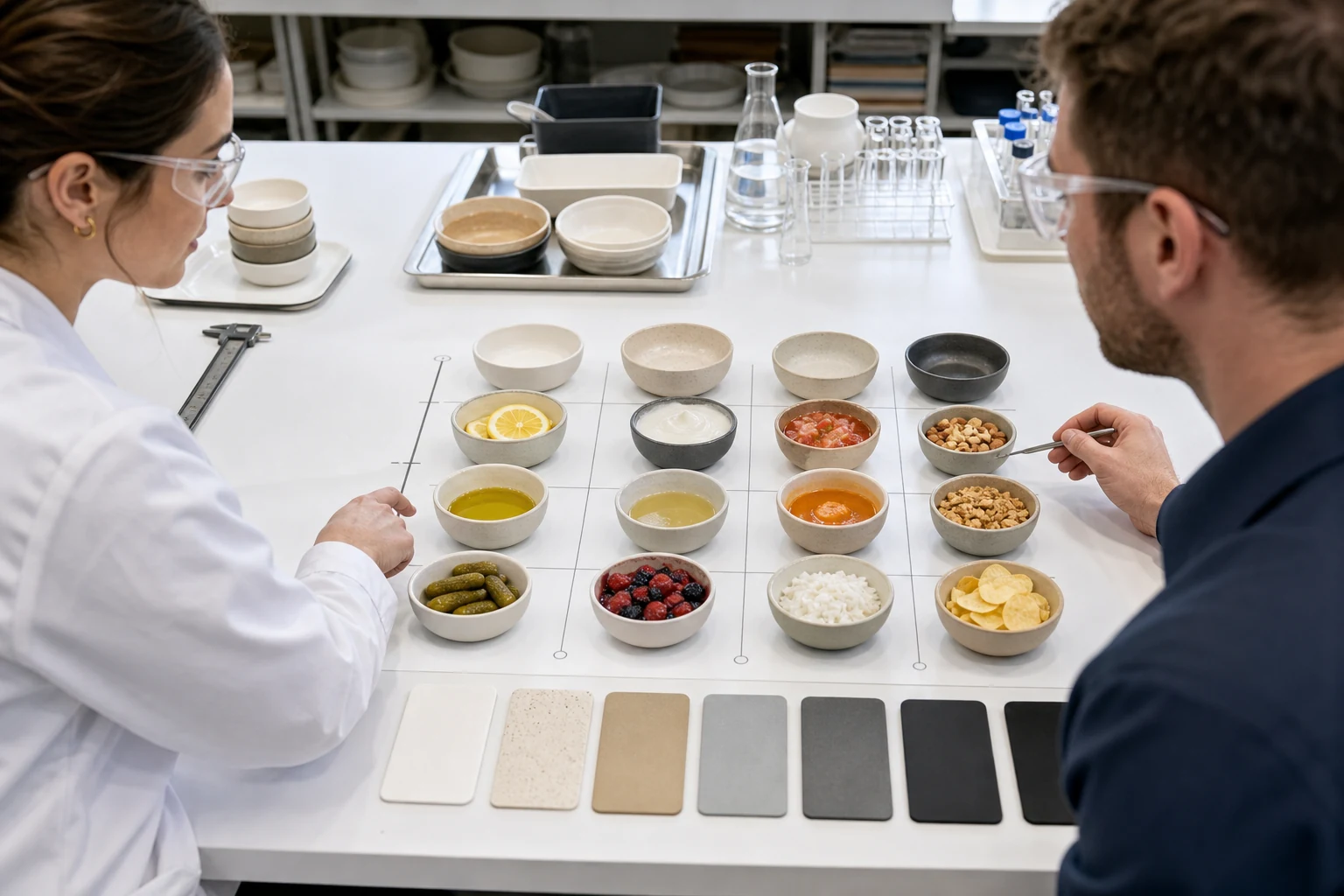
Food composition influences which substances can migrate and which simulants or test media are relevant. Buyers should distinguish aqueous, acidic, alcoholic, fatty and dry foods, then add realistic examples from the planned menu so that technical teams do not interpret a category differently.
A mixed meal can expose one surface to several conditions at once. Tomato sauce may be acidic and contain oil, while a dry snack with surface fat differs from a dry food with no free oil; choosing only the easiest category can leave the marketed use unsupported.
Contact should be mapped by component rather than by package name. A silicone seal, printed lid, rigid bowl and adhesive label may have different direct, indirect or no-food-contact roles, and their evidence scope should follow that role.
Use a worst-reasonable food matrix
The most severe food type should be the most demanding one the product is genuinely expected to encounter, not an artificial category selected merely to broaden a sales claim. When several markets or menus are planned, the matrix can list separate covered scenarios and the evidence supporting each.
If intended foods remain undecided, procurement can request a conservative material proposal but should label the assumption as provisional. Testing and artwork approval wait until the final food categories are signed off.
Define Temperature and Time as a Complete Contact Sequence
Temperature and duration work together. A short hot-fill event followed by months of ambient storage is not equivalent to brief serving contact, and a frozen product reheated in its container has more than one stage that may need evaluation.
The brief should state the actual food temperature rather than only an appliance setting. Microwave energy heats food unevenly, dishwasher programs combine heat and chemistry, and a conventional oven can expose empty edges or local surfaces differently from the nominal air temperature.
Record maximum values with units and realistic tolerances. Words such as warm, hot, freezer safe and microwave safe are consumer-facing shorthand, not a sufficient technical input for a laboratory or factory engineer.
Map filling, storage, reheating and serving in order
A sequence map can show initial fill, dwell time, storage temperature and duration, reheating route, serving hold and cooling. The laboratory can then determine whether one protocol covers the full chain or whether separate evidence is required for a specific stage.
Procurement should also identify whether the product is tested empty, filled, lidded or vented during functional trials. These details affect pressure, deformation, leakage and user instructions even when migration testing uses a standardized setup.
Separate Single-Use Exposure from Repeat-Use Service
A reusable product must remain suitable after repeated contact, cleaning and handling, not only when it leaves the mold. The buyer should define an expected service pattern or validation cycle that reflects how often the article is filled, heated, washed, flexed and stacked.
Repeat-use evidence may need to consider migration over successive contacts as well as physical changes such as cracking, swelling, discoloration, odor retention, seal fatigue or surface damage. A pass on one new specimen does not automatically answer durability after cleaning.
Single-use products still need an accurate exposure statement. The relevant time may include filling, transport, retail storage and consumption rather than only the few minutes when a consumer opens the package.
Connect cleaning instructions to the compliance file
If the label permits dishwasher cleaning, the team should define rack position, detergent assumptions, temperature or program and the number of cycles used for validation. Hand-wash-only wording should not be introduced after testing simply to rescue a product originally quoted as dishwasher safe.
Our custom tableware sample approval guide shows how to freeze these instructions with the golden sample. Repeat orders then retain the same use boundary unless a documented change is reviewed.
Translate the Use Matrix into Market-Specific Evidence
The use matrix tells the compliance specialist which regulatory framework, material restrictions, migration conditions and supporting records are relevant. It does not replace that specialist’s assessment, and it should not be rewritten after a test merely to fit an unexpected result.
For U.S. work, FDA food types and conditions of use provide a common reference vocabulary for food-contact substances. For EU plastic materials, Regulation (EU) No 10/2011 and its current amendments use food simulants and standardized time-temperature conditions intended to represent foreseeable contact.
Buyers should distinguish raw-material authorization, finished-article migration, good manufacturing practice, traceability, labeling and product performance. A complete procurement decision may need several evidence types because one report rarely answers all of those questions.
Make every report traceable to the approved scenario
The test request should show product code, color, material revision, food categories, contact temperature, duration, repeat-use status and sample selection. The final reviewer should be able to see why the selected protocol covers the claim without relying on an undocumented email explanation.
Our LFGB versus FDA silicone testing guide explains why market labels cannot be treated as interchangeable shortcuts. Confirm the jurisdiction and application before asking a supplier to quote a report.

Use Conditions to Select Material, Construction and Decoration
Once the boundary is clear, engineering can compare candidate polymers, composites, pigments, seals and decoration systems against the expected food, heat and cleaning exposure. Selection should be based on the finished construction, not a material name alone.
Wall thickness, ribs, closures and transitions affect deformation, handling temperature and leakage. Printed, coated or bonded areas may introduce separate restrictions or durability questions, especially when decoration sits near the food-contact surface or is exposed to repeated washing.
A supplier may propose two versions for different uses rather than force one design to cover every scenario. That can reduce test complexity and cost while giving consumers clearer instructions and lowering the risk of an overbroad claim.
Quote the approved boundary with the product
The quotation should identify the material grade, covered use conditions, excluded uses, required tests and assumptions that affect price or lead time. If the buyer later adds oven use, higher alcohol, long fatty-food storage or more severe cleaning, the change becomes a controlled requote rather than a silent scope expansion.
Manufacturing and quality controls described in our factory capability overview can then follow the selected revision. The technical boundary becomes part of the order, not an informal marketing note.
Align Claims, Symbols and Instructions with the Evidence
Consumer wording should communicate the approved use without implying a broader capability. A microwave symbol, freezer icon, dishwasher claim, temperature limit or warning must match the tested and reviewed scenario for the finished article.
Instructions should cover operational details that matter, such as venting a lid, avoiding direct heat, limiting heating time, checking food temperature or placing the item on a particular dishwasher rack. The evidence file should show why each instruction is present and which risk it controls.
Artwork translations deserve technical review because a short phrase in another language can unintentionally change duration, temperature or mandatory tone. The approved master text and market-specific versions should share a revision number.
Do not let symbols outrun the use specification
A familiar icon may be interpreted as an unlimited promise even when internal testing covered only a narrow cycle. If qualification is necessary, place it where the consumer can reasonably see it rather than burying the limitation in a supplier file.
Final packaging approval should cite the same product and evidence revisions used for production release. This prevents a late design change from turning a technically defensible product into an unsupported consumer claim.
Preserve the Approved Conditions through Production and Reorders
The signed use matrix should sit beside the bill of materials, golden sample, laboratory reports and artwork release. Purchasing and quality teams can then check whether a material, supplier, colorant, decoration, mold or process change affects the evidence basis.
A change does not automatically require every test to be repeated, but it requires a documented technical decision. The reviewer records what changed, which conditions remain covered, what additional evidence is needed and who authorizes release.
Customer requests also trigger review. Adding a new market, fatty-food application, higher temperature, longer storage period or dishwasher claim after launch expands the approved boundary and must be assessed before updated packaging or sales copy goes live.
Make the use matrix part of supplier governance
The traceability controls in our food-contact tableware traceability guide connect finished cartons to the relevant production records. The supplier review questions in our tableware supplier audit checklist help confirm that changes are reported instead of being absorbed informally.
For every repeat order, the release record should confirm the current specification and the date of the latest modification. Preserving the original approval date while recording each later change makes the decision history auditable.

Compare Common Food Contact Conditions of Use
These examples show why a material or report cannot be approved without an application boundary. The final protocol must be selected by the responsible compliance specialist for the exact product and market.
| Use Scenario | Food / Exposure | Temperature and Time | Evidence Focus | Procurement Risk |
|---|---|---|---|---|
| Ambient dry snack | Dry food, no free surface oil | Room-temperature storage | Material suitability and intended-use scope | Over-testing or importing irrelevant fatty-food assumptions |
| Cold acidic food | Acidic aqueous food | Refrigerated contact for stated shelf life | Relevant simulant, duration and closure system | Ignoring long contact because temperature is low |
| Hot soup service | Aqueous or fatty hot food | Defined fill and serving hold | Migration plus heat deformation and handling | Calling every warm-food report “boiling safe” |
| Frozen then reheated meal | Mixed food through two stages | Frozen storage followed by defined reheating | Full sequence, lid venting and repeatability | Testing storage and reheating as unrelated products |
| Microwave reheating | Food-dependent aqueous or fatty exposure | Maximum food temperature and heating time | Migration, hot spots, shape and instructions | Using appliance power as the only condition |
| Reusable dishwasher item | Repeated foods and cleaning chemistry | Defined service and wash cycles | Successive migration, durability and markings | Approving only a new, unwashed specimen |
Buyer Checklist for a Testable Use Specification
Complete these eight controls before requesting a final compliance quotation. Any unresolved answer should be recorded as an assumption or hold point rather than guessed by the supplier.
| Check | Question | Why It Matters |
|---|---|---|
| SKU and contact parts | Which exact components directly or indirectly contact food? | Different resins, seals and decorations can require different evidence. |
| Food categories | Which aqueous, acidic, alcoholic, fatty or dry foods are foreseeable? | Food type drives simulant choice and migration challenge. |
| Temperature sequence | What are the maximum fill, storage, reheating and serving temperatures? | One headline temperature cannot describe a multi-stage use. |
| Contact duration | What is the longest time at each temperature and storage state? | Migration and performance depend on both time and temperature. |
| Reuse and cleaning | Is the article single-use or reusable, and how will it be washed? | Repeated exposure can change migration, appearance and function. |
| Target markets | Which jurisdictions and customer specifications control release? | Evidence scope and documentation vary by market and buyer policy. |
| Claims and exclusions | Which symbols, instructions and prohibited uses will appear? | Consumer communication must stay inside the approved boundary. |
| Change control | Which material, design or use changes require reapproval? | Repeat-order evidence becomes stale when a critical assumption changes. |
Turn the Use Matrix into a Procurement Release File
The checklist becomes effective when each answer is owned, evidenced and frozen at the correct stage. Use the following controls to keep quotation, sample approval, testing, artwork and production aligned.
1. SKU and contact parts control for food contact conditions of use
For SKU and contact parts, buyer and factory teams answer “Which exact components directly or indirectly contact food?” against the current product revision. Mark every direct and indirect contact surface on the current drawing and connect each one to its material and decoration revision.
Different resins, seals and decorations can require different evidence. If a component role is unclear, hold the evidence request because a report on the bowl cannot automatically release its seal or print. Close the item with an approved contact map signed by product engineering and quality.
2. Food categories control for food contact conditions of use
For Food categories, buyer and factory teams answer “Which aqueous, acidic, alcoholic, fatty or dry foods are foreseeable?” against the current product revision. List representative foods beside the applicable aqueous, acidic, alcoholic, fatty or dry category instead of relying on menu names alone.
Food type drives simulant choice and migration challenge. If the launch menu is still changing, record the provisional worst-reasonable category and prevent final artwork release. Close the item when commercial and compliance owners approve one category matrix.
3. Temperature sequence control for food contact conditions of use
For Temperature sequence, buyer and factory teams answer “What are the maximum fill, storage, reheating and serving temperatures?” against the current product revision. Record food temperature at filling, storage, reheating and service, plus the appliance route and any lid or vent position.
One headline temperature cannot describe a multi-stage use. An appliance setting without actual contact conditions is not enough to choose a migration or functional test. Close the item with maximum values, tolerances and excluded heating routes.
4. Contact duration control for food contact conditions of use
For Contact duration, buyer and factory teams answer “What is the longest time at each temperature and storage state?” against the current product revision. State the duration of every stage and identify whether elevated temperature is followed by longer ambient, refrigerated or frozen storage.
Migration and performance depend on both time and temperature. If time is omitted, a technically correct temperature result may still fail to represent the marketed use. Close the item with one ordered contact sequence linked to the test request.
5. Reuse and cleaning control for food contact conditions of use
For Reuse and cleaning, buyer and factory teams answer “Is the article single-use or reusable, and how will it be washed?” against the current product revision. Define single-use or repeat-use status, expected service cycles, wash method, detergent assumptions and inspection criteria.
Repeated exposure can change migration, appearance and function. A pristine sample cannot represent a reusable article when cleaning changes the surface, seal or marking. Close the item with an agreed cycle plan and post-cycle acceptance record.
6. Target markets control for food contact conditions of use
For Target markets, buyer and factory teams answer “Which jurisdictions and customer specifications control release?” against the current product revision. Name the countries, customer protocols and responsible compliance reviewer before the laboratory quotation is approved.
Evidence scope and documentation vary by market and buyer policy. A generic market label can conceal differences in legal scope, documentation and test conditions. Close the item with a jurisdiction-specific evidence index.
7. Claims and exclusions control for food contact conditions of use
For Claims and exclusions, buyer and factory teams answer “Which symbols, instructions and prohibited uses will appear?” against the current product revision. Map every symbol, temperature statement, warning and prohibited use to a supporting result or engineering decision.
Consumer communication must stay inside the approved boundary. When a symbol implies broader use than the file supports, stop print approval and narrow the message. Close the item with controlled master artwork and reviewed translations.
8. Change control control for food contact conditions of use
For Change control, buyer and factory teams answer “Which material, design or use changes require reapproval?” against the current product revision. List supplier, formulation, pigment, decoration, construction, process and use changes that trigger technical review.
Repeat-order evidence becomes stale when a critical assumption changes. Without notification rules, repeat-order goods can drift outside the boundary while old reports remain on file. Close the item through a dated change decision that preserves the first approval and latest modification.
Authoritative References and Practical Limits
The U.S. FDA food types and conditions-of-use tables classify foods and use scenarios ranging from high-temperature sterilization through ambient, refrigerated, frozen, reheating and cooking applications. Buyers can use this vocabulary to state an intended application, while the responsible specialist decides how it applies to the material and finished article.
The FDA chemistry recommendations for food-contact substance submissions ask sponsors to identify food types, maximum temperature and time, and whether an article is single-use or repeat-use. The guidance also explains that migration studies should represent the most severe anticipated temperature and time, which supports defining the use boundary before selecting a test.
The official EUR-Lex text of Regulation (EU) No 10/2011 establishes the EU plastic food-contact framework, including migration testing rules, food simulants, time-temperature conditions and compliance documentation. Buyers should consult the current consolidated text and amendments for the exact market decision rather than relying on a static commercial summary.
Official references establish regulatory context, but they do not choose a protocol for a particular Naike Group product or replace advice from an accredited laboratory, compliance professional or market authority. Confirm current law, sample identity, test scope and consumer claims before commercial release.
Food-Contact Use Condition FAQ for Buyers
Is “food grade” enough for a tableware quotation?
No. The phrase does not define food type, temperature, time, reuse, cleaning or market scope. Provide a use matrix so the factory can quote a material and evidence package for the real application.
Should buyers test the most severe condition available?
Test the most severe condition that reasonably represents the intended use and applicable framework. An unrelated extreme can add cost or damage without supporting a claim consumers will actually see.
Does microwave safe mean the product is safe at every microwave setting?
No. Approval should specify food, fill quantity, heating time, temperature, lid position and other relevant instructions. Microwave performance is shaped by the food and geometry, not only appliance wattage.
When does a repeat order need reapproval?
Review is needed when a critical material, supplier, formulation, decoration, construction, process, market or use claim changes. The technical owner then decides whether document review, functional testing or new migration testing is appropriate.
What should a buyer send before requesting a custom quote?
Send product drawings or examples, food categories, temperature-time sequence, reuse and cleaning expectations, target markets, claims, annual volume and required launch date. This lets the factory identify gaps before tooling or laboratory costs are committed.
Freeze the Use Boundary Before You Freeze the Product
Well-defined food contact conditions of use turn an ambiguous safety request into an engineering and procurement decision. Food type, temperature, time, storage, reuse, cleaning, market and claims become controlled inputs that can be quoted, tested and audited.
The best release file does not promise unlimited suitability. It shows exactly which scenario the finished SKU supports, which evidence proves that boundary, which instructions communicate it and which future changes trigger reapproval.
Contact Our Factory Team for a Use-Condition Review
Share your intended food, temperature-time sequence, cleaning method, target market, customization scope and order volume. Our manufacturing team can identify specification gaps, suggest the next evidence step and prepare a project-specific quotation without broadening claims beyond the available proof.
Request a Custom Quote
Share your product, quantity, target market and customization needs. Our factory team will reply with the next practical step.
Continue Your Sourcing Research
The six newest factory-side articles are updated automatically by publication date.
Wheat Straw vs Bagasse Tableware: Buyer Comparison
A B2B decision guide comparing reusable wheat-straw polypropylene composite tableware with molded bagasse fiber formats across use, evidence, operations and end of life.

Can Wheat Straw Tableware Be Recycled? Buyer Q&A
A practical buyer answer on whether reusable wheat-straw composite tableware can enter PP recycling streams, which evidence matters, and how to qualify market claims.

Global SKU vs Regional SKU: Tableware Decision Guide
A buyer decision framework for choosing one global tableware SKU or controlled regional variants across compliance, packaging, logistics, inventory and change control.

Australia Food Packaging Evidence: Buyer Guide
A practical evidence guide for Australian food-packaging buyers covering intended use, migration risk, supplier assurance, testing, hygiene, release and change control.

EU PPWR Tableware Packaging vs Conventional Packs
A buyer comparison of PPWR-ready and conventional tableware packaging across product protection, material choices, empty space, evidence, labeling and release timing.

Prop 65 Tableware Requirements: Buyer Q&A
A practical buyer Q&A for defining California Proposition 65 exposure scenarios, evidence, warning decisions, supplier records and release controls for tableware.