
Reusable Tableware Test Matrix: Buyer Guide
Turn product markets, materials, claims, use conditions, variants, and approval stages into a test plan buyers can quote and control.

A reusable tableware test matrix should map each applicable requirement and commercial risk to the exact product variant, market, food type, temperature, contact time, reuse cycle, method, sample stage, laboratory, acceptance rule, owner, and retest trigger. Start with mandatory market obligations, then add buyer claims and foreseeable-use risks; remove a test only when the exclusion has a documented rationale.
This approach prevents two expensive failures at once: ordering a broad package of irrelevant tests and discovering after tooling that a critical use condition or product rule was never covered. It also gives procurement a comparable scope when laboratories and suppliers quote different bundles under similar names.
The matrix is a controlled buying document, not a laboratory menu. It should be revised when the product, market, material, color, decoration, packaging, user group, claim, or manufacturing process changes.
Buyer Answer: Build the Matrix From Decisions, Not Test Names
Freeze six inputs before requesting prices: sales markets, intended users, product construction, food-contact conditions, reuse and cleaning claims, and commercial quality claims. For every proposed test, record the requirement or risk it addresses, the worst-case specimen, the project gate it protects, and the evidence needed for release.
Ask laboratories to quote against the same controlled matrix and identify assumptions, exclusions, sample quantities, lead time, report language, and accreditation scope. Buyers can send a product and market brief for a matrix scoping review before comparing test quotations.
Freeze the Commercial Inputs Before Choosing Tests
Begin with the markets where the SKU will actually be placed, not the headquarters location of the buyer or factory. The United States, European Union, United Kingdom, Australia, and individual retail programs can create different legal, documentation, labeling, and laboratory expectations, so “global compliance” is not a usable line item.
Describe the intended user and product function. Adult dinnerware, toddler feeding items, promotional drinkware, cutlery, lunch containers, and institutional products can face different foreseeable misuse, physical hazards, labeling questions, and certification routes even when they use the same polymer family.
Lock the product construction at a level that supports testing decisions: material grade and supplier, fillers, pigments, coatings, printing, adhesives, detachable parts, metal inserts, lids, seals, and final packaging. A matrix built for an undecided construction either becomes excessively broad or produces evidence that cannot be linked to the finished SKU.
Define commercial claims separately from basic function. Microwave, dishwasher, freezer, oven, stain-resistant, odor-resistant, leak-resistant, child-oriented, recycled-content, or long-life claims can add validation work beyond baseline market access and should not be inserted after reports are issued.
Turn intended use into testable conditions
Specify representative food categories, maximum fill temperature, heating method, contact duration, storage, cleaning chemistry, dishwasher cycles, repeated-use count, and expected abuse. The food-contact conditions of use guide explains why vague terms such as “hot food safe” do not define a defensible exposure.
Procurement should require product, quality, regulatory, and marketing owners to approve these inputs before requesting laboratory prices. A later claim expansion should create a matrix revision and gap review rather than an assumption that the original program already covers it.

Separate Mandatory, Customer, and Engineering Tests
The first matrix tier contains tests or assessments needed for applicable law, regulation, or mandatory certification. This tier is market- and product-specific; a buyer should identify the responsible importer or manufacturer, governing rule, evidence form, competent laboratory expectation, and any certificate or declaration that must be issued from the result.
The second tier contains retailer, distributor, platform, or brand requirements. These may be contractually compulsory even when they are not statutory, so label them with the requesting customer, current protocol revision, report-age rule, laboratory restrictions, and consequences of failure.
The third tier contains engineering and quality validation selected to control foreseeable complaints and production variation. Examples can include drop, impact, deformation, leak, suction, dimensional, odor, stain, washing, thermal-cycle, print adhesion, packaging, and functional checks, but each item needs a product-specific purpose and acceptance rule.
Keep these tiers visible instead of merging everything under a generic compliance-testing label. When cost pressure appears, decision makers can see whether a proposed reduction affects legal market access, a customer contract, a published claim, or an internal risk control.
Assign an owner and evidence output to every row
A row without an owner often fails between supplier, importer, laboratory, and buyer teams. Name who confirms applicability, supplies specimens, approves the method, pays the invoice, reviews results, issues any declaration, and releases the project gate.
Also name the required output: complete report, certificate, declaration, calculation, drawing check, factory record, approved reference, or inspection result. A laboratory pass may not generate the market document or production control record that procurement expects.
Map Material and Use Conditions to Test Families
Organize the matrix by risk question before listing method codes. Food-contact chemistry addresses whether substances may transfer under intended conditions, while physical performance addresses breakage, deformation, leaks, sharp edges, small parts, stability, or other functional hazards; one family cannot stand in for the other.
Reusable claims add time as a variable. Washing, heating, cooling, abrasion, flexing, stacking, detergent, ultraviolet exposure, and food contact can alter appearance and performance, so the matrix should state whether evidence comes from a new article, a conditioned article, or both.
Material determines which questions are credible, but it does not define the whole program. Silicone, polypropylene, wheat-straw composite, stainless inserts, coatings, prints, and adhesives have different formulation and processing concerns, while the finished geometry and user action determine many mechanical risks.
Packaging deserves a linked branch because compression, vibration, drop, ink, adhesive, ventilation, and long storage can change the delivered product. Packaging tests should use the final pack count and configuration, not a convenient carton that will never ship.
Make each Reusable Tableware Test Matrix row auditable
Record the requirement source, method and edition, specimen conditioning, sample quantity, test variables, acceptance rule, laboratory or factory location, output, owner, gate, and change trigger. If a field is unknown, mark it open instead of using a generic standard-test label.
Link every row to the controlled product revision and approved use statement. This prevents an old report on a different color, construction, or exposure from silently becoming the basis for a new purchase order.
Choose Worst-Case Variants Without Guessing
Testing every size, color, cavity, decoration, and package combination can make a program commercially impossible. Testing one convenient natural-color sample without a documented rationale creates the opposite problem: low cost but weak coverage that may not represent the highest material loading, thinnest wall, largest contact area, or most demanding use.
Build variant families only after identifying what changes the result for each test family. A dark pigment may be worst case for one chemical question, the largest surface area for another, the thinnest section for impact, the most complex print for adhesion, and the heaviest packed configuration for carton drop; there is rarely one universal worst-case SKU.
Use bracketing when the method and risk logic support it. Testing the smallest and largest sizes may cover intermediate geometry for a defined dimensional or load question, but it does not automatically bridge different material grades, pigments, decorations, suppliers, or contact conditions.
Record the family members, selected specimen, selection rationale, excluded variants, and any confirmatory checks. When a buyer later adds a color or changes a lid, the team can review the affected rationale instead of rebuilding the entire plan from memory.
Control specimen identity before laboratory submission
Test production-intent specimens whenever the question depends on finished geometry, process, decoration, cleaning, or packaging. A raw-material plaque can answer a narrow material question, but it may not support a claim about the molded and packed article.
Use the same revision discipline described in the custom tableware sample approval guide. Submission photos, labels, batch data, drawing revision, and retained counterparts protect procurement when the result is later connected to a purchase order.
Place Each Test at the Gate It Protects
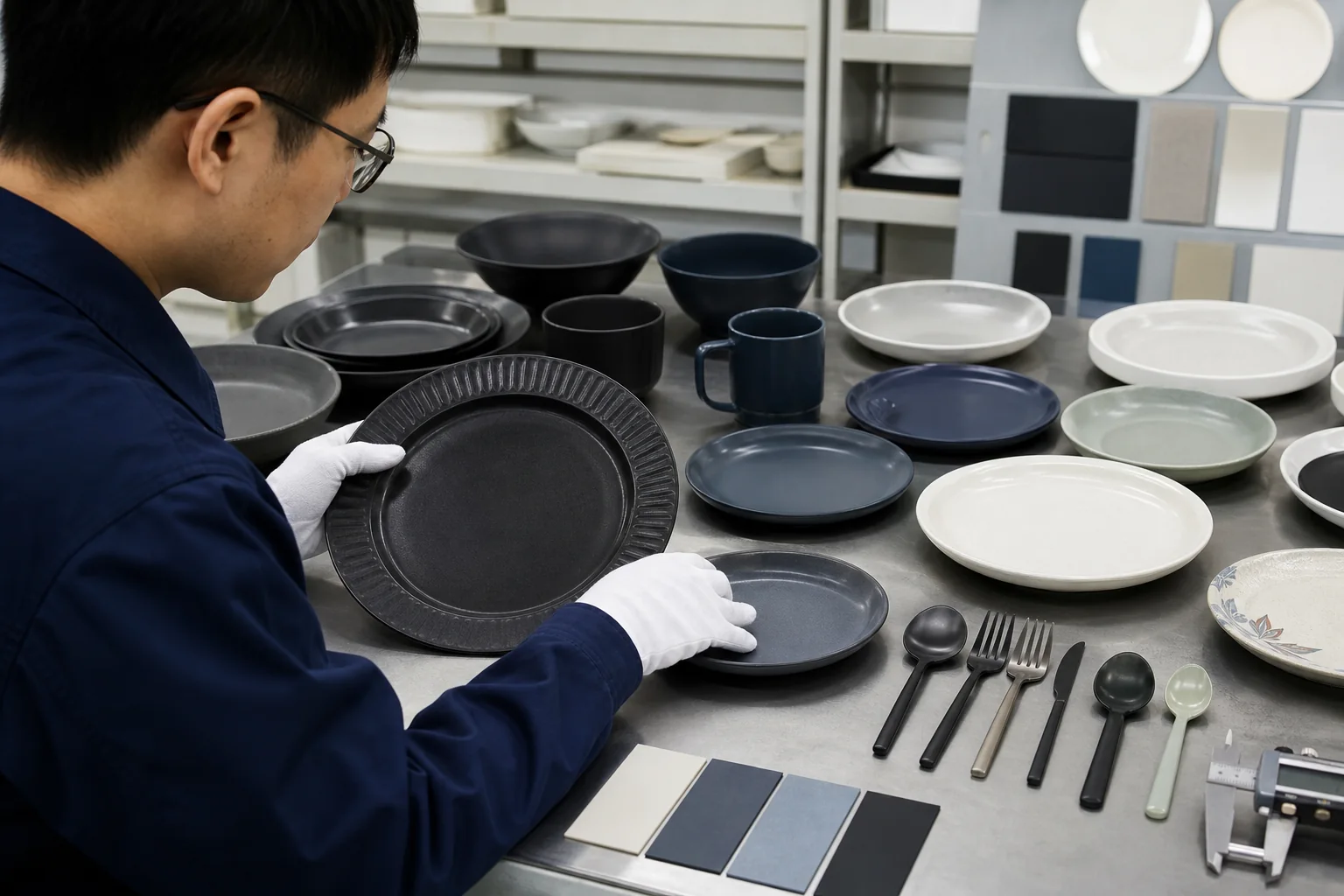
Early screening belongs before expensive commitments when a material, construction, or claim could make the project infeasible. Regulatory applicability review, supplier-document gaps, preliminary material checks, and proof-of-principle function tests can prevent teams from polishing CAD for a route that cannot meet the market brief.
Tooling approval needs tests that depend on production-intent geometry, such as fit, stack, stability, leak, suction, wall deformation, release, sharp features, or component assembly. Use controlled trial samples and resolve failures before final tool acceptance whenever a tooling change would be the corrective action.
Golden-sample approval should confirm the combined material, color, decoration, dimensions, function, cleaning, packaging, and document set at the agreed revision. The matrix should distinguish tests completed on early prototypes from those that must be repeated or confirmed on production-intent samples.
Pre-shipment controls then verify that the released production lot remains within the approved system. Routine inspection can check workmanship, dimensions, pack-out, labels, basic function, and sampling rules through a tableware AQL inspection plan, while specialized laboratory tests may run periodically or after defined changes rather than on every shipment.
Schedule backward from the latest safe decision date
Add quotation, sample preparation, transport, laboratory queue, testing, report review, retest, corrective tooling, and customer approval time to the project plan. A nominal ten-day laboratory lead time does not protect a launch if specimens are not final or a failure leaves no correction window.
Mark which activities can run in parallel and which depend on a prior pass. Procurement should not authorize irreversible packaging print, mass production, or shipment merely because one part of the matrix is complete.
Balance Test Cost Against Failure Exposure
Compare test cost with the decision it protects, not with the product unit price alone. A modest early test can be economical when it prevents a tool revision, rejected retail launch, relabeling, shipment hold, recall, or repeated customer complaint, while an expensive test is wasteful if it addresses no applicable requirement or credible use risk.
Ask laboratories to separate setup charges, per-specimen charges, variant additions, conditioning, report language, rush service, amendment fees, retesting, and sample return or disposal. Quotes that combine these items under one package price are difficult to compare and can hide different assumptions about samples and conditions.
Define who pays when a result fails because of supplier material, factory process, buyer specification, changed claim, packaging, or an invalid specimen. The commercial agreement should also state who owns reports, whether the buyer can verify them with the laboratory, and how confidential formulations or customer protocols are handled.
Set periodic review and event-based retest triggers rather than assigning one arbitrary expiry date to every row. Market-rule changes, material or supplier changes, new pigments, tooling revisions, process relocation, claim expansion, repeated complaints, failed inspections, and long production gaps can affect different parts of the matrix.
Approve reductions with a written risk decision
When budget or timing requires a reduced program, record which rows are deferred, why, who accepted the exposure, and what commercial action is blocked until the evidence exists. Do not silently delete a requirement from the quotation sheet and allow downstream teams to assume it passed.
Buyers can request a test-scope and quotation comparison with markets, product construction, intended use, claims, variants, and launch gates. The result should be a controlled procurement plan, not a promise that one standard package fits every reusable tableware project.

Compare Seven Test-Scope Decisions Before RFQ
Use this matrix to decide why each testing layer belongs in the project and when it should be purchased. The rows are complementary rather than alternative packages, so one SKU may need several layers with different owners and timing.
Do not request prices until every included row has a defined product, market, scenario, output, and release gate. Ask each bidder to flag exclusions instead of filling gaps with its preferred standard bundle.
| Scope decision | Primary question | Cost or risk effect | Procurement action |
|---|---|---|---|
| Market-access baseline | Which laws, rules, material measures, and documents apply in each sales market? | Omission can block import, sale, certification, or buyer approval | Confirm responsible party, citations, laboratory expectations, and required outputs |
| Customer protocol | Which retailer, distributor, platform, or brand requirements exceed the legal baseline? | Protocol age, named labs, or added limits can change price and lead time | Attach the current protocol and record who owns updates and deviations |
| Intended-use coverage | Which foods, temperatures, durations, heating, storage, cleaning, and reuse claims need evidence? | Broad conditions increase testing, but narrow conditions constrain claims and instructions | Approve one written use statement before laboratory quotation |
| Variant family | Which material, color, size, decoration, cavity, and package is worst case for each question? | Sound bracketing reduces duplication; weak grouping creates uncovered SKUs | Document family logic, selected specimens, and untested variants |
| Engineering validation | Which functional failures could create complaints, returns, injury, or tooling changes? | Early screening reduces late rework, while irrelevant tests consume budget | Tie each test to a failure mode, acceptance rule, and design gate |
| Production release | Which lot-level inspections and records show that approved conditions were repeated? | Routine controls can catch drift without repeating every laboratory test | Set sampling, measurement, documentation, and escalation rules |
| Surveillance and change | When should periodic review, focused retesting, or full reassessment occur? | Planned triggers avoid both stale reports and unnecessary annual repetition | List time-based reviews, material changes, process changes, complaints, and rule updates |
Eight Questions to Settle Before Buying Tests
Complete this buyer checklist before issuing an RFQ to a laboratory or accepting a supplier package. The answers should point to controlled project records rather than chat messages or generic brochure claims.
A blank answer is a decision gap, not permission for the laboratory to choose silently. Assign an owner and due date so scope uncertainty does not become an unexpected quotation amendment or launch delay.
| Check | Question | Why It Matters |
|---|---|---|
| Markets and users | Where will the SKU be sold, who is the intended user, and which party holds compliance responsibility? | Market and user classification determine applicable rules, evidence routes, and laboratory restrictions. |
| Product identity | Are materials, suppliers, colors, decorations, parts, drawings, and final packaging fixed? | An unstable construction produces reports that may not match the launched product. |
| Use and claims | Are food types, time, temperature, heating, cleaning, reuse cycles, and marketing claims approved? | Test conditions and commercial language must describe the same product use. |
| Requirement source | Does every mandatory or customer row cite the current rule, protocol, or contract requirement? | Named sources let reviewers distinguish obligations from optional engineering controls. |
| Worst case | Is the selected specimen justified separately for chemical, mechanical, functional, and packaging questions? | One convenient variant is rarely worst case for every test family. |
| Method and pass rule | Are the method edition, conditioning, variables, sample quantity, and acceptance criteria agreed? | Comparable quotations and defensible approvals require the same technical question. |
| Gate and schedule | Which decision does each result protect, and is there time for failure analysis and correction? | Late evidence can arrive after tooling, printing, production, or shipment becomes irreversible. |
| Ownership and retest | Who pays, reviews, releases, retains records, and triggers reassessment after a change? | Clear ownership prevents expired assumptions and uncontrolled scope reductions. |
Use Official Guidance to Define Inputs, Not a Universal Package
Official sources help buyers identify market responsibilities, intended-use variables, and special certification branches. They do not publish one complete reusable-tableware package that automatically fits every material, age group, claim, and country.
Use the sources to populate applicability questions, then ask qualified market specialists and laboratories to confirm the final matrix for the named SKU. Keep the confirmation, quotation, methods, and exclusions with the controlled product file.
The European Commission’s official food-contact materials overview identifies kitchenware and tableware as food-contact materials and points to the EU framework regulation, good manufacturing practice, and material-specific or national legislation. This supports a matrix branch for market, material, manufacturing, and documentation applicability. It does not identify the complete test list for a buyer’s exact silicone, plastic, composite, decorated, or assembled product.
The United States Food and Drug Administration publishes official food types and conditions of use for food-contact substances. The tables show why food category and temperature or treatment are necessary inputs rather than optional laboratory details. They support United States scoping discipline, but they do not approve a finished article, prescribe every reusable-performance test, or replace review of the regulatory status of its components.
The U.S. Consumer Product Safety Commission’s official third-party testing guidance explains that testing varies with product class, intended age, use patterns, material composition, and applicable children’s product rules, and that material changes can trigger affected retesting. This is relevant when tableware is designed or marketed primarily for children and a CPSC-enforced rule applies. It should not be added to every general-use tableware matrix without a documented product-classification and rule review.
Practical disclaimer: this procurement framework is not legal advice, laboratory accreditation guidance, or a complete list of tests for any market. Applicable requirements and methods can change, and the responsible manufacturer or importer must confirm them for the specific product and claims. A matrix controls decisions only when its sources, revisions, specimens, results, and approvals remain traceable.
Choose a Lean, Standard, or Expanded Program
A lean program can fit an established general-use SKU sold in one market when construction, supplier, intended use, and claims are narrow and current evidence already covers the unchanged risks. Lean does not mean skipping applicable requirements; it means documenting which existing evidence remains valid, adding focused gap tests, and retaining routine production controls.
A standard program fits a new private-label SKU with known material, normal reusable claims, final decoration, one or two target markets, and conventional packaging. It usually combines applicability review, production-intent food-contact scope, functional validation, claim checks, packaging confirmation, document review, and an inspection plan at defined development gates.
An expanded program is appropriate when the product uses new material or suppliers, multiple components, child-oriented positioning, broad heating or reuse claims, several markets, demanding retailer protocols, complex decoration, or an unproven pack. It may require multiple worst-case specimens, specialist laboratories, pilot conditioning, additional design iterations, and more schedule contingency.
Select the program tier from documented exposure rather than sales optimism or laboratory convenience. Procurement should issue one version-controlled matrix with the RFQ, require bidders to price the same rows, reconcile technical differences, and approve every exclusion before award.
Buyer FAQs About Reusable Tableware Test Planning
Can a laboratory create the full test matrix for the buyer?
A qualified laboratory can advise on methods and applicability within its competence, but it does not own the buyer’s markets, claims, user classification, product specification, or commercial risk. Procurement should coordinate regulatory, quality, product, marketing, supplier, and laboratory inputs and retain the final approval.
Should every reusable tableware SKU receive the same tests?
No. Shared requirements may apply across a family, but material, construction, color, decoration, food contact, heating, cleaning, user group, market, and claims can change the necessary scope and worst-case specimen.
Is one third-party laboratory required for every matrix row?
Not necessarily. Mandatory rules or customer protocols may require an accredited or specifically accepted laboratory, while some engineering screens and production controls can be performed by a capable factory or other qualified facility; record the required competence and evidence source for each row.
When should testing begin in an OEM project?
Begin applicability and risk review before material and tooling commitments, then place physical tests at the earliest stage with representative specimens. Reserve enough time after production-intent testing for failure analysis, corrections, retesting, report review, and customer approval.
Does a test report expire after one year?
There is no single universal expiry rule for every test and market. Use customer report-age rules, regulatory updates, material and process changes, claims, complaints, production gaps, and periodic risk review to define when each row needs confirmation or retesting.
Reusable Tableware Test Matrix: Issue a Quote-Ready Scope
Before the RFQ leaves procurement, the reusable tableware test matrix should tell every bidder the same story: where the product will sell, who will use it, what it is made from, how it contacts food, which claims it carries, which variants represent risk, what evidence is required, and which gate each result protects. Price differences then expose real technical or service differences instead of hidden scope gaps. Any assumption that remains open should have an owner and a deadline.
Award the program only after applicability, methods, specimens, quantities, conditions, acceptance rules, laboratory competence, reports, timing, fees, change triggers, and failure responsibilities are reconciled. Release tooling, packaging, production, and shipment against the completed rows assigned to those gates. This turns testing from a late certificate purchase into a controlled sourcing decision.
Request a Test-Matrix Quote Review
Share the product drawing, material and color variants, intended users, sales markets, food-contact conditions, cleaning and reuse claims, package plan, customer protocols, and launch milestones. The Naike Group manufacturing team can help organize factory inputs and production-intent samples into a quotation-ready scope for buyer and laboratory review.
Request a Custom Quote
Share your product, quantity, target market and customization needs. Our factory team will reply with the next practical step.
Continue Your Sourcing Research
The six newest factory-side articles are updated automatically by publication date.
Wheat Straw vs Bagasse Tableware: Buyer Comparison
A B2B decision guide comparing reusable wheat-straw polypropylene composite tableware with molded bagasse fiber formats across use, evidence, operations and end of life.

Can Wheat Straw Tableware Be Recycled? Buyer Q&A
A practical buyer answer on whether reusable wheat-straw composite tableware can enter PP recycling streams, which evidence matters, and how to qualify market claims.

Global SKU vs Regional SKU: Tableware Decision Guide
A buyer decision framework for choosing one global tableware SKU or controlled regional variants across compliance, packaging, logistics, inventory and change control.

Australia Food Packaging Evidence: Buyer Guide
A practical evidence guide for Australian food-packaging buyers covering intended use, migration risk, supplier assurance, testing, hygiene, release and change control.

EU PPWR Tableware Packaging vs Conventional Packs
A buyer comparison of PPWR-ready and conventional tableware packaging across product protection, material choices, empty space, evidence, labeling and release timing.

Prop 65 Tableware Requirements: Buyer Q&A
A practical buyer Q&A for defining California Proposition 65 exposure scenarios, evidence, warning decisions, supplier records and release controls for tableware.