
Verify FDA Silicone Food Contact Status: Buyer Guide
A buyer-side audit of what official listings, supplier records, laboratory evidence and factory controls can—and cannot—prove for a finished silicone food-contact article.

Buyer Answer: To verify FDA silicone food contact status, identify every substance in the complete silicone formulation, confirm the regulatory basis applies to the exact manufacturer or supplier and intended use, check all specifications and limitations, then link those inputs to the finished article and production lot. A generic “FDA approved,” food-grade certificate or passing test report cannot perform this full verification.
The evidence must distinguish a legal or regulatory basis from official guidance, a supplier statement, a laboratory observation and a factory control record. Each answers a different question, and no one document automatically proves that every component of a colored, printed or bonded silicone article is acceptable for its U.S. use.
Start with the exact product in the custom silicone tableware range and define exposure through the food-contact conditions-of-use workflow. If formula ownership or the U.S. use case is unclear, send the silicone SKU for an evidence review before approving claims or paying for broad testing.
This article is a sourcing and evidence-control guide, not legal advice or an FDA determination for any product. The manufacturer, importer and other responsible parties should confirm the current law, authorization route and limitations for the particular substances and use.
Factory Insider takeaway: Verify from the substance and supplier outward, then reconnect the decision to the finished SKU and batch. The phrase FDA compliant becomes meaningful only when a reviewer can identify the route, scope, limitations and production evidence behind it. Record the reviewer, date and approved boundaries so the decision can be repeated.
Define the Verification Question before Collecting Certificates
Silicone is a broad material description rather than one regulatory identity. A finished plate, spoon, lid or baby-feeding component may include a base polymer, crosslinking system, catalysts, fillers, pigments, processing aids, surface treatment, printing or bonded parts, and the status of the complete article depends on the relevant substances and uses.
The buyer question should name the SKU, formulation revision, food-contact surfaces, food types, maximum time and temperature, repeat-use pattern and target market. Without those facts, a supplier cannot demonstrate that an authorization, regulation or notification covers the intended conditions.
Separate direct food-contact components from non-contact parts, while still examining foreseeable migration or transfer where relevant. A silicone body may have a different evidence route from an ink, adhesive, plastic insert or metal reinforcement incorporated into the finished construction.
Write a one-page status brief with explicit boundaries
Record the buyer product code, factory code, drawing or mold revision, colorways, decoration, age group, foods, heating, storage, washing and repeated-use claims. Add explicit exclusions for applications not requested, because verification should not silently expand to infant formula, human milk, extreme heat or other conditions outside the file.
State who will rely on the conclusion and what commercial decision it supports. An RFQ screen, sample release, packaging claim and final shipment may require different levels of evidence and ownership.
Identify the Full Silicone Formulation and Commercial Sources
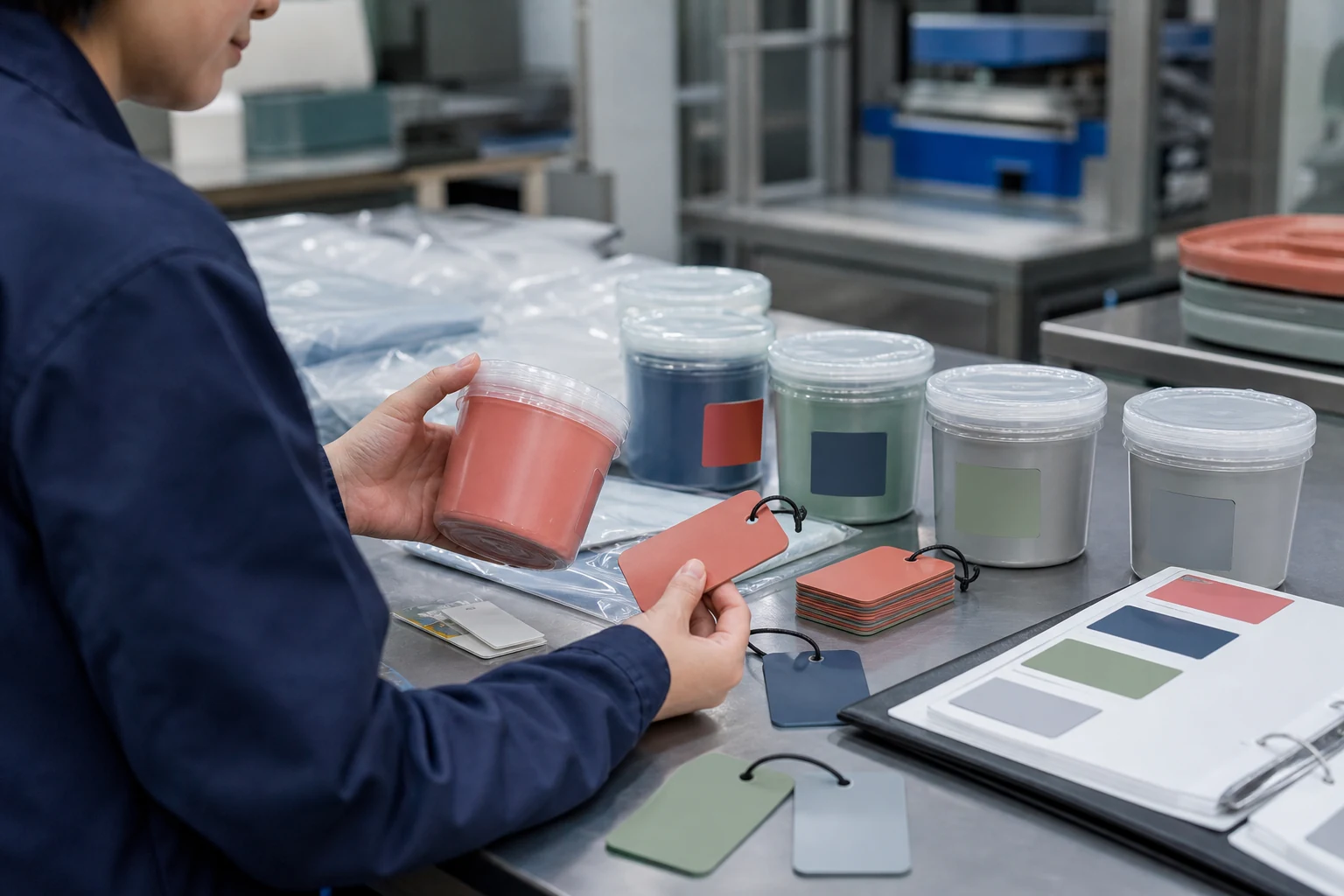
Begin with a controlled composition map that includes every intentionally used component and relevant food-contact layer. Use precise chemical or supplier identities where available, and preserve commercial grade, revision, purity or physical specifications and source information rather than accepting only the term silicone.
Supplier technical data, safety data and certificates can help identify materials, but their purposes differ. A safety data sheet may omit confidential or non-hazardous constituents, while a certificate may state compliance without showing the route or limitations needed for independent review.
Confidential formulations require a workable information pathway rather than forced disclosure to every buyer. The compound supplier can provide a qualified reviewer, laboratory or responsible manufacturer with enough identity and authorization information to support the decision while commercial details remain controlled.
Treat pigments, catalysts and decorations as part of the evidence problem
Color variants and printing systems can introduce substances not represented by a natural or unprinted sample. A buyer should request a color-family rationale, worst-case selection and change rules instead of assuming one neutral report covers every custom Pantone option.
Connect the formula map to the Naike Group material approval workflow. The approved bill of materials should identify which supplier and grade can enter production and which substitution requires renewed technical review.
Map an Applicable Regulatory Route for Every Relevant Substance
FDA explains that the regulatory status of a food-contact material is dictated by the status of the individual substances that comprise the article. Potential routes include an applicable provision in Title 21 of the Code of Federal Regulations, an effective Food Contact Substance Notification, a Threshold of Regulation exemption, a prior sanction or an appropriate GRAS basis, depending on the substance and use.
A route name is only the beginning of the verification. Match the substance identity, specifications or purity, manufacturer or supplier where the route is source-specific, and limitations on conditions of use to the material actually purchased.
Do not infer status from a similar chemical name or another supplier’s record. Polymers and additives can differ in composition, reaction products, impurities, physical properties and manufacturing source even when commercial descriptions look familiar.
Create a route register that exposes missing links
Use one row per relevant substance or controlled mixture and record source, grade, identifier, regulatory basis, intended use, limitations, supporting document and reviewer conclusion. Mark unknowns as holds rather than filling them with the status of the base polymer.
The register should also distinguish current official information from supplier interpretation. An official database entry may establish the boundaries of an authorization, while the supplier must show that its product is the substance and source to which the entry applies.
Check a CFR-Based Claim against the Exact Substance and Use
When a supplier cites a section of Title 21 CFR, read the actual provision and its cross-references rather than treating the citation as a product certificate. Confirm that the named substance or material category matches the purchased commercial grade and that every composition restriction, extractive limit, specification and permitted use is satisfied.
Silicone buyers often encounter a broad reference to 21 CFR 177.2600 for rubber articles intended for repeated use. That citation is not a universal authorization for every silicone recipe, color, decoration or assembled product, and the section contains compositional and extractive requirements that must be evaluated in context.
Ask the supplier to identify which ingredients rely on the cited regulation, which rely on other routes and how the finished formulation meets applicable limitations. A citation without a substance-to-route map leaves the buyer unable to see whether pigments, fillers, catalysts or processing aids have been addressed.
Record the conditions that make the citation applicable
Capture the food types, temperature, duration and repeat-use assumptions tied to the regulatory conclusion, then compare them with the commercial product brief. The conditions-of-use method helps keep a cold-storage claim from being stretched into baking, boiling or prolonged hot-fat exposure.
If a cited provision requires a finished-article test or extractive limit, preserve the test method, sample identity and result beside the legal basis. The regulation and the laboratory result support different parts of the conclusion and should remain separately traceable.
Verify FCN, TOR, GRAS and Other Source-Specific Claims
An effective Food Contact Substance Notification is generally effective only for the identified manufacturer or supplier and the notified substance under the stated conditions of use. Matching only an FCN substance name is therefore insufficient; the buyer must also verify the commercial source, identity, specifications and scope shown in the effective notification.
For a Threshold of Regulation exemption, prior sanction or GRAS rationale, request the specific basis and its boundaries. Determine whether the route is legally available for the intended food-contact use, whether it is source-specific, and whether any purity, exposure, technical-effect or use limitations apply.
A supplier letter may explain why its grade fits a route, but it should point to reviewable evidence. Date the letter, name the grade and manufacturing source, list the intended conditions, identify the authorization basis and require notification when the substance, source or process changes.
Resolve confidential evidence without accepting an empty assurance
If the compounder will not disclose proprietary composition to the buyer, establish a confidential review by a competent third party or the responsible finished-goods manufacturer. The resulting statement should confirm that every intentionally used component was assessed, describe the routes and limitations, and identify the controlled formulation revision without revealing unnecessary trade secrets.
When the evidence cannot be tied to the actual supplier, treat the status as unresolved. Buyers can contact the factory compliance team with the SKU and supplier evidence to define the missing records before samples or labels are approved.

Match Identity, Specifications and Conditions of Use
Verification closes only when the regulatory route and the commercial article describe the same substance, specifications and foreseeable exposure. Compare chemical identity, commercial grade, purity, physical form, maximum use level and any technical-effect restriction with the controlled formulation and purchase specification.
Translate the intended use into evidence variables: aqueous, acidic, alcoholic or fatty food; contact duration; minimum and maximum temperature; repeated-use cycles; heating method; cleaning; and storage. A silicone ice tray, baking mold and infant spoon may share a polymer family while presenting materially different exposure and claim questions.
Apply the most demanding supported condition to each marketed claim and explicitly exclude unsupported uses. This boundary becomes part of the product specification, customer documentation, packaging copy and change-control plan rather than a footnote in a test report.
Use a decision record that another reviewer can reproduce
The decision record should cite the official source, show the supplier and grade match, summarize applicable limitations, identify unresolved assumptions and state the approved intended use. A second reviewer should be able to repeat the reasoning without relying on a sales conversation or an unlabeled PDF.
Link that decision to sample approval through the custom tableware sample workflow. If the approved sample, color master, decoration or compound changes, reopen the relevant parts of the status assessment.
Use Laboratory Tests to Confirm Defined Performance, Not Legal Status
A migration or extractives report can show how an identified specimen performed under a stated method and set of conditions. It does not by itself identify every substance, establish an authorization route, prove supplier-specific FCN coverage or confirm that future production uses the same controlled formulation.
Review the laboratory, accreditation scope where relevant, report date, test standard, specimen description, color, construction, sampling party, simulants, time, temperature, cycles, detection limits and acceptance criteria. Compare every parameter with the approved intended use and document why the tested variant represents the marketed range.
Use testing to address a defined regulatory or risk question after the formulation and use have been mapped. Broad screening may help detect unexpected migration or support due diligence, but it should not replace the substance-level review described by FDA.
Control the sample so the report belongs to the product
Preserve photographs, dimensions, color code, mold revision, compound lot, molding batch, decoration lot and sample-selection record. A report that describes only “silicone product” cannot reliably support a buyer SKU with different pigments, thickness, curing or post-cure conditions.
Set retest triggers for material-source changes, formula revisions, new color systems, altered cure cycles, new food-contact decorations or expanded use. Keep the original report and the written bridging rationale so future reviewers can see why evidence remained applicable.
Connect the Reviewed Evidence to Factory Production and Shipment
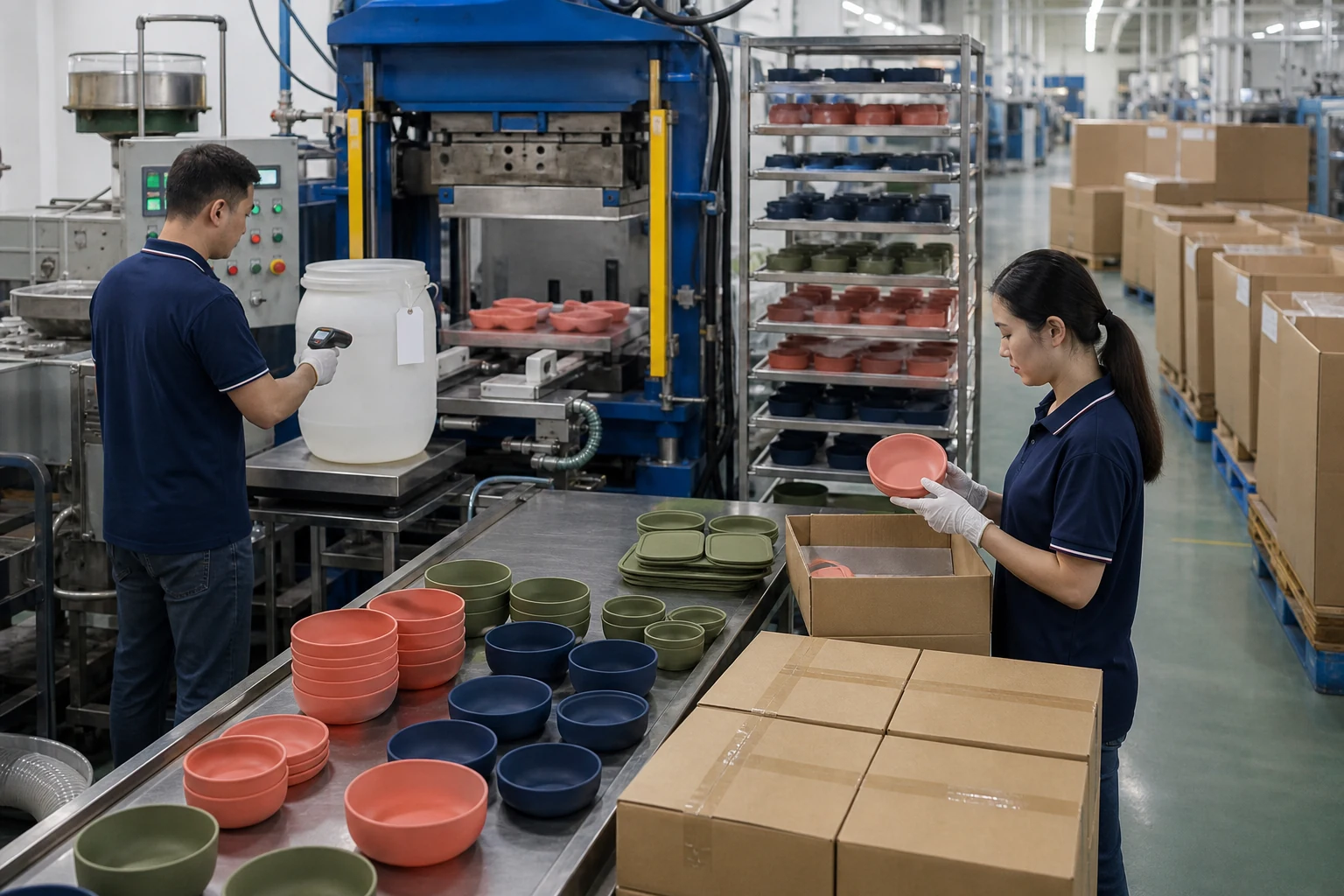
A defensible file continues from approved supplier and compound grade to incoming lot, controlled recipe, molding batch, post-cure record, inspection, retained sample and export carton. This chain prevents an excellent regulatory assessment from becoming detached from the material that was actually used.
Qualify suppliers, restrict purchasing to approved grades, verify incoming labels and certificates, segregate materials and reconcile batch consumption. The food-contact traceability guide shows how buyer and factory identifiers can remain connected through production and shipment.
Change control is the final evidence gate. Require advance review when a compounder, ingredient, pigment, processing aid, plant, formulation, decoration, mold, cure condition or intended use changes, then decide whether documentation, risk assessment, testing or customer approval must be renewed.
Make shipment release an evidence decision
The release packet should identify the purchase order, SKU, approved bill of materials, supplier lots, production lot, inspection result and applicable status file revision. Exceptions should be visible and signed by an authorized reviewer rather than buried in email.
Audit this linkage during factory capability review and confirm it again before shipment. A complete file is useful only when production records show that the reviewed materials and controls were followed.
What Each FDA Silicone Evidence Layer Can Prove
Treat regulatory verification as an evidence ladder. Each layer answers one buyer question, while the combined file supports a reproducible conclusion for the exact silicone SKU and intended use.
| Evidence Layer | What It Can Establish | Boundary to Control |
|---|---|---|
| Official CFR provision | Whether a listed substance or material use is authorized within stated requirements | Does not identify the buyer’s commercial grade or prove every ingredient fits |
| Effective FCN inventory | Notification scope for the named substance, manufacturer or supplier and conditions | Cannot be transferred automatically to another source or broader use |
| TOR, prior sanction or GRAS basis | A specific alternative regulatory rationale and its boundaries | Needs a documented match to the actual substance and application |
| Supplier compliance statement | How the named grade and source are represented against defined routes | Depends on accuracy, scope, currency and change notification |
| Laboratory report | How the identified specimen performed under stated analytical conditions | Does not establish authorization or future-batch identity alone |
| Formula and bill of materials | Which substances, grades, suppliers and revisions form the article | Confidentiality may require controlled third-party review |
| Factory batch records | Whether approved inputs and processes were linked to the shipped lot | Cannot repair a missing regulatory basis upstream |
Eight Checks before Approving an FDA Silicone Claim
Use the checklist at RFQ, sample approval and shipment release. A “no” or “unknown” should become a named hold, evidence request or claim limitation rather than an assumed pass.
| Check | Question | Why It Matters |
|---|---|---|
| Product and use brief | Are SKU, construction, food types, time, temperature, repeat use and exclusions explicit? | The regulatory scope cannot be matched without a defined application. |
| Complete composition map | Are polymer, crosslinker, catalyst, filler, pigment, aid, ink and bonded parts addressed? | Status follows the relevant substances, not the word silicone. |
| Commercial source | Are supplier, grade, plant or other source-specific facts controlled? | An FCN or supplier assurance may not apply to another source. |
| Authorization register | Does each relevant substance have an identified and reviewable regulatory basis? | One base-material citation cannot cover an unexplained additive. |
| Identity and limits | Do identity, purity, specifications, use level and restrictions match the purchased material? | A route is applicable only inside its defined boundaries. |
| Test relevance | Is the tested specimen traceable and are method conditions representative of intended use? | A passing result is meaningful only for its sample and protocol. |
| Production linkage | Can incoming lots, molding batch, cure controls and finished cartons be traced? | The reviewed formula must remain connected to the shipment. |
| Change control | Do supplier and factory rules trigger review before material, process or use changes? | Status can become obsolete when assumptions change. |
Official FDA Sources to Put in the Buyer File
Save the current official page, access date and the specific passage or inventory record used in the assessment. Then record how that source applies to the commercial material rather than treating the URL as a blanket certificate.
1. Product and use brief control for verify FDA silicone food contact status
For Product and use brief, answer “Are SKU, construction, food types, time, temperature, repeat use and exclusions explicit?” for the exact SKU. Freeze the commercial product identity and requested application before opening the regulatory file.
The regulatory scope cannot be matched without a defined application. An undefined use encourages evidence to be stretched beyond the conditions that were actually reviewed. Close the row with an approved brief and named owner.
2. Complete composition map control for verify FDA silicone food contact status
For Complete composition map, answer “Are polymer, crosslinker, catalyst, filler, pigment, aid, ink and bonded parts addressed?” for the exact SKU. Obtain a controlled composition statement or arrange a confidential competent review of every relevant constituent.
Status follows the relevant substances, not the word silicone. A generic material name can hide additives or contact layers with separate status questions. Record formulation revision and permitted suppliers.
3. Commercial source control for verify FDA silicone food contact status
For Commercial source, answer “Are supplier, grade, plant or other source-specific facts controlled?” for the exact SKU. List one defensible regulatory route for each relevant substance and preserve its official scope.
An FCN or supplier assurance may not apply to another source. A base-polymer citation cannot fill an additive-level evidence gap. Flag every unknown as a release hold.
4. Authorization register control for verify FDA silicone food contact status
For Authorization register, answer “Does each relevant substance have an identified and reviewable regulatory basis?” for the exact SKU. Read the cited regulation and cross-references against actual composition, specifications and use.
One base-material citation cannot cover an unexplained additive. A section number alone does not demonstrate that all requirements have been met. Attach the dated applicability rationale.
5. Identity and limits control for verify FDA silicone food contact status
For Identity and limits, answer “Do identity, purity, specifications, use level and restrictions match the purchased material?” for the exact SKU. Confirm source-specific records against supplier, grade and effective inventory details.
A route is applicable only inside its defined boundaries. A notification for one source cannot simply be borrowed by another compounder. Require change notification from the evidence owner.
6. Test relevance control for verify FDA silicone food contact status
For Test relevance, answer “Is the tested specimen traceable and are method conditions representative of intended use?” for the exact SKU. Compare food type, time, temperature, repeated use and cleaning with every stated limitation.
A passing result is meaningful only for its sample and protocol. Commercial claims outside the supported envelope remain unresolved. Narrow the claim or commission justified additional work.
7. Production linkage control for verify FDA silicone food contact status
For Production linkage, answer “Can incoming lots, molding batch, cure controls and finished cartons be traced?” for the exact SKU. Trace the laboratory specimen to color, compound lot, process, method and acceptance criteria.
The reviewed formula must remain connected to the shipment. A passing result without sample identity cannot represent the production SKU. Preserve the sample-selection and bridging record.
8. Change control control for verify FDA silicone food contact status
For Change control, answer “Do supplier and factory rules trigger review before material, process or use changes?” for the exact SKU. Link approved inputs through molding, inspection, retained sample and shipment release.
Status can become obsolete when assumptions change. Even a sound office assessment fails if production substitutes an unreviewed material. Audit forward and backward traceability before shipment.
Official FDA References and Scope Boundaries
FDA: Determining the Regulatory Status of Components of a Food Contact Material explains that status is dictated by the individual substances in the article and describes available regulatory pathways. It also directs reviewers to compare identity, specifications and conditions of use with the applicable authorization.
FDA: Inventory of Effective Food Contact Substance Notifications is the official place to check effective FCNs. The inventory must be read for the named manufacturer or supplier, substance and conditions because an FCN is not a generic authorization for every commercial source.
FDA: Inventory of Food Contact Substances Listed in 21 CFR helps locate substances and applicable CFR provisions. Review the actual regulation, cross-references, specifications and use limitations before connecting an entry to a finished silicone article.
Practical disclaimer: This workflow supports sourcing due diligence and evidence organization. It is not legal advice, an FDA approval, or a substitute for a qualified regulatory review of the exact formulation, supplier and intended use.
FDA Silicone Status Questions from B2B Buyers
Does FDA issue an approval certificate for a finished silicone product?
Usually no blanket finished-product certificate exists for this buyer question. The responsible party must establish that the substances and uses comply through applicable regulations, effective notifications or other valid bases, supported by relevant controls and evidence.
Is a 21 CFR 177.2600 test report enough?
No. It may support specified extractive requirements for an identified repeated-use rubber article, but it does not automatically identify every ingredient, prove another supplier’s authorization or cover every intended condition.
Can one natural-color silicone test cover all custom colors?
Only with a documented technical rationale that addresses pigment systems, composition, worst cases and production controls. New colorants or concentrations can change the substance map and may require renewed review or testing.
What should a buyer request from a confidential compound supplier?
Request a grade-specific statement naming the formulation revision, source, applicable routes, intended-use limits and change-notification duty. A qualified third party can review confidential composition when direct disclosure is not commercially appropriate.
When should the FDA silicone status file be reopened?
Reopen it after supplier, grade, formula, pigment, decoration, process, plant or intended-use changes and when official information changes. Also review it at planned intervals so expiring reports or superseded statements are detected.
Verify FDA Silicone Food Contact Status before Release
The reliable way to verify FDA silicone food contact status is to trace every relevant substance from an applicable official route through supplier identity, specifications and conditions of use, then connect that conclusion to the finished SKU and shipment batch. Tests, declarations and certificates become useful when their precise scope is visible and their assumptions are controlled.
For sourcing teams, the commercial outcome is a clear release decision: approved for defined uses, held for named evidence, or excluded from unsupported claims. That discipline protects product development without pretending that one logo or report answers the entire regulatory question.
Contact the Factory to Audit Your Silicone Evidence
Send the SKU, intended food-contact use, supplier statements and available test reports. Naike Group can map the missing evidence, align sample and production controls, and prepare a practical factory review before quotation or shipment.
Request a Custom Quote
Share your product, quantity, target market and customization needs. Our factory team will reply with the next practical step.
Continue Your Sourcing Research
The six newest factory-side articles are updated automatically by publication date.

Wheat Straw vs Bagasse Tableware: Buyer Comparison
A B2B decision guide comparing reusable wheat-straw polypropylene composite tableware with molded bagasse fiber formats across use, evidence, operations and end of life.

Can Wheat Straw Tableware Be Recycled? Buyer Q&A
A practical buyer answer on whether reusable wheat-straw composite tableware can enter PP recycling streams, which evidence matters, and how to qualify market claims.

Global SKU vs Regional SKU: Tableware Decision Guide
A buyer decision framework for choosing one global tableware SKU or controlled regional variants across compliance, packaging, logistics, inventory and change control.

Australia Food Packaging Evidence: Buyer Guide
A practical evidence guide for Australian food-packaging buyers covering intended use, migration risk, supplier assurance, testing, hygiene, release and change control.

EU PPWR Tableware Packaging vs Conventional Packs
A buyer comparison of PPWR-ready and conventional tableware packaging across product protection, material choices, empty space, evidence, labeling and release timing.

Prop 65 Tableware Requirements: Buyer Q&A
A practical buyer Q&A for defining California Proposition 65 exposure scenarios, evidence, warning decisions, supplier records and release controls for tableware.