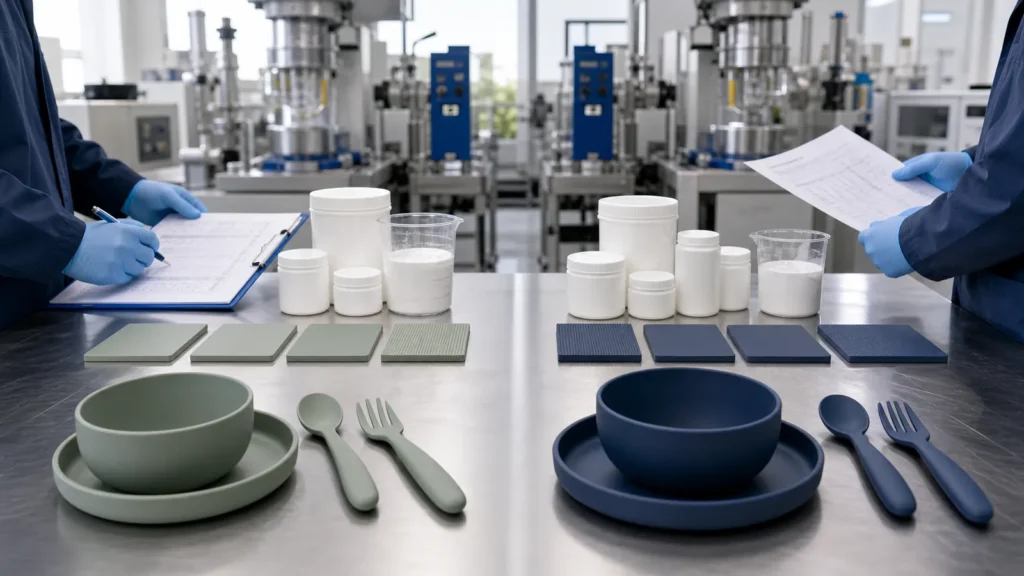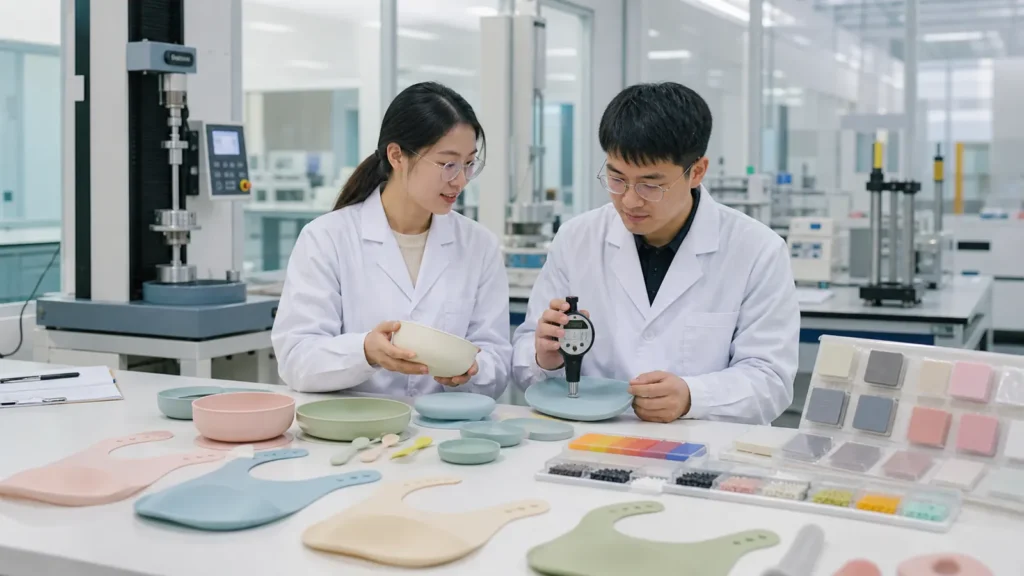
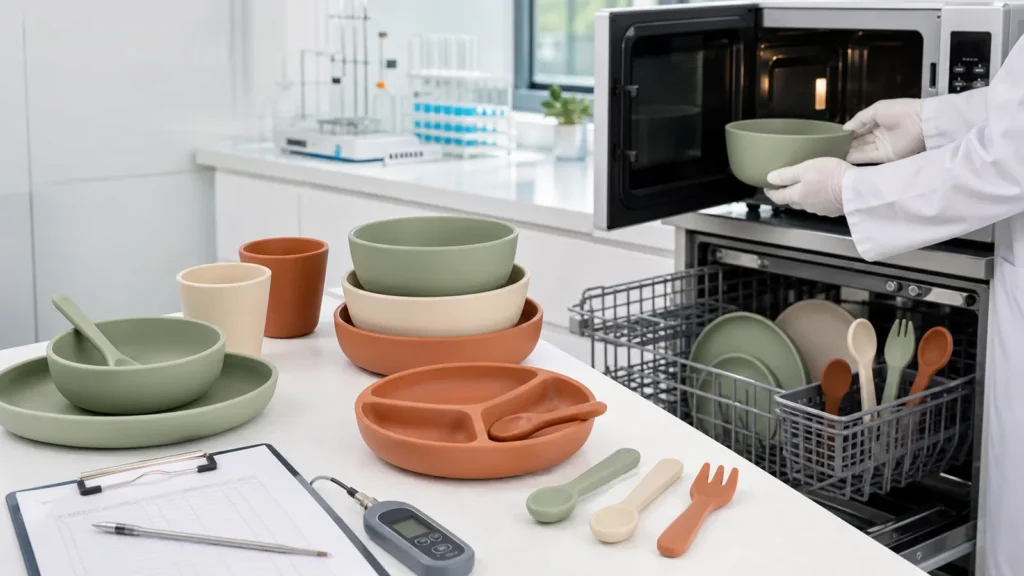
Buyer Answer — Is silicone tableware microwave safe? Yes, a properly formulated and manufactured silicone tableware product can be suitable for microwave reheating and dishwasher cleaning, but the word “silicone” alone does not prove either claim. B2B buyers should approve a defined material, finished construction, maximum use conditions, migration evidence, and repeated-use tests before printing microwave-safe or dishwasher-safe instructions.
The decision should be product-specific. A thick bowl, thin lid, suction plate, printed cup, and bonded multi-material item can respond differently even when each supplier calls the base polymer silicone, so review the exact construction through a controlled custom product development process.
This guide separates three questions that purchasing teams often compress into one claim: whether the material has an appropriate food-contact regulatory basis, whether the finished product tolerates the intended heating or washing cycle, and whether users receive instructions that keep use within the validated boundary. The answer is therefore conditional, not a universal temperature promise for every silicone article.
For buyers sourcing private-label ranges, our custom silicone products program connects material identity, tooling, sample approval and production controls. The same evidence package should travel from quotation through artwork approval and shipment release.
Factory Insider takeaway: Treat microwave-safe and dishwasher-safe as separate, evidence-backed use claims. Define the actual food, power, time, temperature, cycle chemistry, loading, product geometry, decoration and repeat count, then approve only the construction that was tested. The approval record should name the evidence owner and the condition that holds the next commercial gate.
Why “Silicone Tableware Microwave Safe” Is a Conditional Answer
Silicone elastomers are widely selected for flexible food-contact products because suitable grades can retain useful properties across demanding temperatures. That general material capability is only the starting hypothesis for a buyer; it does not identify the formulation, manufacturing residues, color system, decoration, bonding agent or finished-part behavior in a particular order.
Microwave heating acts mainly through the food and water in the container, so the product experiences heat from its contents, hot spots, steam and local contact conditions. An almost empty bowl, an oil-rich food and a full water-based meal can create different thermal loads even when the appliance uses the same displayed power.
Dishwasher exposure is also a system rather than one temperature. Detergent alkalinity, rinse aids, spray force, rack position, drying heat, cycle duration and repeated loading can change surface appearance, odor, printing, adhesion and dimensional recovery over time.
A buyer should therefore ask whether the named finished SKU is validated for a specific use statement. If the evidence describes only a raw material family or a different shape, it supports development but does not automatically authorize the claim on the current product.
Turn a broad safe claim into measurable use conditions
Write the claim as a boundary that a laboratory and factory can reproduce. For microwave use, identify representative foods, fill level, appliance power, heating duration, pauses, target or maximum temperature, and whether reheating rather than cooking is intended.
For dishwasher use, define the machine type, rack position, program, detergent, drying stage and number of cycles. The protocol should also state which changes count as failure, including tackiness, whitening, warpage, cracking, odor, color shift, weakened suction or damaged decoration.
Confirm Food-Contact Status Before Appliance Performance
Food-contact compliance and appliance durability answer different questions. Regulatory evidence addresses whether substances in the controlled construction have an appropriate basis and whether migration or extractives remain within applicable conditions, while a microwave or dishwasher trial examines how the finished product performs during the marketed use.
In the United States, FDA explains that the regulatory status of every component of a food-contact material must be established for the intended use. Buyers should map the supplier grade, pigments and other relevant components to the applicable authorization route instead of accepting “FDA approved silicone” as a complete document description.
European projects likewise need a market-specific compliance assessment. Germany’s BfR Recommendations on Food Contact Materials include a recommendation for silicones, but recommendations, national provisions and the broader EU food-contact framework should be reviewed with the actual product and supply chain in mind.
A test report becomes useful only when its sample identity and conditions match the current bill of materials. Our LFGB versus FDA silicone testing guide explains why market names should not be used as shorthand for one universal certificate.
Connect migration evidence to microwave and repeated use
The evidence plan should reflect the types of food, contact time and temperatures that the brand intends to claim. A room-temperature aqueous test cannot by itself answer every question about hot fatty food, repeated reheating or repeated washing.
Buyers should obtain the underlying report scope, sample description, methods and results, then record why those conditions cover the commercial instructions. Where the intended use falls outside existing evidence, commission an appropriate assessment before packaging approval.
Validate Microwave Reheating on the Finished Silicone Product
Start with the exact production-intent shape because wall thickness, corners, ribs, suction bases and lids influence heating and deformation. Include the approved color and every decoration or insert that will remain on the product during use, since an unprinted laboratory plaque cannot reveal failures at a logo or bonded interface.
Use a documented reheating sequence with representative food loads and conservative foreseeable scenarios. Record initial and final food temperature, heating time, rest time, visible boiling or steam behavior, product surface condition and any handling concern when the item is removed.
Evaluate function after the part cools as well as while it is hot. A bowl may look acceptable in the appliance but show permanent rim distortion, reduced suction, lid-fit change or surface tack after repeated cycles, and those changes matter to repeat-use performance.
Microwave trials should not create unsupported numerical claims. The factory and buyer should agree whether the product is intended for reheating only, whether a cover must be vented, whether empty heating is prohibited, and whether high-fat or high-sugar foods require special limits.
Build a result that purchasing and quality can release
Photograph the setup and identify the sample, appliance, program, load and measurement equipment in the record. Define acceptance before testing so a commercial deadline does not turn an unexpected change into a subjective pass.
When geometry or molding creates weak spots, review the tool and process using our silicone mold manufacturing guide. If cracks, tears, flash or incomplete cure appear, use the structured diagnosis in our silicone compression molding defects guide before retesting.
Test Dishwasher Safety as a Repeated Cleaning Claim
A single clean cycle is a screening observation, not strong evidence for a repeated-use claim. A buyer program should expose production-intent samples to enough controlled cycles to reveal cumulative changes, with unwashed controls retained for side-by-side comparison.
Place products in the rack position stated by the consumer instruction and prevent unrealistic nesting that shields critical surfaces. If both upper-rack and unrestricted dishwasher claims are being considered, test the more demanding location or narrow the instruction to the validated position.
Inspect before testing, at planned intervals and after final conditioning. Record dimensions, mass where relevant, surface feel, odor, gloss, color, printing, bonding, lid fit, suction behavior and any cracking or sticky residue rather than relying on a simple visual pass.
Detergent chemistry matters because household products and commercial programs vary. The validation plan should document the detergent and rinse aid, while risk review decides whether additional chemistries or water conditions are necessary for the target market.
Temperature indicators and machine labels are useful setup evidence, but the team should also record the actual program duration and drying behavior. Repeating the same named cycle on a different machine may not reproduce the same exposure, so equipment identity belongs in the report.
Judge cleanability without confusing it with durability
A product can survive the machine and still retain food or detergent in a poorly designed recess. Review drain paths, undercuts, removable parts and textured zones for accessible cleaning, then inspect after realistic soils rather than only running unused samples.
Drying and storage should also be considered when hollow features or assemblies can trap water. Buyers should resolve these design risks before tooling approval because consumer instructions cannot reliably correct an inaccessible cavity.
Control Material, Cure, Color and Product Design Together
The commercial specification should name the approved silicone grade or controlled formulation, material supplier, hardness range, color system and cure route. Substituting a visually similar compound can change processing, extractives, odor, mechanical behavior or supporting documentation even when the finished part still feels like silicone.
Cure and any required post-cure conditions need traceable process windows. Incomplete or inconsistent processing can contribute to odor, surface behavior and performance variation, so production records should connect the shipped lot to the approved time, temperature and handling route.
Geometry can amplify material behavior. Thin edges may tear, heavy sections may heat and cool differently, ribs may trap soil, and a large suction base may distort if packing pressure or dishwasher loading holds it in the wrong shape.
Hardness is another design input rather than a stand-alone safety grade. Use our silicone Shore hardness buyer guide to connect measured material response with wall thickness, suction, flexibility and finished-product function.
Supplier technical data can guide the initial operating window, yet it does not replace validation on the molded article. Buyers should ask the factory to reconcile datasheet limits with the lower claim boundary justified by the finished geometry and supporting tests.
Include decorations, inserts and packaging in change control
Printed logos, molded color effects, bonded rings and non-silicone components should be assessed as part of the final SKU. A base bowl result cannot automatically cover an added transfer print, adhesive joint, plastic lid or metal insert.
Packaging can deform flexible products during warm storage or long transport. Conduct pack-out recovery checks and confirm that folded, nested or compressed articles return to the approved dimensions and function before consumer use.
Approve Claims, Instructions and Production Release Evidence
Artwork should use the exact wording supported by the validation record. Terms such as microwave safe, reheating only, top-rack dishwasher safe, remove lid, vent before heating or do not heat empty are materially different instructions and must not be selected only for marketing convenience.
Translate the validated boundary into symbols and text suitable for the destination market, then verify consistency across packaging, inserts, online listings and customer service scripts. Conflicting channels create foreseeable misuse and make complaint investigation harder.
Before bulk release, quality should confirm the product revision, material lot, color, decoration, cavity status, cure record, inspection results and packaging configuration against the approved sample. The release file should also identify the reports and internal trials that support each consumer claim.
If evidence is missing or the intended use changes, pause the claim rather than widening it by assumption. Buyers can Contact Us with the target markets, appliance instructions and product drawing so the factory can scope samples and validation before quotation is finalized.
Inspection plans should include objective claim-critical defects, such as distorted rims, damaged markings, loss of lid fit or residue in inaccessible features. Defining those defects before shipment gives the inspector authority to hold a lot when the marketed use is no longer supported.
Keep repeat orders inside the validated boundary
Create reapproval triggers for material supplier, grade, pigment, decoration, geometry, tool repair, cure route, packaging pressure and intended-use wording. The trigger list prevents a purchasing or engineering change from silently invalidating the evidence behind the claim.
Retain approved samples and relevant production-lot records for comparison. When complaints occur, capture the appliance, program, food, cycle count, cleaning agent, lot code and photographs so the team can distinguish misuse, isolated damage and a systematic product issue.
Silicone Tableware Microwave Safe Evidence Compared
The following records answer different buyer questions and should be read together. None of them alone proves that every silicone product is safe for every appliance program, food or repeated-use condition.
| Evidence | Question Answered | Product Link Required | Common Misuse | Buyer Release Decision |
|---|---|---|---|---|
| Raw-material technical data | What properties and processing guidance does the supplier state? | Exact grade and current revision | Treating a typical limit as a finished-product claim | Use to design trials, not as sole release evidence |
| Regulatory-status documents | What food-contact basis applies to each component and use? | Supplier, grade, formulation and intended conditions | Accepting a generic “food grade” statement | Confirm scope with qualified market review |
| Migration or extractives report | What was measured under named test conditions? | Tested sample matched to current construction | Extending one simulant or temperature to every use | Map conditions to marketed foods and exposure |
| Microwave finished-product trial | Does the SKU tolerate controlled reheating scenarios? | Production-intent shape, color, decoration and assembly | Testing an empty plaque or one easy load | Approve precise heating instructions and limits |
| Repeated dishwasher trial | Does cleaning preserve appearance, dimensions and function? | Exact SKU, rack position, detergent and cycle | Calling one wash a repeated-use validation | Approve cycle language and acceptance criteria |
| Production release record | Was the shipped lot made to the validated construction? | Material lots, process, inspection and packaging | Assuming a passing development sample controls substitutions | Release only traceable conforming lots |
B2B Buyer Checklist for Microwave- and Dishwasher-Safe Silicone
Use this checklist before quotation lock, sample approval and packaging release. Each answer should point to a dated specification, report, approved sample or responsible decision maker rather than an informal assurance.
| Check | Question | Why It Matters |
|---|---|---|
| Intended use | Are food types, fill level, heating purpose, power, time and cleaning cycle defined? | A use claim cannot be validated without a reproducible exposure boundary. |
| Material identity | Are silicone grade, supplier, color system and relevant components controlled? | The word silicone does not identify a regulatory or performance-equivalent formulation. |
| Regulatory basis | Does every food-contact component have evidence suited to the target market and use? | Appliance durability does not replace food-contact compliance assessment. |
| Finished sample | Do reports cover the current geometry, decoration, assembly and production-intent process? | Plaques and similar products may not reveal the risks of the marketed SKU. |
| Microwave protocol | Were representative loads, temperatures, repeat cycles and post-cooling functions recorded? | Heat effects can appear during use or only after the product returns to room temperature. |
| Dishwasher protocol | Were machine, rack, program, detergent, drying and repeat count documented? | Cleaning severity varies and cumulative damage may not appear after one cycle. |
| Claim wording | Do packaging, symbols, listings and instructions match the validated limits exactly? | Wider or conflicting language can encourage use outside the evidence boundary. |
| Change control | Which material, color, tool, decoration, process or packaging changes trigger reapproval? | A later change can disconnect the shipped product from the original validation. |
Factory Playbook for Claim-Critical Approval Gates
The playbook converts each buyer question into a controlled record with an owner, evidence source and hold point. During development, Naike Group manufacturing team links those records to the drawing, bill of materials, approved sample and purchase order so production cannot widen a claim without review.
1. Intended use control for silicone tableware microwave safe
For Intended use, the buyer and factory answer “Are food types, fill level, heating purpose, power, time and cleaning cycle defined?” against the current product revision before the next approval. The record names the sample, method, owner and release consequence so the decision survives purchasing and production handoffs.
A use claim cannot be validated without a reproducible exposure boundary. If the evidence is incomplete or a later change affects the answer, the factory holds the dependent claim or production gate. A dated disposition then records whether to retest, narrow the instruction, correct the construction or reject the change.
2. Material identity control for silicone tableware microwave safe
For Material identity, the buyer and factory answer “Are silicone grade, supplier, color system and relevant components controlled?” against the current product revision before the next approval. The record names the sample, method, owner and release consequence so the decision survives purchasing and production handoffs.
The word silicone does not identify a regulatory or performance-equivalent formulation. If the evidence is incomplete or a later change affects the answer, the factory holds the dependent claim or production gate. A dated disposition then records whether to retest, narrow the instruction, correct the construction or reject the change.
3. Regulatory basis control for silicone tableware microwave safe
For Regulatory basis, the buyer and factory answer “Does every food-contact component have evidence suited to the target market and use?” against the current product revision before the next approval. The record names the sample, method, owner and release consequence so the decision survives purchasing and production handoffs.
Appliance durability does not replace food-contact compliance assessment. If the evidence is incomplete or a later change affects the answer, the factory holds the dependent claim or production gate. A dated disposition then records whether to retest, narrow the instruction, correct the construction or reject the change.
4. Finished sample control for silicone tableware microwave safe
For Finished sample, the buyer and factory answer “Do reports cover the current geometry, decoration, assembly and production-intent process?” against the current product revision before the next approval. The record names the sample, method, owner and release consequence so the decision survives purchasing and production handoffs.
Plaques and similar products may not reveal the risks of the marketed SKU. If the evidence is incomplete or a later change affects the answer, the factory holds the dependent claim or production gate. A dated disposition then records whether to retest, narrow the instruction, correct the construction or reject the change.
5. Microwave protocol control for silicone tableware microwave safe
For Microwave protocol, the buyer and factory answer “Were representative loads, temperatures, repeat cycles and post-cooling functions recorded?” against the current product revision before the next approval. The record names the sample, method, owner and release consequence so the decision survives purchasing and production handoffs.
Heat effects can appear during use or only after the product returns to room temperature. If the evidence is incomplete or a later change affects the answer, the factory holds the dependent claim or production gate. A dated disposition then records whether to retest, narrow the instruction, correct the construction or reject the change.
6. Dishwasher protocol control for silicone tableware microwave safe
For Dishwasher protocol, the buyer and factory answer “Were machine, rack, program, detergent, drying and repeat count documented?” against the current product revision before the next approval. The record names the sample, method, owner and release consequence so the decision survives purchasing and production handoffs.
Cleaning severity varies and cumulative damage may not appear after one cycle. If the evidence is incomplete or a later change affects the answer, the factory holds the dependent claim or production gate. A dated disposition then records whether to retest, narrow the instruction, correct the construction or reject the change.
7. Claim wording control for silicone tableware microwave safe
For Claim wording, the buyer and factory answer “Do packaging, symbols, listings and instructions match the validated limits exactly?” against the current product revision before the next approval. The record names the sample, method, owner and release consequence so the decision survives purchasing and production handoffs.
Wider or conflicting language can encourage use outside the evidence boundary. If the evidence is incomplete or a later change affects the answer, the factory holds the dependent claim or production gate. A dated disposition then records whether to retest, narrow the instruction, correct the construction or reject the change.
8. Change control control for silicone tableware microwave safe
For Change control, the buyer and factory answer “Which material, color, tool, decoration, process or packaging changes trigger reapproval?” against the current product revision before the next approval. The record names the sample, method, owner and release consequence so the decision survives purchasing and production handoffs.
A later change can disconnect the shipped product from the original validation. If the evidence is incomplete or a later change affects the answer, the factory holds the dependent claim or production gate. A dated disposition then records whether to retest, narrow the instruction, correct the construction or reject the change.
Authoritative References and Practical Limits
The U.S. Food and Drug Administration explains that food-contact use conditions describe the expected temperature and duration of contact, with categories ranging from high-temperature heat-sterilized use through refrigerated storage. Review the official FDA Food Types and Conditions of Use page when mapping evidence to a marketed heating claim. The buyer still needs to determine which conditions apply to the actual product and food.
FDA also states that the regulatory status of each component of a food-contact material must be established and describes routes such as regulations, effective Food Contact Notifications, exemptions and prior sanctions. Use the official FDA component-status guidance to challenge vague “FDA approved” wording. The page does not certify an individual supplier product or finished SKU.
Germany’s Federal Institute for Risk Assessment maintains its Recommendations on Food Contact Materials database and publishes Recommendation XV for silicones. Consult the official BfR recommendations database and the current silicone recommendation as inputs to a market-specific review. BfR notes that the recommendations are not legal norms, so responsible businesses must still evaluate applicable law and actual conditions of use.
This article provides procurement and factory-control guidance, not legal advice, certification or a universal safety guarantee. Brand owners, importers and responsible business operators should confirm current rules, evidence scope, labeling duties and foreseeable use with qualified laboratories and compliance professionals in each destination market.
Silicone Tableware Microwave and Dishwasher FAQ
Can every food-grade silicone bowl go in a microwave?
No. Food-contact status does not automatically prove that every finished bowl is suitable for microwave use. Confirm the exact material, geometry, decorations, intended food loads and validated heating instructions.
What temperature limit should a buyer print?
Use only a limit supported by the supplier documentation and finished-product validation for the marketed use. A broad raw-material range should not be copied onto packaging without considering geometry, food, duration and other components.
Is one dishwasher cycle enough for approval?
It is useful only as an early screen. A repeated-use claim needs a defined program with enough cycles and interval inspections to detect cumulative changes in appearance, dimensions, odor, decoration and function.
Does platinum-cured silicone automatically make the item microwave safe?
No. Cure chemistry is one material and processing factor, while microwave suitability also depends on formulation, finished construction, production control, intended loads and validation evidence.
What should buyers send for a factory review?
Provide the product drawing, reference sample, target markets, food types, microwave instructions, dishwasher program, decorations, expected order quantity and required claims. That information allows the factory to propose a relevant sample and evidence plan.
Decision Rule: Approve the Use Boundary, Not the Material Name
The practical answer to whether silicone tableware microwave safe claims are supportable is yes only for a controlled product used within validated conditions. Material identity, food-contact status, finished-SKU trials and repeat-order controls must point to the same construction.
A strong approval file distinguishes microwave reheating from dishwasher cleaning, states the measurable boundary for each claim, and carries those limits into consumer instructions. It also tells the factory when a material, color, decoration, tool, process or packaging change requires new review.
Send the drawing, intended foods, target appliance instructions and destination markets through Contact Us. Our team will identify the samples, records and claim-critical tests needed before a production commitment is released.
Validate Your Silicone Use Claims Before Tooling Release
Share the intended heating and cleaning conditions, product construction, order quantity and target market for a factory-side review. The response will separate material documents, finished-product trials and packaging decisions so the next approval step is clear.