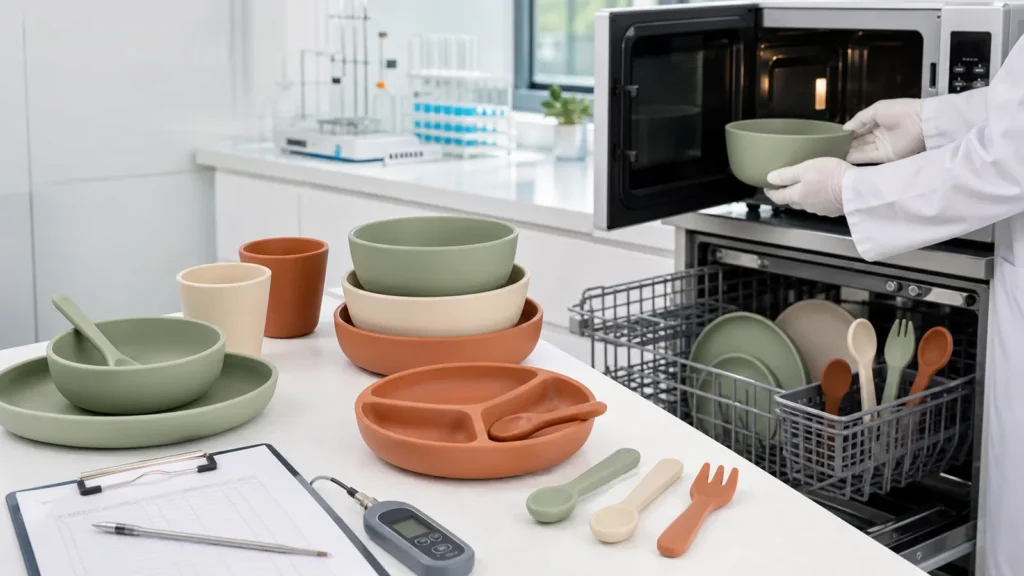
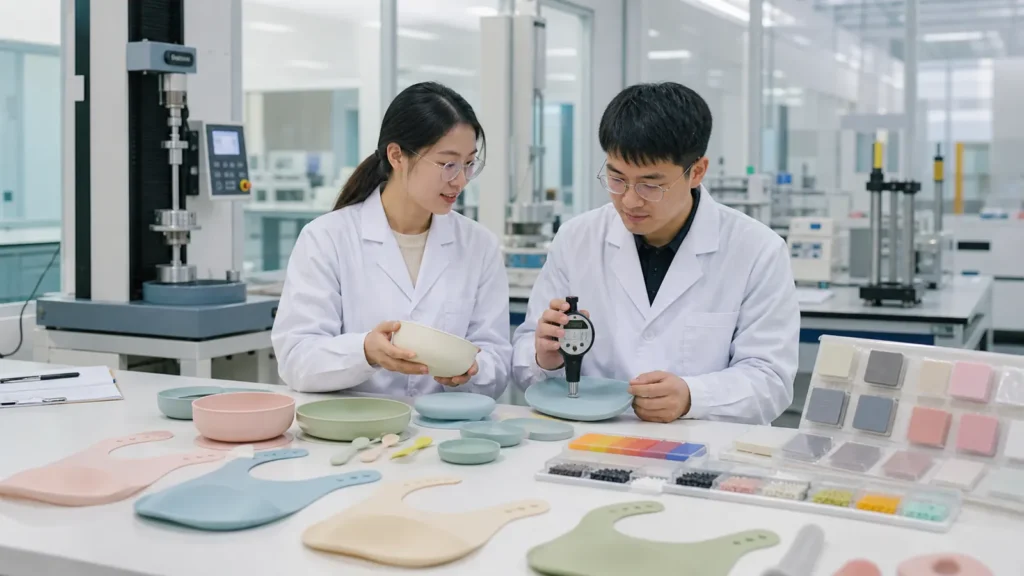
Silicone Shore hardness is a useful material-control value, but it is not a complete description of how a bowl, bib, spoon or suction base will feel and perform. B2B buyers should connect the number to durometer scale, specimen condition, product thickness, geometry, cure history and intended function before approving a custom material.
Naike Group manufacturing team reviews hardness alongside structure and use through our Custom Solutions process. A softer compound can improve flexibility, while a firmer construction may support shape and handling, yet either choice can fail when geometry and process are not designed together.
This guide applies to products in our custom tableware catalog and complements the practical sourcing questions in our silicone baby tableware buyer checklist. It explains what the factory measures, what the buyer experiences and how both sides can approve the same production target.
Factory insider takeaway: Approve a material-and-product system rather than a Shore number in isolation. The specification should identify scale, method, specimen, conditioning, location, tolerance, geometry, performance tests and change-control triggers.
Understand What Silicone Shore Hardness Measures
A durometer measures resistance to indentation under a defined instrument geometry and force. The result is empirical and useful for control, but it is not a direct measurement of tensile strength, tear resistance, compression set or overall product quality.
Shore A is commonly used for many silicone tableware compounds, while other scales address different hardness ranges or specimen conditions. A value without its scale is incomplete and should not be accepted in a quotation or inspection record.
Viscoelastic materials respond over time, so reading delay, contact pressure and specimen support affect the result. The method should state when the reading is taken and how the durometer is applied without rocking or loading the specimen unevenly.
Why silicone Shore hardness needs a controlled specimen
Thin, curved or textured finished parts may not provide the flat thickness required for a repeatable direct reading. The factory may use a controlled plaque for material verification and a separate product test for finished-part function.
When stacked layers are permitted by the selected method, their contact and alignment must be controlled. Buyers should not compare a thick laboratory slab with a thin bib edge as though the readings describe the same test condition.
Translate Hardness into Tableware Function and Buyer Experience
Softness can support folding, gentle contact and easy inversion, but excessive flexibility may make a filled bowl difficult to carry or a spoon unstable during feeding. Firmer silicone can improve shape retention while reducing the soft hand feel expected by some consumer segments.
Suction performance depends on base geometry, sealing surface, wall thickness, material response and the table surface. Increasing hardness alone does not guarantee stronger suction and may make it harder for the base to conform to slight surface variation.
Bibs need drape around the neck, pocket opening and recovery after packing. A single material grade can behave differently across those zones because thickness, ribs and curvature alter the effective stiffness experienced by the user.
Set a silicone Shore hardness target by component
A coordinated feeding set does not always need one hardness value for every part. The buyer can define separate functional targets for utensils, cups, bowls, plates and bibs while controlling color and surface consistency across the range.
Record which component or plaque controls incoming and production verification. This prevents later teams from measuring an easy location that does not represent the approved consumer function.
Separate Compound Hardness from Geometry and Processing Effects
Wall thickness, ribs, hollow sections and undercuts can make two products molded from the same compound feel very different. Product approval should therefore include physical samples in production-intent geometry rather than material data alone.
Cure time, temperature and post-curing can influence measured response and finished feel. Compare samples only after the same defined process and conditioning period, then preserve the approved process window with the hardness record.
Pigments and approved formulation adjustments may affect processing or measurement. Any change in compound, additive or color system should receive a hardness and performance impact review before bulk production.
Connect silicone tableware material selection to tooling
Draft, surface texture, parting lines and demolding features should support the chosen material response. Review those interactions through our silicone mold manufacturing guide before releasing a new tool.
A softer part may stretch during ejection while a firmer part can concentrate stress at thin features. Engineering trials should verify that the product leaves the mold without tears, permanent deformation or hidden handling damage.
Build a Hardness Approval and Tolerance Plan
Begin with benchmark samples representing the intended consumer feel and function. Measure them under one method, then use molded trials to establish a target and tolerance that the process can reproduce without weakening performance.
A very narrow tolerance can create unnecessary rejection when instrument and specimen repeatability are not understood. A wide tolerance can permit noticeable changes in shape retention, suction or feeding behavior, so the range should be validated against functional boundaries.
Use multiple readings at defined locations and document how results are summarized. An average can hide a local outlier, while a single reading can overreact to surface or operator variation.
Combine Shore hardness with functional verification
Hardness should be paired with tests relevant to the product, such as suction retention, bending, recovery, tear-sensitive handling, dimensional fit or load behavior. The combination tells the buyer more than either measurement alone.
Boundary samples remain valuable for tactile review. They help purchasing and quality teams recognize an unacceptable consumer difference even when a numerical result is near the specification limit.
Verify Silicone Shore Hardness in Production and Repeat Orders
Production verification should identify material lot, compound code, cavity, shift, process state and test equipment. The first approved order establishes a traceable baseline for later replenishment rather than a one-time sample result.
Calibrate and check durometers according to the selected quality system and instrument instructions. Operators need training in placement, contact, timing and specimen conditioning because small method differences can create apparent lot drift.
Changes to material supplier, grade, pigment system, cure settings, tool geometry or post-cure route should trigger review. The reapproval level should match the expected effect on hardness and finished-product performance.
Investigate hardness drift without guessing
When readings change, preserve samples and verify material and process records before adjusting the recipe. The diagnostic discipline used for silicone compression molding defects also prevents one uncontrolled correction from creating a second problem.
Confirm the corrective action across normal production duration and relevant cavities. Release should require both restored hardness evidence and acceptable finished-product function.
Silicone Shore Hardness Decisions Compared by Product Need
These examples describe tradeoffs rather than universal grade recommendations. Buyers should validate the selected range in the real construction and target use. Record the selected comparison assumptions in the silicone Shore hardness project brief before quotation.
| Product Need | Softer Direction | Firmer Direction | Main Risk | Approval Evidence |
|---|---|---|---|---|
| Flexible bib | Improved drape and folding | Better pocket opening | Neck comfort or collapsed pocket | Wear trial, recovery and physical sample |
| Suction bowl base | Conforms to surfaces | Supports shape | Weak seal or difficult activation | Suction test on defined surfaces |
| Feeding spoon | Gentler flexible tip | Improved control | Excess bend or harsh feel | Bend and user-handling sample |
| Cup or bowl wall | Soft hand feel | Shape retention when filled | Spillage or overly rigid feel | Load handling and deformation check |
| Material plaque | Useful low-range reference | Useful high-range reference | May not represent geometry | Controlled durometer method plus product validation |
B2B Buyer Checklist for Silicone Shore Hardness
Use this checklist before sample approval and purchase-order release. Every answer should identify the current material, method and product revision. Record every answer against the current silicone Shore hardness project assumptions and approval owner.
| Check | Question | Why It Matters |
|---|---|---|
| Durometer scale | Is the hardness value identified with the correct Shore scale? | Numbers from different scales cannot be compared directly. |
| Test method | Are instrument geometry force reading time and application method defined? | Method variation can create apparent material differences. |
| Specimen | Is the test performed on a controlled plaque or a named product location? | Thickness curvature and texture change repeatability. |
| Conditioning | Are cure post-cure temperature and rest time controlled before measurement? | Material response can change with process and conditioning history. |
| Component function | Which consumer function is the hardness target intended to protect? | The same number can produce different outcomes across geometries. |
| Tolerance | Was the allowable range validated against acceptable boundary samples? | A tolerance should reflect process capability and buyer experience. |
| Functional tests | Which suction bending recovery or load tests accompany hardness? | Hardness alone does not prove finished-product performance. |
| Lot traceability | Can readings be linked to compound lot cavity shift and process record? | Traceability supports repeat-order investigation and correction. |
| Equipment control | Are durometer checks calibration and operator training documented? | Instrument and technique errors can be mistaken for material drift. |
| Change control | Which material color process or tool changes trigger reapproval? | Approved feel must remain connected to the construction shipped. |
Factory Control Notes for silicone Shore hardness
These controls convert a tactile preference into records that engineering, production and buyer quality teams can repeat. Each silicone Shore hardness decision should identify its owner, evidence and release condition.
1. Durometer scale control for silicone Shore hardness
For silicone Shore hardness, the durometer scale checkpoint must become a dated project record rather than an informal chat instruction. The resulting durometer scale record must name its owner, source evidence, revision authority and the commercial consequence of a late change after the buyer asks, “Is the hardness value identified with the correct Shore scale?”
Numbers from different scales cannot be compared directly. For the durometer scale decision in this silicone Shore hardness project, our factory links the checkpoint to the quotation, approved sample, purchase order or inspection standard that governs the next approval. If the silicone Shore hardness evidence is incomplete, the team holds that approval gate, closes the information gap and records the revised assumption before production continues.
2. Test method control for silicone Shore hardness
For silicone Shore hardness, the test method checkpoint must become a dated project record rather than an informal chat instruction. The resulting test method record must name its owner, source evidence, revision authority and the commercial consequence of a late change after the buyer asks, “Are instrument geometry force reading time and application method defined?”
Method variation can create apparent material differences. For the test method decision in this silicone Shore hardness project, our factory links the checkpoint to the quotation, approved sample, purchase order or inspection standard that governs the next approval. If the silicone Shore hardness evidence is incomplete, the team holds that approval gate, closes the information gap and records the revised assumption before production continues.
3. Specimen control for silicone Shore hardness
For silicone Shore hardness, the specimen checkpoint must become a dated project record rather than an informal chat instruction. The resulting specimen record must name its owner, source evidence, revision authority and the commercial consequence of a late change after the buyer asks, “Is the test performed on a controlled plaque or a named product location?”
Thickness curvature and texture change repeatability. For the specimen decision in this silicone Shore hardness project, our factory links the checkpoint to the quotation, approved sample, purchase order or inspection standard that governs the next approval. If the silicone Shore hardness evidence is incomplete, the team holds that approval gate, closes the information gap and records the revised assumption before production continues.
4. Conditioning control for silicone Shore hardness
For silicone Shore hardness, the conditioning checkpoint must become a dated project record rather than an informal chat instruction. The resulting conditioning record must name its owner, source evidence, revision authority and the commercial consequence of a late change after the buyer asks, “Are cure post-cure temperature and rest time controlled before measurement?”
Material response can change with process and conditioning history. For the conditioning decision in this silicone Shore hardness project, our factory links the checkpoint to the quotation, approved sample, purchase order or inspection standard that governs the next approval. If the silicone Shore hardness evidence is incomplete, the team holds that approval gate, closes the information gap and records the revised assumption before production continues.
5. Component function control for silicone Shore hardness
For silicone Shore hardness, the component function checkpoint must become a dated project record rather than an informal chat instruction. The resulting component function record must name its owner, source evidence, revision authority and the commercial consequence of a late change after the buyer asks, “Which consumer function is the hardness target intended to protect?”
The same number can produce different outcomes across geometries. For the component function decision in this silicone Shore hardness project, our factory links the checkpoint to the quotation, approved sample, purchase order or inspection standard that governs the next approval. If the silicone Shore hardness evidence is incomplete, the team holds that approval gate, closes the information gap and records the revised assumption before production continues.
6. Tolerance control for silicone Shore hardness
For silicone Shore hardness, the tolerance checkpoint must become a dated project record rather than an informal chat instruction. The resulting tolerance record must name its owner, source evidence, revision authority and the commercial consequence of a late change after the buyer asks, “Was the allowable range validated against acceptable boundary samples?”
A tolerance should reflect process capability and buyer experience. For the tolerance decision in this silicone Shore hardness project, our factory links the checkpoint to the quotation, approved sample, purchase order or inspection standard that governs the next approval. If the silicone Shore hardness evidence is incomplete, the team holds that approval gate, closes the information gap and records the revised assumption before production continues.
7. Functional tests control for silicone Shore hardness
For silicone Shore hardness, the functional tests checkpoint must become a dated project record rather than an informal chat instruction. The resulting functional tests record must name its owner, source evidence, revision authority and the commercial consequence of a late change after the buyer asks, “Which suction bending recovery or load tests accompany hardness?”
Hardness alone does not prove finished-product performance. For the functional tests decision in this silicone Shore hardness project, our factory links the checkpoint to the quotation, approved sample, purchase order or inspection standard that governs the next approval. If the silicone Shore hardness evidence is incomplete, the team holds that approval gate, closes the information gap and records the revised assumption before production continues.
8. Lot traceability control for silicone Shore hardness
For silicone Shore hardness, the lot traceability checkpoint must become a dated project record rather than an informal chat instruction. The resulting lot traceability record must name its owner, source evidence, revision authority and the commercial consequence of a late change after the buyer asks, “Can readings be linked to compound lot cavity shift and process record?”
Traceability supports repeat-order investigation and correction. For the lot traceability decision in this silicone Shore hardness project, our factory links the checkpoint to the quotation, approved sample, purchase order or inspection standard that governs the next approval. If the silicone Shore hardness evidence is incomplete, the team holds that approval gate, closes the information gap and records the revised assumption before production continues.
9. Equipment control control for silicone Shore hardness
For silicone Shore hardness, the equipment control checkpoint must become a dated project record rather than an informal chat instruction. The resulting equipment control record must name its owner, source evidence, revision authority and the commercial consequence of a late change after the buyer asks, “Are durometer checks calibration and operator training documented?”
Instrument and technique errors can be mistaken for material drift. For the equipment control decision in this silicone Shore hardness project, our factory links the checkpoint to the quotation, approved sample, purchase order or inspection standard that governs the next approval. If the silicone Shore hardness evidence is incomplete, the team holds that approval gate, closes the information gap and records the revised assumption before production continues.
10. Change control control for silicone Shore hardness
For silicone Shore hardness, the change control checkpoint must become a dated project record rather than an informal chat instruction. The resulting change control record must name its owner, source evidence, revision authority and the commercial consequence of a late change after the buyer asks, “Which material color process or tool changes trigger reapproval?”
Approved feel must remain connected to the construction shipped. For the change control decision in this silicone Shore hardness project, our factory links the checkpoint to the quotation, approved sample, purchase order or inspection standard that governs the next approval. If the silicone Shore hardness evidence is incomplete, the team holds that approval gate, closes the information gap and records the revised assumption before production continues.
Authoritative References and Practical Limits
ASTM D2240 describes durometer hardness measurement for rubber and elastomeric materials. Review the official ASTM D2240 record when defining a hardness method. Buyers should confirm how this reference applies to the named product, target market and current silicone Shore hardness project.
ISO 48-4:2018 specifies indentation hardness by durometer method and identifies Shore scales for different hardness ranges. Consult the official ISO 48-4 overview. Buyers should confirm how this reference applies to the named product, target market and current silicone Shore hardness project.
United States provisions for rubber articles intended for repeated food contact appear in 21 CFR 177.2600. Review the current eCFR section with qualified compliance professionals. Buyers should confirm how this reference applies to the named product, target market and current silicone Shore hardness project.
Hardness measurement is a material and process control, not proof of food-contact compliance or complete product performance. Buyers should define intended use and verify all applicable regulatory, migration, mechanical and consumer requirements separately.
Silicone Shore Hardness Buyer FAQ
Is a lower Shore A number always softer in the finished product?
It generally indicates lower indentation hardness under the same method. Finished feel still depends strongly on wall thickness, ribs, curvature and temperature.
Can hardness be measured directly on a silicone bib?
Only when the selected method and specimen condition support a valid reading. Thin or curved areas may require a controlled plaque plus separate product-function approval.
Does higher hardness create stronger suction?
Not automatically. Suction depends on base geometry, sealing surface, activation and recovery as well as material response.
What tolerance should a buyer specify?
There is no universal range for every product. Validate the tolerance against test repeatability, process capability, boundary samples and functional results.
Can color changes affect hardness?
Pigment and formulation changes can affect processing or measured response. The factory should review and verify the impact rather than assuming every color behaves identically.
Conclusion: Approve Silicone Shore Hardness with Product Function
A useful silicone Shore hardness specification identifies the scale, method, specimen, conditioning and tolerance while connecting the result to real product function. This approach prevents a single number from replacing physical sample and performance approval.
Our factory combines material records, controlled molding, durometer verification and component-specific testing. Buyers receive a clearer path from desired feel to repeatable bulk production.
Send the product type, target feel, quantity, market and reference sample through Contact Us. Naike Group manufacturing team will propose a material and sampling route for review.
Define the Right Silicone Feel for Your Product
Share your component functions, reference samples, quantity and target market for a factory material review. Our manufacturing team will use those details to define the next review step for your silicone Shore hardness project.