Silicone Mold Manufacturing: Compression vs Injection Molding Guide
If you are sourcing custom silicone products, silicone mold manufacturing is the single most important investment you will make.
Get the mold right, and your unit cost drops, your lead times shrink, and your product quality stays consistent across thousands of cycles.
Get it wrong, and you are paying for that mistake on every single unit that comes out of it — forever.
Silicone mold manufacturing is not one process. It is two fundamentally different approaches: compression molding and liquid silicone rubber (LSR) injection molding.
Each has its own mold design logic, cost structure, and volume sweet spot. Knowing which one your product needs before you pay for tooling is the difference between a mold that pays for itself in six months and one that never quite does.
Silicone Mold Manufacturing: The Two Processes at a Glance
Compression molding is the older, simpler silicone mold manufacturing method. A pre-measured chunk of solid silicone — called a preform — is placed into an open mold cavity.
The mold closes under heat and pressure, usually between 150 and 200 degrees Celsius, and the silicone flows to fill the cavity. After a curing cycle of roughly two to five minutes, the mold opens and the finished part is removed.
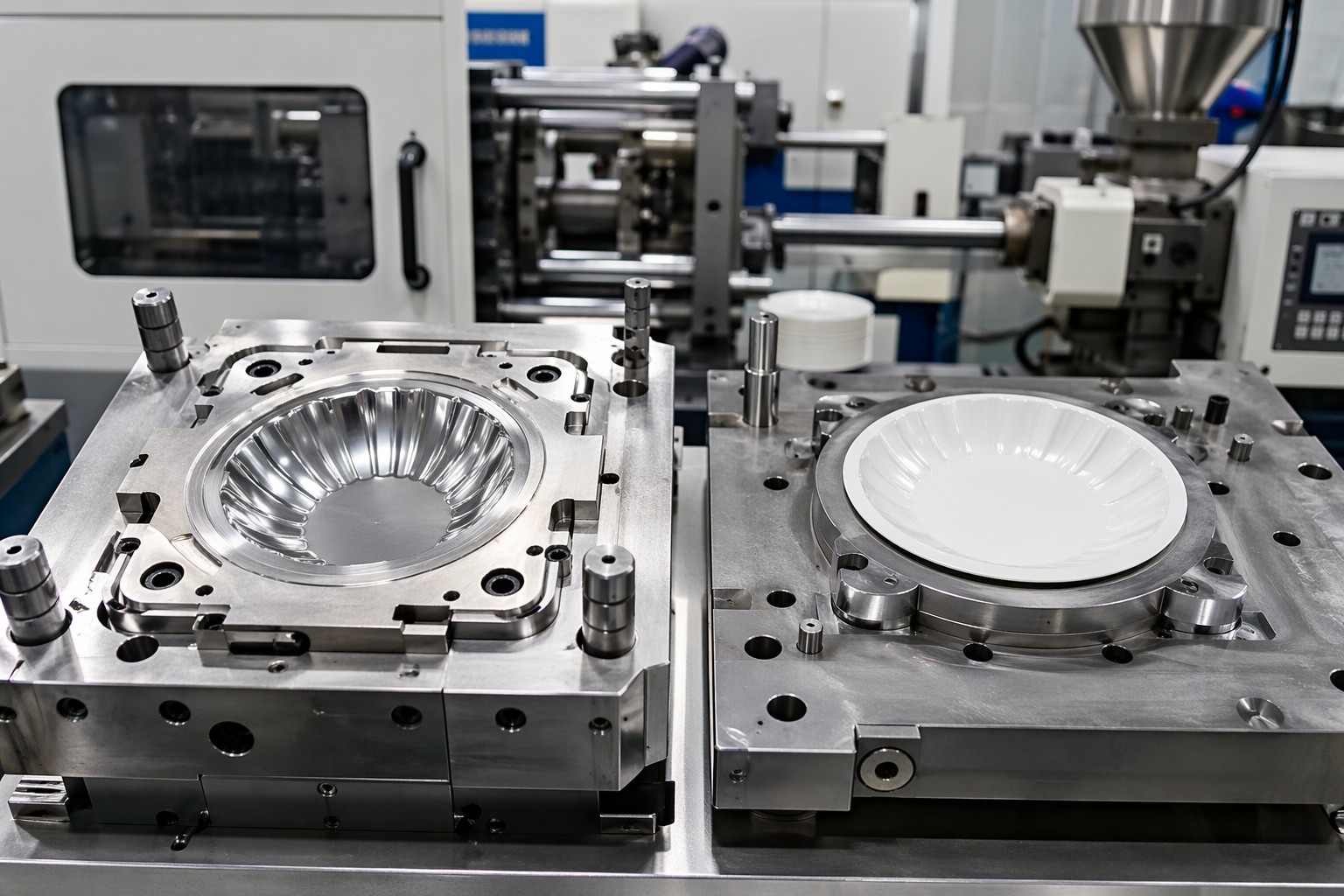
The mold itself is relatively simple: two steel plates with cavities machined into them, a basic ejector system, and heating channels.
LSR injection molding — the other pillar of silicone mold manufacturing — works differently. Two liquid silicone components are mixed and pumped into a cooled barrel, then injected under high pressure into a closed, heated mold.
The silicone cures almost instantly on contact with the hot mold surface. Cycle times are measured in seconds, not minutes. But the mold is significantly more complex: it needs a cold runner system, precision gate design, and much tighter tolerances throughout.
A detailed breakdown is available from Xometry's manufacturing comparison guide. Jiga's updated 2026 analysis provides additional data on cycle times and tooling costs.
Compression Molding Silicone: Lower Tooling Cost, Better for Small-to-Medium Runs
Compression molding silicone is the dominant process for solid silicone products — the kind made from high-consistency rubber, or HCR, which comes in sheet or strip form rather than as a liquid.
This covers the vast majority of silicone tableware, baby feeding products, bakeware, and kitchen utensils.
Compression Molding Silicone: Mold Design Basics
A compression mold is essentially a two-plate tool. The bottom plate carries the cavity — the negative space that defines the part shape. The top plate carries the core, which forms the inside surface.
When the press closes, the silicone preform is squeezed between them and flows outward to fill the cavity. Excess material flashes out along a parting line and is trimmed off.
Mold steel choice depends on production volume. P20 pre-hardened steel works for 20,000 to 50,000 cycles at roughly 1,200to1,200to3,000 per cavity.
H13 tool steel, hardened to 48-52 HRC, handles 100,000-plus cycles at 2,500to2,500to5,000 per cavity. For food-grade products, S136 stainless steel adds roughly 30 percent to the cost but eliminates rust contamination risk.
Compression Molding Silicone: Cavity Count Economics
A single-cavity mold produces one part per cycle. A four-cavity mold produces four parts in the same cycle time.
The per-unit labor cost drops proportionally, while the mold cost increases sub-proportionally. A four-cavity mold costs roughly two to three times a single-cavity mold, not four times, because much of the mold base and ejection system is shared.
For a baby feeding plate with a three-minute compression cure cycle, a single cavity produces about 20 parts per hour. Four cavities produce about 80.
At a labor rate of 8to8to12 per hour, the per-unit labor cost drops from roughly 0.40to0.40to0.60 down to 0.10to0.10to0.15. For 10,000 units, that difference alone covers the additional mold investment.
Compression molding silicone wins when your part geometry is simple, your volume is under 50,000 units per year, and you want lower upfront tooling cost. Our custom mold development capabilities cover both processes.
Silicone Injection Molding: Higher Tooling Cost, Built for Volume
If you are ordering 100,000 units per year or more, silicone injection molding almost always delivers a lower total cost per part despite the higher mold investment.
Silicone Injection Molding: How It Differs
LSR is a two-part platinum-cured silicone that arrives as separate liquid components — typically labeled A and B. These are pumped through a static mixer into a cooled injection barrel.
The mixed material is injected through a cold runner system into a heated mold, where it cures in seconds. The cold runner keeps the silicone liquid until it reaches the gate, preventing premature curing and eliminating runner waste.
This is a significant material cost saving over compression molding, where the preform flash is trimmed off and discarded.
Cycle times for silicone injection molding typically range from 15 to 60 seconds for parts with wall thicknesses under 5 millimeters. Compare that to two to five minutes for compression molding.
An LSR injection mold with four cavities running a 30-second cycle produces 480 parts per hour. The same part in a four-cavity compression mold at three minutes produces 80.
Silicone Injection Molding: Mold Complexity and Cost
LSR injection molds are more expensive for several reasons. The cold runner system requires precision machining and thermal isolation between the cooled runner block and the heated cavity plate.
The gate design must produce a balanced fill across all cavities. Venting must be precise enough to allow air to escape while preventing silicone flash.
A single-cavity LSR mold typically costs 3,000to3,000to8,000 — two to three times the cost of an equivalent compression mold. A four-cavity LSR mold runs 10,000to10,000to25,000.
The investment only makes sense at volumes high enough for the cycle-time advantage to offset the tooling premium.
LSR is almost always platinum-cured, meeting the strictest food-contact and medical-grade requirements. For baby products, LFGB VOC limits are easier to achieve with silicone injection molding than with compression-molded HCR.
Silicone Mold Tooling: Surface Finish, Tolerances, and Why They Matter
The mold cavity surface finish directly transfers to the part surface. A mirror-polished cavity — SPI A1 or A2 — produces a glossy, non-stick surface that resists staining.
A matte finish — SPI C1 — produces a soft-touch surface that hides fingerprints.
For food-contact products, surface finish is not just aesthetic. A highly polished surface has fewer microscopic crevices where food residue can accumulate. LFGB sensory testing is more likely to flag a matte-finished part than a polished one.
Dimensional tolerances are tighter in silicone injection molding — typically plus or minus 0.05 millimeters versus plus or minus 0.10 to 0.15 millimeters for compression. For products with snap-fit lids or gasket grooves, that difference determines whether the assembly works consistently.
A useful reference on mold material selection is available from Extreme Molding's process comparison.
Silicone Mold Manufacturing: Which Process Should You Use?
The choice comes down to three variables: part complexity, annual volume, and surface finish requirements.
Simple parts under 50,000 units per year — compression molding silicone will almost always deliver the lower total cost per part when mold amortization is included.
Complex geometry — silicone injection molding is better regardless of volume. Injection pressure forces silicone into fine details that compression molding cannot reach.
Over 100,000 units per year — silicone injection molding wins on total cost even for simple geometries, because the cycle-time advantage amortizes the higher mold cost within the first year.
Mirror-polished or medical-grade finish — silicone injection molding consistently outperforms on surface quality because the closed-mold, air-free fill process produces fewer defects.
Most factories we work with run both processes side by side. The processes are complementary, not competitive.
Silicone Mold Tooling Costs: A Complete Breakdown
Understanding silicone mold tooling costs before you commit is essential for accurate product pricing. The numbers below are indicative ranges for molds manufactured in China, and they vary with complexity.
| Mold Type | Compression Mold Cost | LSR Injection Mold Cost | Typical Lead Time |
|---|---|---|---|
| Single-cavity plate mold | 1,200–1,200–3,000 | 3,000–3,000–8,000 | 20–35 days |
| 4-cavity plate mold | 3,500–3,500–6,000 | 10,000–10,000–25,000 | 30–45 days |
| Single-cavity bowl mold | 800–800–1,800 | 2,500–2,500–6,000 | 18–30 days |
| Multi-cavity complex mold | 5,000–5,000–12,000 | 15,000–15,000–35,000 | 35–60 days |
The steel grade is the biggest cost driver. P20 steel keeps the mold affordable but wears faster. H13 extends mold life significantly at a 60 to 80 percent cost premium. S136 stainless is the premium choice for food-contact production.
Why LSR Molds Cost More
LSR injection molds carry three cost premiums over compression tooling. First, the cold runner system requires precision-machined cooling channels and thermal isolation plates. Second, the gate system must be engineered for balanced cavity fill, which adds design and machining time. Third, LSR molds need tighter clearances and better venting to handle injection pressure without flash.
Mold Ownership and Amortization
Mold ownership should transfer to you upon full payment. Many factories amortize mold costs into the first production order instead of charging an upfront tooling fee — this is common, but it means the mold price is hidden in your unit cost.
Always request a separate tooling quotation and a unit price quotation. Compare the two against your projected volumes to determine whether amortized tooling or upfront tooling is better for your cash flow.
Our custom mold development page provides detailed tooling quotations with mold ownership documentation on every project.
Common Silicone Mold Manufacturing Defects and How to Avoid Them
Even experienced factories produce defective parts. Knowing the common failure modes helps you specify quality controls in advance.
Flash and Parting Line Issues
Flash is the thin layer of silicone that escapes along the mold parting line. A small amount is normal and gets trimmed. Excessive flash indicates mold misalignment, insufficient clamping pressure, or an oversized preform. Specify a maximum flash allowance in your quality agreement.
Air Traps and Surface Voids
Air trapped in the cavity creates surface voids — visible dimples or bubbles on the part surface. Compression molding is more prone to this because preform placement determines air escape. LSR injection handles venting more predictably through designed vent channels.
Incomplete Fill and Short Shots
A short shot happens when silicone does not fully fill the cavity. In compression molding, this usually means the preform was undersized or unevenly placed. In LSR injection, it points to insufficient injection pressure or a partially blocked gate.
Sticking and Ejection Damage
Silicone sticks to mold surfaces, especially in deep-draw parts. Poor ejection system design causes torn or stretched parts on removal. A proper mold includes ejector pins or an air-blast system sized for the part geometry.
Batch-to-Batch Color Variation
Color inconsistency between production batches is a common complaint in silicone mold manufacturing. It is caused by masterbatch formulation drift, inconsistent mixing, or curing temperature variation. Specify a Delta-E tolerance of 2.0 or below in your quality agreement, and request retained color samples from every batch.
Silicone Mold Maintenance: Protecting Your Tooling Investment
A well-maintained mold lasts 100,000 cycles or more. A neglected mold wears out in a fraction of that time. Maintenance is not optional — it is part of the cost of silicone mold manufacturing.
Daily Maintenance
Clean the cavity surfaces after every production shift. Silicone residue and release agent buildup degrades surface finish over time. Use the recommended release agent type — the wrong one can cause mold fouling or surface defects.
Weekly Maintenance
Inspect cavity surfaces for scratches, pitting, or corrosion. Check ejector pins for wear and alignment. Verify heating channels are delivering uniform temperature across all cavities.
Periodic Re-Polishing
Cavity surfaces wear down through thousands of cycles, especially at gate and vent locations. Plan for re-polishing every 20,000 to 30,000 cycles for food-contact products, where surface smoothness is critical.
Documentation
Require a maintenance log from your factory. A factory that documents every service visit takes mold care seriously. A factory with no maintenance records is degrading your tooling asset silently.
Silicone Mold Manufacturing FAQ
Q: How long does silicone mold manufacturing take?
Standard compression molds take 20 to 35 days from design approval. LSR injection molds take 30 to 60 days because of the cold runner system complexity. Add 7 to 10 days for T1 sampling and design iteration.
Q: Can one mold produce multiple colors?
One mold produces one color per production run. Color changes require purging the molding equipment between runs. Multi-color products need either multiple molds or an over-molding process.
Q: What is the minimum order quantity for custom silicone molds?
With your own mold, MOQs drop significantly — typically 500 to 1,000 pieces per SKU. Without a mold, factories require 3,000 to 5,000 pieces to justify tooling investment. This is the core advantage of owning your mold.
Q: How many cavities should I choose?
Balance your annual volume against mold cost. Under 20,000 units per year, a single cavity is usually enough. From 20,000 to 100,000 units, two to four cavities amortize well. Above 100,000 units, consider six to eight cavities or LSR injection.
Q: Does mold steel affect food safety?
The steel does not directly contact food in use, but surface finish and corrosion resistance affect part cleanliness. S136 stainless is recommended for food-contact silicone mold manufacturing to eliminate rust contamination risk.
Q: What is the difference between T1 and T2 samples?
T1 is the first test shot from the finished mold — it confirms the basic geometry, dimensions, and cavity fill. T2 follows after mold adjustments and confirms the part meets the full production specification. Plan 10 to 14 days for this iteration cycle.
Q: Can I change my product design after the mold is made?
Small changes — surface texture, minor dimension tweaks — are usually possible with cavity modifications. Major changes, like different geometry or wall thickness, require a new mold. This is why design-for-manufacturing review before mold fabrication is so important.
Q: How do I verify a supplier's silicone mold manufacturing experience?
Ask for three things: photos of their mold shop, a list of active production molds, and references from current customers. Then ask to speak with their mold engineer directly — not the salesperson. The engineer's answers to technical questions reveal real capability.
Silicone Mold Manufacturing Strategy: How to Negotiate and Order
Getting the mold right is half the battle. Negotiating the right commercial terms protects your investment from day one.
Always Ask for Separate Tooling and Unit Pricing
Many suppliers blur the line between tooling cost and unit cost. Some quote a low tooling fee but recover it through inflated unit pricing. Others quote tooling high and units low.
Request both numbers separately. Then run your own math: total cost equals tooling plus units times volume. The cheapest option depends entirely on your projected order volume.
Lock Down Mold Ownership in Writing
Mold ownership must transfer to you at final payment. This is non-negotiable in silicone mold manufacturing.
Get it in the contract. Specify that the mold is yours, that you hold the CAD files, and that the factory cannot use the mold for any other customer. Without these three clauses, your "custom" mold can legally produce units for your competitors.
Plan for T1 and T2 Samples
T1 is the first test shot from the finished mold. It confirms geometry and dimensions. T2 follows after mold adjustments and confirms the part meets full specification.
Budget 10 to 14 days for this iteration cycle. A factory that promises production directly from T1 without adjustment is cutting corners — or worse, planning to fix problems on your production run.
Consider Mold Insurance
For high-value molds above $10,000, ask whether the factory offers mold insurance coverage against damage, theft, or fire. Most reputable factories can add this to the contract for a small premium. It is rarely expensive and covers a catastrophic loss scenario.
The Sample-to-Scale Path
A smart approach for first-time buyers: order a small trial run from an existing mold first, verify product-market fit, then invest in your custom silicone mold manufacturing project. This de-risks the tooling investment against a product that has not yet proven itself in the market.
Questions to Ask Your Silicone Mold Manufacturer
Six questions before you approve a mold design:
What steel grade and why? The answer should reference your production volume and surface finish requirements.
What is the expected mold life in cycles and the maintenance interval? A mold maker who cannot give a cycle-life estimate has not done the engineering.
Can I see the gate design and fill simulation for an LSR mold? A proper LSR mold has a documented fill analysis.
What is the ejection system design? Silicone is flexible and sticky — it does not eject cleanly like rigid thermoplastic.
Will you provide mold ownership documentation at final payment? If the answer is not yes, transfer is standard, find a different mold maker.
What is your sampling protocol? A proper mold maker provides T1 samples with a dimensional inspection report, makes adjustments, provides T2 samples, and does not consider the mold complete until parts meet the agreed specification.
If you are evaluating suppliers for custom silicone mold manufacturing, we can provide mold design recommendations, detailed tooling quotations, and production samples based on your product specifications. Reach out through naikegroup.com.
Get A Qutoe