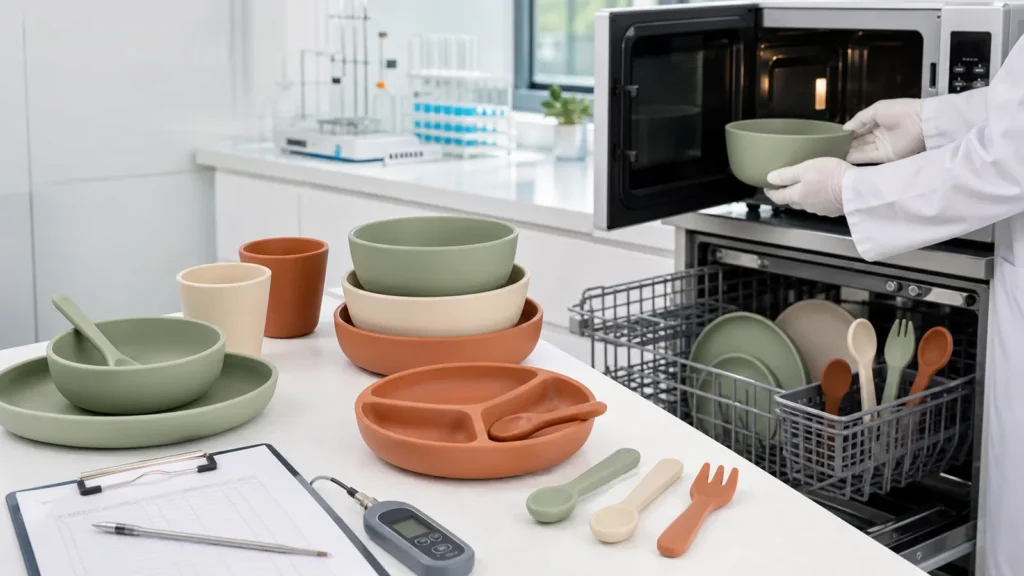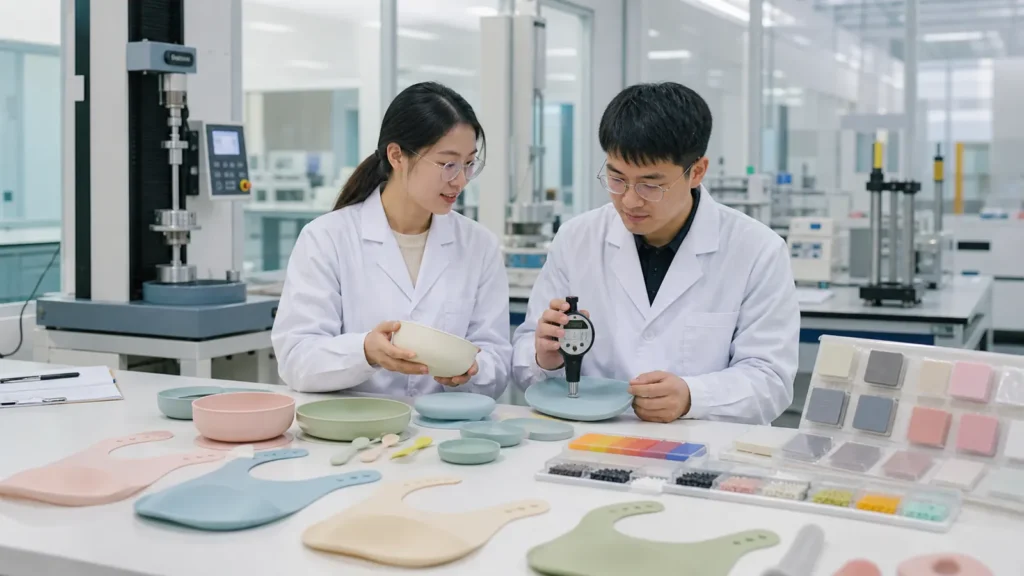
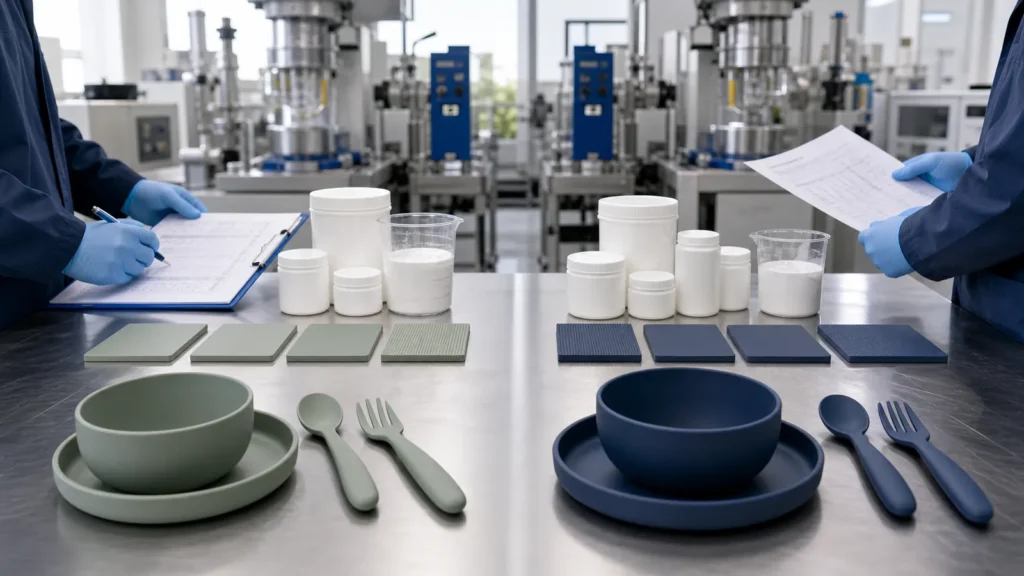
Buyer Answer — platinum cured vs peroxide cured silicone: Platinum-addition cure is often preferred when buyers prioritize low cure by-products, clean appearance and tightly controlled food-contact or sensitive applications. Peroxide cure can remain a valid, economical HCR route when the formulation, cure and any required post-cure are correctly controlled; the buyer should select by finished-product evidence, not by catalyst name alone.
The two routes create crosslinks through different reaction systems, which changes factory handling, inhibition risk, by-product management, equipment planning and validation priorities. Neither label by itself establishes food-contact compliance, consumer safety, mechanical performance or suitability for a specific tableware design.
Naike Group evaluates cure route together with material grade, geometry, tooling and target market through its custom silicone product program. This comparison gives procurement teams a decision structure for requesting quotations and approving production-intent samples.
Factory Insider takeaway: Use cure chemistry as one controlled design input. Compare the exact grade, process, post-cure need, contamination controls, regulatory evidence, functional performance, color requirements, capacity and total cost before approving either route. The selection memo should identify the technical owner and the assumption that controls commercial release.
Compare the Two Cure Reactions Before Comparing Prices
Platinum-cured silicone generally uses an addition reaction in which a platinum catalyst helps reactive silicone groups form the elastomer network. Supplier technical literature describes addition cure as producing no reaction by-products, although the finished article still requires appropriate formulation control, processing and evidence for its intended use.
Peroxide-cured silicone uses an organic peroxide initiator to generate crosslinking reactions in suitable high consistency rubber compounds. Depending on the peroxide chemistry and application, reaction residues or by-products may require carefully defined cure and post-cure controls before the article reaches its approved condition.
The comparison is not simply liquid versus solid silicone. Liquid silicone rubber is typically a two-component platinum-addition system, while high consistency rubber can be formulated for platinum or peroxide cure, so buyers should ask for both the material form and the cure system.
Commercial grade selection matters more than a generic chemistry diagram. Reinforcement, polymer structure, additives, pigment and supplier formulation affect flow, molding, mechanical properties and documentation alongside the catalyst route.
Ask the supplier to name the complete cure system
A quotation should identify the supplier, grade, component or catalyst package, mix ratio where applicable and proposed molding route. If a peroxide system is offered, request the peroxide type and the supplier’s stated cure and post-cure guidance without asking the factory to disclose unrelated proprietary formulation detail.
Record permitted alternates before tooling release. A buyer who approves only “food-grade silicone” may later receive a different material form or cure package that needs new processing and evidence review.
Compare Mixing, Molding and Cure-Control Tradeoffs
Platinum systems can support fast, precise processing, especially in automated liquid injection molding, but the catalyst is sensitive to certain contaminants that can inhibit cure. Material handling, color dosing, mold release practices, tools and cleaning therefore need controls that prevent inhibition and incomplete vulcanization.
Peroxide-cured HCR is widely processed by compression, transfer or extrusion routes and can fit established equipment and economical production models. The factory must still control compound preparation, catalyst dispersion, storage, time and temperature so every cavity reaches the intended state.
Cycle time should be compared at the complete process level. A faster in-mold reaction can require different mixing and tooling investment, while an apparently inexpensive compound may add labor, oven capacity, energy, work-in-process and inspection through a post-cure step.
Geometry and annual volume influence the route as strongly as chemistry. Review tool design, flash, vents and automation options in our silicone molding comparison before treating a per-kilogram material quote as the project cost.
Audit the process window behind the sample
Request the actual trial parameters and identify which values become controlled production limits. A perfect hand-selected sample does not show whether normal shifts, cavities and material lots can reproduce the result at the quoted capacity.
For either system, define how incomplete cure, contamination, mixing errors and oven deviations are detected. The control plan should connect the defect to containment and reapproval rather than relying only on final visual inspection.
Evaluate By-Products, Volatiles and Post-Cure Requirements
Addition cure is attractive in sensitive applications because the crosslinking reaction is described by suppliers as generating no cure by-products. That advantage should not be converted into a claim that every platinum-cured formulation is automatically cleaner, compliant or ready for food contact without finished-product assessment.
Peroxide systems require a route-specific review of decomposition products and residual volatiles. Supplier guidance, intended-use requirements and the selected peroxide chemistry determine whether post-curing is specified and which time, temperature, airflow and loading conditions must be maintained.
Post-cure is a manufacturing process, not a ceremonial bake. Overloaded ovens, poor air exchange, inconsistent part spacing or shortened cycles can create lot variation even when the set temperature displayed on the controller appears correct.
Buyers should define the evidence that proves the released lot followed the approved route. Batch identity, oven record, loading pattern, cycle timing and deviation disposition may all be relevant when post-cure supports odor, extractives or performance objectives.
Separate odor observations from compliance conclusions
Odor can be a useful quality observation, but its absence does not prove chemical compliance and its presence does not identify the cause. Evaluate unexpected odor through material, process, storage and packaging records, then use appropriate analytical or migration work when risk requires it.
Retain comparison samples after defined conditioning so buyers do not judge a hot, freshly molded part against an older approved sample. The sensory review method should identify timing, environment and acceptance authority.
Compare Food-Contact Evidence Without Ranking Labels
Platinum cure is frequently selected for food-contact and medical product families, but catalyst choice is not a regulatory authorization. Buyers must establish the status of the exact polymer, additives, pigments and other components for the intended market and conditions of use.
Peroxide-cured grades may also be offered for compliant food-contact applications when their composition and processing meet the applicable basis. The buyer should review the named grade, supplier documentation, cure instructions and finished-product test scope rather than rejecting or approving the route by reputation.
Migration or extractives results need a traceable sample description. Confirm whether the test article represents the current grade, color, geometry, post-cure, decoration and intended conditions instead of applying one family report to every private-label SKU.
Supplier declarations and laboratory reports also serve different purposes. A declaration may explain composition or regulatory basis, while a report records results for a named sample and method; procurement should retain both roles without presenting either document as universal certification.
Market terminology can hide these distinctions. Use our LFGB versus FDA silicone guide to separate regulatory frameworks, laboratory conditions and buyer responsibilities before approving a claim.
Build a cure-system evidence matrix
List each material and finished-product document with its issuer, revision, sample, market, use conditions and project relevance. The matrix should also identify which production step, such as post-cure, is an assumption behind the evidence.
Where an existing report does not cover the proposed construction, document the gap and obtain qualified advice or targeted testing. Closing the gap before packaging approval is cheaper than changing claims after production.
Approve Mechanical Performance, Color and Consumer Experience
Cure system can influence processing and achievable properties, but finished behavior depends on the complete grade and product geometry. Compare tear resistance, elongation, compression set, recovery, suction, dimensional stability and handling with production-intent samples rather than catalyst assumptions.
Platinum-addition HCR suppliers often promote strong mechanical-property balance and easier bright coloration. Buyers should still approve real colors after cure and aging because pigment loading, thickness, surface texture and batch processing affect the appearance consumers see.
Peroxide-cured compounds may satisfy the same commercial function at an attractive cost, particularly where established compression equipment and sensible tolerances fit the design. Validate that the selected route achieves odor, color, bloom, surface and performance expectations after the full production process.
Color approval should specify lighting, master sample, tolerance method and conditioning time. A route that produces acceptable appearance in a small trial must also control normal lot variation, cavity differences and any shift caused by the complete cure or post-cure sequence.
Hardness readings help control the material but do not replace product tests. Pair the methods in our silicone Shore hardness guide with component-specific bending, suction, fit or recovery criteria.
Use boundary samples to make tradeoffs visible
Approve a golden sample and, where useful, acceptable and unacceptable boundary samples for color, surface, flexibility and odor. Objective methods should govern measurable features, while controlled samples align teams on tactile or visual judgments that are difficult to express in one number.
Repeat the comparison after expected washing, heating, aging or packing exposure. A cure route should be judged on the consumer condition at release and during foreseeable use, not only on a fresh part beside the molding machine.
Choose the Cure Route by Total Project Risk and Cost
Unit price is only one line in the comparison. Include compound cost, catalyst package, mixing or dosing, cycle time, scrap risk, post-cure labor and energy, oven capacity, inspection, documentation, tooling, qualification and the commercial cost of a late change.
Platinum systems may justify higher input or equipment costs when speed, automation, low cure by-products, color, precision or sensitive-use evidence creates value. Peroxide systems may be commercially strong when qualified grades, stable HCR processing and controlled post-cure fit the product and factory assets.
Capacity claims should be checked against the complete route. A molding press can appear available while post-cure ovens, conditioning space or inspection become the actual bottleneck, and platinum processing can be disrupted if contamination controls are weak.
Calculate landed project impact rather than comparing isolated resin quotations. More predictable yield, shorter work-in-process time or fewer claim risks can outweigh a compound premium, while a robust existing peroxide line may avoid equipment and qualification costs that offer no buyer benefit.
Ask the supplier to quote both the approved specification and the assumptions behind it. Buyers can Contact Us with annual volume, design, target markets and performance needs for a route comparison before committing to the tool.
Write a decision memo before sample approval
The memo should state why the selected grade and cure system fit the product, what evidence remains open and which alternatives require reapproval. Record commercial assumptions such as cycle time, yield, post-cure and minimum material order so later negotiations do not silently change the technical basis.
A good decision may differ across a product family. A high-volume precision feeding component and a simple compression-molded accessory can use different routes while sharing consistent brand requirements for compliance, color and user experience.
Platinum Cured vs Peroxide Cured Silicone Decision Matrix
The matrix describes common decision tendencies, not a universal winner. Buyers should score the exact commercial grades and factory routes against their product, market, volume and evidence requirements.
| Decision Factor | Platinum-Addition Route | Peroxide Route | Buyer Evidence | Decision Risk |
|---|---|---|---|---|
| Material form | Common for LSR and available for HCR | Common for suitable HCR compounds | Grade TDS and factory route | Confusing liquid/solid form with cure chemistry |
| Cure reaction | Addition reaction using a platinum catalyst | Radical crosslinking initiated by organic peroxide | Supplier processing guidance | Treating chemistry alone as finished-product proof |
| Cure by-products | Supplier literature describes no reaction by-products | Route-dependent decomposition products require review | Grade, peroxide, cure and post-cure specification | Ignoring the complete conditioning route |
| Process sensitivity | Cure inhibition from certain contaminants is a key control | Mixing, dispersion, temperature and post-cure are key controls | Process flow, control plan and trial records | Approving a sample without normal-run capability |
| Color and appearance | Often favored for clean bright coloration | Can meet appearance needs with qualified formulation and process | Approved colors and aged samples | Extending one color result to every pigment |
| Commercial fit | Can reward automation, precision and fast cure | Can fit established economical HCR production | Total-cost and capacity model | Comparing resin price without process cost |
| Food-contact project | Often selected for sensitive applications | Can be valid with suitable grade and controlled processing | Component status and finished-product evidence | Calling either catalyst automatically compliant |
B2B Buyer Checklist for Silicone Cure-System Selection
Complete these checks before approving material, tooling and packaging claims. Every answer should be traceable to the current grade, production-intent sample and named factory route.
| Check | Question | Why It Matters |
|---|---|---|
| Commercial grade | Are supplier, product code, material form and permitted alternates identified? | Generic cure labels cannot control formulation, processing or evidence scope. |
| Cure package | Is the platinum system or peroxide type and dosing route defined? | The specific chemistry determines handling, inhibition and by-product controls. |
| Process window | Are mixing, molding, cure and conditioning limits recorded from trials? | A sample result must be reproducible across production lots and cavities. |
| Post-cure | Is any required time, temperature, airflow, loading and release criterion controlled? | An informal oven step can create inconsistent residue, odor and performance outcomes. |
| Compliance scope | Do component status and test records match market, use and construction? | Catalyst name alone does not establish food-contact suitability. |
| Performance | Do samples pass mechanical, dimensional, color and use-condition requirements? | The complete grade and geometry determine consumer performance. |
| Total cost | Does the quote include yield, cycle, post-cure, capacity, inspection and qualification? | Material price can hide the real cost and bottleneck of the selected route. |
| Change control | Which grade, catalyst, pigment, process, tool or supplier changes require reapproval? | Unreviewed substitutions can invalidate the approved evidence and experience. |
Procurement Playbook: From Cure-System Shortlist to Release
Use the comparison as a sequence of hold points rather than a one-time material preference. The buyer, material supplier and factory should agree who owns each document, trial, deviation and commercial assumption before the purchase order authorizes bulk production.
1. Commercial grade control for platinum cured vs peroxide cured silicone
For Commercial grade, score both feasible cure routes against “Are supplier, product code, material form and permitted alternates identified?” using the same product revision and annual-volume assumption. The comparison file identifies the supporting grade, trial result, process owner and cost consequence before procurement selects a route.
Generic cure labels cannot control formulation, processing or evidence scope. When one option lacks evidence or a change alters the score, sourcing pauses the material decision and asks engineering to reassess the affected tradeoff. The resulting memo records whether the team qualifies another grade, revises the process model, repeats the trial or removes the option.
2. Cure package control for platinum cured vs peroxide cured silicone
For Cure package, score both feasible cure routes against “Is the platinum system or peroxide type and dosing route defined?” using the same product revision and annual-volume assumption. The comparison file identifies the supporting grade, trial result, process owner and cost consequence before procurement selects a route.
The specific chemistry determines handling, inhibition and by-product controls. When one option lacks evidence or a change alters the score, sourcing pauses the material decision and asks engineering to reassess the affected tradeoff. The resulting memo records whether the team qualifies another grade, revises the process model, repeats the trial or removes the option.
3. Process window control for platinum cured vs peroxide cured silicone
For Process window, score both feasible cure routes against “Are mixing, molding, cure and conditioning limits recorded from trials?” using the same product revision and annual-volume assumption. The comparison file identifies the supporting grade, trial result, process owner and cost consequence before procurement selects a route.
A sample result must be reproducible across production lots and cavities. When one option lacks evidence or a change alters the score, sourcing pauses the material decision and asks engineering to reassess the affected tradeoff. The resulting memo records whether the team qualifies another grade, revises the process model, repeats the trial or removes the option.
4. Post-cure control for platinum cured vs peroxide cured silicone
For Post-cure, score both feasible cure routes against “Is any required time, temperature, airflow, loading and release criterion controlled?” using the same product revision and annual-volume assumption. The comparison file identifies the supporting grade, trial result, process owner and cost consequence before procurement selects a route.
An informal oven step can create inconsistent residue, odor and performance outcomes. When one option lacks evidence or a change alters the score, sourcing pauses the material decision and asks engineering to reassess the affected tradeoff. The resulting memo records whether the team qualifies another grade, revises the process model, repeats the trial or removes the option.
5. Compliance scope control for platinum cured vs peroxide cured silicone
For Compliance scope, score both feasible cure routes against “Do component status and test records match market, use and construction?” using the same product revision and annual-volume assumption. The comparison file identifies the supporting grade, trial result, process owner and cost consequence before procurement selects a route.
Catalyst name alone does not establish food-contact suitability. When one option lacks evidence or a change alters the score, sourcing pauses the material decision and asks engineering to reassess the affected tradeoff. The resulting memo records whether the team qualifies another grade, revises the process model, repeats the trial or removes the option.
6. Performance control for platinum cured vs peroxide cured silicone
For Performance, score both feasible cure routes against “Do samples pass mechanical, dimensional, color and use-condition requirements?” using the same product revision and annual-volume assumption. The comparison file identifies the supporting grade, trial result, process owner and cost consequence before procurement selects a route.
The complete grade and geometry determine consumer performance. When one option lacks evidence or a change alters the score, sourcing pauses the material decision and asks engineering to reassess the affected tradeoff. The resulting memo records whether the team qualifies another grade, revises the process model, repeats the trial or removes the option.
7. Total cost control for platinum cured vs peroxide cured silicone
For Total cost, score both feasible cure routes against “Does the quote include yield, cycle, post-cure, capacity, inspection and qualification?” using the same product revision and annual-volume assumption. The comparison file identifies the supporting grade, trial result, process owner and cost consequence before procurement selects a route.
Material price can hide the real cost and bottleneck of the selected route. When one option lacks evidence or a change alters the score, sourcing pauses the material decision and asks engineering to reassess the affected tradeoff. The resulting memo records whether the team qualifies another grade, revises the process model, repeats the trial or removes the option.
8. Change control control for platinum cured vs peroxide cured silicone
For Change control, score both feasible cure routes against “Which grade, catalyst, pigment, process, tool or supplier changes require reapproval?” using the same product revision and annual-volume assumption. The comparison file identifies the supporting grade, trial result, process owner and cost consequence before procurement selects a route.
Unreviewed substitutions can invalidate the approved evidence and experience. When one option lacks evidence or a change alters the score, sourcing pauses the material decision and asks engineering to reassess the affected tradeoff. The resulting memo records whether the team qualifies another grade, revises the process model, repeats the trial or removes the option.
Authoritative References and Practical Limits
Elkem explains that high consistency rubber can use an organic peroxide crosslinker or a platinum catalyst, while liquid silicone rubber uses platinum addition cure. Its official silicone rubber technical overview also describes faster reaction, no cure by-products and mechanical or color advantages for its platinum polyaddition range. These supplier statements guide material comparison but do not certify a buyer’s finished product.
The U.S. FDA states that the regulatory status of every component in a food-contact material must be established for the intended use and describes multiple authorization routes. Review the official FDA component-status guidance when checking either cure route. Catalyst choice does not replace component and use-condition review.
Germany’s BfR publishes Recommendation XV for silicones within its official food-contact recommendations system. Use the current BfR Recommendation XV: Silicones together with the database status and qualified market advice when evaluating formulation and processing assumptions. A recommendation is evidence context, not a blanket approval for an unspecified SKU.
This comparison is practical procurement guidance, not legal advice, a material endorsement or a claim that one cure route is universally safer. Buyers and responsible business operators should confirm the exact formulation, current rules, intended conditions, supplier documentation and finished-product evidence with qualified professionals.
Cure-System Questions from Private-Label Buyers
Is platinum-cured silicone always food grade?
No. Platinum describes a catalyst route, not the complete regulatory status of the formulation or finished product. Verify every relevant component, intended use, production process and supporting evidence.
Is peroxide-cured silicone unsuitable for tableware?
Not automatically. Qualified peroxide-cured grades can be used in food-contact projects when the formulation, cure, any required post-cure and finished-product evidence satisfy the applicable requirements.
Does platinum cure eliminate the need for post-curing?
Do not assume a universal rule. Follow the technical guidance and validated process for the exact grade and intended use, then record any conditioning step that supports the approved product.
Why can platinum cure fail in production?
Certain contaminants can inhibit platinum-catalyzed addition cure. Factories need controlled material handling, tools, cleaning, color dosing and release practices plus a response plan for incomplete cure.
Which route costs less for a custom project?
The answer depends on grade price, equipment, tooling, cycle, yield, labor, post-cure, capacity, inspection and qualification. Compare total project cost using the same product requirements and annual volume.
Selection Outcome for Platinum Cured vs Peroxide Cured Silicone
There is no credible one-line winner in platinum cured vs peroxide cured silicone for every tableware program. Platinum addition cure often earns preference for low reaction by-products, automation, color and sensitive applications, while a qualified peroxide HCR route can deliver strong value when its cure and post-cure controls match the product.
The defensible sourcing choice is the route whose exact grade, process window, evidence, performance, capacity and cost assumptions can be reproduced in bulk. Put those assumptions in the approval file and make any later material or process change pass through formal reapproval.
For a side-by-side factory assessment, send the drawing, annual volume, target markets and required properties through Contact Us. Naike Group will outline the material trials and commercial inputs needed to choose a production route.
Turn the Cure-System Debate into a Controlled Trial
Provide your design, quantity, color range, performance targets and compliance markets. Our materials and process team will compare feasible grades, tooling routes and evidence gaps before you approve a golden sample.