
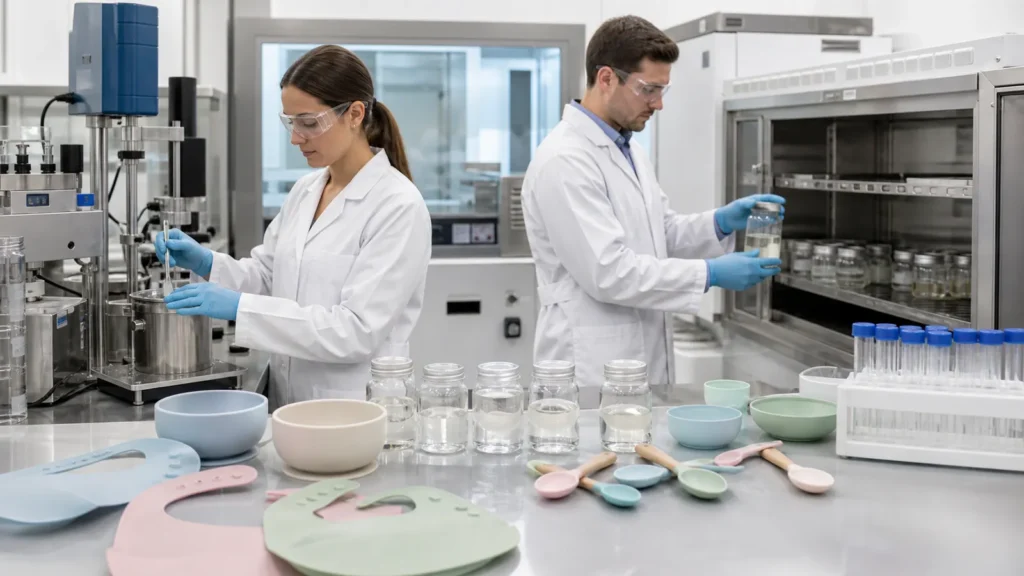
LFGB vs FDA silicone testing is often reduced to the claim that one standard is “stricter,” but that shortcut can produce the wrong test plan. The United States and European markets use different legal frameworks, authorization concepts, test references and documentation practices, while German LFGB and BfR recommendations add a commonly requested route for silicone articles sold in Europe.
From our factory perspective, the buyer’s first job is to name the destination countries, intended users, food types, temperatures, contact duration and repeated-use claims. A silicone bib, freezer tray, baking mold and baby spoon may use similar material language but create different exposure conditions and test priorities.
This guide explains how Naike Group prepares a test-ready project without presenting laboratory work as legal advice. Buyers can connect the compliance plan to the production stages in our silicone baby feeding set guide and to engineering decisions described on the custom mold tooling page.
Factory insider takeaway: Do not buy a generic “FDA silicone” or “LFGB silicone” claim. Define the finished article, complete formulation, color, intended use and market, then agree on the exact laboratory scope before testing.
LFGB vs FDA Silicone Testing Begins with Different Legal Paths
In the United States, food-contact compliance is tied to the regulatory status of substances for specified intended uses and conditions of use. FDA maintains regulations and inventories for food-contact substances, but a finished silicone bowl is not automatically “FDA approved” merely because a supplier uses a familiar polymer name.
The buyer should evaluate each component of the material formulation, including polymer, fillers, pigments, processing aids and other additives, against the applicable authorization basis. Intended use matters because food type, temperature and contact conditions determine whether the cited regulatory basis is relevant.
In the European Union, Regulation (EC) No 1935/2004 establishes the general safety principle for food-contact materials. Silicone does not have one fully harmonized EU-specific measure equivalent to the plastics regulation, so national requirements, Council of Europe guidance, BfR recommendations and customer specifications can become important depending on the market.
German LFGB is national law, while BfR Recommendation XV is a recognized technical reference for silicones. Buyers frequently use “LFGB testing” as shorthand, but the purchase order and laboratory request should state the actual methods, limits and article conditions instead of relying on the shorthand alone.
Why FDA food contact silicone cannot be confirmed by color or hardness
Shore hardness, transparency and an odor-free appearance do not reveal the regulatory status of every ingredient. Two visually identical compounds can use different pigments, catalysts or fillers and therefore require separate documentation review.
Request a formulation-specific declaration from the material supplier and keep the batch identity connected to the finished test sample. If the formulation or pigment changes, assess whether retesting or documentary review is required.
Define the Finished Silicone Article Before Selecting Migration Tests
A test plan should describe the product rather than only the raw material. Geometry, wall thickness, surface area, cavities, decoration, assembly and post-curing can influence extraction, migration and sensory performance, so the finished production-intent article is normally more informative than an unrepresentative material plaque.
State whether the item will contact aqueous, acidic, fatty or dry foods and whether contact occurs at room temperature, refrigeration, boiling, baking or reheating conditions. Laboratories use these assumptions to select simulants, time, temperature and repeated-use cycles.
Baby feeding products need particular care because the user group, oral contact, cleaning frequency and product misuse scenarios may expand the buyer’s risk assessment. Claims such as microwave safe, dishwasher safe, freezer safe or oven safe should be supported by appropriate product-specific evaluation.
The submitted sample must be traceable to the approved formulation and color. Our factory recommends sealing representative pieces with a sample record that identifies mold, cavity where relevant, production date, material batch, color batch, curing or post-curing condition and requested laboratory scope.
How silicone migration testing samples should be controlled
Agree on whether the laboratory, buyer or factory selects the specimens. Independent sampling reduces substitution risk, while witnessed sealing can provide a practical balance for custom projects with limited pilot quantities.
Retain duplicate samples under controlled conditions. If a result is unexpected, the retained set allows structured investigation without guessing whether a new production batch is comparable.
Examine the German LFGB and BfR Route Beyond a Pass Label
A German-market program commonly examines overall migration under selected conditions and may include volatile organic components, extractable substances, peroxide-related residues, organoleptic behavior or other parameters associated with the relevant recommendation and customer specification. The exact scope must be confirmed with a qualified laboratory.
BfR recommendations are not certificates issued to a brand for every future product. They provide technical guidance for materials, and the laboratory report applies to the identified samples, methods and conditions listed in that report.
Sensory evaluation is commercially important because a silicone item can satisfy an analytical limit yet still create an unacceptable odor or taste experience. Buyers should define how odor, flavor transfer and visible surface change will be evaluated after heat, washing and storage.
Review the report line by line. Check the applicant, manufacturer when listed, product description, color, sample receipt date, test dates, methods, simulants, conditions, reporting limits, results and conclusion; then compare the tested sample with the purchase specification.
When LFGB silicone certification language becomes misleading
Avoid printing “LFGB certified” as a broad product claim unless the legal basis, certification meaning and substantiation have been reviewed for the target market. A laboratory test report is evidence for its samples, not an unlimited authorization for all colors, molds or future batches.
A safer B2B specification describes the applicable test report and controlled construction. Marketing wording should be reviewed separately by the importer’s compliance adviser.
Build the U.S. FDA Compliance File Around Authorized Uses
For the U.S. market, buyers should identify the regulatory basis for each food-contact substance and confirm that the intended use and conditions match the finished article. FDA resources distinguish food-contact notifications, indirect additive regulations, prior sanctions and other status pathways.
A supplier declaration should cite the relevant basis rather than saying only “FDA grade.” The declaration should also identify the supplied compound or formulation, revision, color coverage and limitations, with supporting information available for technical review.
Finished-product migration or extractables testing may still be requested by retailers, brands or risk managers even when the formulation has a documented regulatory basis. Those tests can provide additional evidence but should not be confused with FDA issuing an approval certificate for the individual bowl or bib.
California or retailer requirements may add chemical disclosure, warning or restricted-substance considerations beyond the federal food-contact question. The importer should map every destination and customer requirement before the packaging artwork is released.
What a useful FDA food contact silicone declaration contains
Look for supplier identity, material designation, applicable regulations or notifications, intended-use limitations, manufacturing controls, issue date and authorized signature. The document should be specific enough to connect to the material received by the factory.
Keep declarations under change control. A new pigment source, catalyst system or compound grade can require renewed review even when the product name remains unchanged.
Control Curing, Post-Curing, Pigments and Repeated Use in Production
Laboratory compliance cannot compensate for unstable production. Mixing ratio, color dispersion, molding temperature, cure time, post-curing where specified, contamination control and storage can influence odor, appearance and extractable residues in the finished article.
The process window should be defined during sampling and transferred to mass production through a controlled work instruction. First-piece approval must confirm dimensions, surface, color and function before the line produces the full lot.
Different pigments can change analytical and sensory behavior, so color families should not be assumed equivalent without review. Dark, fluorescent, metallic or highly loaded colors may need separate risk assessment or testing depending on formulation and market requirements.
Repeated-use articles should be evaluated after representative washing, heating and flexing cycles. Inspect deformation, tackiness, whitening, cracking, odor retention, suction performance and printed-logo durability alongside chemical test evidence.
How our factory links the test sample to mass production
Naike Group records the approved material, color reference, molding route and sample status before production release. In-process checks and retained samples help compare the shipment lot with the construction that supported the compliance file.
Buyers developing a new shape should freeze contact surfaces and critical wall sections before tool approval. Structural changes follow the documented route on our tooling development page.
Choose the Test Program by Market, Use and Commercial Risk
A U.S.-only product does not automatically need a German-market test package, and a German retail program should not rely on a generic U.S. declaration. Testing should follow the markets actually served, while a multi-market program can use a gap assessment to combine samples and avoid unnecessary duplication.
Start with the strictest known customer requirement only after confirming that it is legally and technically relevant. Retail specifications may be more detailed than baseline law, but an expensive test that does not match the finished use can still fail to control the real risk.
Budget laboratory lead time before packaging approval because unexpected findings may require formulation review, additional post-curing, color change, retesting or claim revision. Testing at the end of bulk production turns a manageable development question into a shipment emergency.
The final compliance file should connect legal assessment, material declarations, laboratory reports, sample traceability, change control and production records. That combination is more defensible than a single report uploaded to a product page.
A practical multi-market test briefing format
Send the laboratory a product photo, material composition, colors, dimensions, intended foods, contact temperatures, durations, repeated-use conditions, destination countries and retailer specifications. Ask the laboratory to confirm methods, specimen quantity, turnaround and report wording before samples are shipped.
Have the importer’s compliance adviser approve the final scope. The factory can prepare and trace samples, but market access responsibility remains with the business placing the product on that market.
LFGB vs FDA Silicone Testing: Buyer Comparison
This table compares the practical questions a buyer must resolve. It is a sourcing guide, not a legal determination for a specific product. Record the selected comparison assumptions in the LFGB vs FDA silicone testing project brief before quotation.
| Decision Area | German / EU Route | U.S. Route | Factory Action | Buyer Risk |
|---|---|---|---|---|
| Legal framework | EU general food-contact rules plus applicable national and technical references | FDA food-contact substance authorization and conditions-of-use framework | Collect formulation and intended-use data before sample approval | Using a familiar claim without a matching legal basis |
| Common shorthand | “LFGB tested” or “BfR compliant” | “FDA grade” or “FDA compliant” | Replace shorthand with cited requirements and limitations | Claims that overstate the report or declaration |
| Migration program | Selected simulants, conditions and technical parameters based on article use | Testing or evidence selected around authorized use and buyer requirements | Submit production-intent, traceable finished articles | Testing the wrong color, construction or use condition |
| Sensory review | Often emphasized through odor and taste expectations | May be required by customer specification and product risk | Control curing, post-curing, storage and packaging odor | Analytical pass but unacceptable consumer experience |
| Documentation | Declarations, reports and traceability for the EU/German market route | Regulatory-basis declarations and supporting records | Maintain revision and batch linkage | A valid document disconnected from received material |
| Change control | Assess new pigment, material, process and geometry | Assess authorization and intended-use impact of changes | Hold release until the compliance impact is reviewed | Mass production no longer matches the tested sample |
B2B Buyer Checklist for LFGB vs FDA Silicone Testing
Complete the checklist before requesting a quotation or test report so the factory and laboratory work from the same assumptions. Record every answer against the current LFGB vs FDA silicone testing project assumptions and approval owner.
| Check | Question | Why It Matters |
|---|---|---|
| Markets | Which countries and retailer programs will receive the finished article? | The applicable legal and customer requirements depend on where the product is placed on the market. |
| Intended use | What foods, temperatures, durations and repeated-use conditions are expected? | Use conditions determine regulatory relevance and laboratory test parameters. |
| Formulation | Is the complete compound and pigment system identified and documented? | Silicone appearance alone cannot establish the regulatory status of every ingredient. |
| Finished article | Will the laboratory receive production-intent pieces with all colors and decorations? | Geometry, processing and decoration can affect the finished product evidence. |
| Sample traceability | Can each test specimen be linked to material batch, color, mold and processing record? | Traceability allows the test report to support the controlled production construction. |
| Methods | Has a qualified laboratory confirmed the methods, simulants, conditions and limits? | Generic requests create irrelevant tests, delays and ambiguous conclusions. |
| Sensory quality | Are odor, taste transfer, surface and appearance expectations documented? | Consumer acceptance requires more than a numerical migration result. |
| Repeated use | Does the program reflect washing, heating, flexing and storage over the claimed life? | Reusable products can change after cycles that a one-time visual check will miss. |
| Change control | Which material, pigment, tool or process changes trigger review or retesting? | Unreviewed changes can break the link between reports and shipped products. |
| Claims | Has packaging language been checked against the actual evidence and market rules? | Overbroad “approved” or “certified” claims can create regulatory and customer risk. |
Factory Control Notes for LFGB vs FDA silicone testing
These controls keep the regulatory review, laboratory request and factory production record aligned from sample to shipment. Each LFGB vs FDA silicone testing decision should identify its owner, evidence and release condition.
1. Markets control for LFGB vs FDA silicone testing
For LFGB vs FDA silicone testing, the markets checkpoint must become a dated project record rather than an informal chat instruction. The buyer should ask, “Which countries and retailer programs will receive the finished article?” and then require the answer to identify the responsible person, the controlling document, the evidence available at that stage and the point at which a change would affect cost or schedule.
The applicable legal and customer requirements depend on where the product is placed on the market. For the markets decision in this LFGB vs FDA silicone testing project, our factory links the checkpoint to the quotation, approved sample, purchase order or inspection standard that governs the next approval. If the LFGB vs FDA silicone testing evidence is incomplete, the team holds that approval gate, closes the information gap and records the revised assumption before production continues.
2. Intended use control for LFGB vs FDA silicone testing
For LFGB vs FDA silicone testing, the intended use checkpoint must become a dated project record rather than an informal chat instruction. The buyer should ask, “What foods, temperatures, durations and repeated-use conditions are expected?” and then require the answer to identify the responsible person, the controlling document, the evidence available at that stage and the point at which a change would affect cost or schedule.
Use conditions determine regulatory relevance and laboratory test parameters. For the intended use decision in this LFGB vs FDA silicone testing project, our factory links the checkpoint to the quotation, approved sample, purchase order or inspection standard that governs the next approval. If the LFGB vs FDA silicone testing evidence is incomplete, the team holds that approval gate, closes the information gap and records the revised assumption before production continues.
3. Formulation control for LFGB vs FDA silicone testing
For LFGB vs FDA silicone testing, the formulation checkpoint must become a dated project record rather than an informal chat instruction. The buyer should ask, “Is the complete compound and pigment system identified and documented?” and then require the answer to identify the responsible person, the controlling document, the evidence available at that stage and the point at which a change would affect cost or schedule.
Silicone appearance alone cannot establish the regulatory status of every ingredient. For the formulation decision in this LFGB vs FDA silicone testing project, our factory links the checkpoint to the quotation, approved sample, purchase order or inspection standard that governs the next approval. If the LFGB vs FDA silicone testing evidence is incomplete, the team holds that approval gate, closes the information gap and records the revised assumption before production continues.
4. Finished article control for LFGB vs FDA silicone testing
For LFGB vs FDA silicone testing, the finished article checkpoint must become a dated project record rather than an informal chat instruction. The buyer should ask, “Will the laboratory receive production-intent pieces with all colors and decorations?” and then require the answer to identify the responsible person, the controlling document, the evidence available at that stage and the point at which a change would affect cost or schedule.
Geometry, processing and decoration can affect the finished product evidence. For the finished article decision in this LFGB vs FDA silicone testing project, our factory links the checkpoint to the quotation, approved sample, purchase order or inspection standard that governs the next approval. If the LFGB vs FDA silicone testing evidence is incomplete, the team holds that approval gate, closes the information gap and records the revised assumption before production continues.
5. Sample traceability control for LFGB vs FDA silicone testing
For LFGB vs FDA silicone testing, the sample traceability checkpoint must become a dated project record rather than an informal chat instruction. The buyer should ask, “Can each test specimen be linked to material batch, color, mold and processing record?” and then require the answer to identify the responsible person, the controlling document, the evidence available at that stage and the point at which a change would affect cost or schedule.
Traceability allows the test report to support the controlled production construction. For the sample traceability decision in this LFGB vs FDA silicone testing project, our factory links the checkpoint to the quotation, approved sample, purchase order or inspection standard that governs the next approval. If the LFGB vs FDA silicone testing evidence is incomplete, the team holds that approval gate, closes the information gap and records the revised assumption before production continues.
6. Methods control for LFGB vs FDA silicone testing
For LFGB vs FDA silicone testing, the methods checkpoint must become a dated project record rather than an informal chat instruction. The buyer should ask, “Has a qualified laboratory confirmed the methods, simulants, conditions and limits?” and then require the answer to identify the responsible person, the controlling document, the evidence available at that stage and the point at which a change would affect cost or schedule.
Generic requests create irrelevant tests, delays and ambiguous conclusions. For the methods decision in this LFGB vs FDA silicone testing project, our factory links the checkpoint to the quotation, approved sample, purchase order or inspection standard that governs the next approval. If the LFGB vs FDA silicone testing evidence is incomplete, the team holds that approval gate, closes the information gap and records the revised assumption before production continues.
7. Sensory quality control for LFGB vs FDA silicone testing
For LFGB vs FDA silicone testing, the sensory quality checkpoint must become a dated project record rather than an informal chat instruction. The buyer should ask, “Are odor, taste transfer, surface and appearance expectations documented?” and then require the answer to identify the responsible person, the controlling document, the evidence available at that stage and the point at which a change would affect cost or schedule.
Consumer acceptance requires more than a numerical migration result. For the sensory quality decision in this LFGB vs FDA silicone testing project, our factory links the checkpoint to the quotation, approved sample, purchase order or inspection standard that governs the next approval. If the LFGB vs FDA silicone testing evidence is incomplete, the team holds that approval gate, closes the information gap and records the revised assumption before production continues.
8. Repeated use control for LFGB vs FDA silicone testing
For LFGB vs FDA silicone testing, the repeated use checkpoint must become a dated project record rather than an informal chat instruction. The buyer should ask, “Does the program reflect washing, heating, flexing and storage over the claimed life?” and then require the answer to identify the responsible person, the controlling document, the evidence available at that stage and the point at which a change would affect cost or schedule.
Reusable products can change after cycles that a one-time visual check will miss. For the repeated use decision in this LFGB vs FDA silicone testing project, our factory links the checkpoint to the quotation, approved sample, purchase order or inspection standard that governs the next approval. If the LFGB vs FDA silicone testing evidence is incomplete, the team holds that approval gate, closes the information gap and records the revised assumption before production continues.
9. Change control control for LFGB vs FDA silicone testing
For LFGB vs FDA silicone testing, the change control checkpoint must become a dated project record rather than an informal chat instruction. The buyer should ask, “Which material, pigment, tool or process changes trigger review or retesting?” and then require the answer to identify the responsible person, the controlling document, the evidence available at that stage and the point at which a change would affect cost or schedule.
Unreviewed changes can break the link between reports and shipped products. For the change control decision in this LFGB vs FDA silicone testing project, our factory links the checkpoint to the quotation, approved sample, purchase order or inspection standard that governs the next approval. If the LFGB vs FDA silicone testing evidence is incomplete, the team holds that approval gate, closes the information gap and records the revised assumption before production continues.
10. Claims control for LFGB vs FDA silicone testing
For LFGB vs FDA silicone testing, the claims checkpoint must become a dated project record rather than an informal chat instruction. The buyer should ask, “Has packaging language been checked against the actual evidence and market rules?” and then require the answer to identify the responsible person, the controlling document, the evidence available at that stage and the point at which a change would affect cost or schedule.
Overbroad “approved” or “certified” claims can create regulatory and customer risk. For the claims decision in this LFGB vs FDA silicone testing project, our factory links the checkpoint to the quotation, approved sample, purchase order or inspection standard that governs the next approval. If the LFGB vs FDA silicone testing evidence is incomplete, the team holds that approval gate, closes the information gap and records the revised assumption before production continues.
Authoritative References and Practical Limits
FDA explains that food-contact substances are assessed for intended use and migration exposure. Review the agency’s food-contact substance overview before interpreting a supplier claim. Buyers should confirm how this reference applies to the named product, target market and current LFGB vs FDA silicone testing project.
The official EU Regulation (EC) No 1935/2004 states the general safety principle for food-contact materials and articles. Buyers should confirm how this reference applies to the named product, target market and current LFGB vs FDA silicone testing project.
BfR publishes technical recommendations for food-contact materials, including its Recommendation XV on silicones, which can inform an appropriate German-market review. Buyers should confirm how this reference applies to the named product, target market and current LFGB vs FDA silicone testing project.
Requirements can change and may differ by Member State, customer, product and intended use. This factory guide does not replace advice from a qualified laboratory, importer compliance professional or competent authority.
LFGB vs FDA Silicone Testing Buyer FAQ
Is LFGB always stricter than FDA for silicone tableware?
Not as a universal statement. The routes use different laws, references and evidence. A requirement can be more demanding for one parameter or customer program, but the correct comparison must use the same finished article and intended use.
Can one silicone test report cover every product color?
Not automatically. Pigment chemistry and loading can differ, and the laboratory or compliance adviser should determine whether colors can be grouped or require separate review.
Does food-grade silicone mean the finished article is compliant?
No. “Food grade” is a commercial phrase unless connected to a defined formulation, regulatory basis, finished-product use, processing controls and supporting evidence.
Should testing happen before or after mass production?
The main compliance route should be established with production-intent samples before bulk release. Shipment verification can then confirm that mass production matches the controlled construction.
Can Naike Group arrange samples for third-party testing?
Our factory can prepare traceable samples and coordinate with the buyer’s nominated laboratory after the target markets and scope are confirmed. Send the product brief through Contact Us for a project-specific review.
Conclusion: Control LFGB vs FDA Silicone Testing from the Brief
A defensible LFGB vs FDA silicone testing plan begins with the market and intended use, not with a supplier badge. The buyer must connect formulation, color, finished geometry, processing, test conditions and claims to the same production-intent article.
Naike Group treats laboratory evidence as one control inside a wider manufacturing system. Material identity, sample traceability, process settings, inspection records and change approval keep mass production aligned with the evidence created during development.
Before requesting cost and lead time, prepare the destination countries, user group, product reference, temperature claims, colors, decoration and retailer specifications. That information allows our manufacturing team and the selected laboratory to build a focused test route.
Prepare a Test-Ready Silicone Project
Send your target market, product type, use conditions, colors, quantity and required test references for a factory feasibility review. Our manufacturing team will use those details to define the next review step for your LFGB vs FDA silicone testing project.