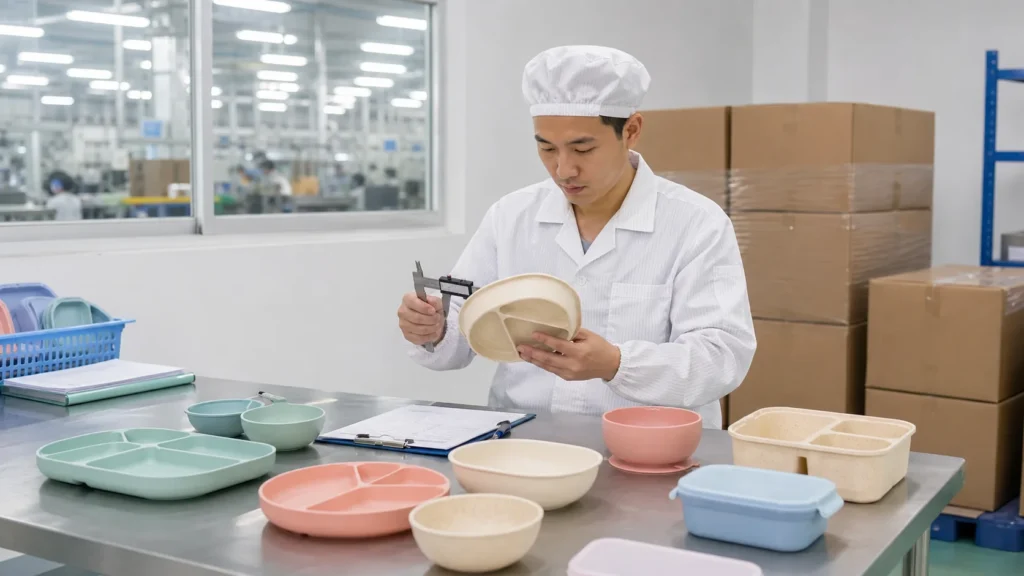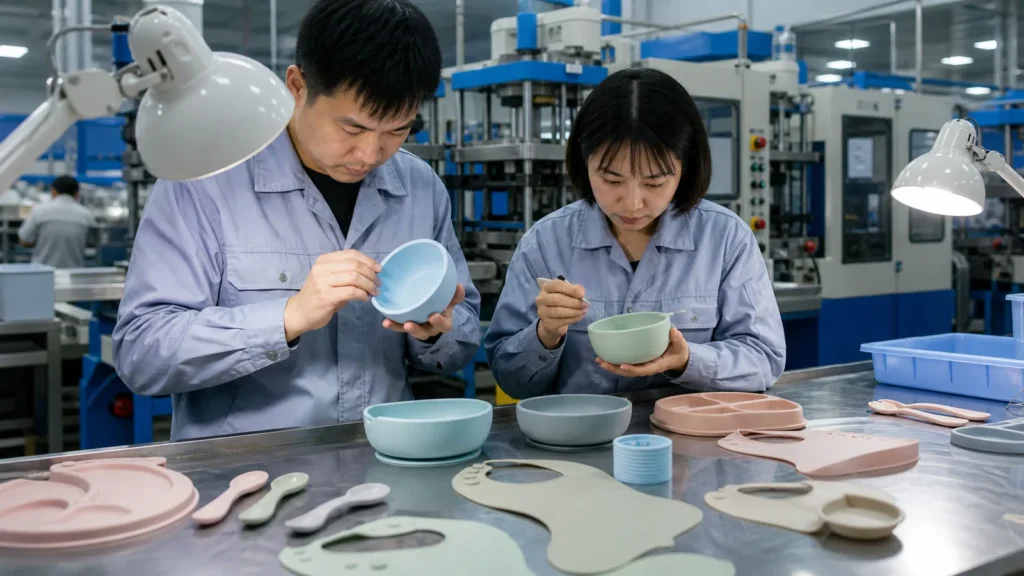
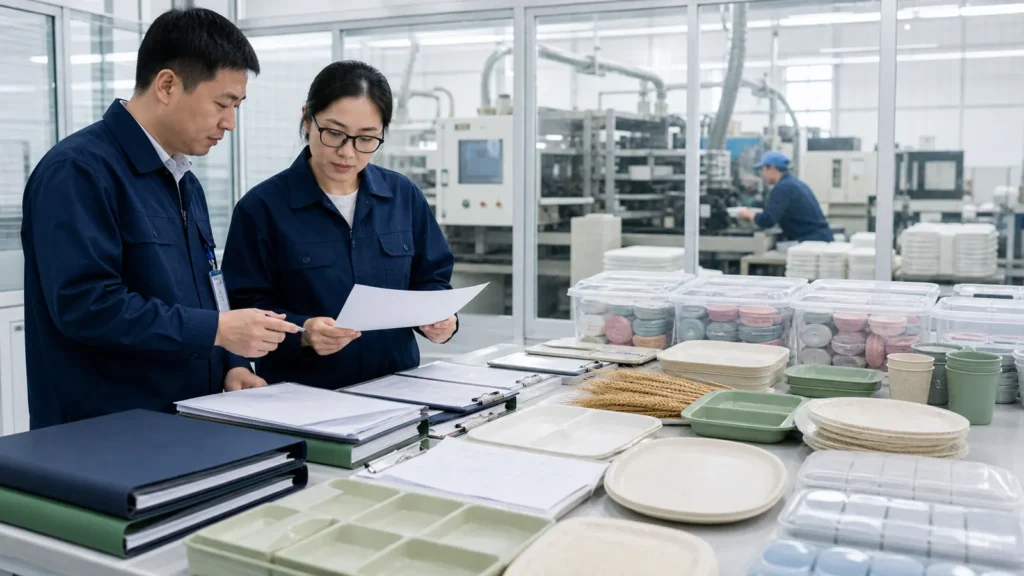
Food contact tableware traceability connects the product in a buyer shipment to its material identity, intended use, manufacturing records, compliance evidence and change history. A folder of certificates is not enough when nobody can show that the tested sample and the shipped construction are the same.
Naike Group manufacturing team builds that connection through material approval, lot control, production records, retained samples and shipment release in our Factory Capability process. The exact evidence depends on product material, target market and conditions of use.
This guide supports silicone and wheat-straw composite projects in our custom tableware catalog. Buyers can use it with the market comparison in our LFGB versus FDA silicone testing guide while obtaining qualified legal and laboratory advice for their own products.
Factory insider takeaway: Traceability must connect five identities: approved material, finished construction, tested sample, production lot and shipped lot. Every change should have an owner, impact decision and evidence before release.
Answer the First Food Contact Traceability Questions
Ask which legal entity is responsible for the material declaration, which product revision it covers and which intended use was evaluated. The answer should name documents and records rather than relying on general phrases such as food grade or export quality.
Confirm whether the evidence applies to a substance, material formulation or finished article. A supplier statement about one polymer does not automatically cover pigments, fillers, processing aids, decorations, adhesives or the complete product.
Identify the target countries, food types, temperatures, contact duration, repeated-use claims and age group. Compliance evidence can be unsuitable when the use condition in the file differs from the use promoted to consumers.
What food contact tableware traceability must connect
The compliance file should link product code and drawing revision to bill of materials, approved suppliers, material grades, lot records, test samples and shipment codes. Missing links create uncertainty even when individual documents look professional.
Assign responsibility for maintaining the current file. Purchasing, engineering and quality should know which change can invalidate an older declaration or laboratory report.
Control Material and Supplier Identity before Production
Approve the exact supplier, grade, specification and intended food-contact use for each relevant component. Trade names alone can be ambiguous, while an equivalent material from another source may have different composition or authorization status.
Incoming records should capture purchase order, supplier lot, received quantity, inspection status and storage location. Segregation and status control prevent unapproved material from entering a project during shortages or urgent production.
For composites, record the polymer matrix, plant-derived filler system, additives and pigment according to the controlled specification. Fiber percentage is not a substitute for full formulation and intended-use review.
Trace wheat-straw composite tableware beyond the marketing name
Our wheat-straw composite material guide explains why the finished material is a controlled system rather than loose agricultural fiber. Buyers should require records that identify the production formulation represented by testing.
Supplier changes, recycled content claims or additive substitutions need documented review. The factory should not extend evidence from the original construction without evaluating the changed material.
Link Laboratory Evidence to the Tested Construction
A laboratory report should identify sample description, material, color, product or specimen, test method, conditions and result. Compare those details with the current drawing and bill of materials before treating the report as project evidence.
Retain a sample or controlled image set where practical and record how the laboratory sample was selected. A sample prepared separately from normal production may support development but should not be presented as proof of an unrelated shipped lot.
Review report date and later changes rather than applying an automatic expiration rule. Evidence can become unsuitable because the product, supplier, regulation or intended use changed even when the document still looks current.
Separate tableware compliance documents by purpose
Declarations, material authorizations, migration reports, sensory results and factory inspection records answer different questions. Build an index showing the role and product scope of each document so buyers do not mistake one test for complete approval.
Laboratories provide test results, while market responsibility remains with the relevant business operators. Buyers should confirm the required conformity route with qualified professionals for every destination.
Carry Traceability through Molding, Inspection and Packing
Production orders should issue the approved product revision and bill of materials. Batch records then connect material lots, pigment or additive lots, equipment, cavities, dates, shifts and relevant process controls to finished quantities.
In-process identification must survive movement between molding, post-curing, assembly, inspection and packing. Temporary trays and mixed work-in-process create traceability gaps when labels are removed before the next status is applied.
Finished-product codes should support practical investigation without exposing unnecessary internal data to consumers. The coding logic must allow the factory to identify the corresponding production and material records when a buyer reports a problem.
Use retained samples to support shipment investigation
Define the retained quantity, identification, storage condition and retention period according to risk and customer agreement. A retained sample is useful only when its connection to the shipped lot is documented.
Combine retained samples with defect and release records described in our supplier evaluation checklist. This gives the buyer evidence for both compliance identity and manufacturing quality.
Manage Changes, Shipment Release and Trace-Back
Create change triggers for material supplier, grade, formulation, pigment, tool, product geometry, process, decoration, packaging contact and intended use. The responsible team should determine whether documents, testing, declarations or customer approvals need updating.
Shipment release should verify current product revision, lot identity, required inspection and compliance-file status. A packing list alone cannot prove that an outdated construction was prevented from entering the order.
Test the trace-back process periodically using one finished lot. The team should retrieve supplier, material, production, inspection, retained-sample and shipment information within a defined time and record any missing link.
Prepare food contact tableware traceability for buyer incidents
When a complaint occurs, first secure the product code, lot code, purchase order, photographs and use conditions. Preserve related stock and records while the team determines whether the issue is isolated, lot-specific or connected to a broader change.
A clear traceability chain supports proportionate containment and communication. Without it, businesses may need to hold a much larger population because they cannot define the affected scope.
Tableware Traceability Documents Compared by Purpose
Each record controls a different link in the compliance chain. A robust file explains how the records connect instead of presenting them as interchangeable certificates. Record the selected comparison assumptions in the food contact tableware traceability project brief before quotation.
| Record | Primary Purpose | Must Identify | Common Gap | Owner |
|---|---|---|---|---|
| Material declaration | State composition or regulatory basis | Supplier, grade, intended use and scope | Generic family statement | Material supplier and buyer compliance |
| Laboratory report | Report tested sample and result | Sample, method, conditions and date | No link to production construction | Applicant and qualified laboratory |
| Bill of materials | Define approved finished construction | All controlled components and revisions | Uncontrolled substitution | Engineering and purchasing |
| Batch record | Connect production to material lots | Order, lots, process and quantity | Mixed work-in-process identity | Factory production and quality |
| Shipment release | Authorize the supplied lot | Product revision, lot, checks and documents | Packing record without compliance status | Factory quality and exporter |
B2B Buyer Checklist for Food Contact Tableware Traceability
Use this checklist during supplier qualification, sample approval and repeat-order review. Require records that connect to the exact product rather than broad promotional claims. Record every answer against the current food contact tableware traceability project assumptions and approval owner.
| Check | Question | Why It Matters |
|---|---|---|
| Market and use | Are destination food types temperature duration and repeated use defined? | Evidence must match the actual intended conditions. |
| Product revision | Which drawing bill of materials color and component set control the order? | Traceability begins with one unambiguous finished construction. |
| Material identity | Are supplier grade formulation and intended-use specifications approved? | Generic material names cannot control composition or authorization. |
| Incoming lots | Can every received lot be linked to purchase and inspection records? | Material traceability is lost when warehouse identity is incomplete. |
| Tested sample | Does each report identify a sample connected to the current construction? | A passing result cannot govern an unrelated product revision. |
| Document index | Is the purpose scope owner and revision of each compliance record listed? | An index prevents outdated or irrelevant documents from being reused. |
| Production batch | Can finished lots be traced to material cavity date shift and process records? | Batch links support focused investigation and containment. |
| Retained sample | Is a labeled sample retained under a defined period and condition? | Physical evidence helps compare complaints with the shipped lot. |
| Change control | Which supplier material tool process or use changes trigger reassessment? | Evidence remains valid only while its controlling assumptions remain true. |
| Trace-back test | Has the factory demonstrated retrieval of one lot from shipment to supplier? | A practical test reveals missing links before a real incident. |
Factory Control Notes for food contact tableware traceability
These controls turn compliance files into an operating traceability system that can support qualification, shipment release and incident response. Each food contact tableware traceability decision should identify its owner, evidence and release condition.
1. Market and use control for food contact tableware traceability
For food contact tableware traceability, the market and use checkpoint must become a dated project record rather than an informal chat instruction. The resulting market and use record must name its owner, source evidence, revision authority and the commercial consequence of a late change after the buyer asks, “Are destination food types temperature duration and repeated use defined?”
Evidence must match the actual intended conditions. For the market and use decision in this food contact tableware traceability project, our factory links the checkpoint to the quotation, approved sample, purchase order or inspection standard that governs the next approval. If the food contact tableware traceability evidence is incomplete, the team holds that approval gate, closes the information gap and records the revised assumption before production continues.
2. Product revision control for food contact tableware traceability
For food contact tableware traceability, the product revision checkpoint must become a dated project record rather than an informal chat instruction. The resulting product revision record must name its owner, source evidence, revision authority and the commercial consequence of a late change after the buyer asks, “Which drawing bill of materials color and component set control the order?”
Traceability begins with one unambiguous finished construction. For the product revision decision in this food contact tableware traceability project, our factory links the checkpoint to the quotation, approved sample, purchase order or inspection standard that governs the next approval. If the food contact tableware traceability evidence is incomplete, the team holds that approval gate, closes the information gap and records the revised assumption before production continues.
3. Material identity control for food contact tableware traceability
For food contact tableware traceability, the material identity checkpoint must become a dated project record rather than an informal chat instruction. The resulting material identity record must name its owner, source evidence, revision authority and the commercial consequence of a late change after the buyer asks, “Are supplier grade formulation and intended-use specifications approved?”
Generic material names cannot control composition or authorization. For the material identity decision in this food contact tableware traceability project, our factory links the checkpoint to the quotation, approved sample, purchase order or inspection standard that governs the next approval. If the food contact tableware traceability evidence is incomplete, the team holds that approval gate, closes the information gap and records the revised assumption before production continues.
4. Incoming lots control for food contact tableware traceability
For food contact tableware traceability, the incoming lots checkpoint must become a dated project record rather than an informal chat instruction. The resulting incoming lots record must name its owner, source evidence, revision authority and the commercial consequence of a late change after the buyer asks, “Can every received lot be linked to purchase and inspection records?”
Material traceability is lost when warehouse identity is incomplete. For the incoming lots decision in this food contact tableware traceability project, our factory links the checkpoint to the quotation, approved sample, purchase order or inspection standard that governs the next approval. If the food contact tableware traceability evidence is incomplete, the team holds that approval gate, closes the information gap and records the revised assumption before production continues.
5. Tested sample control for food contact tableware traceability
For food contact tableware traceability, the tested sample checkpoint must become a dated project record rather than an informal chat instruction. The resulting tested sample record must name its owner, source evidence, revision authority and the commercial consequence of a late change after the buyer asks, “Does each report identify a sample connected to the current construction?”
A passing result cannot govern an unrelated product revision. For the tested sample decision in this food contact tableware traceability project, our factory links the checkpoint to the quotation, approved sample, purchase order or inspection standard that governs the next approval. If the food contact tableware traceability evidence is incomplete, the team holds that approval gate, closes the information gap and records the revised assumption before production continues.
6. Document index control for food contact tableware traceability
For food contact tableware traceability, the document index checkpoint must become a dated project record rather than an informal chat instruction. The resulting document index record must name its owner, source evidence, revision authority and the commercial consequence of a late change after the buyer asks, “Is the purpose scope owner and revision of each compliance record listed?”
An index prevents outdated or irrelevant documents from being reused. For the document index decision in this food contact tableware traceability project, our factory links the checkpoint to the quotation, approved sample, purchase order or inspection standard that governs the next approval. If the food contact tableware traceability evidence is incomplete, the team holds that approval gate, closes the information gap and records the revised assumption before production continues.
7. Production batch control for food contact tableware traceability
For food contact tableware traceability, the production batch checkpoint must become a dated project record rather than an informal chat instruction. The resulting production batch record must name its owner, source evidence, revision authority and the commercial consequence of a late change after the buyer asks, “Can finished lots be traced to material cavity date shift and process records?”
Batch links support focused investigation and containment. For the production batch decision in this food contact tableware traceability project, our factory links the checkpoint to the quotation, approved sample, purchase order or inspection standard that governs the next approval. If the food contact tableware traceability evidence is incomplete, the team holds that approval gate, closes the information gap and records the revised assumption before production continues.
8. Retained sample control for food contact tableware traceability
For food contact tableware traceability, the retained sample checkpoint must become a dated project record rather than an informal chat instruction. The resulting retained sample record must name its owner, source evidence, revision authority and the commercial consequence of a late change after the buyer asks, “Is a labeled sample retained under a defined period and condition?”
Physical evidence helps compare complaints with the shipped lot. For the retained sample decision in this food contact tableware traceability project, our factory links the checkpoint to the quotation, approved sample, purchase order or inspection standard that governs the next approval. If the food contact tableware traceability evidence is incomplete, the team holds that approval gate, closes the information gap and records the revised assumption before production continues.
9. Change control control for food contact tableware traceability
For food contact tableware traceability, the change control checkpoint must become a dated project record rather than an informal chat instruction. The resulting change control record must name its owner, source evidence, revision authority and the commercial consequence of a late change after the buyer asks, “Which supplier material tool process or use changes trigger reassessment?”
Evidence remains valid only while its controlling assumptions remain true. For the change control decision in this food contact tableware traceability project, our factory links the checkpoint to the quotation, approved sample, purchase order or inspection standard that governs the next approval. If the food contact tableware traceability evidence is incomplete, the team holds that approval gate, closes the information gap and records the revised assumption before production continues.
10. Trace-back test control for food contact tableware traceability
For food contact tableware traceability, the trace-back test checkpoint must become a dated project record rather than an informal chat instruction. The resulting trace-back test record must name its owner, source evidence, revision authority and the commercial consequence of a late change after the buyer asks, “Has the factory demonstrated retrieval of one lot from shipment to supplier?”
A practical test reveals missing links before a real incident. For the trace-back test decision in this food contact tableware traceability project, our factory links the checkpoint to the quotation, approved sample, purchase order or inspection standard that governs the next approval. If the food contact tableware traceability evidence is incomplete, the team holds that approval gate, closes the information gap and records the revised assumption before production continues.
Authoritative References and Practical Limits
Regulation (EC) No 1935/2004 establishes general food-contact requirements and traceability principles in the European Union. Review the official EUR-Lex regulation record. Buyers should confirm how this reference applies to the named product, target market and current food contact tableware traceability project.
The U.S. FDA explains how the regulatory status of each component affects a food-contact material and notes manufacturer-specific scope for Food Contact Notifications. See the official FDA industry guidance page. Buyers should confirm how this reference applies to the named product, target market and current food contact tableware traceability project.
Food Standards Australia New Zealand discusses chemical migration from food packaging and related safety assessment work. Review the official FSANZ food packaging page as part of Australian and New Zealand market research. Buyers should confirm how this reference applies to the named product, target market and current food contact tableware traceability project.
This guide explains factory traceability practices and is not legal advice or product certification. Importers and brand owners should confirm current requirements, responsible parties, conformity documents and testing with qualified specialists in every target market.
Food Contact Tableware Traceability FAQ
Is a supplier food-grade certificate enough?
No. Buyers need to confirm scope, material identity, intended use and connection to the finished product and shipment.
How should a test report connect to production?
The tested sample should link to a controlled product revision, bill of materials and material identity. Later changes require an impact decision.
Do all repeat orders need new laboratory testing?
Not automatically. The decision depends on requirements, risk, evidence scope and whether any material, process, supplier or intended-use assumption changed.
What should a finished lot code reveal?
It should let the factory retrieve relevant production, material, inspection and shipment records. The public code does not need to display every internal detail.
Why perform a mock trace-back?
It tests whether records can actually be retrieved and connected within the required time. Missing links can then be fixed before a complaint or recall decision.
Conclusion: Make Food Contact Tableware Traceability Operational
Reliable food contact tableware traceability links approved materials, the finished construction, tested samples, production batches and shipped lots. Documents become useful when their scope and relationship can be demonstrated quickly.
Our factory combines incoming identity, batch records, retained samples, change review and shipment release. This structure helps B2B buyers investigate issues and protect repeat orders without depending on disconnected certificates.
Share the product, material, intended use, target markets and required documents through Contact Us. Naike Group manufacturing team will review the traceability and evidence route before quotation.
Build a Traceable Tableware Compliance File
Send your material, product revision, target market and intended-use requirements for a factory document review. Our manufacturing team will use those details to define the next review step for your food contact tableware traceability project.