
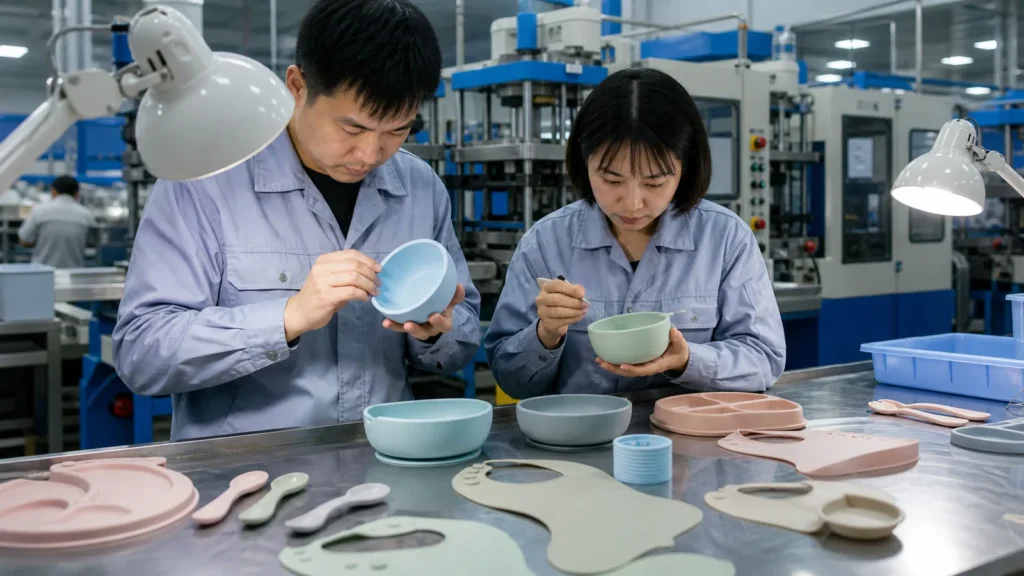
Silicone compression molding defects are not solved reliably by asking an operator to inspect more carefully. Flash, short fill, trapped air, contamination, color streaks and deformation can originate in material preparation, tool condition, process settings, part design or handling, so the buyer needs a diagnostic path that connects each symptom to evidence.
Naike Group manufacturing team treats defect control as part of the production release described in our Factory Capability workflow. The goal is to prevent recurring defects through defined standards, stable process windows and traceable corrective action rather than sorting an unstable process forever.
This guide supports silicone bowls, plates, cups, bibs, spoons and feeding sets available through our custom tableware products. New structures should also connect defect risk to the tooling decisions explained in our silicone mold manufacturing guide.
Factory insider takeaway: Name the defect, map its location, preserve the sample and verify the process record before changing anything. Corrective action should address a confirmed cause and then prove that the change does not create a different failure.
Classify Silicone Compression Molding Defects before Correction
Start with a defect map that records product revision, cavity, lot, shift, location, size, frequency and functional effect. A phrase such as bad surface combines unrelated conditions and prevents engineering, production and quality teams from comparing the same evidence.
Separate critical safety or function defects from major commercial defects and minor appearance variation. The buyer and factory should agree which categories trigger lot rejection, one-hundred-percent containment, rework evaluation or monitored acceptance.
Preserve representative defect samples and matched acceptable units. Photographs are useful for communication, but retained physical boundary samples show depth, flexibility, texture and visibility more accurately than a compressed image.
Build a silicone compression molding defects library
A useful defect library includes flash, mismatch, short fill, knit lines, air traps, bubbles, scorching, contamination, color streaks, surface drag, tears, deformation and post-cure marks. Each entry should show unacceptable and acceptable limits for the actual product zone.
Update the library only through controlled approval. Informal new standards created during a busy shipment can quietly lower the buyer requirement and make repeat-order performance impossible to compare.
Trace Flash, Mold Mismatch and Short Fill to Their Sources
Excess flash may reflect material charge, closing force, vent condition, tool wear, alignment or an intentional overflow design. Trimming can remove evidence from the finished product, but repeated heavy flash increases labor, dimensional variation and risk of torn edges.
Mold mismatch appears when opposing tool features do not align consistently. Check guide components, tool seating, contamination on the parting surface, cavity wear and press condition before assuming the operator created the problem during demolding.
Short fill or incomplete detail requires review of charge weight and placement, material flow, temperature, pressure, venting and geometry. Increasing pressure without diagnosis may close vents, enlarge flash or trap air elsewhere in the part.
Use cavity evidence instead of averaging visible defects
Record defects by cavity and location. A problem concentrated in one cavity or one thin feature points toward different causes than a lot-wide change occurring across the complete tool.
Compare first pieces, steady-state production and restart pieces separately. Warm-up and interruption behavior can reveal process sensitivity that is hidden when inspectors combine every stage into one defect percentage.
Diagnose Bubbles, Air Traps and Silicone Surface Contamination
Visible bubbles can come from trapped air, volatile contamination, material handling, mixing or cure behavior. Cut and document rejected samples when appropriate so the team can distinguish a surface blister from an internal void or foreign particle.
Air-trap location often follows the flow path and vent strategy. Engineering should compare the defect position with charge placement, cavity filling direction and vent condition before adding random process time or pressure.
Contamination control begins with material segregation, clean tools, covered work-in-process and defined cleaning materials. Fibers, dust, incompatible lubricant or fragments from handling equipment can become embedded and may require containment beyond cosmetic sorting.
Link silicone tableware quality control to material identity
Verify compound grade, batch, pigment, storage condition, mixing record and time limits whenever a new defect pattern appears. Material substitution or cross-use between projects can change flow, cure and appearance even when the products look similar before molding.
Quarantine suspect material and finished goods with clear status labels. A diagnosis is unreliable if conforming, unverified and rejected materials continue moving through the same staging area.
Separate Demolding Tears, Deformation and Cure Problems
Tears at thin edges, undercuts or holes may result from geometry, surface condition, release direction, cure state or demolding technique. Inspect where the tear starts and whether it repeats at one feature before changing the entire material system.
Deformation can develop inside the mold, during ejection, while hot parts are stacked or during post-curing. Measure products after a defined conditioning period and compare handling fixtures, loading density and cooling time across shifts.
Under-cure and overexposure require controlled review of time, temperature, tool heat distribution and compound behavior. A surface impression alone cannot prove cure condition, so the quality plan should identify the test or production evidence that controls release.
Confirm that a corrective setting remains inside the approved process window
A temporary setting that produces attractive samples may reduce throughput, change dimensions or create performance risk. Validate the corrected setting across the planned cavity count, run duration and normal material variation before accepting it as the new standard.
Update work instructions, parameter limits and training after approval. Otherwise the process returns to the previous condition when the engineer or experienced operator is no longer present.
Move from Defect Containment to Controlled Bulk Release
Containment protects the current shipment while root-cause work protects future lots. Define the affected time window, material, cavities and inventory locations, then inspect or hold the population using the approved defect boundaries.
Corrective trials should change a controlled factor and document the before-and-after result. When variables interact, use a planned experiment rather than several unrecorded adjustments that produce a passing sample without explaining why.
Release requires evidence that the cause was addressed, containment was effective and the process remains stable. Monitor the next production lots at increased frequency before returning to the normal inspection plan.
Set acceptance sampling for silicone compression molding defects
Sampling plans need a defined lot, inspection level, defect classification and acceptance rule. AQL language does not permit known critical defects or replace process control, and buyers should understand the consumer risk behind every defect category.
Use the supplier controls in our tableware supplier evaluation checklist to review whether defect records, containment and corrective actions are repeatable. Stable evidence is more valuable than a perfect inspection report created only for one visit.
Silicone Defect Responses Compared by Commercial Risk
Different responses protect different time horizons. Buyers should distinguish temporary shipment protection from actions that improve the molding process itself. Record the selected comparison assumptions in the silicone compression molding defects project brief before quotation.
| Response | Immediate Benefit | Main Limitation | Required Evidence | Best Use |
|---|---|---|---|---|
| Sorting and containment | Separates visible nonconforming units | Does not remove root cause | Defined defect boundary and traceable population | Protecting current inventory |
| Trimming or controlled rework | May recover eligible parts | Can damage function or hide instability | Approved method and reinspection result | Limited repairable conditions |
| Process adjustment | Can reduce recurring variation | May create another defect | Parameter trial and capability evidence | Confirmed process cause |
| Tool maintenance or revision | Addresses wear, venting or geometry | Requires downtime and reapproval | Tool record and first-article validation | Confirmed tooling cause |
| Material corrective action | Controls compound-related failure | Change can affect compliance and performance | Material identity and full revalidation plan | Verified material cause |
B2B Buyer Checklist for Silicone Compression Molding Defects
Complete these questions before accepting a corrective action or releasing a contained lot. Each answer should identify evidence rather than an undocumented verbal assurance. Record every answer against the current silicone compression molding defects project assumptions and approval owner.
| Check | Question | Why It Matters |
|---|---|---|
| Defect definition | Is the defect named with location severity and approved visual boundaries? | Consistent language prevents inspection decisions from changing by operator. |
| Lot traceability | Which material lots cavities shifts and time window are affected? | Containment must cover the complete risk population without mixing statuses. |
| Functional risk | Can the condition affect food contact fit strength cleaning or consumer use? | Functional consequences determine classification and release authority. |
| Material record | Are compound pigment storage mixing and batch identities verified? | Material variation can change flow cure appearance and defect frequency. |
| Tool evidence | Were parting surfaces vents alignment and cavity condition inspected? | Tool wear or blockage can create repeatable location-specific defects. |
| Process record | Are charge placement temperature pressure time and restart conditions available? | A diagnosis needs the actual process state that produced the defect. |
| Containment plan | Who controls held stock sorting criteria rework and reinspection? | Clear ownership protects the shipment while root-cause work continues. |
| Corrective trial | Which variable changed and what before-and-after evidence proves improvement? | Controlled trials distinguish a real cause from a coincidental passing sample. |
| Revalidation | Did the correction preserve dimensions performance color and compliance assumptions? | Fixing one symptom must not create a new commercial or regulatory risk. |
| Ongoing monitoring | How will the next lots be checked before normal sampling resumes? | Increased monitoring confirms that the corrective action remains effective. |
Factory Control Notes for silicone compression molding defects
These control notes convert defect observations into a shared factory record. They help buyers compare root-cause discipline rather than comparing only final inspection percentages. Each silicone compression molding defects decision should identify its owner, evidence and release condition.
1. Defect definition control for silicone compression molding defects
For silicone compression molding defects, the defect definition checkpoint must become a dated project record rather than an informal chat instruction. The resulting defect definition record must name its owner, source evidence, revision authority and the commercial consequence of a late change after the buyer asks, “Is the defect named with location severity and approved visual boundaries?”
Consistent language prevents inspection decisions from changing by operator. For the defect definition decision in this silicone compression molding defects project, our factory links the checkpoint to the quotation, approved sample, purchase order or inspection standard that governs the next approval. If the silicone compression molding defects evidence is incomplete, the team holds that approval gate, closes the information gap and records the revised assumption before production continues.
2. Lot traceability control for silicone compression molding defects
For silicone compression molding defects, the lot traceability checkpoint must become a dated project record rather than an informal chat instruction. The resulting lot traceability record must name its owner, source evidence, revision authority and the commercial consequence of a late change after the buyer asks, “Which material lots cavities shifts and time window are affected?”
Containment must cover the complete risk population without mixing statuses. For the lot traceability decision in this silicone compression molding defects project, our factory links the checkpoint to the quotation, approved sample, purchase order or inspection standard that governs the next approval. If the silicone compression molding defects evidence is incomplete, the team holds that approval gate, closes the information gap and records the revised assumption before production continues.
3. Functional risk control for silicone compression molding defects
For silicone compression molding defects, the functional risk checkpoint must become a dated project record rather than an informal chat instruction. The resulting functional risk record must name its owner, source evidence, revision authority and the commercial consequence of a late change after the buyer asks, “Can the condition affect food contact fit strength cleaning or consumer use?”
Functional consequences determine classification and release authority. For the functional risk decision in this silicone compression molding defects project, our factory links the checkpoint to the quotation, approved sample, purchase order or inspection standard that governs the next approval. If the silicone compression molding defects evidence is incomplete, the team holds that approval gate, closes the information gap and records the revised assumption before production continues.
4. Material record control for silicone compression molding defects
For silicone compression molding defects, the material record checkpoint must become a dated project record rather than an informal chat instruction. The resulting material record record must name its owner, source evidence, revision authority and the commercial consequence of a late change after the buyer asks, “Are compound pigment storage mixing and batch identities verified?”
Material variation can change flow cure appearance and defect frequency. For the material record decision in this silicone compression molding defects project, our factory links the checkpoint to the quotation, approved sample, purchase order or inspection standard that governs the next approval. If the silicone compression molding defects evidence is incomplete, the team holds that approval gate, closes the information gap and records the revised assumption before production continues.
5. Tool evidence control for silicone compression molding defects
For silicone compression molding defects, the tool evidence checkpoint must become a dated project record rather than an informal chat instruction. The resulting tool evidence record must name its owner, source evidence, revision authority and the commercial consequence of a late change after the buyer asks, “Were parting surfaces vents alignment and cavity condition inspected?”
Tool wear or blockage can create repeatable location-specific defects. For the tool evidence decision in this silicone compression molding defects project, our factory links the checkpoint to the quotation, approved sample, purchase order or inspection standard that governs the next approval. If the silicone compression molding defects evidence is incomplete, the team holds that approval gate, closes the information gap and records the revised assumption before production continues.
6. Process record control for silicone compression molding defects
For silicone compression molding defects, the process record checkpoint must become a dated project record rather than an informal chat instruction. The resulting process record record must name its owner, source evidence, revision authority and the commercial consequence of a late change after the buyer asks, “Are charge placement temperature pressure time and restart conditions available?”
A diagnosis needs the actual process state that produced the defect. For the process record decision in this silicone compression molding defects project, our factory links the checkpoint to the quotation, approved sample, purchase order or inspection standard that governs the next approval. If the silicone compression molding defects evidence is incomplete, the team holds that approval gate, closes the information gap and records the revised assumption before production continues.
7. Containment plan control for silicone compression molding defects
For silicone compression molding defects, the containment plan checkpoint must become a dated project record rather than an informal chat instruction. The resulting containment plan record must name its owner, source evidence, revision authority and the commercial consequence of a late change after the buyer asks, “Who controls held stock sorting criteria rework and reinspection?”
Clear ownership protects the shipment while root-cause work continues. For the containment plan decision in this silicone compression molding defects project, our factory links the checkpoint to the quotation, approved sample, purchase order or inspection standard that governs the next approval. If the silicone compression molding defects evidence is incomplete, the team holds that approval gate, closes the information gap and records the revised assumption before production continues.
8. Corrective trial control for silicone compression molding defects
For silicone compression molding defects, the corrective trial checkpoint must become a dated project record rather than an informal chat instruction. The resulting corrective trial record must name its owner, source evidence, revision authority and the commercial consequence of a late change after the buyer asks, “Which variable changed and what before-and-after evidence proves improvement?”
Controlled trials distinguish a real cause from a coincidental passing sample. For the corrective trial decision in this silicone compression molding defects project, our factory links the checkpoint to the quotation, approved sample, purchase order or inspection standard that governs the next approval. If the silicone compression molding defects evidence is incomplete, the team holds that approval gate, closes the information gap and records the revised assumption before production continues.
9. Revalidation control for silicone compression molding defects
For silicone compression molding defects, the revalidation checkpoint must become a dated project record rather than an informal chat instruction. The resulting revalidation record must name its owner, source evidence, revision authority and the commercial consequence of a late change after the buyer asks, “Did the correction preserve dimensions performance color and compliance assumptions?”
Fixing one symptom must not create a new commercial or regulatory risk. For the revalidation decision in this silicone compression molding defects project, our factory links the checkpoint to the quotation, approved sample, purchase order or inspection standard that governs the next approval. If the silicone compression molding defects evidence is incomplete, the team holds that approval gate, closes the information gap and records the revised assumption before production continues.
10. Ongoing monitoring control for silicone compression molding defects
For silicone compression molding defects, the ongoing monitoring checkpoint must become a dated project record rather than an informal chat instruction. The resulting ongoing monitoring record must name its owner, source evidence, revision authority and the commercial consequence of a late change after the buyer asks, “How will the next lots be checked before normal sampling resumes?”
Increased monitoring confirms that the corrective action remains effective. For the ongoing monitoring decision in this silicone compression molding defects project, our factory links the checkpoint to the quotation, approved sample, purchase order or inspection standard that governs the next approval. If the silicone compression molding defects evidence is incomplete, the team holds that approval gate, closes the information gap and records the revised assumption before production continues.
Authoritative References and Practical Limits
ISO 2859-1:2026 defines AQL-indexed sampling schemes for lot-by-lot inspection by attributes. Review the official ISO 2859-1 overview when specifying acceptance sampling and switching rules. Buyers should confirm how this reference applies to the named product, target market and current silicone compression molding defects project.
United States requirements for rubber articles intended for repeated food contact are stated in 21 CFR 177.2600. Review the current eCFR section 177.2600 with qualified compliance professionals. Buyers should confirm how this reference applies to the named product, target market and current silicone compression molding defects project.
Regulation (EC) No 1935/2004 establishes general requirements and traceability principles for food-contact materials in the European Union. Use the official EUR-Lex regulation record for current market review. Buyers should confirm how this reference applies to the named product, target market and current silicone compression molding defects project.
Defect inspection and food-contact compliance are separate controls. A cosmetic acceptance decision does not demonstrate legal compliance, while a material compliance document does not prove that the molded product meets dimensional, functional or workmanship requirements.
Silicone Compression Molding Defects Buyer FAQ
Can heavy silicone flash simply be trimmed away?
Only when the approved product and rework method allow it. Heavy or recurring flash can signal tool, charge or process instability and trimming may tear edges or change dimensions.
Why do bubbles appear only in one cavity?
A cavity-specific pattern can involve venting, flow path, temperature, surface condition or geometry. Compare cavity and process evidence before changing the full material batch.
Is one-hundred-percent inspection enough after a defect?
It can protect current inventory when the defect is detectable and boundaries are clear, but it does not replace root-cause correction or verification of the molding process. The factory should still prove why the defect occurred and monitor the corrected process.
Should every visible mark cause lot rejection?
No universal rule fits every product zone. The buyer and factory should classify safety, functional and appearance risks with approved boundary samples and sampling rules.
When should a tooling change trigger new samples?
Any change that can affect geometry, venting, surface, parting line or process behavior should receive an impact review and the agreed level of first-article reapproval. The project record should identify the revised tool condition and approval evidence.
Conclusion: Control Silicone Compression Molding Defects before Shipment
Effective control of silicone compression molding defects starts with precise classification and traceability, not with a larger sorting team. Material, tool, process and handling evidence should point toward a confirmed cause before corrective settings are released.
Our factory uses defect boundaries, cavity records, controlled trials and increased post-correction monitoring to protect repeat orders. This gives B2B buyers a clearer connection between the approved sample, actual process and shipment decision.
Send product drawings, reference photos, target quantity, market and defect concerns through Contact Us. Naike Group manufacturing team will review the tooling, sampling and production-control route for your project.
Review Your Silicone Molding Risk with Our Factory
Share the product geometry, defect evidence, quantity and target market for a controlled manufacturing review. Our manufacturing team will use those details to define the next review step for your silicone compression molding defects project.