
Naike Group Repeat Order Quality: Control Guide
Follow the records and release decisions that help a returning SKU remain aligned with its buyer-approved baseline.

Naike Group repeat order quality is controlled by reconnecting every returning purchase order to an approved product baseline, then checking current materials, tooling, process settings, appearance, dimensions, function, packaging, and inspection evidence against that baseline. Any intentional change is reviewed and approved before it becomes the new reference; unexplained drift is investigated rather than accepted as normal.
For buyers, consistency does not mean that every unit is microscopically identical. It means agreed characteristics stay within defined limits, important visual and functional references remain recognizable, and each release decision can be traced to the correct specification, sample, production lot, and authorized deviation.
This Brand Entity guide explains the operating logic the Naike Group manufacturing team uses for repeat projects. It does not promise zero variation or replace a buyer-specific quality agreement; it shows which records and decisions should be visible before another shipment is approved.
Buyer Answer: Reconnect the New Order to Its Approved Baseline
Begin by confirming the SKU, drawing revision, bill of materials, material source, color standard, decoration, packaging version, functional limits, approved sample, and known concessions from the previous release. Then review what has changed since the last production run and assign focused checks to every change that could affect fit, appearance, use, compliance evidence, or delivery performance.
During production, use first-off checks, in-process measurements, workmanship controls, retained references, and final sampling to show that the current lot follows the approved route. Buyers can request a repeat-order control review with the prior approval file and the new purchase-order requirements.
Define Consistency as a Controlled Range, Not a Vague Promise
A buyer may describe consistency as the same color, feel, fit, suction, stack, print, pack-out, or carton performance as before. The factory needs each expectation translated into an identifiable reference or measurable acceptance rule, because the word “same” alone cannot resolve a borderline shade, dimension, texture, or functional result.
The controlled range can combine drawings and tolerances, material and component specifications, approved color references, signed samples, test methods, workmanship limits, packaging artwork, inspection plans, and customer-specific exceptions. Different characteristics need different evidence: a Pantone target cannot define lid fit, and a dimensional drawing cannot define an acceptable surface texture.
Natural variation still exists in raw materials, pigments, molding, finishing, printing, assembly, measurement, and handling. Quality control manages that variation around the agreed baseline and flags patterns before they become customer-visible drift; it does not make an honest manufacturing process mathematically variation-free.
Procurement should therefore ask which characteristics are critical, major, or cosmetic, what range is acceptable, how the result is measured, and who can approve an exception. These decisions turn a familiar product into a controlled repeat-order specification.
How Naike Group Repeat Order Quality Separates Product Identity From Shipment Acceptance
Product identity describes what must be made: SKU, revision, materials, components, color, geometry, marking, package, and intended use. Shipment acceptance describes how the current lot is sampled, measured, classified, and released against that identity.
Keeping those layers separate prevents an inspection result from silently rewriting the product. A passed sample does not authorize an unrecorded material, drawing, logo, or packaging change.
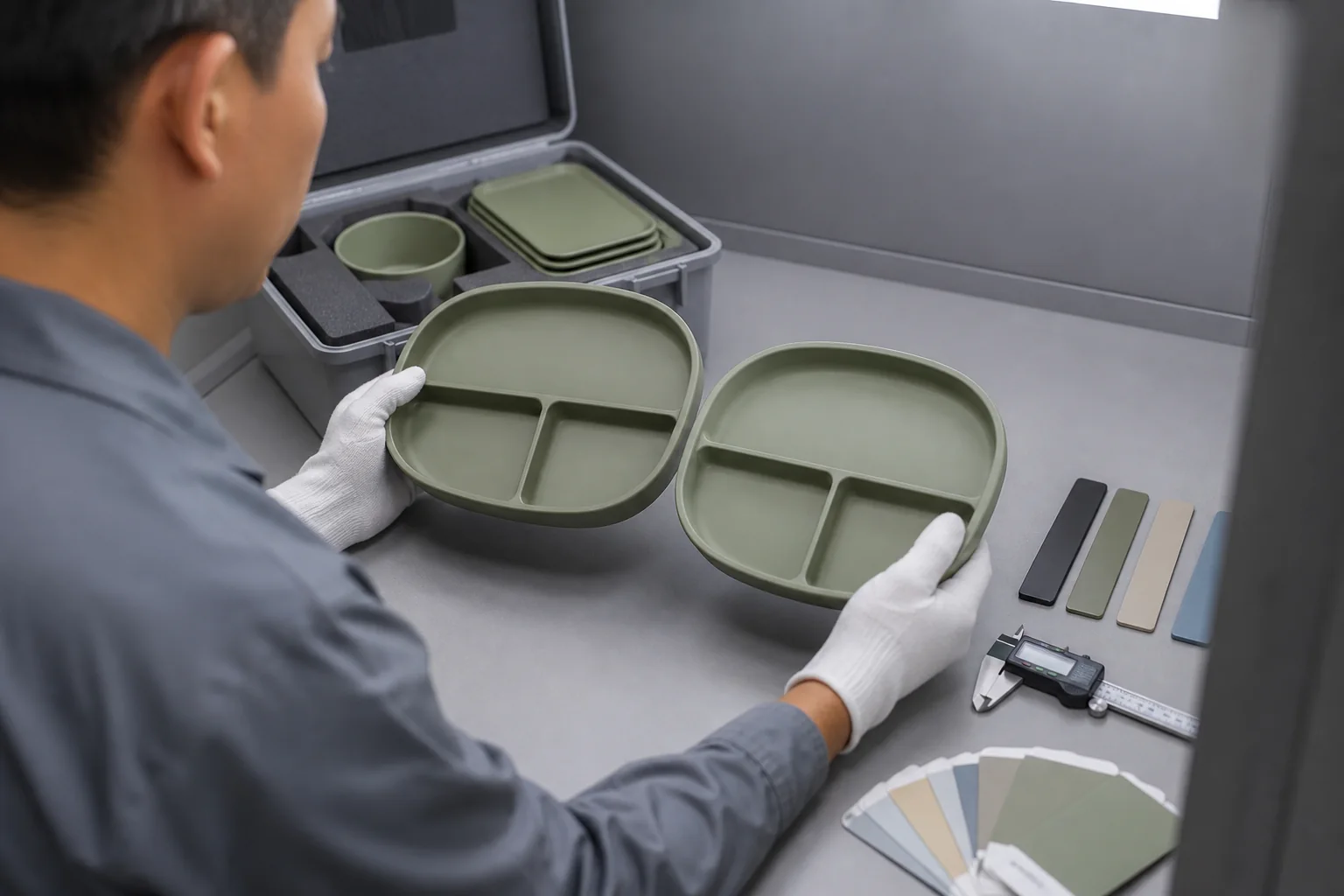
Freeze the Repeat-Order Baseline Before Material Is Released
The repeat-order review starts with document identity. The sales order, purchase order, controlled drawing, bill of materials, color code, artwork, packing instruction, approved sample reference, test file, and quality plan should point to compatible revisions before purchasing or production scheduling begins.
A previous shipment is not automatically the approved baseline. It may include a one-time concession, temporary pack-out, substitute component, customer-authorized deviation, or correction that was never intended to carry forward, so the team must distinguish permanent approvals from order-specific decisions.
Physical references also need identity and protection. A master sample should carry the SKU, revision, approval date, color or decoration reference, and responsible parties, while storage controls should reduce fading, deformation, contamination, loss, or casual replacement.
The custom tableware sample approval guide explains how a golden sample connects tooling trials, material, color, logo, function, and packaging decisions. For repeat production, that connection matters only when the reference remains current and linked to the order being released.
Close revision gaps before the factory schedules the lot
If the buyer purchase order cites an old artwork while the factory file contains a newer carton, the gap must be resolved in writing. Production should not choose the version that appears most convenient or rely on an informal chat history.
A short pre-production baseline review is usually less expensive than sorting finished goods, reprinting packaging, rebuilding mixed sets, or debating which version was intended after inspection. Close the mismatch before releasing material or capacity.
Screen Changes Since the Last Approved Production Run
Repeat orders often look unchanged commercially while inputs have moved. Material supplier, resin or compound grade, pigment batch, packaging paper, ink, adhesive, subcontracted process, mold maintenance, cavity condition, machine assignment, work instruction, operator training, or regulatory expectations may differ from the prior run.
The team should compare the new order with the last approved production record and classify each difference by affected characteristic. A new pigment may require color and applicable material-evidence review; a polished cavity may affect gloss and release; a packaging board change may affect compression, printing, barcode contrast, and pack dimensions.
Not every change requires a complete requalification. The response should match the credible effect: document review for an administrative update, targeted measurement or trial for a limited process change, customer sample approval for a visible difference, or broader retesting when material identity, use conditions, claims, or market obligations are affected.
Changes also come from the buyer. New assortment ratios, private-label artwork, warning text, retail channels, markets, cleaning claims, or delivery configurations should reopen the relevant specification and evidence branches instead of being treated as purchasing notes.
Use a written impact decision for every meaningful change
Record what changed, why it changed, which SKUs and lots are affected, which characteristics could move, what verification is required, who approves it, and whether the approved baseline will be revised. This creates a reviewable path between continuity and authorized improvement.
Silence is not evidence that a change is harmless. When the impact is uncertain, a controlled trial and focused comparison provide a better release basis than optimistic assumptions.
Approve First-Off Output Before Normal Production Builds
The first-off check asks whether the current materials, tool, machine, settings, people, and work instructions can reproduce the controlled baseline before the lot accumulates. It should use production-intent inputs and the planned cavity, decoration, assembly, and packaging route rather than a hand-selected development sample.
Inspect the characteristics most sensitive to setup and recent change. Depending on the product, these can include weight, critical dimensions, wall distribution, flash, short fill, deformation, part fit, suction, lid closure, color, gloss, odor, print position, assembly, and immediate functional checks.
A first-off approval is a gate, not a ceremonial signature. If a characteristic is outside its limit or visibly inconsistent with the master reference, the team should contain the output, adjust the cause, make new samples, and record the recheck before routine production continues.
Cavity-level identity matters when one mold makes multiple pieces at once. A pooled result can hide a damaged or imbalanced cavity, so checks should preserve cavity information where tooling construction and risk make that distinction useful.
Connect the approved setup to the production record
Record the date, order, SKU revision, material lot, machine, mold and cavity, critical settings, sample results, disposition, and approver. Photos can support the record, but they do not replace measurements or a clearly identified physical reference.
The Naike Group factory capability overview gives buyers context for molding, customization, quality control, and production support. A repeat-order plan should translate those capabilities into the specific checkpoints required by the current SKU.
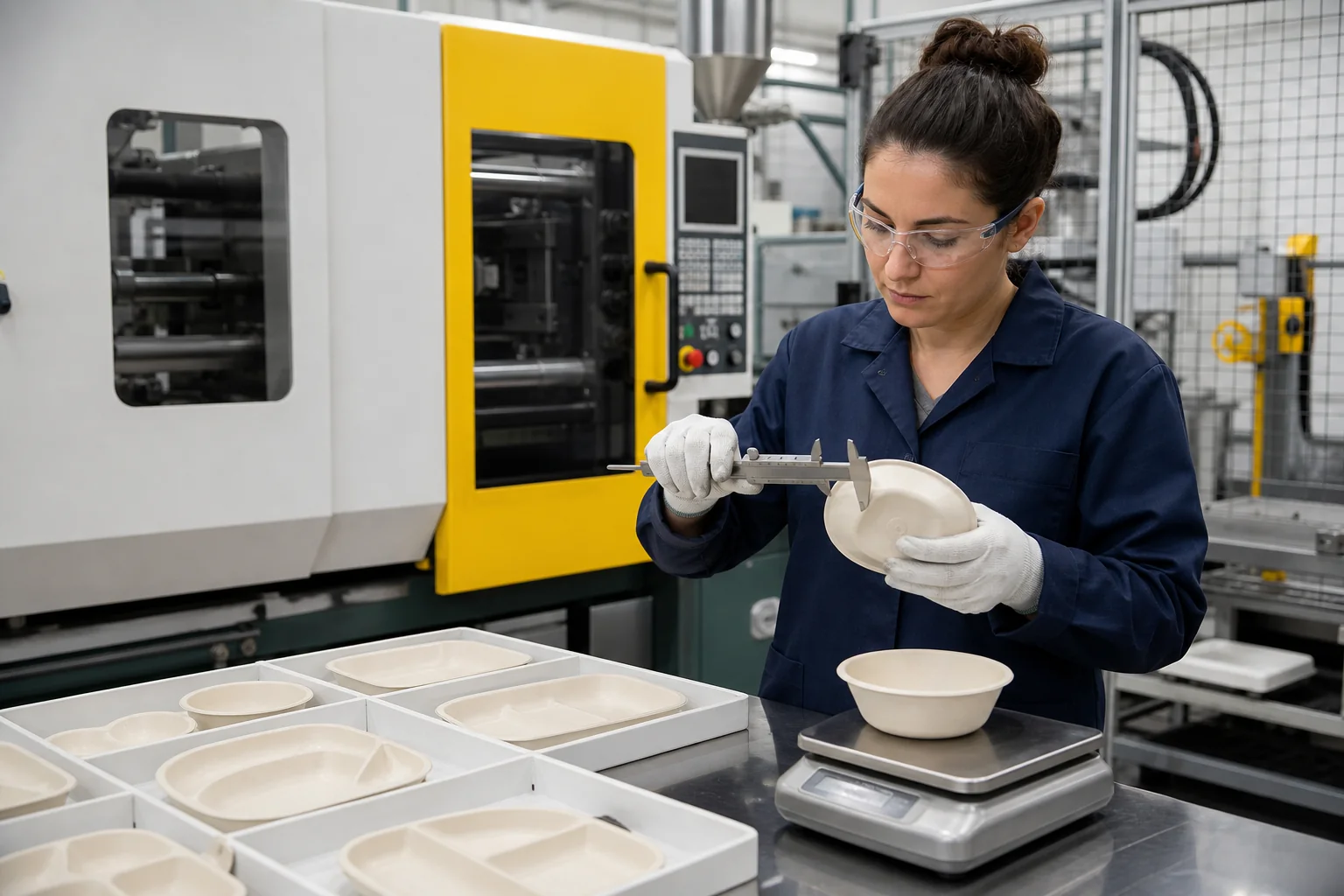
Hold the Process Window With In-Process Evidence
A good first-off result does not prove that every later hour will remain stable. Material replenishment, pigment mixing, temperature, pressure, cure or cooling time, tool condition, operator actions, decoration setup, assembly, and handling can shift during the run, so selected characteristics need checks at defined intervals and events.
Choose in-process frequency from risk and process behavior rather than using one universal clock. Critical dimensions may be checked by cavity at startup and after interruption, color may be compared when a pigment or material batch changes, and functional assembly may be challenged after tooling adjustment or component replenishment.
Trend information is more valuable than isolated pass marks. When measurements move steadily toward a limit, the team can intervene before nonconforming output appears; a record containing only “OK” hides the direction, magnitude, and repeatability of the process.
Reaction rules should state what happens after an out-of-limit or abnormal result. Define the last known good check, the product range to isolate, the investigation and correction, the resampling requirement, who can release contained output, and how the event changes the next check frequency.
Keep measurement methods fit for the decision
Use identified gauges, fixtures, scales, color references, functional setups, and work instructions that match the specified characteristic. A precise-looking number is weak evidence when the method, reference, environmental condition, or instrument status is unclear.
Operators and inspectors should interpret the same defect and acceptance rule consistently. Reference photos, boundary samples, defect libraries, and brief method training can reduce subjective disagreement without pretending that every visual judgment becomes purely numerical.
Release Each Shipment With Layered Evidence
Final inspection samples the completed lot and confirms that released goods match the current product and packaging baseline. It should cover identity, workmanship, critical dimensions, function, assortment, quantity, marking, retail packaging, carton details, and any order-specific checks defined before production.
Sampling does not replace process control or guarantee that every unit is conforming. It provides a stated decision rule for the lot, while material records, first-off approval, in-process data, test evidence, and deviation approvals explain how the lot was made and why its risk is acceptable.
The buyer and factory should agree defect classes, sample level, acceptance and rejection numbers, reinspection rules, and handling of critical findings before the shipment deadline. The tableware AQL inspection guide provides a practical framework for defining those decisions without treating AQL as a product specification.
Release status should remain visible until corrective actions, contained quantities, replacement work, document gaps, and buyer concessions are closed. Shipping against a verbal promise moves an unresolved factory risk into the buyer’s warehouse and customer channel.
Send a compact repeat-order evidence pack
For risk-appropriate projects, the pack can identify the order and lot, approved baseline, material or component lots, change review, first-off result, key process checks, final inspection, current test or compliance evidence, deviations, and shipment release. The food-contact tableware traceability guide shows why product, material, sample, report, and lot links must remain explicit.
Buyers can send the prior approval file for a repeat-order gap review before the next production window. The useful output is a short list of confirmed baselines, changed inputs, focused verification, open decisions, and release owners.

Compare Seven Control Layers Across a Repeat Order
Repeat-order consistency comes from several connected controls rather than one final inspection. Use this comparison to decide which record answers each buyer question, when it must be reviewed, and what can still go wrong if the layer is missing.
The layers reinforce one another but are not interchangeable. An approved sample cannot prove current material identity, and a final AQL pass cannot prove that an unrecorded process or specification change was authorized.
| Control layer | Primary reference | Current-order evidence | Risk if absent |
|---|---|---|---|
| Order and revision review | Purchase order, SKU, drawing, bill of materials, artwork, packing instruction | Reconciled order checklist with open gaps closed | The factory can make a familiar product to the wrong revision or configuration |
| Approved visual baseline | Identified master sample, color standard, boundary samples, defect library | Condition check and current-sample comparison | Appearance judgments depend on memory or personal preference |
| Change impact review | Last approved production record and permanent approval history | Change list, affected characteristics, verification and approval | A supplier, material, tool, process, or buyer change enters production silently |
| First-off approval | Critical dimensions, appearance, function, setup limits and cavity plan | Production-intent sample results linked to setup and input lots | Normal output builds before the current route is shown to be capable |
| In-process control | Check method, frequency, reaction rule and escalation owner | Measurements, trends, observations, containment and correction records | Drift grows between startup and final inspection |
| Final lot decision | Inspection plan, defect classes, sampling and release rules | Final inspection, packaging verification and disposition | Shipment status rests on an informal visual check or deadline pressure |
| Learning loop | Complaint, return, deviation and corrective-action history | Updated risk controls and next-order requirements | The same failure can repeat because the prior order taught the next order nothing |
Eight Checks Before Releasing a Repeat Purchase Order
Use this checklist before materials are purchased or production capacity is committed. Each answer should point to a controlled file, named owner, approved physical reference, or measurable rule rather than an email fragment or personal recollection.
A “no change” answer still needs a comparison basis. Ask who reviewed the current order against the last approved production record and when that review occurred.
| Check | Question | Why It Matters |
|---|---|---|
| Product baseline | Do the purchase order, SKU, drawing, materials, color, artwork, pack-out, and approved sample identify compatible revisions? | Conflicting references create preventable rework and approval disputes. |
| Prior exceptions | Were one-time concessions, temporary substitutes, repair instructions, or shipment-specific deviations excluded from the permanent baseline? | An exceptional last shipment should not silently become the new normal. |
| Input changes | Have material suppliers, grades, pigments, components, ink, adhesive, packaging, and subcontractors been compared with the last approved run? | Commercially invisible input changes can move appearance, function, evidence, and process behavior. |
| Tool and process status | Were mold maintenance, cavity condition, equipment, setup parameters, work instructions, and operator requirements reviewed? | The same drawing can produce different output when the manufacturing route changes. |
| First-off gate | Which current-production characteristics must pass before routine output continues, and who approves them? | Early detection limits the amount of product exposed to a setup error. |
| In-process plan | Are check frequency, measurement method, cavity or batch identity, reaction limits, and containment rules defined? | Periodic evidence detects drift and makes the response repeatable. |
| Final release | Are defect classes, sampling rules, functional tests, packaging checks, deviations, and shipment authority agreed? | A deadline should not substitute for a documented lot decision. |
| Feedback to next order | Will complaints, returns, inspection findings, concessions, and corrective actions revise the next risk review? | Repeatability improves only when prior evidence changes future controls. |
Use Official Sources as Control References, Not Brand Claims
Official sources help buyers understand why manufacturing controls, change review, testing, and measurement traceability matter. They do not prove that a named factory follows every requirement, certify a particular shipment, or define the complete acceptance plan for a custom tableware SKU.
Naike Group project files should state the actual buyer-approved requirements and evidence used for the order. Where a contract invokes a regulation, standard, retailer protocol, or test method, confirm its scope, edition, applicability, competence, and acceptance rule instead of relying on a logo or generic quality phrase.
The European Commission’s official food-contact materials overview identifies tableware and kitchenware as food-contact materials and points to the European Union framework and good manufacturing practice rules. This supports controlled manufacture and documentation when a product is placed on the applicable European Union market. It does not prove that a named SKU or factory complies, and it does not define the buyer’s dimensional, visual, functional, packaging, or sampling limits.
The United States Consumer Product Safety Commission’s official third-party testing guidance explains testing, certification, material-change, and periodic-testing responsibilities for products subject to applicable CPSC rules. This supports a change review when tableware is classified as a children’s product and a changed material, component, process, or source can affect compliance. It should not be applied to every general-use tableware order without confirming product classification and the specific rule.
The United States National Institute of Standards and Technology states in its official policy on metrological traceability that a measurement result needs a documented unbroken chain of calibrations to specified references, with each link contributing to measurement uncertainty. NIST also cautions that traceability alone does not guarantee fitness for purpose. For buyers, that means instrument status supports a result only when the characteristic, method, range, resolution, uncertainty, environment, and decision need are also appropriate.
Practical disclaimer: this article describes a buyer-facing quality-control framework, not a guarantee that every product, process, order, or market uses identical checks. Contract requirements, product risks, regulations, materials, tooling, inspection plans, and evidence needs must be confirmed for the named SKU. References to the European Commission, CPSC, or NIST explain concepts and do not state certification, accreditation, endorsement, or approval of Naike Group.
Choose Controls for the Actual Repeat-Order Scenario
For a stable SKU reordered soon after a conforming shipment, begin with baseline reconciliation, input-lot confirmation, routine first-off and in-process checks, and the agreed final inspection plan. Do not expand work merely to make the file look impressive, but confirm that no temporary concession or unrecorded change has slipped into the new order.
After a long production gap, reopen tooling condition, stored master references, material availability, supplier continuity, artwork revisions, equipment assignment, and employee instructions. A focused trial can be prudent because storage, maintenance, sourcing, and process memory may have changed even when the buyer specification did not.
For a visible private-label update, separate the changed color, logo, artwork, component, or packaging from unchanged product characteristics. Approve the new visual or dimensional branch, verify any affected function or evidence, and update the baseline without discarding valid controls for the unchanged construction.
After a complaint, return, failed inspection, or concession, treat the next order as a corrective-action verification opportunity. Confirm the cause, containment, permanent action, affected specifications or instructions, effectiveness evidence, and enhanced checks before returning to the normal control level.
Buyer FAQs About Repeat-Order Consistency
Does an approved golden sample guarantee every repeat order?
No. It provides an important appearance and construction reference, but current materials, tooling, process conditions, inspection evidence, and authorized changes still need control. A stored sample can also age or lose relevance if its identity and condition are not maintained.
Must a factory test every characteristic on every unit?
No. Control frequency should reflect characteristic risk, process capability, detection method, cavity or batch behavior, and the agreed sampling plan. Critical prevention, in-process monitoring, and final sampling play different roles.
What should buyers send with a repeat purchase order?
Send the controlled SKU and drawing revision, material and color references, artwork, pack-out, approved sample identity, quality plan, current market or claim changes, and any prior deviations or corrective actions. Mark what is permanent, what was order-specific, and what requires renewed approval.
When does a repeat order need a new sample approval?
A new approval is useful when a change can affect visible appearance, fit, function, construction, use, compliance evidence, packaging, or customer acceptance. The extent can be focused on affected characteristics rather than automatically repeating the whole development program.
Can final inspection alone control repeat-order quality?
No. Final inspection samples the finished lot and may detect defects, but it cannot efficiently prevent all drift or explain how current output relates to materials, setup, process changes, and prior approvals. Strong release evidence combines prevention, process records, inspection, and traceable decisions.
Naike Group Repeat Order Quality: Close the Learning Loop
Before scheduling a returning SKU, assemble one current baseline pack and one change list. Resolve revision conflicts, separate permanent approvals from past concessions, assign verification to meaningful changes, and define the first-off, in-process, final-inspection, and release records required for this order.
During production, use evidence to decide whether the process remains connected to that baseline. The goal of Naike Group repeat order quality is not to describe the new lot as “the same as last time,” but to show what stayed controlled, what changed, how the effect was checked, and who accepted the result.
After shipment, feed complaints, returns, deviations, inspection findings, and successful corrections into the next order review. That final step turns each purchase order into a stronger starting point for the next one instead of an isolated batch of records.
Contact the Factory for a Repeat-Order File Review
Share the previous purchase order, current revisions, approved sample identity, material and color references, inspection plan, complaint history, proposed changes, and delivery window. The Naike Group manufacturing team can help organize a buyer-reviewable baseline, change list, sample plan, and production evidence request for the next order.
Request a Custom Quote
Share your product, quantity, target market and customization needs. Our factory team will reply with the next practical step.
Continue Your Sourcing Research
The six newest factory-side articles are updated automatically by publication date.

Wheat Straw vs Bagasse Tableware: Buyer Comparison
A B2B decision guide comparing reusable wheat-straw polypropylene composite tableware with molded bagasse fiber formats across use, evidence, operations and end of life.

Can Wheat Straw Tableware Be Recycled? Buyer Q&A
A practical buyer answer on whether reusable wheat-straw composite tableware can enter PP recycling streams, which evidence matters, and how to qualify market claims.

Global SKU vs Regional SKU: Tableware Decision Guide
A buyer decision framework for choosing one global tableware SKU or controlled regional variants across compliance, packaging, logistics, inventory and change control.

Australia Food Packaging Evidence: Buyer Guide
A practical evidence guide for Australian food-packaging buyers covering intended use, migration risk, supplier assurance, testing, hygiene, release and change control.

EU PPWR Tableware Packaging vs Conventional Packs
A buyer comparison of PPWR-ready and conventional tableware packaging across product protection, material choices, empty space, evidence, labeling and release timing.

Prop 65 Tableware Requirements: Buyer Q&A
A practical buyer Q&A for defining California Proposition 65 exposure scenarios, evidence, warning decisions, supplier records and release controls for tableware.