Silicone color matching is often treated as a quick choice from a digital palette, yet the factory must convert that choice into a repeatable material recipe, molded surface and inspection decision. For B2B buyers, the commercial risk is not finding an attractive color once; it is keeping the approved color stable across product thicknesses, production lots, post-curing and replenishment orders.
Naike Group manufacturing team approaches custom color as a controlled development path that begins before pigment is weighed. The product geometry, silicone grade, surface finish, intended market and approval method should be defined alongside the wider Custom Solutions brief, because each variable changes how the final color is perceived and reproduced.
This guide explains how to move from a Pantone or brand reference to production evidence without promising an unrealistic visual match. Buyers can use the process with standard products from our custom tableware catalog or with new tooling managed through our custom mold development route.
Factory insider takeaway: Approve a color system, not a screen image. The system should identify the physical reference, material and pigment recipe, molded geometry, viewing conditions, instrument method, visual limits, signed sample and change-control rule.
Start Silicone Color Matching with a Measurable Brief
Begin by stating what the color must accomplish in the finished product. A muted retail palette, a high-chroma promotional color and a coordinated baby feeding set can require different pigment loading, approval tolerances and surface decisions even when the buyer provides a similar reference chip.
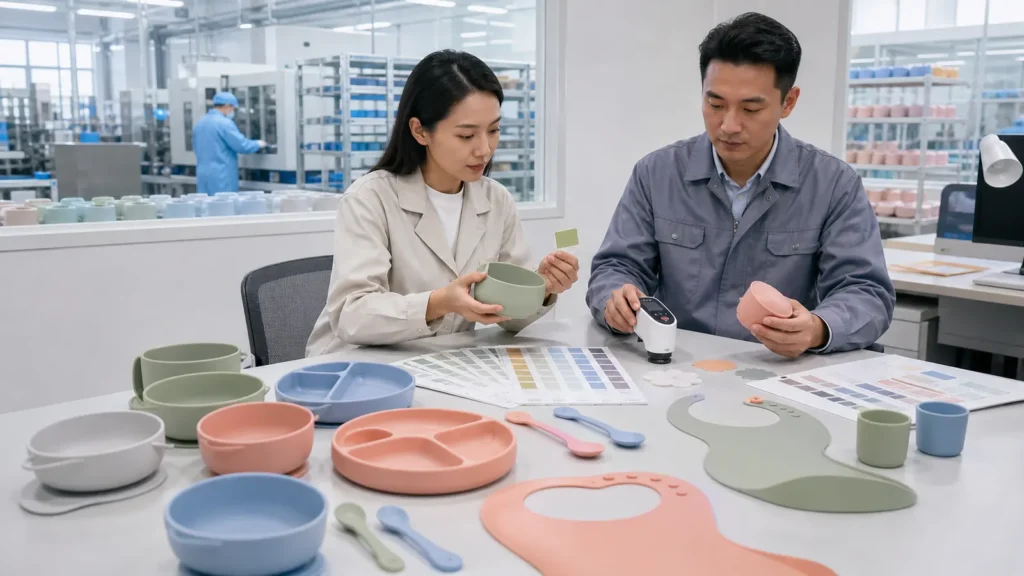
Record the reference system, code, edition, physical chip condition, target surface and viewing environment. A screenshot or web hex code can communicate direction, but monitor calibration, browser rendering and ambient light make it unsuitable as the only production master.
The brief should also identify every component that must coordinate rather than match exactly. Silicone, PP lids, printed logos, paper sleeves and coated cartons reflect light differently, so one numerical target cannot automatically make unlike materials look identical.
Why a physical Pantone reference is only the starting point
A physical guide gives the factory a stable visual anchor, but it does not define silicone translucency, gloss, thickness or texture. The approved result must therefore be demonstrated in the actual compound and a representative molded construction.
If the buyer supplies a branded object instead of a color chip, identify the exact area being referenced and whether age, coating or wear has altered it. The project file should preserve photos and a retained reference so later teams do not reinterpret the target.
Translate the Reference into Silicone Material and Surface Conditions
Silicone base color and transparency influence the pigment recipe before molding begins. A translucent compound can create depth and brightness, while an opaque system may require a different masterbatch and can expose dispersion marks more readily on broad surfaces.
Wall thickness changes the optical path through the material, which means a thin bib edge and a thick suction base may appear different even when molded from one batch. Buyers should decide whether the acceptance target applies to the main viewing area, the thickest section or the coordinated impression of the full product.
Texture and gloss also change perceived lightness and saturation. A polished mold surface reflects highlights, a matte texture scatters light and engraved zones introduce shadows, so the color trial should use production-intent surfaces rather than a generic flat plaque alone.
Coordinate custom silicone colors across a product family
For bowls, plates, cups, spoons and bibs in one set, select a primary approval component and compare the remaining geometries against it. The goal is a commercially coherent family under agreed viewing conditions, not a claim that every curved or textured area has the same optical reading.
Where silicone must coordinate with rigid plastics or packaging, approve cross-material harmony separately. The buyer can accept a deliberate tonal relationship while still controlling obvious clashes and unapproved lot-to-lot drift.
Build a Controlled Pigment Recipe through Molded Trials
The factory should select colorants compatible with the specified silicone system and intended food-contact market, then document supplier, product code, lot and use level. Regulatory suitability must be assessed for the finished application rather than inferred from a generic phrase such as food grade pigment.
A practical trial ladder begins with calculated pilot recipes and narrows the options through molded samples. Each revision should change a recorded variable, because undocumented visual adjustments create a sample that cannot be reproduced reliably after approval.
Mixing sequence, weighing resolution, batch size and dispersion time affect uniformity. Small laboratory trials can exaggerate or hide production effects, so the final approval sample should be made with a process that represents the intended bulk route.
Separate pigment correction from process correction
When a trial looks too dark or too yellow, first confirm material lot, sample thickness, cure state and viewing condition before changing pigment. Correcting a process variation with a new recipe can produce the opposite error when normal production conditions return.
Use dated trial labels and retain rejected references long enough to understand the decision path. This reduces the chance that an earlier recipe is accidentally released after the buyer has approved a later revision.
Account for Molding, Curing and Post-Curing Color Shift
Temperature, cure time and compound history can alter visual appearance or expose dispersion differences. Color approval should therefore occur after the sample has completed the same defined curing and conditioning steps expected for commercial production.
Post-curing may be specified for odor, volatile or customer-control reasons, but it can also influence shade and surface condition. The trial report should state whether post-curing was used, along with the time, temperature, loading arrangement and evaluation delay.
Hot samples and recently conditioned samples may not represent their stable appearance. Establish a consistent cooling and rest period before visual or instrumental review so production inspectors compare like with like.
Protect the approved shade when the process window changes
Tool revision, cavity balance, molding pressure and surface repair can change how a part reflects light even when the recipe remains constant. Engineering changes should trigger a defined color-impact review rather than relying on the original approval indefinitely.
For new structures, link the color gate to the sample stages described in our silicone molding guide. This keeps geometry approval, process approval and appearance approval inside one controlled release path.
Combine Visual Judgment with Instrument Color Measurement
Visual review remains important because buyers purchase a product appearance, not a single instrument value. Reviewers should use consistent lighting, neutral surroundings, normal color vision and a defined viewing angle while avoiding simultaneous comparison of too many similar shades.
Instrument measurement can quantify difference in a color space such as CIELAB, but the buyer and factory must define instrument geometry, illuminant, observer, aperture, measurement locations and averaging method. A Delta E limit without those settings is incomplete and may not be comparable between devices.
Curved, soft and textured silicone can be difficult to position repeatably. Create a fixture or choose stable measurement zones, then verify that the method correlates with the visual areas that matter to the customer.
Set a silicone color tolerance that reflects commercial risk
A very tight numerical tolerance can increase trial cycles, scrap and cost without improving the shelf appearance. A loose tolerance can permit visible lot variation, so the final limit should reflect color family, product geometry, brand sensitivity, instrument repeatability and customer expectation.
Use both an approved standard and boundary thinking. The project team should know which visual deviations are unacceptable even when an average reading appears within the agreed number.
Release Silicone Color Matching into Production and Repeat Orders
Mass production should begin from a signed or electronically controlled approval that identifies sample version, recipe revision, material, process and acceptance method. A photograph can support the record, but it should not replace the retained physical sample and measurement data.
First-piece inspection should compare each active cavity and the main viewing zones before the lot grows. In-process checks then monitor recipe identity, mixing records, appearance and measurement trends so drift is detected before packing.
For repeat orders, review material and pigment lot changes, storage life, supplier notifications and process maintenance. A repeat purchase order should reference the same controlled color file or formally approve an updated standard rather than depending on a color name alone.
Use change control to preserve custom silicone colors
Changes to compound grade, pigment source, dosing method, tool finish, cure settings or approved component geometry can affect appearance. Require impact review and a defined reapproval level before any changed construction enters shipment.
Naike Group links color evidence with material, molding and inspection records visible in our Factory Capability workflow. This traceability helps buyers maintain a coordinated range after the original development team has moved to other projects.
Silicone Color Reference and Approval Methods Compared
The methods solve different parts of the decision, so a reliable program normally combines direction, physical approval and production measurement. Select the combination that the factory and buyer can repeat during every order. Record the selected comparison assumptions in the silicone color matching project brief before quotation.
| Method | Best Use | Strength | Limitation | Control Record |
|---|---|---|---|---|
| Screen image or hex code | Early creative direction | Fast for remote discussion | Device and lighting variation | Reference only, never final approval |
| Physical Pantone guide | Stable target communication | Recognized visual reference | Not molded silicone | Code, edition, chip condition and date |
| Molded color plaque | Recipe screening | Shows compound response | May not represent product geometry | Recipe, thickness, surface and cure state |
| Production-intent product sample | Final visual approval | Represents geometry and finish | Requires controlled sample identity | Signed sample, version and retained unit |
| Spectrophotometer reading | Quantifying lot difference | Objective and trendable | Method-sensitive on soft curved parts | Device, settings, location and Delta E result |
B2B Buyer Checklist for Silicone Color Matching
Complete the checklist before approving the final shade or placing a production order. The answers should identify the record that will control sampling, bulk manufacture and repeat orders. Record every answer against the current silicone color matching project assumptions and approval owner.
| Check | Question | Why It Matters |
|---|---|---|
| Target reference | Which physical color reference, edition and exact chip control the project? | A named physical reference prevents screen rendering from becoming the production master. |
| Silicone system | Which compound grade, opacity and food-contact basis are included? | Base material changes light transmission, pigment response and compliance evidence. |
| Product geometry | Which component, thickness and viewing zone define acceptance? | Soft parts can appear different across thin edges, thick bases and curved walls. |
| Surface finish | Are matte, polished and textured areas evaluated separately? | Gloss and texture alter perceived lightness and instrument repeatability. |
| Pigment record | Are colorant supplier, code, lot, recipe and weighing method traceable? | A visually approved sample has little value when its recipe cannot be reproduced. |
| Process state | Was the sample molded, cured, post-cured and conditioned by the production route? | Color can shift when heat history or evaluation timing changes. |
| Visual method | Which lighting, background, angle and reviewers control visual approval? | Consistent viewing conditions reduce avoidable buyer-factory disagreement. |
| Instrument method | Which device settings, aperture, locations and Delta E formula apply? | A tolerance number is not transferable when measurement methods differ. |
| Boundary decision | What visible deviations remain unacceptable inside the numerical tolerance? | Averages can hide streaks, cavity differences or localized mismatch. |
| Change control | Which material, pigment, tool or process changes trigger reapproval? | Repeat-order consistency depends on reviewing changes before shipment. |
Factory Control Notes for silicone color matching
The following factory controls turn the checklist into a dated approval trail. Purchasing, design, engineering, production and quality should be able to identify the same current reference. Each silicone color matching decision should identify its owner, evidence and release condition.
1. Target reference control for silicone color matching
For silicone color matching, the target reference checkpoint must become a dated project record rather than an informal chat instruction. The resulting target reference record must name its owner, source evidence, revision authority and the commercial consequence of a late change after the buyer asks, “Which physical color reference, edition and exact chip control the project?”
A named physical reference prevents screen rendering from becoming the production master. For the target reference decision in this silicone color matching project, our factory links the checkpoint to the quotation, approved sample, purchase order or inspection standard that governs the next approval. If the silicone color matching evidence is incomplete, the team holds that approval gate, closes the information gap and records the revised assumption before production continues.
2. Silicone system control for silicone color matching
For silicone color matching, the silicone system checkpoint must become a dated project record rather than an informal chat instruction. The resulting silicone system record must name its owner, source evidence, revision authority and the commercial consequence of a late change after the buyer asks, “Which compound grade, opacity and food-contact basis are included?”
Base material changes light transmission, pigment response and compliance evidence. For the silicone system decision in this silicone color matching project, our factory links the checkpoint to the quotation, approved sample, purchase order or inspection standard that governs the next approval. If the silicone color matching evidence is incomplete, the team holds that approval gate, closes the information gap and records the revised assumption before production continues.
3. Product geometry control for silicone color matching
For silicone color matching, the product geometry checkpoint must become a dated project record rather than an informal chat instruction. The resulting product geometry record must name its owner, source evidence, revision authority and the commercial consequence of a late change after the buyer asks, “Which component, thickness and viewing zone define acceptance?”
Soft parts can appear different across thin edges, thick bases and curved walls. For the product geometry decision in this silicone color matching project, our factory links the checkpoint to the quotation, approved sample, purchase order or inspection standard that governs the next approval. If the silicone color matching evidence is incomplete, the team holds that approval gate, closes the information gap and records the revised assumption before production continues.
4. Surface finish control for silicone color matching
For silicone color matching, the surface finish checkpoint must become a dated project record rather than an informal chat instruction. The resulting surface finish record must name its owner, source evidence, revision authority and the commercial consequence of a late change after the buyer asks, “Are matte, polished and textured areas evaluated separately?”
Gloss and texture alter perceived lightness and instrument repeatability. For the surface finish decision in this silicone color matching project, our factory links the checkpoint to the quotation, approved sample, purchase order or inspection standard that governs the next approval. If the silicone color matching evidence is incomplete, the team holds that approval gate, closes the information gap and records the revised assumption before production continues.
5. Pigment record control for silicone color matching
For silicone color matching, the pigment record checkpoint must become a dated project record rather than an informal chat instruction. The resulting pigment record record must name its owner, source evidence, revision authority and the commercial consequence of a late change after the buyer asks, “Are colorant supplier, code, lot, recipe and weighing method traceable?”
A visually approved sample has little value when its recipe cannot be reproduced. For the pigment record decision in this silicone color matching project, our factory links the checkpoint to the quotation, approved sample, purchase order or inspection standard that governs the next approval. If the silicone color matching evidence is incomplete, the team holds that approval gate, closes the information gap and records the revised assumption before production continues.
6. Process state control for silicone color matching
For silicone color matching, the process state checkpoint must become a dated project record rather than an informal chat instruction. The resulting process state record must name its owner, source evidence, revision authority and the commercial consequence of a late change after the buyer asks, “Was the sample molded, cured, post-cured and conditioned by the production route?”
Color can shift when heat history or evaluation timing changes. For the process state decision in this silicone color matching project, our factory links the checkpoint to the quotation, approved sample, purchase order or inspection standard that governs the next approval. If the silicone color matching evidence is incomplete, the team holds that approval gate, closes the information gap and records the revised assumption before production continues.
7. Visual method control for silicone color matching
For silicone color matching, the visual method checkpoint must become a dated project record rather than an informal chat instruction. The resulting visual method record must name its owner, source evidence, revision authority and the commercial consequence of a late change after the buyer asks, “Which lighting, background, angle and reviewers control visual approval?”
Consistent viewing conditions reduce avoidable buyer-factory disagreement. For the visual method decision in this silicone color matching project, our factory links the checkpoint to the quotation, approved sample, purchase order or inspection standard that governs the next approval. If the silicone color matching evidence is incomplete, the team holds that approval gate, closes the information gap and records the revised assumption before production continues.
8. Instrument method control for silicone color matching
For silicone color matching, the instrument method checkpoint must become a dated project record rather than an informal chat instruction. The resulting instrument method record must name its owner, source evidence, revision authority and the commercial consequence of a late change after the buyer asks, “Which device settings, aperture, locations and Delta E formula apply?”
A tolerance number is not transferable when measurement methods differ. For the instrument method decision in this silicone color matching project, our factory links the checkpoint to the quotation, approved sample, purchase order or inspection standard that governs the next approval. If the silicone color matching evidence is incomplete, the team holds that approval gate, closes the information gap and records the revised assumption before production continues.
9. Boundary decision control for silicone color matching
For silicone color matching, the boundary decision checkpoint must become a dated project record rather than an informal chat instruction. The resulting boundary decision record must name its owner, source evidence, revision authority and the commercial consequence of a late change after the buyer asks, “What visible deviations remain unacceptable inside the numerical tolerance?”
Averages can hide streaks, cavity differences or localized mismatch. For the boundary decision decision in this silicone color matching project, our factory links the checkpoint to the quotation, approved sample, purchase order or inspection standard that governs the next approval. If the silicone color matching evidence is incomplete, the team holds that approval gate, closes the information gap and records the revised assumption before production continues.
10. Change control control for silicone color matching
For silicone color matching, the change control checkpoint must become a dated project record rather than an informal chat instruction. The resulting change control record must name its owner, source evidence, revision authority and the commercial consequence of a late change after the buyer asks, “Which material, pigment, tool or process changes trigger reapproval?”
Repeat-order consistency depends on reviewing changes before shipment. For the change control decision in this silicone color matching project, our factory links the checkpoint to the quotation, approved sample, purchase order or inspection standard that governs the next approval. If the silicone color matching evidence is incomplete, the team holds that approval gate, closes the information gap and records the revised assumption before production continues.
Authoritative References and Practical Limits
ISO/CIE 11664-4 defines the CIE 1976 L*a*b* colour space and methods for calculating colour differences. Review the official ISO/CIE 11664-4 overview when specifying an instrument-based comparison method. Buyers should confirm how this reference applies to the named product, target market and current silicone color matching project.
The U.S. FDA explains that a colorant used in a food-contact polymer is regulated according to its intended food-contact use rather than as a color added directly to food. See the official FDA colorant and color additive explanation. Buyers should confirm how this reference applies to the named product, target market and current silicone color matching project.
Commission Regulation (EU) No 10/2011 addresses plastic materials and articles intended to contact food, including composition and migration requirements. Use the current EUR-Lex regulation record as a starting point for EU-market review. Buyers should confirm how this reference applies to the named product, target market and current silicone color matching project.
These references describe colorimetry and regulatory frameworks; they do not approve a specific pigment, silicone compound or finished article. The importer should confirm the intended use, current legal requirements and laboratory plan with qualified compliance professionals.
Silicone Color Matching Buyer FAQ
Can a factory match a silicone product from a hex code?
A hex code can communicate creative direction, but it is not a reliable final production standard because screens and viewing conditions differ. Use a physical reference and approve a molded production-intent sample.
Does the same pigment recipe look identical in every silicone part?
Not necessarily. Thickness, translucency, texture, gloss, curvature and cure history can change perceived color, so a coordinated set needs geometry-specific review.
What is an acceptable Delta E for custom silicone colors?
There is no universal value for every product. The buyer and factory should validate a tolerance against color family, geometry, instrument repeatability and visible commercial boundaries.
Why can a repeat order differ from the approved sample?
Material or pigment lot changes, weighing variation, tool finish, cure settings and measurement conditions can contribute. Controlled recipes, retained standards and change review reduce that risk.
Should color be approved before or after post-curing?
Approve the stable product after all production-intent curing, post-curing and conditioning steps are complete. The approved state must match the condition used for shipment inspection.
Conclusion: Control Silicone Color Matching as a Production System
Reliable silicone color matching connects a physical target with material identity, a reproducible pigment recipe, production-intent molding and a repeatable acceptance method. That chain is more useful to a B2B buyer than an unsupported promise of a perfect screen-to-product match.
Naike Group manufacturing team recommends defining geometry, surface, cure state, visual conditions and instrument settings before final approval. The resulting file can then govern first pieces, in-process checks, shipment inspection and replenishment orders.
To begin, send the product reference, target color system, quantity, intended market and packaging direction through Contact Us. Our factory will identify the sample route and evidence needed before quotation or production release.
Start a Controlled Custom Silicone Color Project
Share your Pantone reference, product geometry, target market, quantity and launch timing for a factory-side color feasibility review. Our manufacturing team will use those details to define the next review step for your silicone color matching project.