
Silicone Baby Tableware Buyer Checklist: The Complete 2026 Procurement Guide
There is a particular moment in every baby product buyer’s sourcing journey when the excitement of finding a beautiful silicone feeding set online gives way to a quieter, more uncomfortable question: what happens if this product fails a safety test after I have already placed a five-thousand-unit order?
The silicone feeding sets market reached 1.8 billion in 2025 and istracking to ward 3.4 billion by 2034, growing at a 7.3 percent compound annual rate according to DataIntelo’s latest research. Demand is not the problem. The problem is that the market’s growth has attracted a wave of factories that understand cost per unit but do not understand what it means when a six-month-old puts their product in their mouth three times a day for two years.
This checklist is built from the questions that actually matter — the ones that separate a safe, sellable product line from a compliance nightmare.
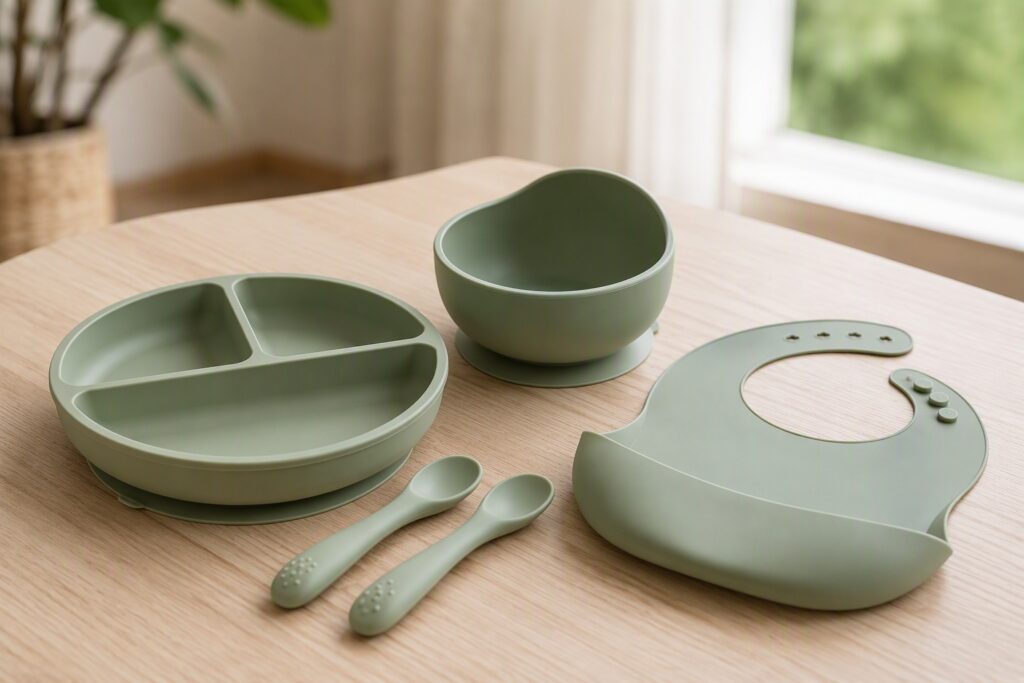
The Material Grade That Determines Everything
Not all silicone is food-grade, and not all food-grade silicone is safe for babies. The distinction matters more than most suppliers are willing to admit.
Platinum-Cured vs Peroxide-Cured: The Chemistry That Separates Safe from Suspect
Silicone rubber is made by cross-linking siloxane polymers through a curing reaction. Two catalyst systems achieve this: platinum catalysts and peroxide catalysts. The end product looks identical to the naked eye. It is not identical.
Platinum-cured silicone uses a platinum complex as the curing catalyst. The reaction produces virtually no chemical byproducts — the platinum drives cross-linking without leaving residues in the finished material. This is why platinum-cured silicone is the universal standard for medical implants, infant feeding products, and any application where chemical purity is non-negotiable.
Peroxide-cured silicone uses organic peroxides as the curing agent. The reaction leaves trace decomposition products — primarily low-molecular-weight siloxane oligomers and residual peroxide fragments — embedded in the polymer matrix. A post-curing oven cycle at 200 degrees Celsius for four to six hours can drive off most of these volatiles, but not all factories run adequate post-curing. The ones that cut corners produce silicone that looks fine, feels fine, and costs less per kilogram — and then fails volatile organic compound testing when it reaches a European testing laboratory.
How to Verify What Your Supplier Is Actually Using
Ask for the silicone compound certificate of analysis. A legitimate COA lists the manufacturer — Dow SILASTIC, Wacker ELASTOSIL, Shin-Etsu, or a reputable domestic compounder — along with the specific grade designation, curing method, and filler content. Food-grade platinum-cured silicone should have filler content below two percent by weight.
Then do the twist test. Take a sample plate, grip a section between your fingers, and twist it until the material goes white under tension. Release it. Pure platinum-cured silicone snaps back to its original color within one second. Silicone loaded with cheap fillers stays white for three seconds or longer, or never fully recovers. This is not a laboratory test, but it catches the most common form of silicone adulteration — cutting the expensive polymer with cheap calcium carbonate or fumed silica fillers — in under ten seconds.
For a deeper understanding of how we control raw material quality from incoming inspection through finished product testing, our manufacturing standards overview explains the full chain of custody.
Safety Certifications: Your Non-Negotiable Market Passport
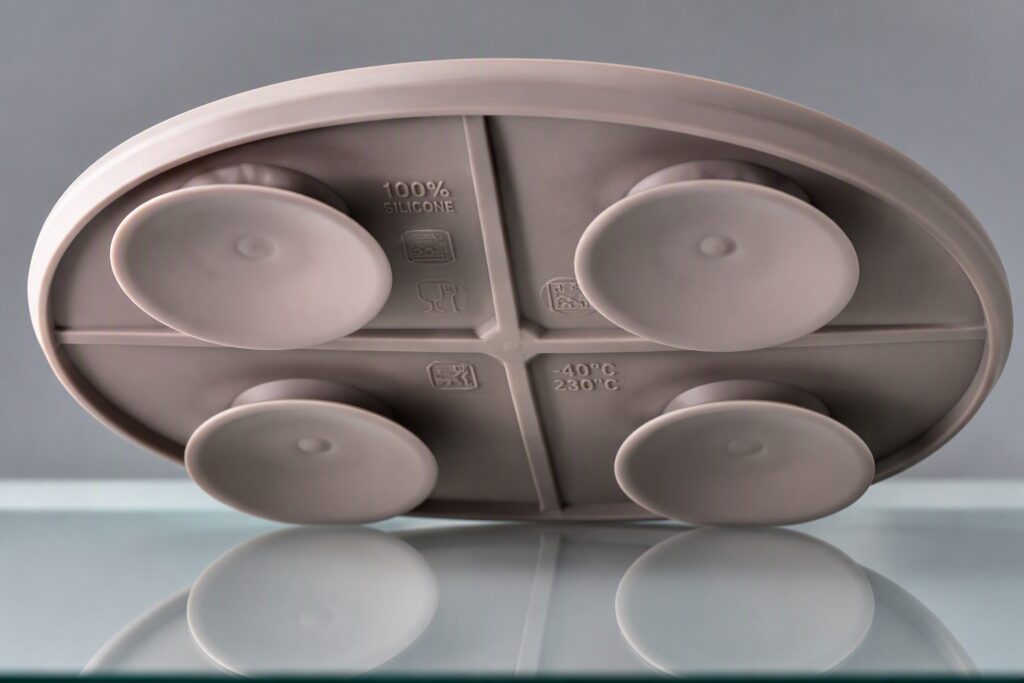
Baby products face the strictest regulatory scrutiny of any consumer goods category. For silicone feeding products, three certification frameworks dominate, and each tests different things to different standards.
LFGB: The European Gold Standard
LFGB — Germany’s Food and Feed Code — is the most demanding food-contact material standard in commercial use. It tests for overall migration (substances that leach from the product into food simulants), specific migration of restricted substances, and — critically — volatile organic compounds and sensory transfer. The sensory panel actually smells and tastes water that has been in contact with the product to determine whether the silicone imparts any detectable odor or flavor.
The VOC limit under LFGB is 0.5 percent by weight. This threshold is what separates platinum-cured silicone from inadequately post-cured peroxide silicone. A product can look flawless, pass a visual inspection, and still fail LFGB because the gas chromatograph found 0.7 percent residual volatiles that a human nose cannot detect.
FDA 21 CFR 177.2600: The US Baseline
The FDA standard tests for extractables in distilled water and n-hexane, with a limit of five milligrams per square inch for fatty food simulant. It does not test for VOCs. It does not include a sensory panel. An FDA-compliant silicone product can still fail LFGB — not because the FDA standard is less rigorous in what it tests, but because it simply does not test for the same things.
For the US market, FDA compliance is the legal minimum, and it represents a meaningful safety assurance. Just understand that it is a narrower assurance than what European buyers and regulatory bodies expect.
CPSIA and ASTM F963: Children’s Product Requirements
In the United States, silicone baby feeding products also fall under the Consumer Product Safety Improvement Act because they are classified as children’s products. This triggers additional testing requirements beyond food-contact standards: total lead content in substrate (100 parts per million limit), lead in surface coatings (90 parts per million), and phthalate content for eight regulated compounds, each limited to 0.1 percent by weight.
The CPSC’s enforcement guidance on children’s products outlines the testing and certification obligations. For suction plates specifically, ASTM F963-17 Section 8.9 covers tension testing — relevant because a suction cup that detaches from the plate body becomes a small part and a potential choking hazard.
An excellent comparison of LFGB and FDA testing as applied to silicone baby bowls is available from Malacasa’s safety standards explainer, which breaks down what each certification actually measures.
Certificate Verification Protocol
Three checks on every test report before you accept it:
First, the laboratory. The report must come from an ISO/IEC 17025-accredited lab. SGS, Intertek, TÜV Rheinland, and Bureau Veritas are the recognized names. A report from an unrecognized lab with no accreditation number is not a document — it is a decoration.
Second, the date. Certificates older than twelve months are expired for procurement purposes. Raw material batches change. Production parameters drift. A certificate from 2024 tells you what a different batch of silicone did two years ago.
Third, the product match. The certificate must list the exact product name, material specification, and color. A migration test report for “silicone kitchen spatula” does not cover your “silicone baby suction plate.” If the certificate does not match the product, it does not count.
Our compliance documentation page details how we maintain batch-level traceability from raw material COA to finished product test report.
Design Specifications That Separate a Best-Seller from a Return
Safety gets your product onto the shelf. Design keeps it there. For silicone baby tableware, four design decisions determine whether your product generates repeat purchases or one-star reviews.
Suction Base: The Feature Parents Actually Buy
The primary value proposition of a silicone baby plate is that it stays where a child puts it. If the suction base fails, the product fails. Parents do not evaluate suction performance on a specification sheet — they evaluate it at 6:30 in the morning, with a toddler, a bowl of oatmeal, and approximately four minutes of patience.
A well-engineered suction base has four individual suction cups, each with a minimum diameter of thirty-five millimeters. A single large suction ring is cheaper to mold but distributes holding force unevenly — one edge lifts, air enters, and the whole plate releases. Four independent cups mean that even if one cup gets compromised by a crumb or an uneven surface, the other three maintain grip.
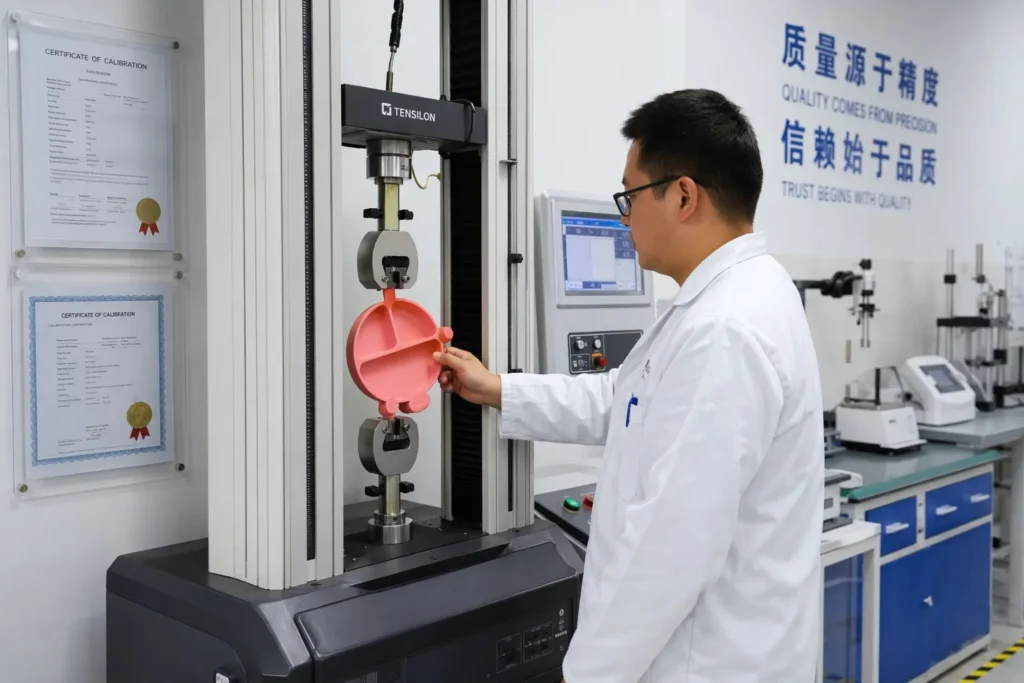
The pull-force requirement: a properly designed suction plate should hold at least three kilograms of lateral force before release on a clean glass surface. On textured surfaces — wood high-chair trays, laminate tabletops — expect roughly half that. A supplier who cannot provide pull-force test data has almost certainly never measured it, which means they have not engineered the suction base — they copied a mold from a competitor and hoped for the best.
The release tab matters too. Each suction cup needs a small pull tab, integrated into the cup silicone rather than glued on, large enough for an adult fingernail but positioned and sized so that a curious eighteen-month-old cannot figure it out. This sounds like a small detail. Spend ten minutes on Amazon reviews for silicone baby plates and you will discover it is not.
Divided vs Undivided: The Plate Geometry That Reflects How People Feed Their Children
The three-section divided plate has become the dominant format, and the reason is behavioral, not aesthetic. Baby-led weaning — the feeding philosophy where infants self-feed whole foods rather than being spoon-fed purees — has gone from a niche parenting approach to a mainstream practice across North America, Europe, and Australia. In baby-led weaning, foods are presented separately: protein in one compartment, vegetable in another, fruit or carbohydrate in the third. The divided plate serves this need. An undivided plate does not.
The compartment walls should be high enough to prevent food mixing — twenty-five to thirty-five millimeters for the outer wall, twenty to twenty-five millimeters for internal dividers. Lower than that, and a scoop of yogurt spreads across the plate like a slow-motion disaster.
Single-section suction bowls fill a different need. For the six-to-twelve-month age range, when most meals are still semi-solid or puree-based, a bowl with a three-hundred to four-hundred-milliliter capacity and a steep wall angle for spoon access outsells divided plates. A complete product line offers both formats.
Edge Design: The Detail Nobody Thinks About Until a Review Mentions It
The outer rim of a silicone baby plate should be curved, not sharp-cut. A mold that produces a clean ninety-degree edge is easier to fabricate, but it leaves a rim that can press into a baby’s chin and leave a red mark during self-feeding. Rounded, rolled edges cost slightly more in mold fabrication — the cavity needs a radius rather than a sharp corner — but they eliminate the single most common comfort complaint in user reviews.
Color Palette: The Market Has Moved Past Primary Colors
The color language of premium baby products has shifted decisively toward muted, desaturated tones. Sage green, warm sand, dusty rose, soft terracotta, oatmeal, and pale charcoal. Gender-neutral earth tones that photograph well, coordinate with modern kitchen interiors, and — this is not trivial — do not show tomato sauce stains the way bright white does.
The shift away from baby blue and bubblegum pink is not a trend to follow or ignore. It is a structural market change. If your product line uses the primary color palette that dominated the category five years ago, you are signaling to consumers that your brand has not updated its understanding of what modern parents want.
OEM Customization: Building a Brand, Not Just a Product
Sourcing an off-the-shelf silicone feeding set is a reasonable first step. Building a branded product line is where margins expand from fifteen percent to fifty percent and where repeat buyers stop comparing your listing to the identical one three rows down.
Logo and Brand Integration
Embossing is the strongest long-term option for silicone baby products. The logo is molded directly into the product body — no ink to wear off, no adhesive to fail, no concern about whether the branding material meets food-contact standards. The mold cost absorbs the logo fabrication as part of the cavity machining, so the per-unit cost is zero after mold payment. Laser engraving works well for smaller runs and sample batches, producing a permanent mark without mold modification. The per-unit cost is negligible, and there is no minimum order impact.
Pad printing should be avoided for baby feeding products. The ink layer degrades through repeated high-temperature dishwasher cycles, and parents interpret ink flaking off a baby plate as a safety concern — which, from their perspective, it is. The ink itself may be food-safe, but a consumer cannot verify that, and the visual of ink separating from the product is enough to generate a return regardless of the chemistry.
Custom Color Matching
Silicone accepts pigment with excellent color fidelity. Pantone matching is standard across the industry. Most factories charge a one-time color-matching fee of two hundred to four hundred dollars per custom color, with a minimum order of three thousand to five thousand pieces per color SKU. The process involves formulating a masterbatch — a concentrated pigment-silicone compound — that is metered into the base silicone at the molding press. Delta-E values of two or below are standard for solid silicone colors.
Packaging That Works for Retail and Amazon FBA
Three packaging tiers serve three distribution channels:
A kraft paper belly band with minimal printing arrives at six to ten cents per unit and works for Amazon FBA, where the product is the hero and the packaging is primarily protective. A full-color cardboard box with a die-cut window runs twenty-five to fifty cents per unit and positions the product for boutique retail and specialty baby stores where shelf presence drives purchase decisions. A gift-set box with a foam insert at forty to eighty cents per unit targets the baby shower and registry market — high perceived value, high margin, highly seasonal demand pattern peaking in the second and third quarters.
Visit our custom manufacturing capabilities page for detailed specifications on mold production, color development, and packaging design workflows.
The Twenty-Point Pre-Order Checklist
Print this. Send it to your supplier. The answers you get back will tell you more about whether they are a real manufacturer than any sales conversation ever will.
| # | Checklist Item | Response |
|---|---|---|
| 1 | Silicone type and curing method (must be platinum-cured) | |
| 2 | Raw material COA: manufacturer, grade, filler content (target: less than 2 percent) | |
| 3 | Twist test result on pre-production sample (pass/fail) | |
| 4 | FDA 21 CFR 177.2600 migration test — lab name, date (within 12 months), product match | |
| 5 | LFGB overall migration and VOC test — lab name, date, product match | |
| 6 | CPSIA lead in substrate (less than 100 ppm) and phthalate content test report | |
| 7 | ASTM F963-17 Section 8.9 tension test for suction cup attachment | |
| 8 | EN 14372 phthalate migration test (required for EU distribution) | |
| 9 | Suction cup count and diameter per cup (minimum 3 cups, 35mm each) | |
| 10 | Suction pull-force data on glass and textured surfaces (minimum 3 kg lateral on glass) | |
| 11 | Release tab design: integrated into cup silicone, not glued | |
| 12 | Plate outer wall height (25-35 mm); bowl depth (45-55 mm) | |
| 13 | Edge finishing: rounded or rolled, not sharp-cut | |
| 14 | Custom color: Pantone code, color-matching fee, MOQ per color | |
| 15 | Branding method and per-unit cost (emboss or laser recommended) | |
| 16 | Packaging type and per-unit cost (belly band / window box / gift set) | |
| 17 | Mold: cavity count, steel type, lead time, ownership after payment | |
| 18 | FOB pricing at 1,000 / 5,000 / 10,000 piece volumes | |
| 19 | Post-curing protocol: oven temperature, duration, capacity | |
| 20 | Payment terms and production lead time |
Why This Checklist Matters
The silicone baby feeding category is not particularly difficult to enter. It is, however, particularly expensive to get wrong. A failed safety test does not just cost you a shipment. It costs you the relationship with the retail buyer who trusted you to deliver compliant product. In markets like Germany and Australia, where regulatory enforcement is aggressive and consumer expectations are high, it can cost you the entire market.
When you get it right — platinum-cured silicone, verified certifications, smart design choices, consistent branding — the category delivers exactly what every importer wants. Strong margins. High repeat purchase rates. Brand loyalty that starts with a six-month-old and follows them through cups, utensils, lunch boxes, and every other feeding product they will need for the next five years.
If you are evaluating suppliers or preparing to launch a silicone baby feeding line, we can walk you through material samples, certification documentation, and a detailed FOB quotation specific to your product configuration. Reach out through naikegroup.com.
CONTACT US

How to Verify Wheat Straw Fiber Content Claims
A factory-side evidence guide for buyers assessing wheat straw percentage claims, mass-balance records, laboratory methods and change control.
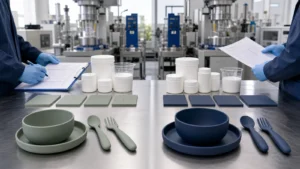
Platinum Cured vs Peroxide Cured Silicone: Buyer Comparison
A decision-focused comparison of platinum-addition and peroxide cure systems for custom silicone tableware, including process, evidence and sourcing tradeoffs.
Is Silicone Tableware Microwave Safe and Dishwasher Safe?
A buyer-focused answer on when silicone tableware can be used in microwaves and dishwashers, what evidence matters, and how to validate a custom product.

Custom Tableware Sample Approval: Golden Sample Guide
A stage-gate factory guide to drawings, prototypes, tooling trials, packaging samples, golden samples and production release for custom tableware.

Tableware AQL Inspection: Buyer Guide
A factory-side guide to defect classification, sampling levels, acceptance limits and evidence for silicone and wheat-straw tableware shipments.

Food Contact Tableware Traceability: Buyer Guide
A factory-insider guide to material identity, declarations, test reports, batch records, change control and shipment traceability for B2B tableware buyers.