Wheat Straw Cutlery Buying Guide: Sizes, Finishes, and Bulk Pricing Tiers
If you are sourcing reusable cutlery for an import business, a corporate gifting program, or a retail chain, wheat straw cutlery sets are probably already on your shortlist. They are lightweight, BPA-free, and carry a plant-based story that sells well in the US, EU, and Australia.
But here is the problem most buyers run into: every supplier offers a slightly different set, a different finish, and a different price that is hard to compare.
The global biodegradable cutlery market is projected to grow from 45.5millionin2026to45.5millionin2026to82.8 million by 2034, according to Fortune Business Insights, with Grand View Research tracking a similar 8.3 percent CAGR trajectory through 2033. The category is growing fast, and the buying decisions you make now will shape your product line for years.
This guide breaks down the wheat straw cutlery category into the decisions that actually matter: configurations, sizes, finishes, pricing tiers, packaging, and certification requirements.
Standard Cutlery Configurations: What the Market Actually Buys
Before you compare prices, you need to know what you are buying. The wheat straw cutlery category has settled into three standard configurations.
The 3-Piece Set
The 3-piece set — fork, spoon, and knife — is the entry-level configuration and the most common in retail. It covers the basic eating needs of an adult or a child over three, and it packs into a compact footprint.
Retail packaging for 3-piece sets is typically a clear polybag with a header card, or a kraft belly band. This configuration is the workhorse of the category — the highest volume, the most competitive pricing, and the easiest to source from multiple factories.
The 5-Piece Set
The 5-piece set adds two pieces to the core trio. Most commonly this means adding chopsticks and a straw, or adding a second fork and spoon for a "couples" or "family picnic" positioning.
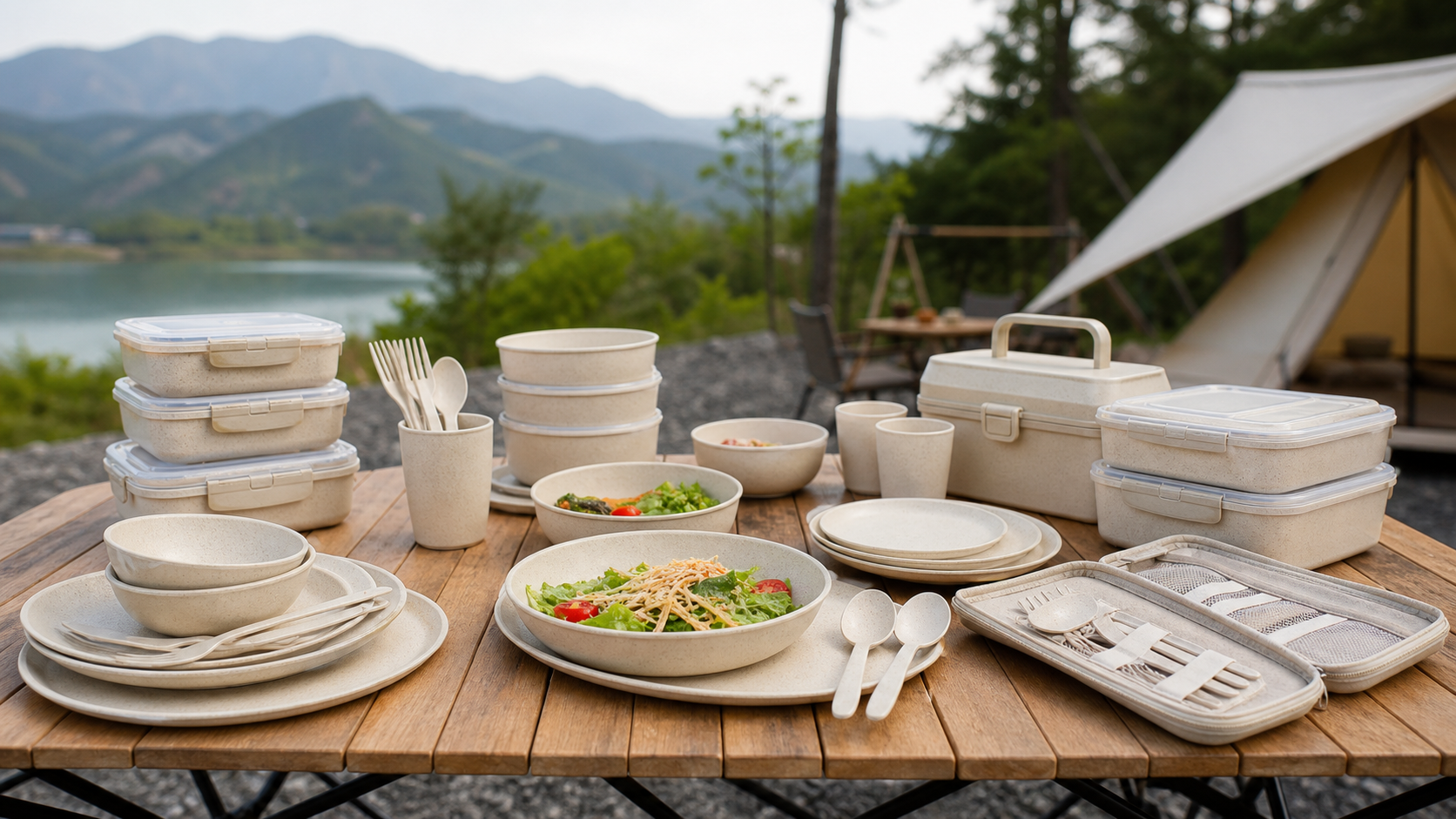
The 5-piece set is where the eco lifestyle story gets stronger. It is the configuration used in travel kits, office desk sets, and outdoor adventure products, usually paired with a carrying case or pouch.
Promotions Now's wheat straw cutlery set listing shows a typical 3-piece configuration with a carry case, targeted at office, school, and travel use.
The Full Flatware Set
Full flatware sets — 12 to 16 pieces covering four place settings — are a newer, premium extension of the category. They position wheat straw as a dinner-table product, not just a travel or lunchbox accessory.
Full sets demand more mold investment and higher MOQs, and they compete directly with bamboo fiber and premium PP flatware. They are best suited to brands with established retail distribution.
The Chopsticks and Straw Extras
Beyond the core configurations, chopsticks and collapsible straws are the two most requested add-ons. A 3-piece set with chopsticks is the standard configuration in East Asian markets and a fast-growing variant in Australia, where wheat straw chopsticks have taken market share from disposable wooden chopsticks.
Cutlery Dimensions: Sizes That Matter in Practice
Sizing is one of the most misunderstood parts of cutlery sourcing. Here are the standard dimensions that the market has converged on.
Fork Dimensions
A standard wheat straw fork measures 190 to 200 millimeters (7.5 to 7.9 inches) in length. The tines run 25 to 30 millimeters, and the handle diameter is 8 to 10 millimeters at the grip.
For children's cutlery, the fork shortens to 150 to 160 millimeters with a slimmer handle. Children's wheat straw cutlery is a growing niche, particularly in the US and Australia, where it competes with silicone feeding sets.
Spoon Dimensions
Standard spoons match the fork at 190 to 200 millimeters. The bowl width is 35 to 40 millimeters, and the bowl depth is 8 to 12 millimeters — deep enough for soup, shallow enough to eat with comfortably.
A teaspoon variant at 150 millimeters is sometimes offered for coffee or dessert use. It is a low-volume SKU but rounds out a gift set nicely.
Knife Dimensions
The knife is the most complex piece to mold because of the serrated edge. Standard knives run 200 to 210 millimeters, with a serrated cutting edge of 35 to 45 millimeters on one side.
The serration must be designed into the mold cavity — it cannot be cut after molding without degrading the composite surface. This is why knives are the most expensive piece per unit in any cutlery set.
Weight and Balance
A 3-piece adult set typically weighs 60 to 80 grams total. The balance point matters more than consumers admit — a fork that tips forward in the hand feels cheap. The best molds shift material into the handle to balance the weight.
Our custom cutlery mold capabilities cover dimension engineering and balance tuning for all standard configurations.
Surface Finishes and Color Options
Wheat straw composite accepts several surface treatments, and the finish you choose affects both the look and the cost.
Natural Beige Finish
The natural finish shows the wheat fiber texture directly. It is the most eco-authentic look, and it costs the least — no pigment is added to the formulation.
The natural finish is slightly matte, which means it hides fingerprints well. It pairs naturally with kraft paper packaging and minimal branding.
Solid Color Finishes
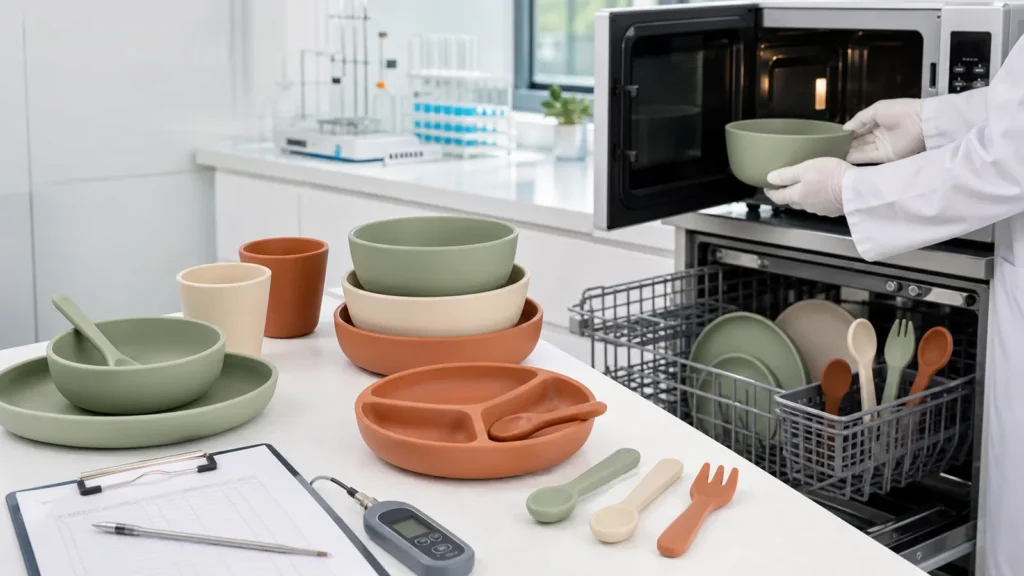
Pigmented wheat straw cutlery comes in pastel and earth-tone palettes — sage green, terracotta, warm sand, dusty blue. The pigment is added at the compounding stage, so the color runs through the entire piece, not just the surface.
Custom Pantone matching is standard, with a one-time color-matching fee of 200to200to400 per color and a minimum of 3,000 to 5,000 pieces per color SKU.
Two-Tone Options
Two-tone cutlery — a colored handle with a natural-colored head, or vice versa — requires a two-shot molding process. It is the most premium finish in the category and adds 15 to 25 percent to the unit cost.
Two-tone pieces are almost always used in premium gift sets rather than open-stock retail. If your brand targets the corporate gifting segment, the two-tone finish is worth the premium.
Surface Texture
The mold cavity texture transfers directly to the piece. A polished cavity produces a smooth, slightly glossy surface. A bead-blasted or textured cavity produces a matte, soft-touch surface.
For cutlery, a fine texture on the handle improves grip and hides scratches from daily use. This is a specification detail worth writing into your quality agreement.
Bulk Pricing Tiers: What You Should Pay
Pricing is where the wheat straw cutlery category gets confusing, because quotes vary wildly between suppliers. The numbers below are indicative FOB China port ranges based on current market conditions.
3-Piece Set Pricing by Volume
| Order Volume | FOB Price per Set | Typical Use |
|---|---|---|
| 1,000–3,000 sets | 0.85–1.20 | Sampling, small retail test |
| 5,000–10,000 sets | 0.65–0.90 | Regional retail, promo programs |
| 20,000+ sets | 0.50–0.70 | National retail, institutional contracts |
5-Piece Set Pricing by Volume
| Order Volume | FOB Price per Set | Typical Use |
|---|---|---|
| 1,000–3,000 sets | 1.40–2.00 | Travel and gift sets |
| 5,000–10,000 sets | 1.10–1.60 | Office and outdoor programs |
| 20,000+ sets | 0.85–1.30 | Major retail programs |
What Drives Price Variance
Three factors explain most of the price differences between suppliers:
Raw material quality. Cutlery made with 40 percent wheat fiber and consistent PP binder costs more than material with 25 percent fiber and cheap filler. The cheaper material also fails bending tests more often.
Mold cavity count. A factory running 8-cavity cutlery molds has a fundamentally lower labor cost per piece than one running 2-cavity molds. Ask for the cavity count — it is the single best indicator of a supplier's cost structure.
Knife serration quality. The serrated edge is the hardest feature to mold consistently. Factories that invest in precision knife molds price them higher — and their knives actually work.
Packaging Options for Retail and Gifting
Cutlery packaging ranges from bare minimum to premium gift presentation. Your choice depends on channel and price point.
Economy Packaging
A polybag with a header card or a simple kraft sleeve runs 0.03 to 0.08 per set. This is the standard for Amazon FBA and discount retail, where the product is the hero and the packaging is protective.
Retail-Ready Packaging
A full-color cardboard box, printed paperboard sleeve, or window box runs 0.15 to 0.35 per set. Retail-ready packaging transforms cutlery from a commodity into a giftable product and justifies a 2to2to4 retail uplift.
Premium Gift Packaging
A rigid gift box with foam insert and brand printing runs 0.50 to1.20 per set. This tier targets corporate gifting and premium e-commerce, where the unboxing experience is part of the product.
Carrying Cases
A zippered or snap-close carrying case adds 0.40to0.40to0.80 per set and is the standard companion for 5-piece and travel configurations. Cases are typically made from PP, TPU, or recycled fabric, and they open up the outdoor and commute-use case that drives the category's growth.
Certifications and Testing for Wheat Straw Cutlery
Cutlery touches food directly, so certification requirements are non-negotiable.
Required Certifications by Market
For the US market, FDA 21 CFR compliance is required. For the EU, LFGB or EU 1935/2004 documentation confirming overall migration limits is required — LFGB includes VOC and sensory testing, which is stricter than FDA.
For Australia, FSANZ food contact compliance is required. The certification path for wheat straw cutlery mirrors that of wheat straw dinnerware, which we covered in detail in our dinnerware certification guide.
The Bending Test
The most practical quality test for cutlery is the bending test. A fork or spoon tine should flex under moderate pressure and return to its original shape without cracking or whitening.
Material with inadequate fiber dispersion or low binder quality fails this test — the composite cracks at the stress point. Request bending test data from your supplier before approving samples.
The Dishwasher Test
Cutlery faces more thermal stress than plates because pieces are thinner and heat up faster. Run a 50-cycle dishwasher test on samples at 60 degrees Celsius, then check for warping, color change, and surface degradation.
The Drop Test
Drop test cutlery from 1 meter onto a hard surface. Good wheat straw cutlery survives without breaking, though the knife serration may show edge damage. Repeated failures at this test indicate low fiber-to-binder quality.
For our in-house quality control protocols, including the full test matrix we run on every cutlery batch, see our quality assurance page.
Customization: Logo, Color, and Private Label
Custom branding is where wheat straw cutlery margins expand from commodity levels to gift-product levels.
Logo Options
Embossed logos are molded into the handle — permanent, dishwasher-proof, and zero per-unit cost after mold payment. This is the preferred option for recurring orders.
Laser engraving works for small runs and samples — permanent mark, no mold modification, negligible per-unit cost. Pad printing works for multi-color logos but degrades over repeated dishwasher cycles, making it a poor choice for food-contact products.
Private Label and Gift Programs
The corporate gifting segment is the highest-margin use case for wheat straw cutlery. Branded 5-piece sets in gift boxes command 45 to 55 percent margins. We detailed the full gift program configuration in our corporate gifts guide.
MOQ Structure for Custom Orders
With an existing mold, MOQs start at 1,000 to 2,000 pieces per SKU. With a custom mold, expect 3,000 to 5,000 pieces per SKU plus mold costs of 3,000to3,000to8,000 depending on cavity count and complexity.
Wheat Straw Cutlery Buying Checklist
Before you place your order, run through this checklist:
Confirm the configuration: 3-piece, 5-piece, or full flatware set.
Verify dimensions against your market's expectations: fork and spoon at 190-200 mm for adults, 150-160 mm for children.
Select the finish: natural beige, solid color, or two-tone.
Request Pantone-matched color samples before production.
Confirm the knife serration design and test it on real food.
Request bending, dishwasher, and drop test data from your supplier.
Verify FDA, LFGB, or FSANZ certification documents — dated within 12 months.
Compare pricing at 1K, 5K, and 20K tiers from at least three suppliers.
Confirm the cavity count on your supplier's cutlery molds.
Agree on packaging: polybag, retail box, gift box, or carrying case.
Seasonal Demand and Market Timing
Wheat straw cutlery demand is not flat across the year. Understanding the seasonal pattern helps you time orders and avoid stockouts.
The Gift Season Window
Corporate gifting peaks in the September-to-December window. HR departments and marketing agencies place branded cutlery gift orders in August and September for holiday delivery. If you target this segment, place production orders by July at the latest.
Outdoor and Camping Season
The outdoor use case — camping, hiking, road trips — peaks in the northern hemisphere summer. Retailers place these orders in Q1 to stock shelves by May. Plan your Q1 production capacity accordingly.
School and Office Resets
Back-to-school (August) and office return waves (January) drive the lunchbox and commute segment. These are consistent annual bumps that reward retailers who hold inventory through the shoulder months.
The Lead Time Math
Custom wheat straw cutlery orders run 25 to 40 days of production plus 20 to 35 days of sea freight. A full custom program — mold, color matching, packaging — needs 60 to 90 days from order to delivery. Working backward from your target on-shelf date is the only reliable way to schedule.
Common Sourcing Mistakes with Wheat Straw Cutlery
Every cutlery buyer makes mistakes on the first order. Here are the ones we see most often, and how to avoid them.
Comparing Only Unit Price
Two suppliers can quote the same set price and deliver completely different products. One runs 8-cavity molds with 40 percent wheat fiber. The other runs 2-cavity molds with 25 percent fiber and cheap filler.
Compare material grade, cavity count, and bending test data first. Price only after the specification is locked.
Forgetting the Knife Test
The knife is the piece that fails most often in production. Serration quality varies wildly between factories, and a poorly molded knife edge is useless on real food.
Test every supplier's knife on actual cooked food before you commit. This single test eliminates more bad suppliers than any other check.
Skipping the Sensory Check
Wheat straw composite can absorb odors from food and packaging. A set that smells slightly of plastic out of the box fails the moment a customer opens it.
Specify a sensory test in your quality agreement — the product must be odor-free and impart no taste to food. This is part of LFGB compliance and it matters for every market.
Ordering Without a Seasonal Plan
Cutlery production windows close fast in peak seasons. A buyer who orders in September for holiday gifting has missed the window. Plan 60 to 90 days backward from your target delivery date, and hold buffer stock through peak months.
Wheat Straw Cutlery Sourcing FAQ
Q: Is wheat straw cutlery dishwasher safe?
Yes, top-rack dishwasher safe up to 60 degrees Celsius. Extended commercial dishwasher cycles above 70 degrees will accelerate surface wear. Hand washing extends the product's life significantly.
Q: Can wheat straw cutlery handle hot food?
Yes. Wheat straw composite is heat resistant up to 100 to 120 degrees Celsius. Hot soup, pasta, and cooked dishes are all within range. The material does not soften under normal eating temperatures.
Q: Is wheat straw cutlery biodegradable?
The wheat fiber component is biodegradable, but the PP binder is not. The product is not backyard compostable. It is best positioned as a durable, plant-based alternative to plastic, not a disposable compostable product.
Q: What is the minimum order quantity?
With an existing mold, 1,000 to 2,000 pieces per SKU. With a custom mold, 3,000 to 5,000 pieces per SKU. Lower MOQs are available for trial runs at a premium per-unit price.
Q: How long does a custom mold take?
Standard cutlery molds take 25 to 40 days from design approval, plus 10 to 14 days for T1 and T2 sampling. Full custom programs — color, logo, packaging — run 60 to 90 days door to door.
Q: Does the knife actually cut food?
Yes, when the serration is properly molded. The serrated edge handles soft and medium foods — cooked vegetables, sandwiches, fish — reliably. It is not designed for dense or frozen foods.
Making Your Sourcing Decision
Wheat straw cutlery is a maturing category with stable configurations, established pricing, and clear certification requirements. The buyers who succeed in it follow the same playbook: lock down the specification, compare suppliers on cavity count and material grade, verify test data, and invest in packaging that lifts the product out of commodity pricing.
If you are evaluating wheat straw cutlery suppliers or building a private-label cutlery line, we can provide material samples, certification documentation, bending and dishwasher test reports, and FOB quotations at the volume tiers above. Reach out through naikegroup.com.
Get A Qutoe