Silicone vs Plastic Baby Tableware: Which Material Wins for Your Target Market
Every importer sourcing baby tableware eventually faces the same two-material decision. Silicone on one side. Plastic on the other.
Both serve the same market. Both fill the same retail shelf category. But the products behave very differently — in safety testing, in consumer perception, and in the margins they deliver.
The global baby feeding accessories market reached 2.7 billion in 2024 and is projected to hit 5.1 billion by 2034, according to market.us research. Within that category, silicone is the fastest-growing material segment.
This guide compares both materials from a buyer's perspective — not a manufacturer's. The goal is simple: help you decide which material fits which market, channel, and price point.
The Safety Conversation: What Regulators Say About Each Material
Safety is where the two materials diverge most sharply — and where the differences have direct commercial consequences.
The Regulatory History of Plastic Baby Products
The regulatory history of plastic baby tableware is, in large part, a history of bans. The European Union banned polycarbonate baby bottles containing BPA in 2011, citing migration risks from the chemical.
That ban extended to all food contact materials containing BPA for children under three in the years that followed. Hong Kong's Centre for Food Safety provides a clear summary of the global regulatory timeline.
In 2022, the EU went further, banning melamine and bamboo-melamine composites in food contact products intended for children under three. Melamine dinnerware had been a staple of children's tableware for decades.
The pattern is consistent: plastic materials that were once considered standard for baby products have been progressively restricted as migration data accumulates. Each ban creates an immediate gap in the market — and buyers who anticipated the shift captured the shelf space first.
Where Silicone Sits Today
Food-grade platinum-cured silicone faces no such regulatory pressure. It contains no bisphenols, no phthalates, and no melamine. It does not require additives to achieve its safety profile — the polymer itself is inert.
The regulatory landscape for silicone is stable across every market your products will enter. That stability has commercial value. A silicone product line does not carry the risk of a future ban disrupting your supply chain or forcing a product recall.
The Microplastics Question
A newer concern is microplastics. Plastic tableware sheds microscopic particles during washing, heating, and normal wear — particularly as the surface develops micro-scratches over time.
Silicone, being a cross-linked polymer rather than a thermoplastic, does not shed particles the same way. This difference is increasingly cited by pediatric groups and consumer advocates when recommending tableware materials.
For an importer, this matters because the consumer conversation has already moved. Parents searching for baby tableware today are not just looking for "BPA-free" — they are actively avoiding plastic for babies altogether.
A detailed comparison of the two materials' safety profiles is available from Onzenna's silicone vs plastic guide, which covers chemical stability, heat behavior, and real-world usage differences.
Consumer Perception: The Market Has Already Made Its Choice
The safety debate is settled in the consumer's mind, even if the regulatory timeline is still catching up.
The "Plastic for Babies" Problem
Walk into any premium baby store in New York, Sydney, or Berlin, and you will see the pattern. Silicone products dominate the tableware section. Plastic occupies a shrinking corner.
The shift is generational. Millennial and Gen Z parents grew up reading about BPA, phthalates, and plastic degradation. For them, "plastic baby plate" is a contradiction in terms. The word plastic has become a disqualifier, regardless of certifications.
This perception gap creates a pricing opportunity. Parents pay a premium for products they perceive as safe — and silicone carries that perception intrinsically.
Regional Differences That Matter
Consumer attitudes vary by market, and the differences affect product strategy:
In the United States, the "BPA-free" label was the historic purchase trigger, but the conversation has moved beyond BPA to total plastic avoidance. Clean-label parenting influencers drive significant category behavior.
In Western Europe, regulation leads the conversation. German and French parents are conditioned by years of product recalls and EU bans — they expect documented certification and are skeptical of plastic regardless of claims.
In Australia, the market sits between the two — regulation is lighter, but consumer awareness is high, and Australian brands like Brightberry have built their positioning on the silicone safety story. Brightberry's comparison of silicone and plastic for babies explains the Australian perspective in detail.
In emerging markets — Southeast Asia, Latin America, the Middle East — plastic still dominates shelves, and price sensitivity is the primary driver. This is where the two materials compete on cost rather than perception.
What This Means for Your Product Line
If your target market is the US, EU, or Australia, silicone is the safer positioning bet. The consumer already expects it. Plastic, in those markets, requires heavy discounting or a very specific value story.
If your target market is a developing economy, plastic remains a viable, higher-margin option — the market has not yet shifted its perception, and price per unit drives purchase decisions.
Durability and Real-World Performance
Claims aside, both materials fail in specific ways. Understanding the failure modes helps you design better products and set honest expectations.
How Silicone Performs
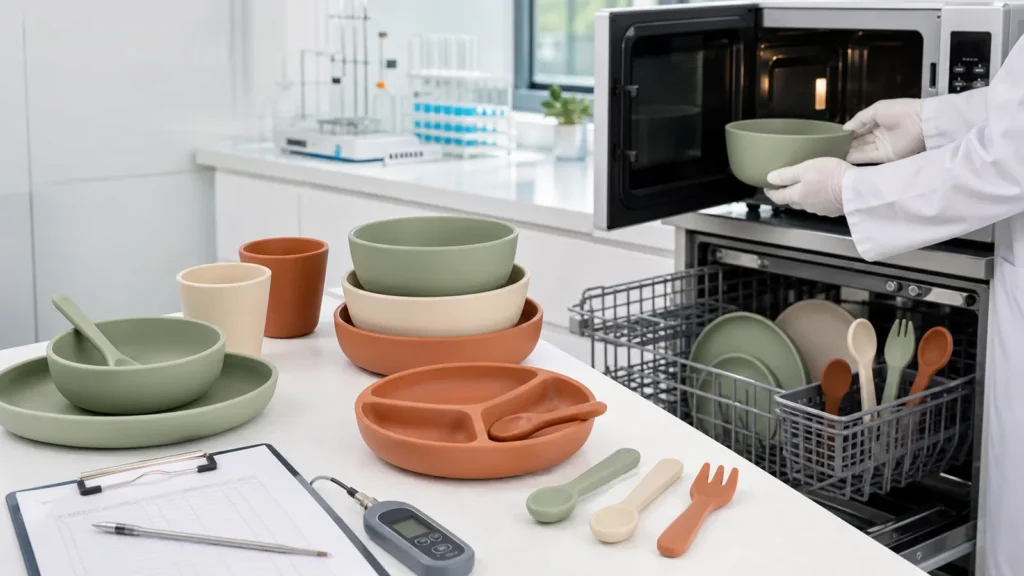
High-quality platinum-cured silicone survives temperatures from minus 40 to 230 degrees Celsius. That covers boiling water sterilization, dishwasher cycles, and microwave reheating.
Silicone is virtually unbreakable. Drop it, throw it, step on it — it bounces. This durability is the core of the baby product value proposition: a product that lasts through the entire toddler stage and often into the next child's.
The real failure mode of silicone is surface degradation over years of use. Tomato-based foods can cause light staining. Prolonged contact with oily foods can cause surface tackiness. And low-quality silicone with heavy filler content will eventually crack or become sticky — which is why the material grade matters more than the material itself.
How Plastic Performs
Food-grade PP plastic is durable and cheap, but it degrades through use in ways parents notice. Micro-scratches accumulate from washing. Odors and colors absorb into the surface. High-heat exposure — a hot dishwasher, microwave use — accelerates the degradation.
The cost advantage of plastic is real, and for institutional buyers — daycares, hospitals, budget retail — it remains the dominant material. But the durability gap narrows when you factor in the replacement cycle. A parent who buys a silicone plate at 18 and uses it for two years pays less per use than a parent who buys a 6 plastic plate twice in the same period.
The Stain and Odor Test
A quick way to communicate material difference to your retail buyers: fill both a silicone and a plastic plate with tomato sauce, microwave for two minutes, then wash. The silicone plate cleans up with no residue. The plastic plate retains a faint orange tint.
This is not a lab test, but it is a retail test — and it sells products.
The Cost Structure: Where the Margins Live
Price is where many importers make their first mistake — assuming the cheaper material means better margins.
Wholesale Cost Comparison
A food-grade PP baby plate with suction base costs roughly 0.40to0.40to0.90 FOB in bulk. A platinum-cured silicone equivalent costs 1.80to1.80to3.50 FOB. The silicone plate costs three to four times more at the factory gate.
Retail Price Comparison
At retail, the same silicone plate sells for 14to14to24. The plastic plate sells for 6to6to10.
The silicone plate carries a much higher absolute margin — typically 8to8to15 per unit versus 3to3to6 for plastic. Percentage margins are similar, but the absolute margin on silicone is where distributors build sustainable revenue.
Why the Silicone Premium Is Sustainable
The retail premium for silicone is not a temporary trend. It is supported by three structural factors: the regulatory history of plastic, the consumer perception shift, and the durability advantage that justifies the price.
Hb Silicone's OEM comparison of silicone and plastic for baby products provides a factory-side view of how material cost translates into wholesale pricing at different volumes.
For importers evaluating both materials, the practical question is not "which is cheaper" but "which market segment am I serving." If the answer is premium retail in developed markets, silicone wins on margin per unit. If the answer is mass distribution in price-sensitive markets, plastic wins on unit volume. Our custom manufacturing page shows how we run both material lines under one roof.
Certification Requirements: Know the Difference Before You Commit
The certification burden differs significantly between the two materials — and getting this wrong can cost you an entire shipment.
Silicone Certifications
Platinum-cured silicone requires LFGB certification for European markets and FDA 21 CFR 177.2600 compliance for the US. LFGB testing includes volatile organic compound analysis and sensory testing — the material must not impart taste or odor to food.
For the Australian market, food-grade silicone products require compliance with FSANZ standards, which align closely with international migration testing protocols.
These certifications are stable, well-understood, and achievable with consistent material sourcing. Once your factory has the certifications in place, they apply across your entire silicone product line.
Plastic Certifications
Food-grade plastic requires the same food contact certifications plus children's product compliance. In the US, CPSIA testing adds lead content limits, phthalate restrictions, and third-party lab certification requirements.
In the EU, plastic products fall under Regulation EU 10/2011, with migration testing for each polymer type. Melamine-based products face the 2022 ban for children under three — effectively removing that material from the category entirely.
The certification burden for plastic is heavier and more volatile. Each polymer type requires its own testing, and regulatory changes can invalidate existing certifications.
The Practical Takeaway
For a buyer launching a baby tableware line, silicone offers a simpler, more stable certification pathway. One material, one set of certifications, applicable across markets.
For a buyer diversifying into budget segments, plastic requires more regulatory diligence — particularly if you are considering melamine or multi-material composites.
Our compliance documentation and testing page details the full certification matrix we maintain across silicone and plastic product lines.
Retail Presentation: How the Two Materials Sell Differently
The two materials present differently at retail, and that difference influences everything from packaging design to shelf placement.
Silicone's Retail Advantages
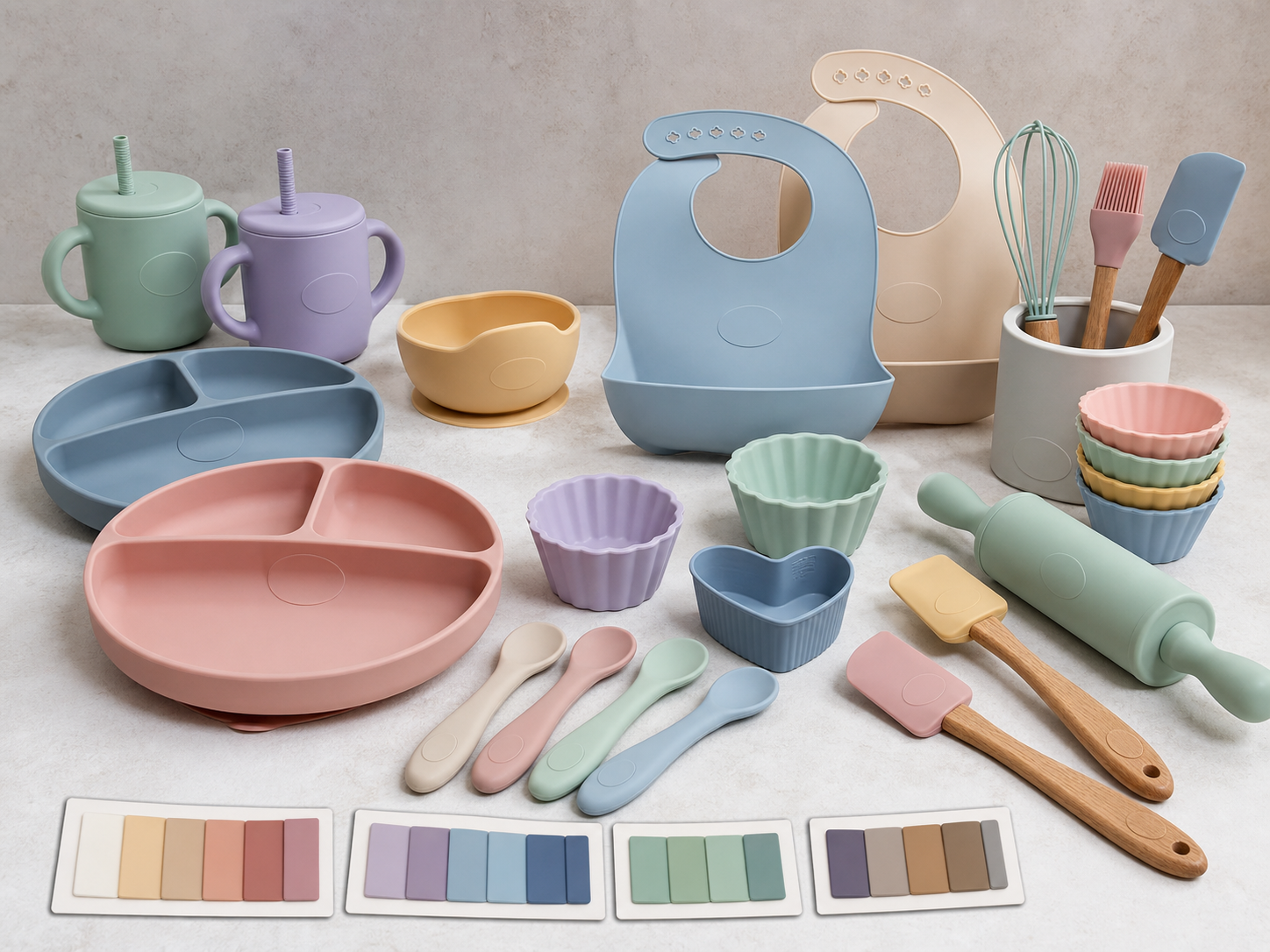
Silicone products photograph beautifully. The muted earth tones, the soft matte texture, the tactile quality — they translate into premium shelf appeal that supports the price point.
Silicone also carries the sustainability story. It is durable, long-lasting, and does not shed microplastics. For retailers building sustainability narratives, silicone is the easier story to tell.
The packaging opportunity is real: gift-box presentation, premium cardstock, lifestyle imagery. Silicone supports premium packaging economics.
Plastic's Retail Advantages
Plastic's retail advantage is purely price-led. Bright colors, low price points, high volume. It wins the "second purchase" and "convenience" segments — the spare plate, the travel set, the budget gift.
Plastic packaging is typically minimal — clamshell or hang card — because the product must compete on price.
Channel Fit
Silicone performs best in: specialty baby stores, premium department stores, Amazon (with strong listing content), and e-commerce marketplaces where product photography drives conversion.
Plastic performs best in: big-box retail, discount chains, school supply channels, and institutional procurement where unit price is the decision variable.
Which Material Should You Choose?
The answer depends on three questions: your target market, your channel, and your margin model.
Choose Silicone If
Your target market is the US, EU, or Australia. Your channel is specialty retail or e-commerce. Your brand position is premium or eco-conscious. Your margin model requires $8-plus per unit.
Choose Plastic If
Your target market is a price-sensitive developing economy. Your channel is big-box or institutional. Your brand position is budget or value. Your margin model is built on unit volume.
The Smart Portfolio Approach
The most successful baby tableware importers run both materials — silicone as the hero line, plastic as the volume line. The silicone line builds the brand and the premium margins. The plastic line fills containers and serves the budget segment.
The two materials are not competitors in a well-run portfolio. They serve different customers, different channels, and different price points.
If you are evaluating suppliers for a baby tableware line, we can provide material samples, certification documentation, and FOB quotations for both silicone and plastic configurations. Reach out through naikegroup.com.
Get A Qutoe