
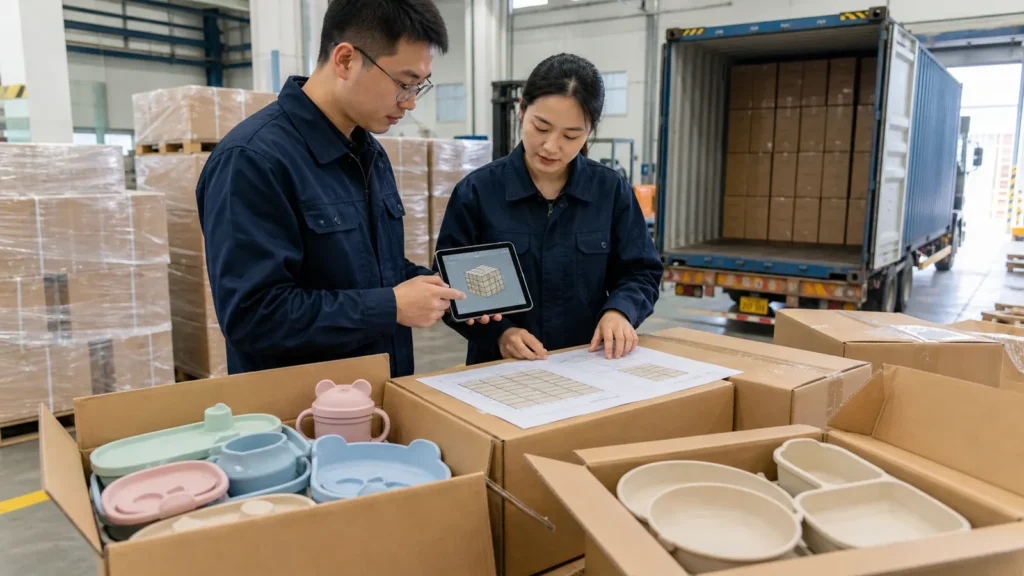
Tableware carton optimization is the controlled reduction of freight and packaging waste without weakening protection, labeling or retail presentation. A lower carton volume is useful only when the product still arrives saleable and the shipment can be handled, counted and unloaded safely.
Naike Group manufacturing team begins with the actual product set, nesting behavior, retail pack and destination route. This work should be aligned with product decisions in Custom Solutions, because dimensions frozen during molding or packaging artwork can limit later logistics improvements.
The guide is relevant to silicone sets, wheat-straw tableware, lunch boxes and mixed custom assortments in our product catalog. It also complements the commercial timing controls in our payment terms and lead-time guide.
Factory insider takeaway: Optimize the complete shipment system, not carton volume in isolation. Product nesting, retail packs, master cartons, pallets, container loading, moisture protection, labels and receiving limits must be reviewed as one connected design.
Begin Tableware Carton Optimization with a Shipment Baseline
Picture two quotations for the same tableware set: one has a lower unit price, while the other ships more sets per cubic meter with fewer damaged retail boxes. Buyers cannot compare landed economics until product quantity, pack-out, carton dimensions, gross weight and route assumptions are stated together.
Build a baseline from measured production-intent products and packaging rather than early CAD volume. Flexible silicone may nest differently after molding, and rigid wheat-straw plates can require separators or rim protection that changes the real pack density.
Record units per retail pack, retail packs per master carton, carton external dimensions, net and gross weight, pallet assumptions and estimated container quantity. Keep dimensional tolerances because a few millimeters repeated across carton rows can change a loading plan.
Define the commercial objective behind tableware carton optimization
The target may be lower ocean freight per unit, better pallet handling, reduced damage, faster warehouse receiving or compliance with retailer carton limits. Rank these priorities so the factory does not improve one metric by creating a more expensive problem elsewhere.
Decide whether the shipment is floor-loaded or palletized and whether destination warehouses impose weight, label or carton-size rules. A carton optimized for one channel can be inefficient or unacceptable in another.
Engineer Product Nesting and Retail Packs before Master Cartons
Nesting begins with product geometry and surface protection. Deep bowls may stack efficiently but lock together, while silicone parts can deform when compressed for too long or pick up dust when packed without suitable protection.
Retail packaging establishes fixed dimensions for sleeves, boxes, inserts, windows and hanging features. Test the complete product set inside production-intent packaging before approving artwork, because later reductions can disturb graphics, barcode quiet zones or opening experience.
Mixed sets require an assembly sequence that operators can repeat without forcing parts. Create a pack standard with orientation photos, component count, protective layers and closed-pack dimensions measured after normal conditioning.
Compare empty space with protection value
Not every void is waste. Clearance can protect rims, printed surfaces and retail corners, but unstructured space allows movement and concentrates impact when cartons are dropped or vibrated.
Private-label projects should freeze inserts and printed packaging through the approval route described in our private-label dinnerware guide. This keeps shipping calculations connected to the exact sellable configuration.
Balance Master Carton Strength, Weight and Handling
A master carton must withstand its product load, stacking period, humidity and handling route. Board grade, flute, joint, closure and internal supports should be selected from the complete distribution risk rather than copied from an unrelated product.
Very large cartons may improve theoretical cube utilization but become difficult to lift, deform during stacking or exceed warehouse limits. Very small cartons increase material, labels, handling events and count reconciliation.
Measure gross weight on packed production samples and define an allowable range. Carton dimensions should be external values at the agreed condition because bulging or loose closure changes pallet and container fit.
Test ocean freight packaging as a system
Compression, drop, vibration and climatic exposure address different hazards. Select a test plan from route, product fragility, pallet method and customer requirement rather than using one generic pass certificate for every shipment.
Record failure location and product consequence during trials. A crushed corner, scuffed retail box and broken product need different corrective actions even if they occurred in the same test sequence.
Model Pallet Patterns and Container Utilization
Calculate carton count by orientation while respecting pallet footprint, height, gross weight and overhang limits. Then perform a physical stack trial because carton compression and dimensional variation can make a mathematically perfect pattern unstable.
For floor-loaded containers, review row pattern, door clearance, load distribution, unloading sequence and carton strength. Maximum cubic utilization is not the only goal when a dense wall of cartons becomes unsafe at the door or difficult for the receiving team to remove.
Do not present container quantities as guaranteed until carton dimensions, loading method and container type are frozen. Actual equipment dimensions and operational constraints can vary, so quotations should identify the planning assumptions and permitted tolerance.
Use sensitivity scenarios instead of one container number
Show a base plan and alternatives for changed retail pack, units per carton or pallet requirement. Sensitivity analysis helps buyers see which packaging decision has the strongest effect on freight per sellable unit.
Include mixed-SKU orders in the model. A single-SKU calculation can overstate utilization when launch assortments require several colors, product sizes or partial carton quantities.
Control Loading, Moisture and Shipment Release
Inspect container condition before loading, including cleanliness, odor, visible water entry and structural concerns. Use the agreed moisture-control approach according to route, season, product and packaging rather than treating desiccant quantity as a universal formula.
Loading records should connect carton count, lot, pallet or floor-load position and seal information. Photographs can support the record when they show the staged quantity, loading progression and secured final condition instead of only a closed door.
Final release should verify labels, carton integrity, gross weight, pack-out, shipping marks and document consistency. A highly optimized load loses its value when destination receiving cannot identify cartons or reconcile quantities.
Protect repeat orders with packaging change control
Changes to product dimensions, retail inserts, carton supplier, board grade, pack quantity or pallet method can alter both protection and freight assumptions. Define which changes require recalculation, physical trial or customer reapproval.
Our factory capability process links packaging versions with product and shipment records. That traceability helps buyers compare landed results across seasons instead of relying on an obsolete carton quotation.
Ocean Freight Packaging Options Compared for Tableware
The best option depends on channel, product rigidity, warehouse requirements and damage risk. Compare the complete landed and receiving effect rather than choosing the smallest carton automatically. Record the selected comparison assumptions in the tableware carton optimization project brief before quotation.
| Configuration | Cube Efficiency | Protection | Handling | Best Fit |
|---|---|---|---|---|
| Dense nested bulk pack | High | Needs surface and deformation control | Efficient count but more unpacking | Wholesale or repacking programs |
| Retail boxes in master carton | Medium | Good shelf-unit separation | Straightforward receiving | Retail and e-commerce brands |
| Floor-loaded master cartons | High potential | Depends on carton stacking strength | Labor-intensive unloading | Volume programs with suitable receiving |
| Palletized cartons | Lower cube potential | Stable unitized handling | Fast mechanical movement | Warehouses requiring pallet receipts |
| Mixed-SKU container plan | Variable | Requires clear segregation | More complex reconciliation | Launch assortments and distributors |
B2B Buyer Checklist for Tableware Carton Optimization
Use these questions before approving packaging dimensions or comparing freight quotations. The answers should be based on measured production-intent packs. Record every answer against the current tableware carton optimization project assumptions and approval owner.
| Check | Question | Why It Matters |
|---|---|---|
| Product revision | Are measured products representative of the approved material mold and dimensions? | Early estimates can change when real nesting clearance and deformation are known. |
| Retail pack | Are artwork inserts barcode zones and sellable-pack dimensions frozen? | Retail packaging usually controls the master carton calculation. |
| Pack quantity | Can operators repeat the units and orientation without forcing products? | Unstable pack-out creates count errors damage and dimensional variation. |
| Carton specification | Are external dimensions board construction closure and gross weight defined? | Container and pallet models require the actual finished carton specification. |
| Protection test | Which compression drop vibration or climate risks must be evaluated? | Optimization is valid only when protection remains suitable for the route. |
| Handling limit | Do carton size and weight fit supplier carrier and destination rules? | An efficient carton can still fail ergonomic or warehouse acceptance limits. |
| Pallet method | Is the order floor-loaded or palletized with a defined footprint and height? | The loading method changes both cube utilization and receiving labor. |
| Container model | Are container type door clearance weight and loading tolerances stated? | A headline quantity is unreliable when its operating assumptions are hidden. |
| Moisture plan | How are container condition route humidity and packaging sensitivity controlled? | Long ocean exposure can weaken cartons and damage retail presentation. |
| Change control | Which product or packaging revisions trigger recalculation and reapproval? | Repeat orders must remain connected to the pack plan used for quotation. |
Factory Control Notes for tableware carton optimization
The following controls turn freight assumptions into a packaging specification that purchasing, production, logistics and receiving teams can use consistently. Each tableware carton optimization decision should identify its owner, evidence and release condition.
1. Product revision control for tableware carton optimization
For tableware carton optimization, the product revision checkpoint must become a dated project record rather than an informal chat instruction. The resulting product revision record must name its owner, source evidence, revision authority and the commercial consequence of a late change after the buyer asks, “Are measured products representative of the approved material mold and dimensions?”
Early estimates can change when real nesting clearance and deformation are known. For the product revision decision in this tableware carton optimization project, our factory links the checkpoint to the quotation, approved sample, purchase order or inspection standard that governs the next approval. If the tableware carton optimization evidence is incomplete, the team holds that approval gate, closes the information gap and records the revised assumption before production continues.
2. Retail pack control for tableware carton optimization
For tableware carton optimization, the retail pack checkpoint must become a dated project record rather than an informal chat instruction. The resulting retail pack record must name its owner, source evidence, revision authority and the commercial consequence of a late change after the buyer asks, “Are artwork inserts barcode zones and sellable-pack dimensions frozen?”
Retail packaging usually controls the master carton calculation. For the retail pack decision in this tableware carton optimization project, our factory links the checkpoint to the quotation, approved sample, purchase order or inspection standard that governs the next approval. If the tableware carton optimization evidence is incomplete, the team holds that approval gate, closes the information gap and records the revised assumption before production continues.
3. Pack quantity control for tableware carton optimization
For tableware carton optimization, the pack quantity checkpoint must become a dated project record rather than an informal chat instruction. The resulting pack quantity record must name its owner, source evidence, revision authority and the commercial consequence of a late change after the buyer asks, “Can operators repeat the units and orientation without forcing products?”
Unstable pack-out creates count errors damage and dimensional variation. For the pack quantity decision in this tableware carton optimization project, our factory links the checkpoint to the quotation, approved sample, purchase order or inspection standard that governs the next approval. If the tableware carton optimization evidence is incomplete, the team holds that approval gate, closes the information gap and records the revised assumption before production continues.
4. Carton specification control for tableware carton optimization
For tableware carton optimization, the carton specification checkpoint must become a dated project record rather than an informal chat instruction. The resulting carton specification record must name its owner, source evidence, revision authority and the commercial consequence of a late change after the buyer asks, “Are external dimensions board construction closure and gross weight defined?”
Container and pallet models require the actual finished carton specification. For the carton specification decision in this tableware carton optimization project, our factory links the checkpoint to the quotation, approved sample, purchase order or inspection standard that governs the next approval. If the tableware carton optimization evidence is incomplete, the team holds that approval gate, closes the information gap and records the revised assumption before production continues.
5. Protection test control for tableware carton optimization
For tableware carton optimization, the protection test checkpoint must become a dated project record rather than an informal chat instruction. The resulting protection test record must name its owner, source evidence, revision authority and the commercial consequence of a late change after the buyer asks, “Which compression drop vibration or climate risks must be evaluated?”
Optimization is valid only when protection remains suitable for the route. For the protection test decision in this tableware carton optimization project, our factory links the checkpoint to the quotation, approved sample, purchase order or inspection standard that governs the next approval. If the tableware carton optimization evidence is incomplete, the team holds that approval gate, closes the information gap and records the revised assumption before production continues.
6. Handling limit control for tableware carton optimization
For tableware carton optimization, the handling limit checkpoint must become a dated project record rather than an informal chat instruction. The resulting handling limit record must name its owner, source evidence, revision authority and the commercial consequence of a late change after the buyer asks, “Do carton size and weight fit supplier carrier and destination rules?”
An efficient carton can still fail ergonomic or warehouse acceptance limits. For the handling limit decision in this tableware carton optimization project, our factory links the checkpoint to the quotation, approved sample, purchase order or inspection standard that governs the next approval. If the tableware carton optimization evidence is incomplete, the team holds that approval gate, closes the information gap and records the revised assumption before production continues.
7. Pallet method control for tableware carton optimization
For tableware carton optimization, the pallet method checkpoint must become a dated project record rather than an informal chat instruction. The resulting pallet method record must name its owner, source evidence, revision authority and the commercial consequence of a late change after the buyer asks, “Is the order floor-loaded or palletized with a defined footprint and height?”
The loading method changes both cube utilization and receiving labor. For the pallet method decision in this tableware carton optimization project, our factory links the checkpoint to the quotation, approved sample, purchase order or inspection standard that governs the next approval. If the tableware carton optimization evidence is incomplete, the team holds that approval gate, closes the information gap and records the revised assumption before production continues.
8. Container model control for tableware carton optimization
For tableware carton optimization, the container model checkpoint must become a dated project record rather than an informal chat instruction. The resulting container model record must name its owner, source evidence, revision authority and the commercial consequence of a late change after the buyer asks, “Are container type door clearance weight and loading tolerances stated?”
A headline quantity is unreliable when its operating assumptions are hidden. For the container model decision in this tableware carton optimization project, our factory links the checkpoint to the quotation, approved sample, purchase order or inspection standard that governs the next approval. If the tableware carton optimization evidence is incomplete, the team holds that approval gate, closes the information gap and records the revised assumption before production continues.
9. Moisture plan control for tableware carton optimization
For tableware carton optimization, the moisture plan checkpoint must become a dated project record rather than an informal chat instruction. The resulting moisture plan record must name its owner, source evidence, revision authority and the commercial consequence of a late change after the buyer asks, “How are container condition route humidity and packaging sensitivity controlled?”
Long ocean exposure can weaken cartons and damage retail presentation. For the moisture plan decision in this tableware carton optimization project, our factory links the checkpoint to the quotation, approved sample, purchase order or inspection standard that governs the next approval. If the tableware carton optimization evidence is incomplete, the team holds that approval gate, closes the information gap and records the revised assumption before production continues.
10. Change control control for tableware carton optimization
For tableware carton optimization, the change control checkpoint must become a dated project record rather than an informal chat instruction. The resulting change control record must name its owner, source evidence, revision authority and the commercial consequence of a late change after the buyer asks, “Which product or packaging revisions trigger recalculation and reapproval?”
Repeat orders must remain connected to the pack plan used for quotation. For the change control decision in this tableware carton optimization project, our factory links the checkpoint to the quotation, approved sample, purchase order or inspection standard that governs the next approval. If the tableware carton optimization evidence is incomplete, the team holds that approval gate, closes the information gap and records the revised assumption before production continues.
Authoritative References and Practical Limits
The IMO/ILO/UNECE CTU Code provides global guidance for packing and handling cargo transport units used by sea and land. Review the official UNECE CTU Code page when preparing loading and securing procedures. Buyers should confirm how this reference applies to the named product, target market and current tableware carton optimization project.
International Standard for Phytosanitary Measures No. 15 addresses regulated wood packaging material used in international trade. Consult the official IPPC ISPM 15 record when wooden pallets or dunnage are included. Buyers should confirm how this reference applies to the named product, target market and current tableware carton optimization project.
EU Regulation 2025/40 establishes packaging and packaging-waste requirements that affect packaging design and market responsibilities. Use the official EUR-Lex Regulation 2025/40 record for current European Union planning. Buyers should confirm how this reference applies to the named product, target market and current tableware carton optimization project.
Container quantities and freight savings are planning estimates until production packaging, loading method and equipment assumptions are frozen. Buyers remain responsible for carrier, retailer, customs, environmental and destination requirements with their qualified service providers.
Tableware Carton Optimization Buyer FAQ
Does the smallest carton always produce the lowest landed cost?
No. Smaller cartons can increase material, handling, deformation or damage, while a slightly larger pack may create a better pallet or container pattern.
Should silicone tableware be compressed to improve container quantity?
Only within validated limits. Long compression can deform parts or packaging, so production-intent packs should be conditioned and inspected after the expected storage period.
Is floor loading better than palletizing?
Floor loading can improve cube utilization, while pallets can speed handling and support warehouse requirements. The best choice depends on labor, product protection, destination and order scale.
Can estimated carton dimensions be used for a firm container quantity?
They should be identified as estimates. Firm planning requires external measurements from packed production-intent cartons plus tolerance and operating clearance.
When should packaging be retested?
Review retesting after changes to product geometry, pack quantity, insert, carton construction, supplier, pallet method or route severity. The level of retesting should match the effect that the change can have on protection and handling.
Conclusion: Make Tableware Carton Optimization Shipment-Ready
Effective tableware carton optimization connects product nesting, retail presentation, carton strength, handling and container planning. A cube reduction is successful only when the complete shipment remains traceable, safe to handle and saleable on arrival.
Our factory recommends measuring production-intent packs, testing the route risks and documenting alternative load scenarios before packaging approval. This gives buyers a defensible basis for comparing landed cost and repeat-order performance.
Share the product set, quantity, destination, retail packaging and loading preference through Contact Us. Naike Group manufacturing team will review pack-out and quotation assumptions with the project team.
Build a Better Tableware Shipping Plan
Send product dimensions, retail pack direction, quantity, destination and pallet requirements for a factory packaging review. Our manufacturing team will use those details to define the next review step for your tableware carton optimization project.