
Tableware Factory Audit: BSCI, ISO 9001 & SGS
A factory-side verification guide for importers who need to separate valid audit evidence from attractive but incomplete certificate claims.

Tableware factory audit evidence is often presented as a row of logos in a supplier profile, yet those logos answer different questions. BSCI focuses on social-performance monitoring, ISO 9001 addresses the organization’s quality management system, and SGS may appear as an auditor, inspection company, laboratory or verification provider depending on the document.
From the Naike Group manufacturing team’s perspective, an importer should never approve a supplier because three familiar names appear on a presentation. A dependable decision comes from matching each document to the correct legal entity, factory address, activity scope, issuing body, audit date, finding status and product program.
This guide shows how to conduct a risk-based review before ordering custom silicone or wheat-straw tableware. It also explains where buyers should connect certificate checks with the physical controls shown on our Factory Capability page and the project approvals described in Custom Solutions.
Factory insider takeaway: Treat every certificate as one piece of evidence, not a substitute for due diligence. Verify who was assessed, what was covered, when the assessment occurred, which findings remain open and whether the same controls are operating on your order.
A Tableware Factory Audit Starts by Separating Three Evidence Types
The first diagnostic question is not whether a factory “has BSCI, ISO and SGS.” It is what business risk each document is intended to control. Social compliance, management-system consistency and product conformity overlap in daily operations, but they are assessed through different criteria and cannot be substituted for one another.
A BSCI monitoring result can indicate how the site performed against social requirements at a point in time. It does not prove that a silicone spoon complies with a food-contact requirement, that a wheat-straw plate matches an approved color or that the supplier can hold a delivery date during peak production.
An ISO 9001 certificate can support confidence that the named organization operates a defined quality management system within a stated scope. It does not certify every product, guarantee zero defects or confirm that the certificate covers the actual factory manufacturing your order.
An SGS document must be read by document type. A laboratory report, factory assessment, pre-shipment inspection and supplier-verification report each have a different sample basis, date, scope and conclusion, so the buyer must identify exactly what SGS performed instead of treating the company name as a universal approval mark.
Why the tableware supplier audit checklist needs a document map
Build a one-page map that lists the evidence requested, the risk it controls, the issuing organization, the assessed entity and the renewal or recheck date. This prevents a social-audit report from being used to answer a product-safety question and prevents a product test from being used to infer production capacity.
The map should also identify buyer-owned checks. Your product specification, approved sample, packaging artwork and inspection plan remain order-specific controls even when the factory has a mature management system.
Verify Legal Identity, Site Address and Certificate Scope Before Scoring
The most common documentary failure is a mismatch between the company named on the purchase order and the company shown on the certificate. Trading companies, sister factories, old legal names and relocated facilities can all create legitimate explanations, but the relationship must be documented before the evidence is accepted.
Compare the legal name, registered address, manufacturing address and business license with the quotation and bank beneficiary. If a document covers a different entity, ask for a written organization chart, ownership relationship and explanation of which site will receive materials, mold parts, produce goods, inspect finished pieces and pack the shipment.
Scope language matters as much as the company name. A certificate covering “sales of household products” does not provide the same evidence as a scope covering manufacture of the relevant silicone or composite tableware. The buyer should also confirm that outsourced processes such as printing, packaging or mold construction are included in the supplier-control system.
Validity should be checked at the issuer or certification-body source whenever a public verification path exists. Screenshots are weak evidence because they can omit suspension, withdrawal, scope and site details that materially change the buyer’s interpretation.
How to verify ISO 9001 tableware evidence
Ask for the complete certificate, certification-body name, accreditation details, issue date, expiry date and scope. Then sample the operating records that demonstrate the system, such as incoming inspection, equipment calibration, nonconforming-product control, corrective action, training and customer-complaint review.
A credible factory can connect the certificate to current records without staging a special presentation. The objective is not to collect paperwork; it is to see whether the documented process controls the actual production route used for your order.

Read BSCI Social-Audit Evidence as a Time-Bound Monitoring Result
amfori BSCI operates through a member-based supply-chain system, and an audit request is controlled through the responsible member relationship. Buyers should therefore ask who holds responsibility for the monitored producer, which site was assessed and whether the report being shown is the current platform record rather than an isolated PDF.
The rating should be read together with performance-area findings and corrective actions. A single overall grade can hide important differences between occupational health and safety, working time, remuneration, child-labor controls, bonded-labor controls and management practices.
During a site review, compare the report with visible conditions: emergency routes, machine guarding, chemical storage, PPE availability, time-record practices, worker information and dormitory conditions when applicable. A social-audit report describes a monitored moment; ongoing responsibility depends on whether corrective actions remain active after the auditor leaves.
Importers should also align expectations with their own customer code. A retailer may require a specific audit platform, recency threshold, accepted rating or remediation timetable, so “BSCI available” is not a complete commercial answer.
Questions to ask when a BSCI finding is open
Request the finding description, root-cause analysis, corrective action, responsible owner, completion target and verification evidence. A realistic closure plan is more informative than a promise that every issue has already disappeared.
If the finding could affect legal operation, worker safety or production continuity, treat it as an order risk and agree on escalation rules before paying a deposit. Social compliance belongs in supplier governance, not in a marketing appendix.
Identify What SGS Actually Audited, Tested, Inspected or Verified
SGS provides many services across audit, certification, testing, inspection and supplier verification. The SGS name on a page does not explain the service, and a buyer should not assume that a factory assessment includes laboratory testing or that a product report includes an evaluation of production capacity.
Read the title, applicant, manufacturer, sample description, test method, report date and conclusion. For factory assessments, review the criteria, assessed site, process coverage, score and corrective actions. For inspections, confirm the lot size, sample size, inspection stage, acceptance criteria and whether the inspector worked from the buyer’s approved specification.
A report supplied by the factory may still be valid, but the buyer should know who selected and submitted the sample. When risk is high, arrange independent sampling or witness sealing so the tested item can be traced to the intended production construction.
Third-party evidence is strongest when it is placed inside a controlled order plan. The quotation defines assumptions, the approved sample defines appearance and function, the laboratory plan addresses applicable requirements, and the pre-shipment inspection verifies the finished lot before release.
When an SGS factory assessment is useful
Use it to obtain an independent view of legality, production capacity, quality controls, management resources and site conditions when a buyer cannot visit. The assessment should complement reference checks and order-specific verification rather than replace them.
Ask the provider to tailor the checklist to the product route. Silicone compression molding, composite injection molding, decoration, assembly and retail packaging have different bottlenecks and controls.

Connect Certificates to Production-Floor Records and Approved Samples
A tableware factory audit becomes commercially useful when documentary claims are traced into a live order. Select one representative SKU and follow its material receipt, batch identification, work instruction, first-piece approval, in-process inspection, packing verification and nonconforming-product records.
For silicone products, the trail may include compound identification, color mixing, curing parameters, trimming, post-curing where specified, dimensional checks and surface inspection. For wheat-straw composite products, it may include resin and filler identification, drying or conditioning controls, molding parameters, color reference, dimensional stability and odor or appearance acceptance.
Compare the production piece with the buyer-approved sample and drawing. If operators rely on memory, a mobile-phone image or an old sample without version control, the management system is not reliably translating the commercial requirement to the line.
The same logic applies to tooling and packaging. Review how engineering changes are released through the custom mold and tooling process and how approved artwork, inserts and carton marks are controlled through private-label packaging.
Evidence that shows a quality system is operating
Look for records that are completed at the time of work, contain actual measurements or decisions, identify the inspector and connect to a batch or order. Perfectly clean forms filled with identical values after production are less persuasive than consistent records showing real variation, containment and corrective action.
The buyer should sample several dates and shifts. A process that works only during an announced audit does not provide enough confidence for repeat orders.
Use the Audit Result to Set Order Conditions, Not Just Approve or Reject
Supplier evaluation is not always a binary pass or fail. Findings can be converted into order conditions such as a smaller pilot quantity, independent material sampling, additional in-process inspection, packaging drop testing, corrective-action closure or staged payment tied to objective milestones.
Classify findings by consequence and detectability. A missing training signature may be low risk if competence is demonstrated elsewhere, while uncalibrated measuring equipment, unclear material identity or uncontrolled artwork versions can directly affect conformity and should be closed before mass production.
Document who accepts residual risk. Purchasing should not silently waive a quality or compliance concern because the launch date is near; the appropriate technical, legal or brand owner should understand the evidence and approve the decision.
For repeat orders, convert the initial audit into a monitoring plan. Track complaint rate, on-time delivery, inspection results, corrective-action response, document expiry and significant changes in site, equipment, material, subcontractor or ownership.
A practical supplier approval status system
Use statuses such as approved, conditionally approved, development only and blocked, each with an owner and review date. Conditional approval should list the exact actions that must close before deposit, tooling release, mass production or shipment.
This approach keeps commercial momentum without hiding risk. It also gives the factory a clear route to improve rather than a vague demand to “pass the audit.”

BSCI, ISO 9001 and SGS Evidence Compared for Tableware Buyers
The comparison below shows why familiar names cannot be treated as interchangeable approvals. Always read the actual document and its current scope. Record the selected comparison assumptions in the tableware factory audit project brief before quotation.
| Evidence | Primary Question | What It Can Support | What It Does Not Prove | Buyer Verification |
|---|---|---|---|---|
| amfori BSCI monitoring | How is the producer performing against defined social requirements? | Time-bound social-performance findings, ratings and remediation evidence | Product conformity, food-contact compliance, capacity or zero social risk | Site identity, current platform status, performance areas, findings and corrective actions |
| ISO 9001 certificate | Does the named organization maintain a QMS within the stated scope? | Process discipline, responsibilities, records, corrective action and continual improvement framework | Certification of each SKU or automatic acceptance of finished goods | Legal entity, site, scope, certification body, validity and sampled operating records |
| SGS factory assessment | What did the assessed site demonstrate against the chosen checklist? | Independent observations on capability, controls and supplier risk | Every possible legal or product requirement | Service type, criteria, date, site, score, findings and auditor evidence |
| SGS laboratory report | How did the identified sample perform under listed methods? | Results for the tested sample and conditions | Ongoing production conformity or untested colors and constructions | Sample identity, applicant, methods, dates, results and traceability |
| Pre-shipment inspection | Does the sampled finished lot meet the buyer’s acceptance criteria? | Lot-level appearance, dimensions, function, packing and quantity evidence | The entire management system or all hidden material risks | Lot size, sampling plan, approved references, defect limits and release authority |
B2B Tableware Supplier Audit Checklist
Use this checklist before supplier approval and refresh it when the site, legal entity, key process or product construction changes. Record every answer against the current tableware factory audit project assumptions and approval owner.
| Check | Question | Why It Matters |
|---|---|---|
| Legal entity | Does the company on the purchase order match the audited and certified organization? | Entity mismatches can place the evidence, contract and payment with different businesses. |
| Manufacturing site | Is the actual production address included in every relevant document? | A head-office or trading address may not cover the factory producing the order. |
| Scope | Does the certificate or audit scope include the relevant manufacturing activities? | A valid document can still be irrelevant to silicone or composite tableware production. |
| Validity | Can the document status and dates be verified with the issuing or certification source? | Expired, suspended or altered evidence should not support current approval. |
| BSCI findings | What performance-area findings remain open, and who owns each corrective action? | The overall rating alone can hide operational or worker-protection risks. |
| Quality records | Can the factory trace one live SKU from material receipt through final inspection? | Current records show whether the management system controls real production. |
| Testing | Does each report identify the tested sample, construction, method and intended market? | A report applies to its stated sample and conditions, not every product family. |
| Calibration | Are measuring and test devices identified, calibrated and appropriate for the specification? | Unreliable equipment makes recorded dimensions and test decisions questionable. |
| Change control | How are material, color, mold, artwork and subcontractor changes approved? | Uncontrolled changes can invalidate samples, reports and packaging approvals. |
| Order conditions | Which findings must close before deposit, tooling, production or shipment? | A dated conditional-approval plan turns audit findings into actionable risk control. |
Factory Control Notes for tableware factory audit
The following notes turn the checklist into an approval workflow that purchasing, engineering, quality and the factory can operate together. Each tableware factory audit decision should identify its owner, evidence and release condition.
1. Legal entity control for tableware factory audit
For tableware factory audit, the legal entity checkpoint must become a dated project record rather than an informal chat instruction. The buyer should ask, “Does the company on the purchase order match the audited and certified organization?” and then require the answer to identify the responsible person, the controlling document, the evidence available at that stage and the point at which a change would affect cost or schedule.
Entity mismatches can place the evidence, contract and payment with different businesses. For the legal entity decision in this tableware factory audit project, our factory links the checkpoint to the quotation, approved sample, purchase order or inspection standard that governs the next approval. If the tableware factory audit evidence is incomplete, the team holds that approval gate, closes the information gap and records the revised assumption before production continues.
2. Manufacturing site control for tableware factory audit
For tableware factory audit, the manufacturing site checkpoint must become a dated project record rather than an informal chat instruction. The buyer should ask, “Is the actual production address included in every relevant document?” and then require the answer to identify the responsible person, the controlling document, the evidence available at that stage and the point at which a change would affect cost or schedule.
A head-office or trading address may not cover the factory producing the order. For the manufacturing site decision in this tableware factory audit project, our factory links the checkpoint to the quotation, approved sample, purchase order or inspection standard that governs the next approval. If the tableware factory audit evidence is incomplete, the team holds that approval gate, closes the information gap and records the revised assumption before production continues.
3. Scope control for tableware factory audit
For tableware factory audit, the scope checkpoint must become a dated project record rather than an informal chat instruction. The buyer should ask, “Does the certificate or audit scope include the relevant manufacturing activities?” and then require the answer to identify the responsible person, the controlling document, the evidence available at that stage and the point at which a change would affect cost or schedule.
A valid document can still be irrelevant to silicone or composite tableware production. For the scope decision in this tableware factory audit project, our factory links the checkpoint to the quotation, approved sample, purchase order or inspection standard that governs the next approval. If the tableware factory audit evidence is incomplete, the team holds that approval gate, closes the information gap and records the revised assumption before production continues.
4. Validity control for tableware factory audit
For tableware factory audit, the validity checkpoint must become a dated project record rather than an informal chat instruction. The buyer should ask, “Can the document status and dates be verified with the issuing or certification source?” and then require the answer to identify the responsible person, the controlling document, the evidence available at that stage and the point at which a change would affect cost or schedule.
Expired, suspended or altered evidence should not support current approval. For the validity decision in this tableware factory audit project, our factory links the checkpoint to the quotation, approved sample, purchase order or inspection standard that governs the next approval. If the tableware factory audit evidence is incomplete, the team holds that approval gate, closes the information gap and records the revised assumption before production continues.
5. BSCI findings control for tableware factory audit
For tableware factory audit, the bsci findings checkpoint must become a dated project record rather than an informal chat instruction. The buyer should ask, “What performance-area findings remain open, and who owns each corrective action?” and then require the answer to identify the responsible person, the controlling document, the evidence available at that stage and the point at which a change would affect cost or schedule.
The overall rating alone can hide operational or worker-protection risks. For the bsci findings decision in this tableware factory audit project, our factory links the checkpoint to the quotation, approved sample, purchase order or inspection standard that governs the next approval. If the tableware factory audit evidence is incomplete, the team holds that approval gate, closes the information gap and records the revised assumption before production continues.
6. Quality records control for tableware factory audit
For tableware factory audit, the quality records checkpoint must become a dated project record rather than an informal chat instruction. The buyer should ask, “Can the factory trace one live SKU from material receipt through final inspection?” and then require the answer to identify the responsible person, the controlling document, the evidence available at that stage and the point at which a change would affect cost or schedule.
Current records show whether the management system controls real production. For the quality records decision in this tableware factory audit project, our factory links the checkpoint to the quotation, approved sample, purchase order or inspection standard that governs the next approval. If the tableware factory audit evidence is incomplete, the team holds that approval gate, closes the information gap and records the revised assumption before production continues.
7. Testing control for tableware factory audit
For tableware factory audit, the testing checkpoint must become a dated project record rather than an informal chat instruction. The buyer should ask, “Does each report identify the tested sample, construction, method and intended market?” and then require the answer to identify the responsible person, the controlling document, the evidence available at that stage and the point at which a change would affect cost or schedule.
A report applies to its stated sample and conditions, not every product family. For the testing decision in this tableware factory audit project, our factory links the checkpoint to the quotation, approved sample, purchase order or inspection standard that governs the next approval. If the tableware factory audit evidence is incomplete, the team holds that approval gate, closes the information gap and records the revised assumption before production continues.
8. Calibration control for tableware factory audit
For tableware factory audit, the calibration checkpoint must become a dated project record rather than an informal chat instruction. The buyer should ask, “Are measuring and test devices identified, calibrated and appropriate for the specification?” and then require the answer to identify the responsible person, the controlling document, the evidence available at that stage and the point at which a change would affect cost or schedule.
Unreliable equipment makes recorded dimensions and test decisions questionable. For the calibration decision in this tableware factory audit project, our factory links the checkpoint to the quotation, approved sample, purchase order or inspection standard that governs the next approval. If the tableware factory audit evidence is incomplete, the team holds that approval gate, closes the information gap and records the revised assumption before production continues.
9. Change control control for tableware factory audit
For tableware factory audit, the change control checkpoint must become a dated project record rather than an informal chat instruction. The buyer should ask, “How are material, color, mold, artwork and subcontractor changes approved?” and then require the answer to identify the responsible person, the controlling document, the evidence available at that stage and the point at which a change would affect cost or schedule.
Uncontrolled changes can invalidate samples, reports and packaging approvals. For the change control decision in this tableware factory audit project, our factory links the checkpoint to the quotation, approved sample, purchase order or inspection standard that governs the next approval. If the tableware factory audit evidence is incomplete, the team holds that approval gate, closes the information gap and records the revised assumption before production continues.
10. Order conditions control for tableware factory audit
For tableware factory audit, the order conditions checkpoint must become a dated project record rather than an informal chat instruction. The buyer should ask, “Which findings must close before deposit, tooling, production or shipment?” and then require the answer to identify the responsible person, the controlling document, the evidence available at that stage and the point at which a change would affect cost or schedule.
A dated conditional-approval plan turns audit findings into actionable risk control. For the order conditions decision in this tableware factory audit project, our factory links the checkpoint to the quotation, approved sample, purchase order or inspection standard that governs the next approval. If the tableware factory audit evidence is incomplete, the team holds that approval gate, closes the information gap and records the revised assumption before production continues.
Authoritative References and Practical Limits
amfori explains that only members can request a BSCI audit and that the responsible member relationship controls the request. Review the official amfori producer audit guidance when interpreting how a report entered the system. Buyers should confirm how this reference applies to the named product, target market and current tableware factory audit project.
ISO describes ISO 9001 as a quality management system standard and explains that ISO itself does not certify organizations. Use the official ISO 9001 overview to understand the standard’s role and limitations. Buyers should confirm how this reference applies to the named product, target market and current tableware factory audit project.
SGS describes factory quality assessments as evaluations of manufacturing and quality-control systems. The SGS factory quality assessment guide illustrates why the selected assessment scope must match the buyer’s risk questions. Buyers should confirm how this reference applies to the named product, target market and current tableware factory audit project.
These sources explain programs and services; they do not determine whether one supplier, report or product is acceptable for your market. Importers remain responsible for product-specific legal review, test planning, supplier due diligence and contractual controls.
Tableware Factory Audit Buyer FAQ
Does a BSCI report prove that tableware is safe for food contact?
No. BSCI is a social-performance monitoring system, not a food-contact product test. Buyers need a separate compliance plan based on the material, finished product, intended use and destination market.
Does ISO 9001 mean every shipment will be defect-free?
No. ISO 9001 concerns the organization’s quality management system. Buyers still need an approved specification, sample control, inspection criteria and appropriate verification for each order.
Is any document carrying the SGS name enough for supplier approval?
No. Identify whether it is a test report, inspection, factory assessment, verification or certification document, then review its entity, site, sample, scope, date, method and conclusion.
How recent should a factory audit be?
The acceptable interval depends on the buyer’s program, customer requirements, audit scheme, country risk and changes at the site. Significant changes or serious findings can justify review before the normal cycle.
Can Naike Group provide factory and compliance evidence during quotation?
Our factory can discuss available business, audit, quality-system and product documentation after the project scope and intended market are identified. Send the requirements through the inquiry page so the relevant evidence can be reviewed rather than sending a generic certificate bundle.
Conclusion: Make the Tableware Factory Audit an Order Control
A reliable tableware factory audit does not count logos. It separates social monitoring, quality-management evidence, third-party services and order-specific product controls, then tests whether each item belongs to the correct legal entity, factory, process, sample and date.
For B2B buyers, the strongest outcome is a documented approval status with conditions. Open findings become actions, actions receive owners and deadlines, and the next commercial milestone is released only when the agreed evidence is available.
Naike Group recommends beginning with the product brief and target market. Once the material, construction, customization, packaging and quantity are known, our manufacturing team can show how factory controls connect to the proposed production route.
Send Your Supplier Verification and Product Brief
Share the product category, target market, order quantity, required audits and testing priorities so our factory team can prepare a focused response. Our manufacturing team will use those details to define the next review step for your tableware factory audit project.
Request a Custom Quote
Share your product, quantity, target market and customization needs. Our factory team will reply with the next practical step.
Continue Your Sourcing Research
The six newest factory-side articles are updated automatically by publication date.

How to Verify Wheat Straw Fiber Content Claims
A factory-side evidence guide for buyers assessing wheat straw percentage claims, mass-balance records, laboratory methods and change control.
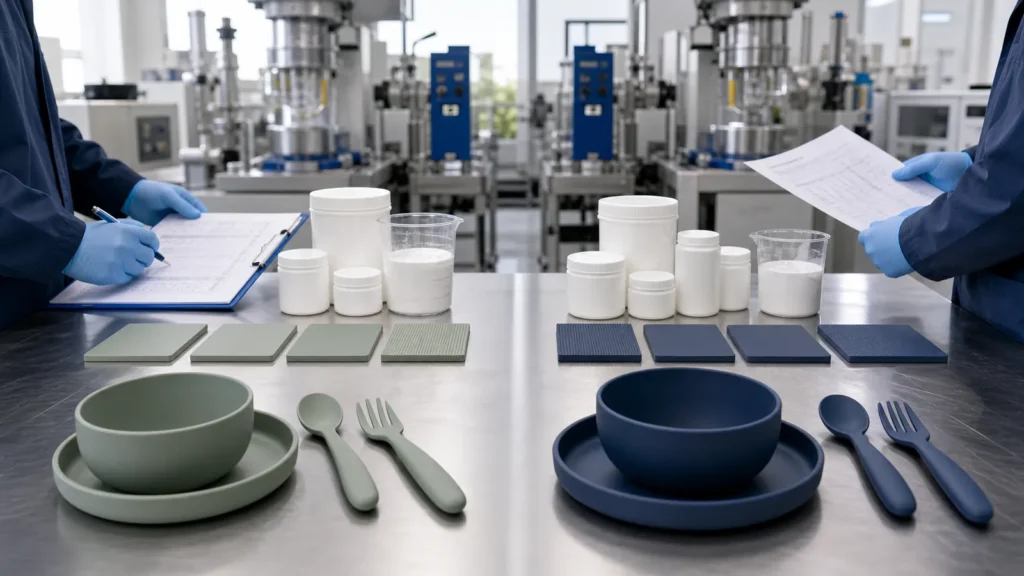
Platinum Cured vs Peroxide Cured Silicone: Buyer Comparison
A decision-focused comparison of platinum-addition and peroxide cure systems for custom silicone tableware, including process, evidence and sourcing tradeoffs.
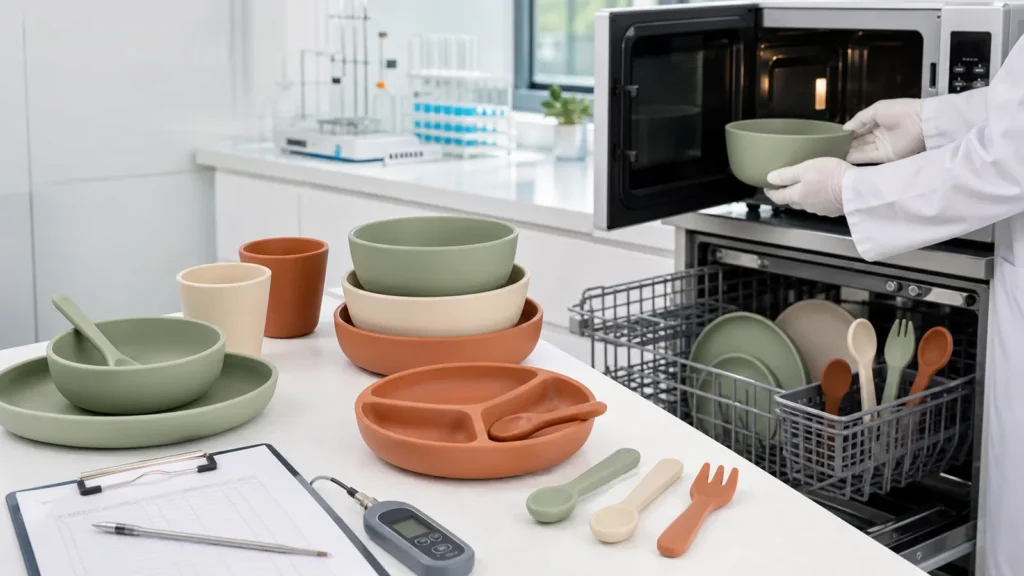
Is Silicone Tableware Microwave Safe and Dishwasher Safe?
A buyer-focused answer on when silicone tableware can be used in microwaves and dishwashers, what evidence matters, and how to validate a custom product.

Custom Tableware Sample Approval: Golden Sample Guide
A stage-gate factory guide to drawings, prototypes, tooling trials, packaging samples, golden samples and production release for custom tableware.
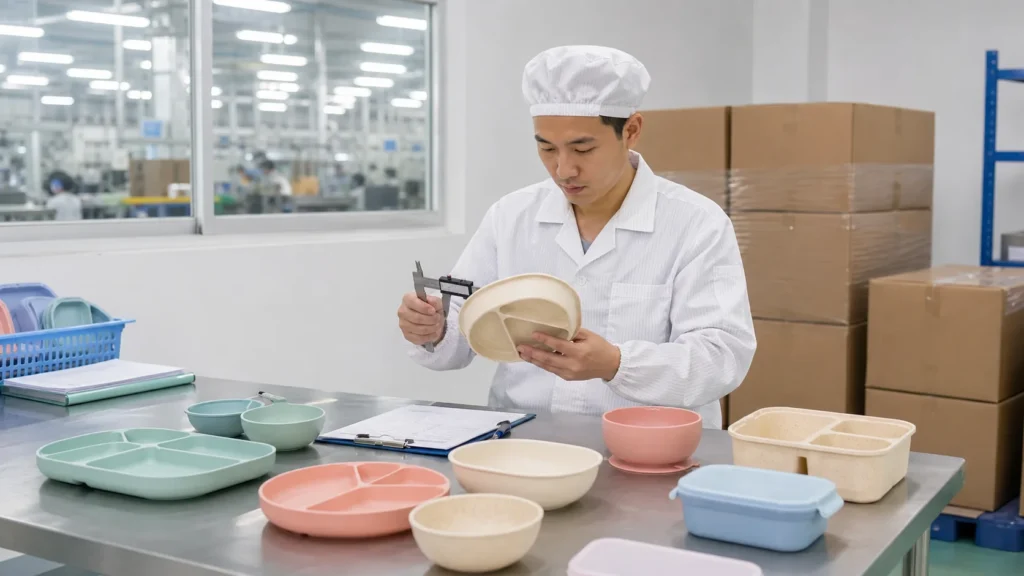
Tableware AQL Inspection: Buyer Guide
A factory-side guide to defect classification, sampling levels, acceptance limits and evidence for silicone and wheat-straw tableware shipments.
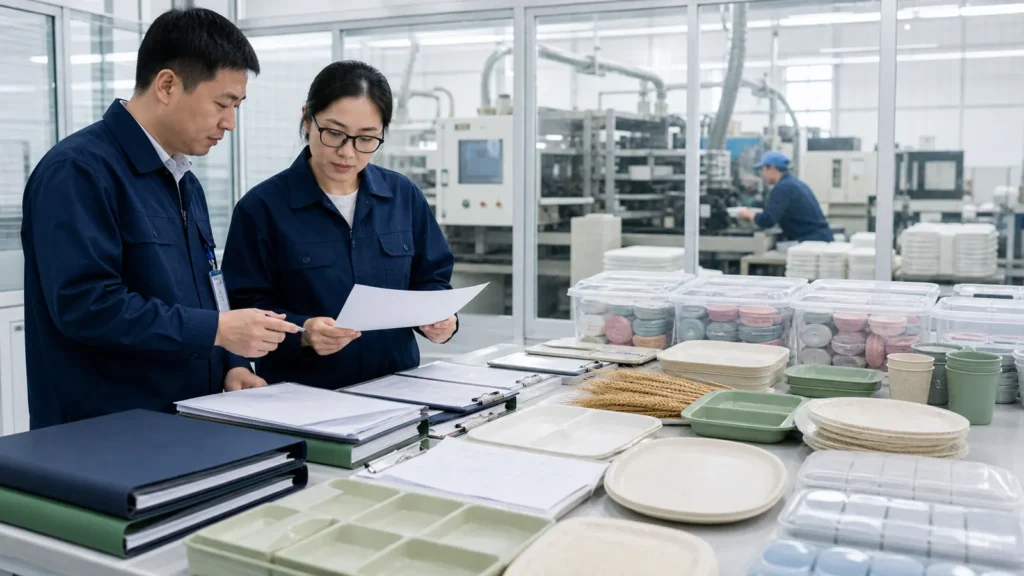
Food Contact Tableware Traceability: Buyer Guide
A factory-insider guide to material identity, declarations, test reports, batch records, change control and shipment traceability for B2B tableware buyers.