
Outdoor Plastic Lunch Box Material Guide: PP vs Tritan vs ABS Compared for B2B Buyers
The global bento box market hit 4.8 billion in 2025 and is projected toreach 8.9 billion by 2034, according to DataIntelo’s market research. That is a 7.1 percent compound annual growth rate driven by packed-lunch culture, office return mandates, and a consumer shift away from single-use takeout containers. For importers and private-label brands, the opportunity is clear. What is less clear — and what this guide addresses — is which plastic material you should build your product line around.
Three materials dominate the outdoor lunch box category: polypropylene, Tritan copolyester, and ABS. They look similar in a catalog thumbnail. They perform very differently in a customer’s backpack.
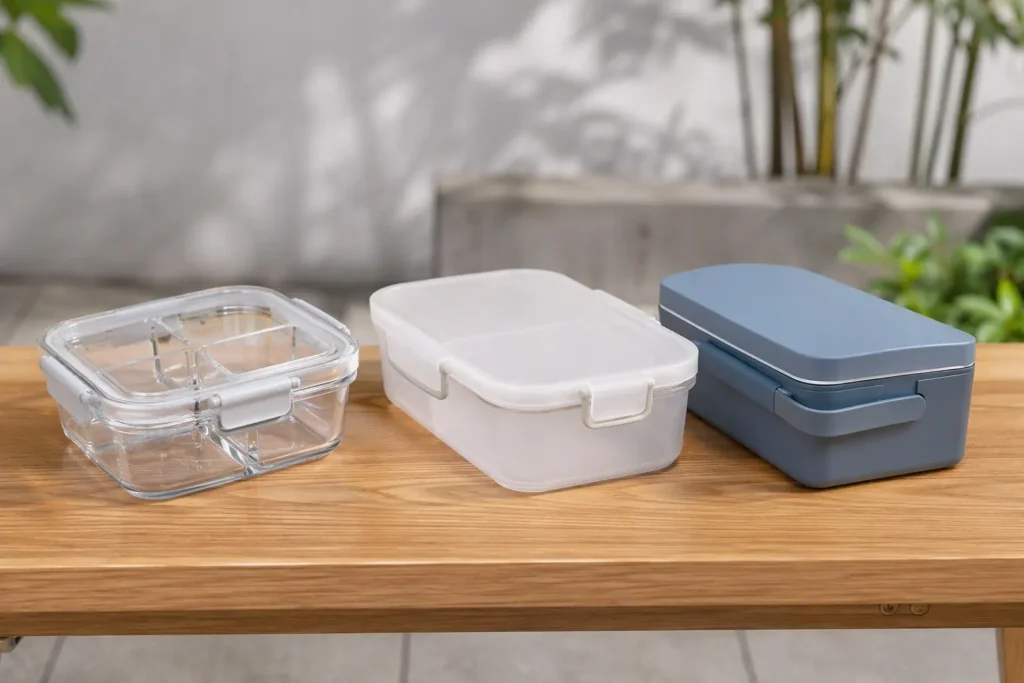
Polypropylene: The Affordable Workhorse That Does Almost Everything Well
Polypropylene — recycling code number five — is the most widely used food-contact plastic in the world, and for good reason. It balances cost, safety, and durability in a way that no other single material quite matches.
What PP Delivers at the Material Level
PP handles a temperature range from minus twenty to plus one hundred and twenty degrees Celsius without warping, leaching, or surface degradation. That means it is microwave-safe for reheating, dishwasher-safe for cleaning, and freezer-safe for meal prep — the three use cases that define how a lunch box gets used in real life. The FDA classifies polypropylene as food-safe under 21 CFR 177.1520, and the European Union includes it in the positive list under Regulation EU 10/2011. It is BPA-free by formulation — polypropylene does not contain bisphenol compounds, so there is nothing to remove.
The practical consequence for importers is that PP lunch boxes clear customs in virtually every market on the planet with minimal documentation friction. If your distribution strategy spans multiple countries with different regulatory frameworks, PP is the lowest-compliance-burden option.
Cost Structure
At bulk volumes — ten thousand units or more per SKU — a standard single-compartment PP lunch box with snap-lock lid lands between 0.80and0.80and1.60 FOB, depending on wall thickness, compartment count, and silicone gasket inclusion. Multi-compartment bento-style PP boxes with two to three sections run 1.40to1.40to2.80. These are the most competitive price points in the category, and they leave room for healthy retail margins even after freight, duties, and Amazon FBA fees.
The Tradeoffs
PP is translucent at best — you cannot achieve the glass-like clarity of Tritan. Over hundreds of dishwasher cycles, the surface develops micro-scratches that give it a slightly cloudy appearance. PP also has a tendency to retain food odors and colors, particularly from tomato-based sauces and curries. None of these are safety issues. But they do show up in Amazon reviews, and they do affect repeat purchase rates among consumers who expect their lunch box to look new after six months.
Tritan Copolyester: The Premium Material That Justifies Its Price
Tritan is a copolyester developed by Eastman Chemical Company, and it occupies a unique position in the food-contact plastics market. It offers the clarity of polycarbonate, the durability of a engineering polymer, and a BPA-free molecular structure that requires no additives to achieve its safety profile.
The Chemistry That Makes Tritan Different
Unlike older-generation transparent plastics — polycarbonate, which relies on bisphenol-A as a building block — Tritan’s polymer backbone does not contain BPA, BPS, or any other bisphenol compound. The FDA issued Food Contact Notification number 729 specifically for Tritan, confirming its safety for repeated-use food contact applications. Eastman’s published safety data on Tritan details the testing and regulatory clearances across global markets.
For importers selling into markets where BPA awareness is high — North America, Western Europe, Australia, Japan — the Tritan story is easy to communicate and hard to argue with. “BPA-free by design, not by reformulation” is a claim that resonates with exactly the consumer demographic that reads labels and pays a premium for products they trust.
Performance Characteristics
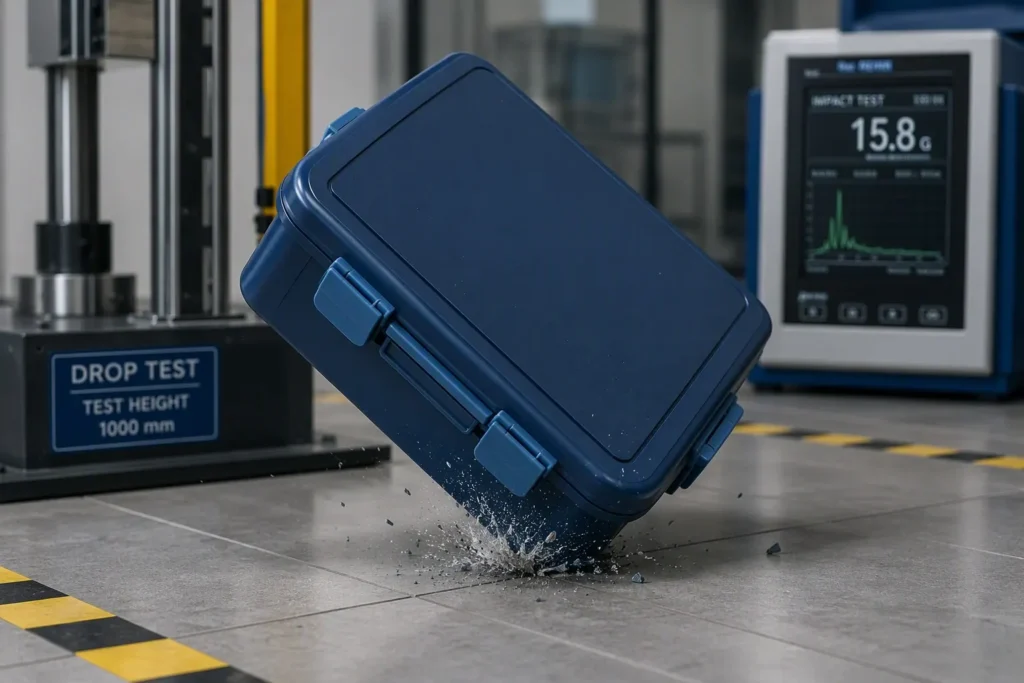
Tritan offers superior impact resistance compared to both PP and ABS. A Tritan lunch box dropped from 1.5 meters onto concrete will typically survive without cracking — a claim that PP can make most of the time and ABS cannot make at all at the same thickness. The material’s optical clarity is comparable to glass, which matters for lunch boxes with transparent lids or all-clear construction — consumers want to see their food without opening the container.
Heat resistance tops out at approximately 100 degrees Celsius, which covers dishwasher top-rack cycles and microwave reheating of food. Tritan is not rated for boiling-water sterilization or extended exposure to steam above 100 degrees. For everyday lunch box use, this is completely adequate. For products marketed as “sterilizable” or “boil-safe,” it is not.
A detailed comparison of Tritan versus PP properties from Haers provides additional performance data across real-world use cases.
Cost Structure
Tritan is expensive. The raw material cost per kilogram runs roughly three to four times higher than PP, and the molding process requires tighter temperature control and longer cycle times. A Tritan lunch box at ten thousand units lands between 3.50and3.50and6.00 FOB — two to three times the cost of an equivalent PP product.
The question for B2B buyers is whether your target market will pay for that premium. In North America and Western Europe, the answer is increasingly yes — consumers who search for “BPA-free lunch box” and read product descriptions before purchasing are willing to pay twenty-five to thirty-five dollars at retail for a Tritan product. In markets where price sensitivity dominates, PP is almost always the better commercial decision.
Manufacturing Considerations
Tritan is hygroscopic — it absorbs moisture from ambient air. Before injection molding, Tritan resin must be dried to a specific moisture content, typically below 0.01 percent, or surface defects and reduced mechanical properties will result. Not every factory has the drying equipment and humidity-controlled storage to handle this consistently. When evaluating a Tritan supplier, ask about their resin drying protocol and whether they have produced Tritan products for export markets before. A factory that runs PP all day and agrees to try Tritan for your order is a factory that will learn on your production run.
ABS: The Impact-Resistant Option with Important Food-Contact Limitations
ABS — acrylonitrile butadiene styrene — is a tough, rigid engineering plastic widely used in consumer products from automotive trim to laptop cases to luggage shells. It appears in the lunch box category primarily in two contexts: as the outer shell of insulated lunch bags and boxes, and as the structural body of multi-layer containers where the food-contact surface is a different material.
Why ABS Shows Up in Lunch Boxes
The appeal of ABS for lunch box exteriors is straightforward. It has excellent impact resistance at low temperatures — a frozen ABS lunch box dropped on concrete will not shatter the way a brittle polymer might. It accepts color well, holds detail in molding, and has a premium-feeling surface finish. For lunch boxes marketed as “rugged,” “heavy-duty,” or “outdoor,” ABS exteriors communicate durability in a way that PP does not.
The insulated lunch box segment — valued at $2.23 billion in 2026 and growing at 6.6 percent annually according to Coherent Market Insights — relies heavily on ABS outer shells bonded to foam insulation layers and PP or stainless steel inner liners.
The Food-Contact Limitation
ABS by itself is not generally approved for direct food contact. The acrylonitrile and styrene monomers that give ABS its desirable mechanical properties are not substances you want leaching into food under heat or acidic conditions. In lunch box design, ABS is almost always used as a structural outer layer with a separate food-contact liner — typically PP, Tritan, or stainless steel.
For importers, this means ABS lunch boxes are inherently more complex products. You are sourcing a multi-material, multi-layer assembly rather than a single-material injection-molded container. The supply chain involves at least two material streams, and quality control must verify both the structural integrity of the ABS shell and the food-contact compliance of the inner liner. This is manageable. It is just more work than a single-material PP lunch box.
Cost Structure
ABS itself is priced between PP and Tritan — raw material costs roughly 50 to 80 percent above PP but well below Tritan. However, the multi-layer construction required for food safety pushes the finished product cost higher. An ABS-shell insulated lunch box with PP inner liner at volume lands between 2.50and2.50and5.00 FOB, depending on insulation material, compartment configuration, and included accessories like ice packs.
Head-To-Head Comparison
| Factor | PP (Polypropylene) | Tritan Copolyester | ABS (Outer Shell Only) |
|---|---|---|---|
| FOB Price (10K+, single box) | 0.80–0.80–2.80 | 3.50–3.50–6.00 | 2.50–2.50–5.00 (with liner) |
| Raw Material Cost/kg | 1.20–1.20–1.80 | 4.00–4.00–6.00 | 1.80–1.80–2.50 |
| BPA-Free | Yes (by formulation) | Yes (by molecular design) | Yes (but FCM needs liner) |
| Direct Food Contact | Yes (FDA, EU 10/2011) | Yes (FDA FCN 729, EU 10/2011) | Not recommended alone |
| Optical Clarity | Translucent | Glass-like clear | Opaque |
| Impact Resistance | Good | Excellent | Very good |
| Heat Resistance | Up to 120°C | Up to 100°C | Up to 80°C |
| Microwave Safe | Yes | Yes (reheating only) | No (outer shell use) |
| Dishwasher Safe | Yes | Top rack recommended | Hand wash recommended |
| Odor/Stain Retention | Moderate | Low | N/A (not food-contact) |
| Mold Cycle Time | Fast | Slower (hygroscopic) | Fast |
| Best For | Budget-mid mass market, multi-market distribution | Premium, BPA-conscious markets (US, EU, AU) | Insulated/rugged lunch bags, outer shells |
The Design Features That Actually Drive Sell-Through
Material choice sets the cost and safety parameters. Design details determine whether the product moves off the shelf or sits in a warehouse.
Leak-Proof Sealing
A lunch box that leaks is not a lunch box — it is a backpack-ruining liability. The silicone gasket seal has become the industry standard for leak-proof performance, replacing older friction-fit and snap-only designs. A properly engineered silicone gasket seated in a lid groove, compressed by locking clips on two or four sides, should pass a leak test with colored water at full inversion for one hour with zero leakage.
The gasket material itself matters. It should be food-grade platinum-cured silicone — the same grade used in baby feeding products — not industrial EPDM or low-grade silicone that will stiffen and crack after fifty dishwasher cycles. Our production quality standards page explains how we verify gasket material and durability across production batches.
Compartment Configuration
The market for multi-compartment bento-style lunch boxes is growing faster than the market for single-compartment containers. The behavioral driver is simple: consumers who pack lunch want to separate their salad from their dressing, their yogurt from their granola, their hot food from their cold food. A two-compartment or three-compartment design serves this need. A single large compartment does not.
The most commercially successful format right now is the two-tier bento: a lower compartment for the main dish, an upper compartment or tray insert for sides and snacks, and a single lid that seals both tiers. This format hits the sweet spot between compartment flexibility and ease of cleaning.
Stackability and Storage
For B2B buyers supplying retail chains, one design variable matters more than most end consumers realize: stackability. Lunch boxes that nest or stack efficiently reduce shelf footprint in retail displays and shipping volume in containers. A stackable design — where the base of one box fits into a recess in the lid of the box below it — can increase container loading density by twenty to thirty percent compared to non-stackable designs. Over a forty-foot container, that translates to thousands of additional units and meaningful per-unit freight savings.
Factory Capabilities: What Separates a Lunch Box Manufacturer from a General Injection Molder
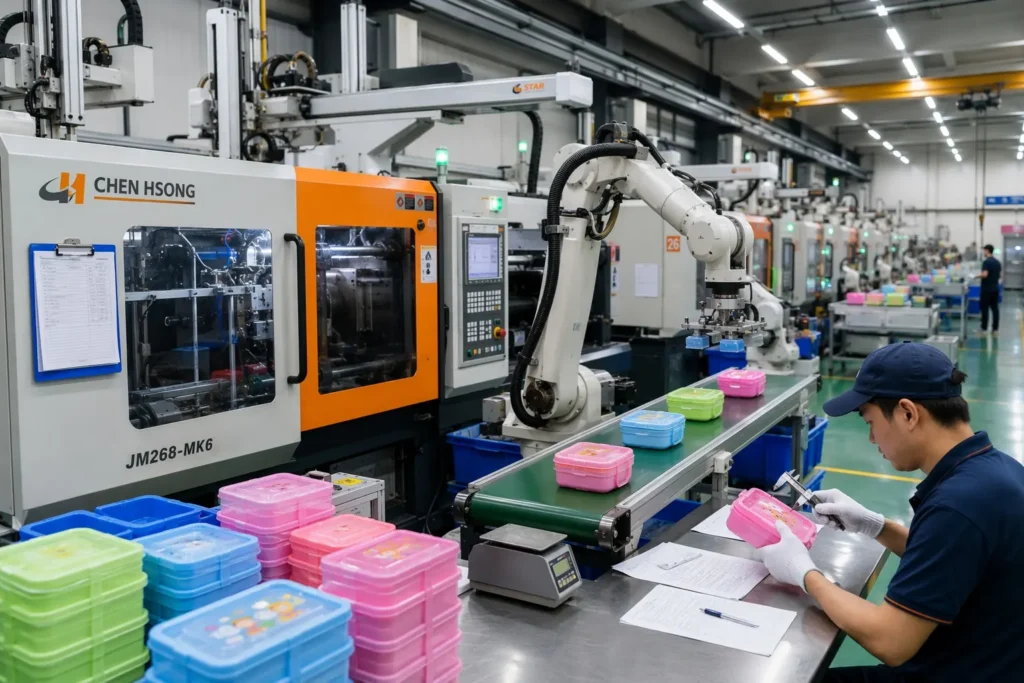
A factory that injection-molds generic plastic parts can probably make a lunch box. A factory that specializes in lunch boxes will make a better one. The distinction comes down to four capabilities.
Multi-Material Molding
A lunch box with a PP body, a Tritan lid, and a silicone gasket requires three different material processing lines under one roof, or a supply chain that coordinates three different factories. In-house multi-material capability means one quality control team, one production schedule, and one point of accountability. Outsourced multi-material supply chains mean three of each, and the coordination burden falls on you.
In-House Mold Shop
Lunch box molds are more complex than dinner plate molds. They involve moving slides for clip mechanisms, precision tolerances for gasket grooves, and surface finish requirements that affect both appearance and cleanability. A factory with an in-house mold shop can iterate on mold design during sampling — adjusting gate locations, cooling channels, and surface textures — without the week-plus turnaround of an outsourced mold maker. For more on how we manage mold development across product categories, visit our custom manufacturing page.
Leak Testing Infrastructure
A factory that makes lunch boxes should have a leak testing station — a dedicated area where finished products undergo systematic water-leak testing as part of final quality control. If the factory does not have one, they are shipping products without verifying the single most important functional specification. Ask for a photo of the leak testing station. A real manufacturer will have one. A trading company will change the subject.
Food-Contact Compliance Documentation
Every batch of raw material should arrive with a certificate of analysis. Every production run should generate retained samples. Every export shipment should include third-party migration test reports from an ISO/IEC 17025-accredited laboratory. A supplier who cannot produce all three within forty-eight hours of your request is not a food-contact manufacturer — they are a plastic parts manufacturer who happens to make things that look like lunch boxes.
Which Material Should You Choose?
There is no universal answer, but there is a decision framework.
Pick PP if price per unit is your dominant variable, your distribution spans multiple markets with different regulatory requirements, and your end consumer is price-sensitive — schools, office supply chains, mass-market retailers, developing-market distribution.
Pick Tritan if your brand competes on safety and transparency, your target market is North America, Western Europe, or Australia, and your retail price point supports the material premium. Tritan is the right choice when your customer reads product descriptions and actively searches for “BPA-free lunch box.”
Pick ABS-with-liner if you are building an insulated or ruggedized outdoor lunch product where the outer shell needs to survive drops, temperature extremes, and rough handling. The multi-layer construction adds supply chain complexity, but the product positioning — “indestructible lunch box” — commands a premium that covers the additional manufacturing cost.
Most successful lunch box brands eventually run all three materials across different product tiers. PP handles the volume SKU. Tritan occupies the premium slot. ABS-with-liner anchors the outdoor and insulated collection. The materials are not competitors. They are tools for different price points, different distribution channels, and different consumer expectations.
If you are evaluating suppliers or planning a lunch box product line across multiple materials, we can provide material samples, certification documentation, and FOB quotations specific to your design requirements. Reach out through naikegroup.com.
CONTACT US
How to Verify Wheat Straw Fiber Content Claims
A factory-side evidence guide for buyers assessing wheat straw percentage claims, mass-balance records, laboratory methods and change control.
Platinum Cured vs Peroxide Cured Silicone: Buyer Comparison
A decision-focused comparison of platinum-addition and peroxide cure systems for custom silicone tableware, including process, evidence and sourcing tradeoffs.
Is Silicone Tableware Microwave Safe and Dishwasher Safe?
A buyer-focused answer on when silicone tableware can be used in microwaves and dishwashers, what evidence matters, and how to validate a custom product.
Custom Tableware Sample Approval: Golden Sample Guide
A stage-gate factory guide to drawings, prototypes, tooling trials, packaging samples, golden samples and production release for custom tableware.
Tableware AQL Inspection: Buyer Guide
A factory-side guide to defect classification, sampling levels, acceptance limits and evidence for silicone and wheat-straw tableware shipments.
Food Contact Tableware Traceability: Buyer Guide
A factory-insider guide to material identity, declarations, test reports, batch records, change control and shipment traceability for B2B tableware buyers.